
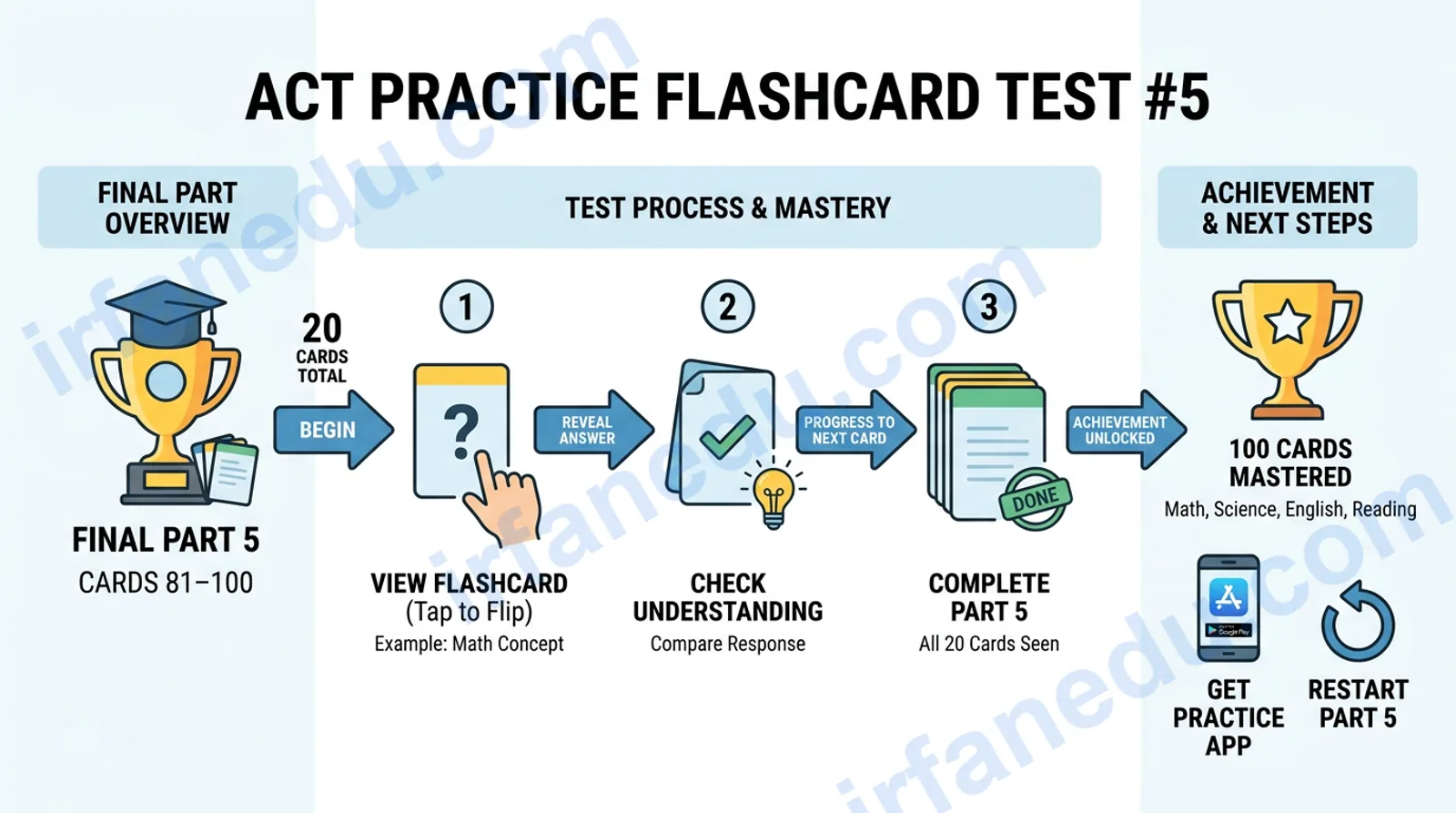
🏆 ACT Flashcards — Part 5
All Questions & Answers
Every question from ACT Practice Flashcard Test #5 with the correct answer and a short explanation, so you can review the full set without working through the interactive cards above.
📐 MATH Q1. What is the difference between mean, median, and mode?
Answer:
Mean: average — sum ÷ count
Median: middle value when sorted.
Mode: most frequent value.
💡 Mean is most affected by outliers.
📐 MATH Q2. What is the FOIL method and when do you use it?
Answer:
FOIL = First, Outer, Inner, Last.
Used to multiply two binomials.
💡 Combine like terms after FOIL.
📐 MATH Q3. What is the difference between complementary and supplementary angles?
Answer:
Complementary angles add to 90°.
Supplementary angles add to 180°.
💡 Complementary is smaller than supplementary.
📐 MATH Q4. What is scientific notation?
Answer:
Scientific notation writes numbers as a × 10ⁿ where 1 ≤ a < 10.
💡 Negative exponent means a small number.
📐 MATH Q5. What is the difference between a ratio and a proportion?
Answer:
A ratio compares two values.
A proportion says two ratios are equal.
💡 Solve proportions by cross-multiplying.
🔬 SCIENCE Q6. What is the difference between a hypothesis, a theory, and a scientific law?
Answer:
Hypothesis = testable prediction.
Theory = well-supported explanation.
Law = describes what happens.
💡 A theory does not become a law.
🔬 SCIENCE Q7. What is the difference between potential and kinetic energy?
Answer:
Potential energy is stored energy.
Kinetic energy is energy of motion.
💡 Falling objects convert PE into KE.
🔬 SCIENCE Q8. What is the difference between a solute, solvent, and solution?
Answer:
Solute is dissolved.
Solvent does the dissolving.
Solution is the mixture.
💡 Water is a common solvent.
🔬 SCIENCE Q9. What is the difference between aerobic and anaerobic respiration?
Answer:
Aerobic uses oxygen and makes more ATP.
Anaerobic uses no oxygen and makes less ATP.
💡 Aerobic is more efficient.
🔬 SCIENCE Q10. What is the difference between frequency, wavelength, and amplitude?
Answer:
Frequency = waves per second.
Wavelength = distance between crests.
Amplitude = wave height.
💡 Frequency and wavelength are inversely related.
✍️ ENGLISH Q11. What is the difference between ‘that’ and ‘which’?
Answer:
‘That’ introduces essential information.
‘Which’ introduces extra information with commas.
💡 Use ‘which’ with commas.
✍️ ENGLISH Q12. What is the Oxford comma?
Answer:
It is the comma before ‘and’ or ‘or’ in a list of three or more items.
💡 ACT prefers the Oxford comma.
✍️ ENGLISH Q13. What is the difference between a gerund and an infinitive?
Answer:
Gerund = verb + ing used as a noun.
Infinitive = to + base verb.
💡 Keep structure parallel in lists.
✍️ ENGLISH Q14. What does economy of language mean?
Answer:
Use the shortest grammatically correct wording without losing meaning.
💡 Remove redundancy.
✍️ ENGLISH Q15. How do you punctuate dialogue correctly?
Answer:
Commas and periods usually go inside quotation marks in American English.
💡 ACT follows American punctuation rules.
📖 READING Q16. What is an analogy?
Answer:
An analogy compares two different things to show a similarity.
💡 Ask what comparison helps explain.
📖 READING Q17. What is the difference between claim and evidence?
Answer:
A claim is what the author argues.
Evidence supports that claim.
💡 Strong evidence directly supports the claim.
📖 READING Q18. What is narrative perspective?
Answer:
It is the point of view from which a story is told.
💡 Perspective shapes what the reader knows.
📖 READING Q19. What is the difference between denotation and connotation?
Answer:
Denotation is literal meaning.
Connotation is emotional association.
💡 ACT vocab depends on context.
📖 READING Q20. What are the 4 ACT Reading passage types?
Answer:
Literary Narrative, Social Science, Humanities, and Natural Science.
💡 Identify passage type early.
Sources & References
Written and fact-checked by Dr Irfan Mansuri. External links open in a new tab and are provided for further reading and verification.