
STAAR Practice Test: Complete Guide to Scoring Higher
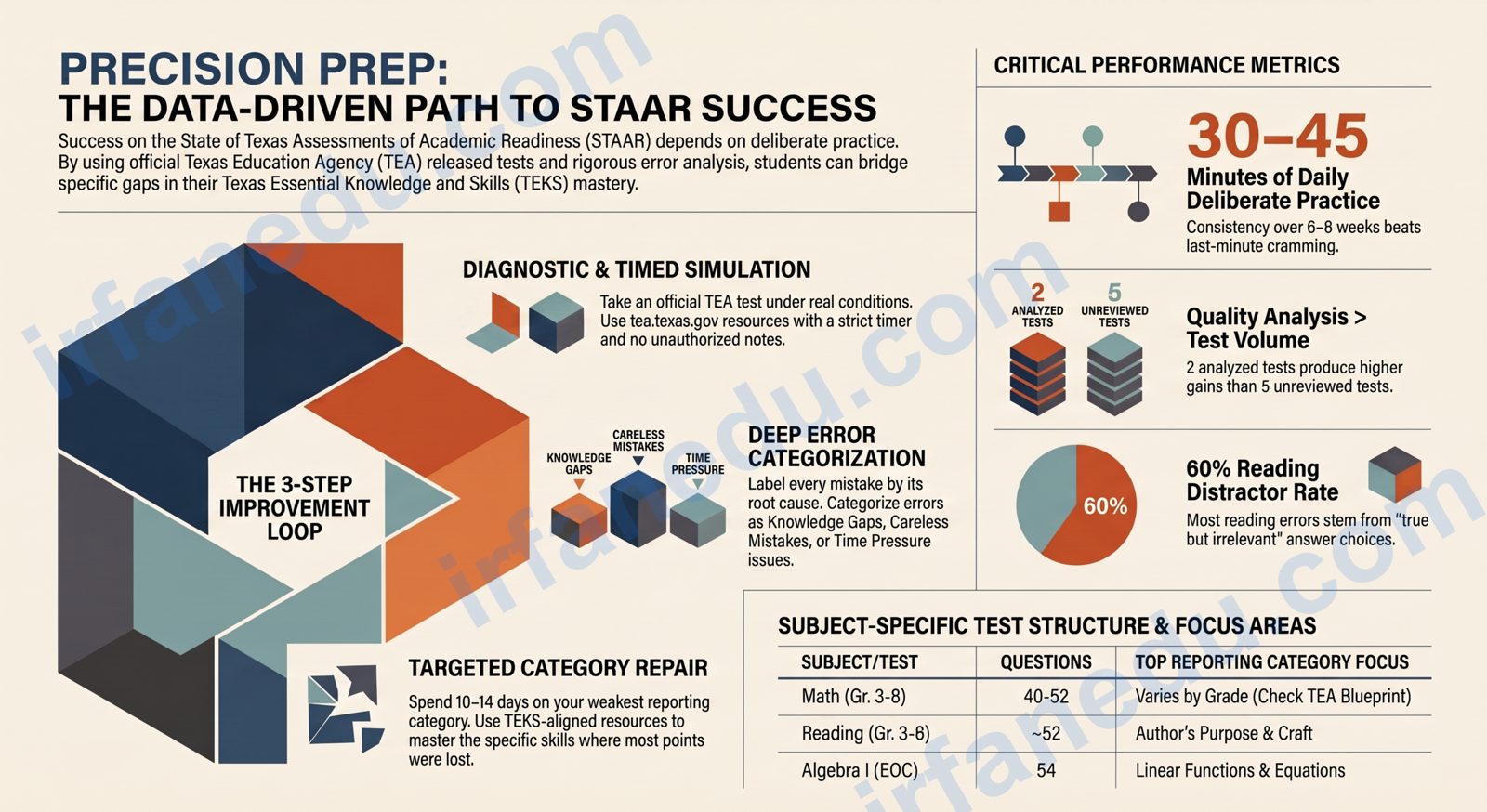
Most students approach the STAAR test by reading their textbook one more time. That strategy rarely moves the needle. The students who improve their scores the most do one thing differently: they practice with real released tests, analyze exactly where they lost points, and fix those specific gaps. This guide shows you precisely how to do that — with worked examples, a subject-by-subject strategy, and a pre-test checklist you can use starting today.
A STAAR practice test is a free official sample exam released by the Texas Education Agency (TEA) that mirrors the real STAAR assessment in format, question type, and difficulty level. Using these released tests under timed conditions is the single most effective preparation strategy available to students in grades 3-12.
A STAAR practice test is a free, official sample exam released by the Texas Education Agency (TEA) that mirrors the real STAAR assessment in format, question style, and difficulty. Students in grades 3-8 and high school can use these tests to identify weak areas, build test-taking stamina, and improve scores before the actual exam date. The best source is tea.texas.gov.
- Official released STAAR tests from TEA are the gold-standard practice material.
- Take a full diagnostic first — then study your weakest reporting category.
- Timed practice builds the stamina the real test demands.
- Error analysis (not just re-doing problems) is what drives score gains.
- 30-45 focused minutes daily over 6-8 weeks beats last-minute cramming.
What Is the STAAR Test and Who Takes It?
STAAR stands for State of Texas Assessments of Academic Readiness. It is the standardized assessment program administered by the Texas Education Agency to measure whether students have mastered the grade-level content outlined in the Texas Essential Knowledge and Skills (TEKS) curriculum standards.
Students in grades 3-8 take STAAR tests in reading/language arts and mathematics each spring. Students in grades 5 and 8 also take a science test. High school students take end-of-course (EOC) exams in English I, English II, Algebra I, Biology, and U.S. History. Passing the EOC exams is a graduation requirement in Texas.
A STAAR practice test is any officially released past exam or TEA-aligned sample assessment used to simulate real test conditions before the actual exam date. The term also covers subject-specific question banks that match the current TEKS blueprint.
The test is scored on a scale, and results are reported in three performance levels: Approaches Grade Level, Meets Grade Level, and Masters Grade Level. Approaches is the minimum passing threshold. Meets and Masters signal stronger readiness for the next grade or course.
Quick Worked Example: How a Student Used One Practice Test to Jump a Full Performance Level
Before diving into strategy, here is a fast, concrete example of what effective STAAR practice looks like in action.
Situation: A student takes the released 2023 STAAR Grade 7 Math test cold. She scores 28 out of 52 — just inside Approaches.
Error analysis (10 minutes): She marks each wrong answer with a category label from the test blueprint. Result: 9 of her 24 errors fall in Proportionality (Reporting Category 2). Only 3 errors are in Number and Operations.
Action: She spends the next 10 days exclusively on proportionality — ratios, rates, percent problems, and scale drawings — using Khan Academy’s TEKS-aligned exercises.
Result: On the second released test (2022), she scores 39 out of 52 — solidly in Meets Grade Level. One targeted category, 10 days, one full performance-level jump.
That is the core loop. Take a test, find your biggest category gap, close it, measure again. The next section shows the full version of this process with more detail.
How to Use a STAAR Practice Test to Improve Your Score
Follow these five steps in order. Skipping step 2 (error analysis) is the most common mistake students make — and it is why many students practice for weeks without improving.
- Take a Full Diagnostic Test Under Timed Conditions. Download a released STAAR test from tea.texas.gov. Set a timer for the official time limit. No notes, no calculator unless the real test allows one. Treat it exactly like the real exam.
- Score It and Categorize Every Error. Use the answer key to score your test. For each wrong answer, label it one of three ways: (A) knowledge gap — you did not know the concept; (B) careless error — you knew it but made a small mistake; (C) time pressure — you ran out of time and guessed. This distinction matters because each type needs a different fix.
- Identify Your Weakest Reporting Category. Every STAAR test is divided into 3-4 reporting categories. Count your errors per category. The category with the most errors is your highest-leverage target. Focus there first.
- Study That Category Specifically. Use the TEKS student expectations listed on the TEA blueprint to find exactly which skills to review. Khan Academy, your textbook, and TEA’s STAAR resources all organize content by these standards.
- Retake a Second Released Test and Measure Progress. Two weeks before the real exam, take a second full released test timed. Compare your score and your per-category error counts to the diagnostic. Repeat for any remaining weak areas.
After you score a practice test, spend at least as much time on error analysis as you spent taking the test. Students who skip this step and just move on to the next practice test see much smaller gains. The review is where the learning happens.
Detailed Worked Example: STAAR Reading Grade 8
Reading tests require a different approach than math. Here is a thorough example that shows how to work through a STAAR literary passage question.
Sample question type (paraphrased from a released format): “Which detail from paragraph 4 best supports the idea that the narrator feels isolated?”
Step 1 — Identify the task. The question asks for a supporting detail for a specific theme/inference. The key word is “best” — all four answer choices may be true, but only one directly supports the stated idea.
Step 2 — Return to the cited paragraph. Go back to paragraph 4 only. Do not rely on memory. Read it with the question in mind: “What in this paragraph shows isolation?”
Step 3 — Eliminate by relevance, not by truth. A common trap: students eliminate choices because they sound negative or unusual. Instead, eliminate choices that are true but do not connect to “isolation.” A detail about the weather, for example, may be accurate but irrelevant to the emotional state.
Step 4 — Select the choice with the tightest logical link. The correct answer will use language that mirrors or directly implies isolation — words like “alone,” “unnoticed,” “silence,” or actions the narrator takes without others.
Why this matters: On the real STAAR, roughly 60% of reading errors come from choosing a “true but irrelevant” distractor. Training yourself to ask “Does this directly support the specific claim in the question?” eliminates most of those errors.
STAAR READING: QUESTION ATTACK PROCESS
───────────────────────────────────────
Read the question first
        │
        ▼
Identify the TASK TYPE
  ├── Main Idea / Theme
  ├── Supporting Detail
  ├── Author's Purpose
  ├── Vocabulary in Context
  └── Inference / Analysis
        │
        ▼
Return to the CITED paragraph/lines
        │
        ▼
Eliminate: "True but IRRELEVANT" choices
        │
        ▼
Select: Tightest LOGICAL LINK to the question
        │
        ▼
Check: Does your answer DIRECTLY answer
       the question as written? ✓
STAAR Practice Test by Subject: What to Expect
Each STAAR subject test has a distinct structure and a different set of skills to prioritize. The table below summarizes the key facts for the most commonly tested subjects.
| Subject / Test | Approx. Questions | Time Limit | Top Reporting Category to Target | Best Practice Resource |
|---|---|---|---|---|
| Math (Gr. 3-8) | 40-52 | 4 hours | Varies by grade; check TEA blueprint | TEA Released Tests + Khan Academy |
| Reading / Language Arts (Gr. 3-8) | ~52 | 4 hours | Author’s Purpose & Craft | TEA Released Tests + CommonLit |
| Science (Gr. 5 & 8) | ~40 | 4 hours | Force, Motion & Energy (Gr. 8) | TEA Released Tests + CK-12 |
| Algebra I (EOC) | 54 | 4 hours | Linear Functions & Equations | TEA Released Tests + Khan Academy |
| English I & II (EOC) | ~52 | 5 hours | Revision & Editing (Writing) | TEA Released Tests + No Red Ink |
| Biology (EOC) | 54 | 4 hours | Biological Processes & Systems | TEA Released Tests + Khan Academy |
| U.S. History (EOC) | ~68 | 4 hours | Government, Citizenship & Culture | TEA Released Tests + Britannica School |
Time limits shown are the standard maximums. Students with approved accommodations may receive extended time. Always verify current details on the official TEA website, as test specifications are updated periodically.
More practice tests do not automatically mean a higher score. Most guides tell students to “take as many practice tests as possible.” That advice is incomplete and can actually backfire. If a student takes five practice tests without doing structured error analysis between them, they repeatedly practice the same mistakes and reinforce incorrect thinking patterns.
The research on deliberate practice (Ericsson et al.) is clear: improvement comes from targeted feedback on specific errors, not from high-volume repetition of the same task. For STAAR specifically, two fully analyzed practice tests will produce larger score gains than five tests taken back-to-back without review. Quality of analysis beats quantity of tests every time.
Where to Find Free STAAR Practice Tests Online
The single best source for STAAR practice tests online is the Texas Education Agency’s own website. Every released test is a real past exam, so the format, wording, and difficulty are identical to what students will face on test day.
Here are the most reliable free sources, ranked by accuracy to the real test:
- TEA Released Tests (tea.texas.gov) — Official past exams for every grade and subject. Free PDF and online formats. This is the primary source every student should use first.
- Khan Academy (khanacademy.org) — TEKS-aligned practice for math and reading. Particularly strong for Algebra I and Grade 3-8 math. Adaptive exercises target your specific weak skills.
- Texas Gateway (texasgateway.org) — The official state portal for TEKS-aligned instructional resources. Includes practice problems organized by student expectation code.
- CK-12 (ck12.org) — Strong for science subjects. Covers Grade 5, Grade 8, and Biology EOC content with interactive practice.
- CommonLit (commonlit.org) — Free literary and informational texts with comprehension questions that mirror STAAR reading question types.
Avoid third-party “STAAR practice test” sites that charge a fee for access to generic question banks. These are rarely aligned to the current TEKS standards and often contain errors. The official TEA released tests are free and are always the most accurate preparation material available.
Pre-Test Preparation Checklist
Use this checklist in the final two weeks before your STAAR test date. Each item addresses a specific, common source of lost points.
- Download at least two released STAAR tests for your subject and grade from tea.texas.gov.
- Complete the first practice test under full timed conditions (no interruptions).
- Score the test and categorize every error (knowledge gap / careless / time pressure).
- Identify your weakest reporting category using the TEA blueprint.
- Spend 10-14 days studying that specific category using TEKS-aligned resources.
- Practice 10-15 questions per session timed to the real per-question pace.
- Take the second released test timed and compare per-category error counts.
- Review all wrong answers on the second test — do not skip this step.
- In the final week, do short 20-minute review sessions, not full tests.
- Night before: prepare your materials, get 8+ hours of sleep, eat breakfast.
Common STAAR Test Mistakes and How to Fix Them
In my experience working with students preparing for standardized tests, the same errors appear again and again. Knowing these in advance gives you a significant advantage.
Mistake 1: Reading answer choices before reading the passage. On reading tests, this primes you to look for specific words rather than to understand the text. Fix: always read the passage (or the cited section) before looking at the choices.
Mistake 2: Skipping the question stem keywords. Words like “best,” “most likely,” “NOT,” and “except” completely change what the question is asking. Fix: underline these words before you read the choices.
Mistake 3: Leaving math questions blank. STAAR does not penalize for wrong answers. A blank is always worth zero; a guess gives you a chance. Fix: if you are stuck, eliminate one or two obviously wrong choices and make your best guess before moving on.
Mistake 4: Spending too long on one question. The STAAR time limit is generous, but students who get stuck on hard questions often run out of time at the end. Fix: if a question takes more than 2-3 minutes, mark it, move on, and return at the end.
Mistake 5: Not checking units and labels on math problems. A correct calculation with the wrong unit (feet instead of inches, for example) is a wrong answer. Fix: circle the unit asked for in the question before you start calculating.
Frequently Asked Questions About STAAR Practice Tests
Where can I find free official STAAR practice tests?
How many questions are on the STAAR test?
Is the STAAR test the same every year?
What is a passing score on the STAAR test?
How long should a student practice each day for STAAR?
Sources & References
- Texas Education Agency. STAAR Released Test Questions. tea.texas.gov. Accessed August 2026.
- Khan Academy. Math Practice — TEKS-Aligned Exercises. khanacademy.org. Accessed August 2026.
- Ericsson, K. A., Krampe, R. T., & Tesch-Römer, C. (1993). The role of deliberate practice in the acquisition of expert performance. Psychological Review, 100(3), 363-406. Referenced for the error-analysis principle in the Commonly Misunderstood section.
- Texas Gateway. TEKS-Aligned Instructional Resources. texasgateway.org. Accessed August 2026.
Editorial note: This article was written and fact-checked by Dr. Irfan Mansuri. All STAAR test specifications referenced are based on publicly available TEA documentation current as of August 2026. Test formats and score thresholds may change; always verify details at tea.texas.gov before your exam date.