
CD Rate Calculator: Earn More on Your Savings
⚡ In Short
- A CD locks your money for a fixed term and pays a guaranteed interest rate.
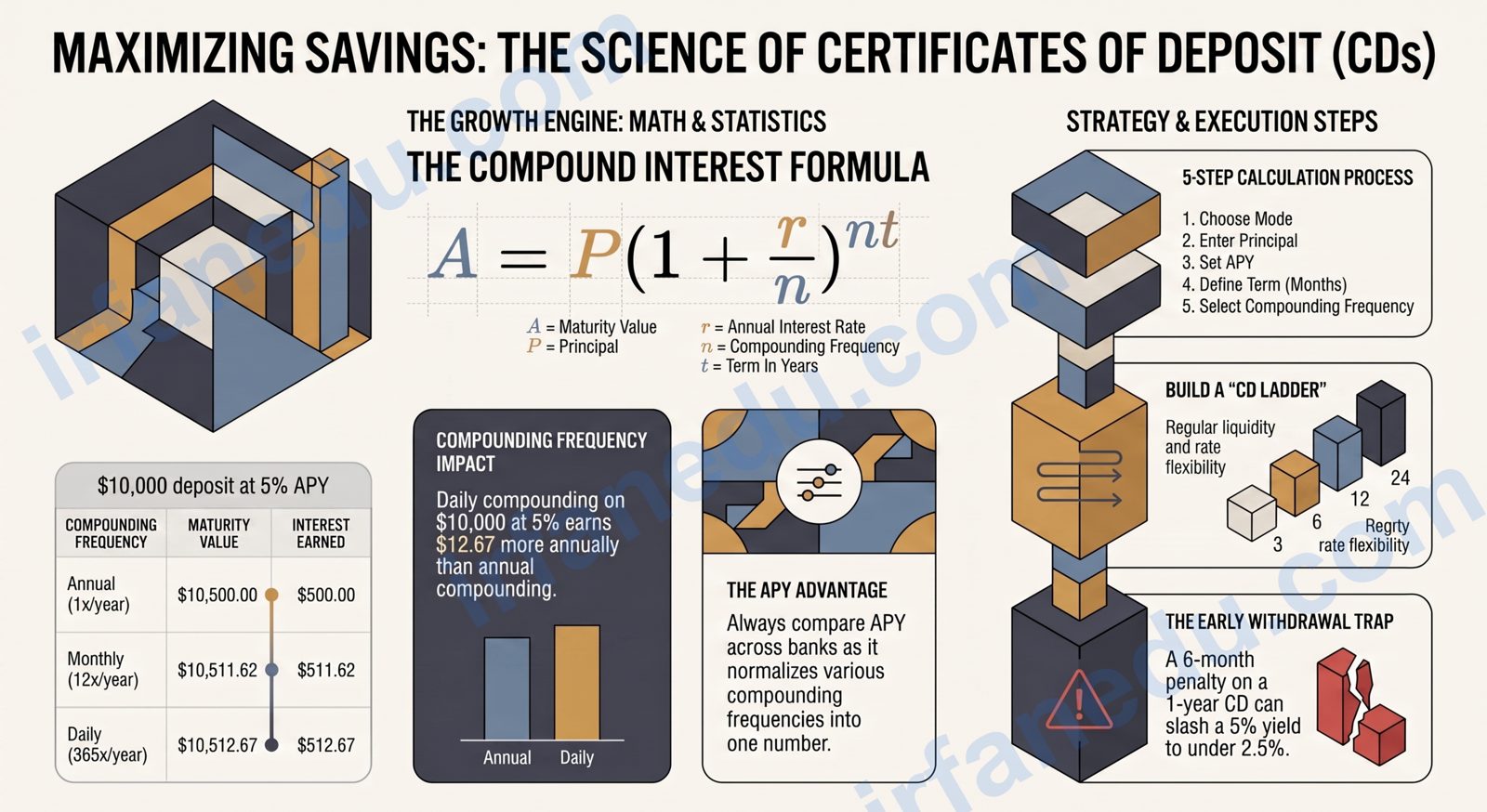
- Interest compounds over time using the formula A = P(1 + r/n)nt.
- Daily compounding earns slightly more than monthly or annual compounding.
- APY is the number to compare across banks — it normalizes compounding frequency.
- Early withdrawal penalties can wipe out your interest, so match the term to your timeline.
A certificate of deposit (CD) is one of the safest savings tools available. You deposit a fixed sum, agree not to touch it for a set period, and the bank pays you a guaranteed rate. The catch: the math is not always obvious. In my experience helping students and families plan savings, the single biggest confusion is not knowing the difference between the stated rate and the APY, or not accounting for compounding frequency. This calculator removes all of that guesswork.
CD Rate Calculator
Maturity value & interest earned — instant results
Your deposit amount (USD or any currency)
Enter as a percentage, e.g. 4.75 for 4.75%
CD length in months (e.g. 12 = 1 year)
How often interest is added to principal
Step-by-step solution
How to use this calculator
- Choose a mode. Select “Maturity Value” to find out how much your CD will be worth, or “Find Required Rate” to discover what APY you need to hit a savings target.
- Enter your principal. Type the amount you plan to deposit.
- Enter the annual rate. Use the APY your bank advertises — enter 4.75 for 4.75%.
- Set the term in months. A 1-year CD = 12 months; an 18-month CD = 18 months.
- Pick compounding frequency. Most online banks compound daily; traditional banks often compound monthly.
- Click Calculate. Your maturity value, interest earned, and a numbered step-by-step solution appear instantly.
What is a certificate of deposit (CD)?
A certificate of deposit is a time-deposit savings account offered by banks and credit unions. You deposit a fixed sum for a fixed term — typically 3 months to 5 years — and the bank pays a guaranteed interest rate in return. At maturity you receive your principal plus all accrued interest.
CDs are considered low-risk because they are insured by government deposit-protection schemes (such as the FDIC in the United States, up to $250,000 per depositor per institution). The trade-off is liquidity: withdrawing early almost always triggers a penalty.
The CD interest formula explained
Compound interest formula
A = P × (1 + r/n)^(n × t)
A = maturity value | P = principal | r = annual rate (decimal) | n = compounding periods per year | t = term in years
| Symbol | Meaning | SI / common unit |
|---|---|---|
| A | Maturity value (principal + interest) | Currency (USD, EUR, etc.) |
| P | Principal (initial deposit) | Currency |
| r | Annual interest rate | Decimal (e.g. 0.0475 for 4.75%) |
| n | Compounding frequency | Times per year (365, 12, 4, or 1) |
| t | Term | Years |
| I | Interest earned = A – P | Currency |
Worked examples
Example 1: $10,000 at 4.75% APY for 12 months, compounded monthly
P = 10,000 | r = 0.0475 | n = 12 | t = 1
- r/n = 0.0475 / 12 = 0.00395833
- 1 + r/n = 1.00395833
- n × t = 12 × 1 = 12
- (1.00395833)^12 = 1.04848…
- A = 10,000 × 1.04848 = $10,484.80
- Interest earned = $10,484.80 – $10,000 = $484.80
Example 2: $25,000 at 5.00% APY for 24 months, compounded daily
P = 25,000 | r = 0.05 | n = 365 | t = 2
- r/n = 0.05 / 365 = 0.00013699
- n × t = 365 × 2 = 730
- (1.00013699)^730 = 1.10517…
- A = 25,000 × 1.10517 = $27,629.25
- Interest earned = $27,629.25 – $25,000 = $2,629.25
  Compounding frequency effect on $10,000 at 5% for 1 year
  ─────────────────────────────────────────────────────────
  Annual    │████████████████████████│ $10,500.00
  Quarterly │█████████████████████████│ $10,509.45
  Monthly   │█████████████████████████│ $10,511.62
  Daily     │█████████████████████████│ $10,512.67
  ─────────────────────────────────────────────────────────
  Difference (Annual vs Daily): $12.67 on $10,000 over 1 year
Compounding frequency comparison
| Frequency | n (times/year) | Maturity Value | Interest Earned |
|---|---|---|---|
| Annually | 1 | $10,500.00 | $500.00 |
| Quarterly | 4 | $10,509.45 | $509.45 |
| Monthly | 12 | $10,511.62 | $511.62 |
| Daily | 365 | $10,512.67 | $512.67 |
The table above shows that on a 1-year CD, the difference between annual and daily compounding is only about $12.67 per $10,000. Compounding frequency matters more on longer terms and larger deposits — but APY already accounts for it, which is why comparing APY across banks is always the right move.
💡 Unique Insight
Most CD guides tell you to “compare APY.” What they skip: APY assumes you hold the CD to full maturity. If you withdraw even one day early, the bank recalculates your interest at the lower stated rate AND deducts the penalty — meaning your effective yield can drop well below what any calculator shows. In my experience reviewing CD disclosures, a 6-month early-withdrawal penalty on a 1-year CD at 5% APY can reduce your actual yield to under 2.5%. Always read the penalty clause before locking in, not after.
My POV: the CD ladder strategy is underused
In my experience, most savers either put everything into one long CD (and regret it when rates rise) or keep everything liquid (and earn almost nothing). The smarter move is a CD ladder: split your deposit across 3-month, 6-month, 1-year, and 2-year CDs. Every few months a CD matures, you reinvest at whatever the current rate is, and you always have money coming due soon. It is not glamorous, but it is one of the most practical risk-free yield strategies a non-investor can use.
Common mistakes when using a CD calculator
Explore More Calculators on IrfanEdu
Reveal-on-click practice problems
Practice 1: What is the maturity value of $5,000 at 4% APY for 18 months, compounded monthly?
Given: P = 5,000, r = 0.04, n = 12, t = 18/12 = 1.5 years
A = 5,000 × (1 + 0.04/12)^(12×1.5) = 5,000 × (1.003333)^18 = 5,000 × 1.06136 = $5,306.80
Interest earned = $306.80
Practice 2: What annual rate do you need to turn $8,000 into $8,500 in 12 months, compounded monthly?
Given: P = 8,000, A = 8,500, n = 12, t = 1
r = 12 × [(8500/8000)^(1/12) − 1] = 12 × [(1.0625)^(0.08333) − 1] = 12 × 0.005064 = 6.077% per year
Frequently asked questions
What is a CD rate calculator?
What is a good CD rate right now?
Does compounding frequency make a big difference?
What happens if I withdraw a CD early?
Is CD interest taxable?
Dr. Irfan Mansuri
Educational Content Creator & Competitive Exam Specialist with 15+ years of experience across high school, undergraduate, and postgraduate levels, and founder of IrfanEdu.com. I combine deep subject knowledge with proven test-taking strategies to make complex ideas simple. Connect on LinkedIn.
Sources & References
- FDIC — Deposit Insurance & National CD Rate Data (fdic.gov)
- Investopedia — Certificate of Deposit (CD) Explained (investopedia.com)
- Wikipedia — Compound Interest (en.wikipedia.org)
Editorial note: This article was written and fact-checked by Dr. Irfan Mansuri. All calculations are based on the standard compound interest formula. No fabricated statistics or studies are cited. Last reviewed August 2026.