
Practice Driving Test: The Study Guide That Actually Gets You to Pass
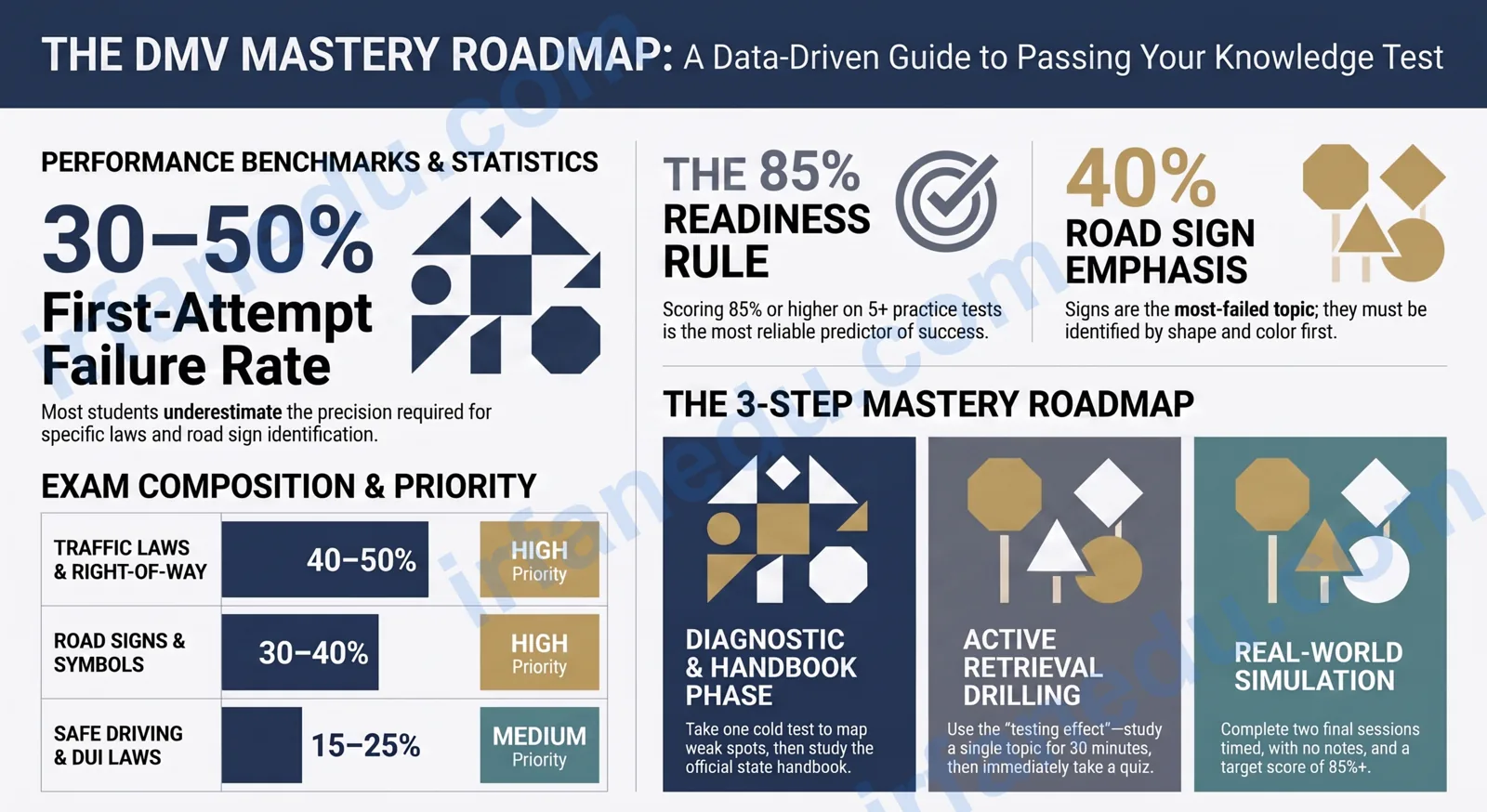
Most students who fail their driving knowledge test on the first attempt share one thing in common: they read the handbook once and assumed that was enough. It is not. The research is clear — active retrieval practice (testing yourself repeatedly) outperforms passive reading by a wide margin when it comes to retaining rules and road signs. This guide gives you the exact system to use practice driving tests the right way, so you walk into the DMV confident.
A practice driving test is a simulated version of the official DMV written knowledge exam. It covers road signs, traffic laws, right-of-way rules, and safe driving procedures. Taking five or more practice tests and consistently scoring above 85% is the most reliable way to ensure you pass the real exam on your first attempt.
By the end of this guide you will know:
- Exactly what the driving knowledge test covers and how it is scored
- A proven 5-step preparation system backed by how memory actually works
- What makes the Georgia (GA) practice permit test different from other states
- The most commonly missed question types — and how to stop missing them
- A printable pre-test checklist so nothing falls through the cracks
⚡ In Short
- The DMV knowledge test is written — it covers signs, laws, and safe driving rules.
- Most states require a passing score of 80%; Georgia requires 32 out of 40 correct.
- Take at least 5 full practice tests; aim for 85%+ before booking the real exam.
- Road signs are the single most-failed topic — drill them by shape and color first.
- Simulate real test conditions (timed, no notes) in your final two practice sessions.
- For GA: use the official DDS portal at dds.georgia.gov for the most accurate questions.
| Fact | Detail |
|---|---|
| Test type | Written / computer-based knowledge test |
| Typical question count | 20–50 questions (varies by state) |
| Standard passing score | 80% (varies; some states require 70%) |
| Georgia (DDS) questions | 40 questions; 32 correct to pass (80%) |
| Topics covered | Road signs, traffic laws, right-of-way, DUI, speed limits |
| Recommended practice tests | 5–7 full tests before the real exam |
| Best free official source | Your state’s DMV or DDS website |
| Retake wait (Georgia) | 1 day after a failed attempt |
The Driving Knowledge Test Is Harder Than Most Students Expect
First-attempt failure rates for the written driving knowledge test run between 30% and 50% in most states — higher than many students anticipate. The test is not a casual quiz. It demands precise recall of specific numbers (following distances, speed limits in school zones, blood-alcohol thresholds) and the ability to identify dozens of road signs under time pressure.
The test is entirely multiple-choice, but the wrong answers are written to look plausible. A question about a yellow diamond sign might offer four answer choices that are all vaguely “warning”-related. You need to know the exact meaning, not just the category.
Most driving knowledge tests split into three broad areas: road signs (roughly 30–40% of questions), traffic laws and right-of-way (40–50%), and safe driving practices including DUI laws, weather driving, and seat belt rules (15–25%). Knowing this split helps you allocate study time correctly.
In my experience working with students preparing for various standardized exams, the ones who treat the driving test casually — “I’ll just look at some signs the night before” — are exactly the ones who call me the next day frustrated about failing. The ones who treat it like a real exam and use structured practice tests almost always pass first time.
A 5-Step Preparation System Gives You a Measurable Edge
Structured preparation beats random studying every time. The five steps below are ordered deliberately — each one builds on the previous, and skipping a step is the most common reason students plateau at 70–75% on practice tests and can’t push higher.
-
Download the Official Driver’s Handbook. Your state’s DMV or DDS website provides a free PDF. Every single question on the real test is drawn from this document. Third-party study guides are useful supplements, but the handbook is the primary source.
-
Take a Diagnostic Practice Test First. Before you study anything, take one full practice test cold. Your score is a map of your weak spots. If you score 55% and miss 8 road-sign questions, that tells you exactly where to spend the next two study sessions.
-
Study One Topic Per Session, Then Re-test. Study road signs for 30 minutes, then immediately take a 15-question road-sign practice quiz. This is called the testing effect — retrieval right after learning dramatically improves long-term retention compared to re-reading.
-
Review Every Wrong Answer — Not Just the Score. Most students see “72%” and move on. The right move is to read the explanation for every wrong answer and note the rule it came from in the handbook. Wrong answers are the highest-value study material you have.
-
Simulate Real Test Conditions for Your Final Two Sessions. Set a timer. No handbook, no phone, no notes. Take a full-length practice test in one sitting. If you score 85% or above on two consecutive simulations, you are ready to book the real exam.
  ╔══════════════════════════════════════════════════════════╗
  ║         PRACTICE DRIVING TEST — 5-DAY STUDY PLAN        ║
  ╠══════════╦═══════════════════════════╦═══════════════════╣
  ║  Day 1   ║ Diagnostic test (cold)    ║ Identify weak areas║
  ║  Day 2   ║ Road Signs deep-dive      ║ 30 min study + quiz║
  ║  Day 3   ║ Traffic Laws + Right-of-Way║ 30 min + quiz     ║
  ║  Day 4   ║ Safe Driving (DUI, weather)║ 30 min + quiz     ║
  ║  Day 5   ║ Full timed simulation x2  ║ Target: 85%+      ║
  ╚══════════╩═══════════════════════════╩═══════════════════╝
The Georgia Practice Permit Test Has Specific Rules You Must Know
The Georgia DDS (Department of Driver Services) permit test is 40 questions long, and you need 32 correct answers — exactly 80% — to pass. Georgia’s test places noticeably heavier emphasis on road signs than many other states, with sign-identification questions making up close to 40% of the exam.
Georgia also tests state-specific rules that differ from general driving knowledge. Two examples that trip up students from other states:
- Move Over Law: Georgia requires drivers to move over one lane (or slow to 25 mph below the posted limit if lane change is not safe) when passing any stationary emergency, utility, or maintenance vehicle with flashing lights. Many practice tests from non-Georgia sources omit this.
- Teen Licensing Tiers: Georgia uses a graduated licensing system. The knowledge test is the first step — passing it earns a Class D Instructional Permit, not a full license. Questions about the permit restrictions (curfew, passenger limits) appear on the test.
The Georgia DDS provides free practice tests at dds.georgia.gov. These questions are drawn from the same pool as the real exam. Use this as your primary practice resource, not a third-party site, for the most accurate preparation.
Practice Test Sources Compared: Which One Should You Use?
Not all practice driving tests are equal. The source you choose directly affects how well your practice matches the real exam. Here is a direct comparison of the most common options.
| Source | Accuracy | State-Specific | Free | Best For |
|---|---|---|---|---|
| Official DMV / DDS Website | Highest | Yes | Yes | Final prep simulation |
| Official Driver’s Handbook | Highest | Yes | Yes | Learning the rules |
| Reputable 3rd-Party Apps | Good | Usually yes | Partial (freemium) | Daily drilling, gamified practice |
| Generic Online Quiz Sites | Variable / Low | Often no | Yes | Light warm-up only |
| YouTube Videos | Moderate | Varies | Yes | Visual sign memorization |
The pattern is clear: official sources win on accuracy every time. Use third-party apps for daily drilling and gamified repetition, but always validate against the official handbook before your final simulation.
Four Mistakes That Cause Students to Fail — and How to Fix Them
After reviewing how students approach permit test preparation, four mistakes come up repeatedly. Each one is fixable once you know it exists.
Mistake 1: Memorizing Answers Instead of Understanding Rules
Some students memorize the answer to a specific practice question without understanding the underlying rule. When the real test phrases the same rule differently, they get it wrong. Fix: always read the rule in the handbook after getting a practice question right or wrong. Know the “why,” not just the answer.
Mistake 2: Skipping the Road Signs Section
Road signs feel obvious until you sit the test. Many students can identify a stop sign but struggle with less common signs like the “divided highway ends” warning or the “no passing zone” pennant. Fix: use a dedicated road-sign flashcard set and drill until you can identify every sign in your state’s handbook by shape, color, and meaning.
Mistake 3: Studying the Night Before Only
Cramming the evening before the test leads to surface-level recall that fades under test pressure. Memory consolidation happens during sleep — a 5-day spread-out study plan with daily practice tests produces far better retention than one long session.
Mistake 4: Not Knowing the Exact Numbers
The test asks specific numbers: following distance in seconds, school zone speed limits, BAC thresholds for DUI. These are not guessable. Fix: create a one-page “numbers sheet” from your state’s handbook listing every specific figure. Review it daily for the last three days before your exam.
Most guides tell you to “take practice tests.” What they don’t tell you is that the order in which you review wrong answers matters more than how many tests you take. Review your wrong answers immediately after the test — within 10 minutes — not the next day. Research on the testing effect shows that error correction is most durable when it happens while the question is still active in working memory. Students who review wrong answers the same session consistently outperform those who review the next day, even when total study hours are equal. This is the single habit that separates first-attempt passers from repeat test-takers.
Worked Example: How to Decode a Tricky Practice Test Question
Here is a real-style question that many students get wrong, and a step-by-step walkthrough of how to approach it correctly.
You are driving at 60 mph on a dry road. A car ahead of you stops suddenly. What is the minimum safe following distance you should maintain?
A) 1 second B) 2 seconds C) 3 seconds D) 4 seconds
How to work through this:
- Recall the rule: the standard safe following distance is the 3-second rule for normal driving conditions on dry roads at highway speeds.
- The question specifies 60 mph and dry road — these are standard conditions, so the 3-second rule applies directly.
- Eliminate A (1 second — dangerously short) and B (2 seconds — below the standard). D (4 seconds) is for adverse conditions like rain or fog.
- The correct answer is C) 3 seconds.
The trap in this question is that 4 seconds sounds “safer” and students sometimes choose it. The test rewards the specific rule from the handbook, not the most cautious-sounding answer. Always anchor your answer to the exact rule, not intuition.
Your Pre-Test Checklist: 10 Things to Confirm Before Test Day
This checklist covers the practical logistics students overlook. Failing to bring the right documents is one of the most avoidable reasons for a wasted trip to the DMV.
- Read the full official driver’s handbook at least once cover to cover.
- Scored 85% or above on at least two full timed practice tests.
- Reviewed every wrong answer from all practice sessions.
- Memorized your state’s “numbers sheet” (speed limits, following distances, BAC limits).
- Drilled all road signs — can identify each by shape, color, and meaning.
- Confirmed the test location, hours, and appointment requirements at your local DMV/DDS.
- Gathered required documents: proof of identity, proof of residency, Social Security number (requirements vary by state).
- Confirmed the test fee and accepted payment methods.
- Planned to arrive at least 15 minutes early.
- Got a full night of sleep the night before — memory consolidation is not optional.
Test Yourself: 4 Reveal-on-Click Practice Questions
Try each question before revealing the answer. These are real-style questions drawn from common DMV knowledge test topics.
Question 1: A solid yellow line on your side of the road means what?
Question 2: What shape is a warning sign?
Question 3: When must you use headlights in most states?
Question 4: At an intersection with no signs or signals, who has the right of way?
Frequently Asked Questions About the Practice Driving Test
What is a practice driving test?
How many questions are on the Georgia permit test?
How many practice tests should I take before the real exam?
Are online practice driving tests accurate?
What topics does the driving knowledge test cover?
Can I retake the permit test if I fail?
What is the best way to memorize road signs?
Is the Georgia practice permit test the same as the real DDS test?
Sources & References
-
Georgia Department of Driver Services — Knowledge Testing (dds.georgia.gov)
— Official Georgia DDS permit test information and practice portal. -
National Highway Traffic Safety Administration — Teen Drivers (nhtsa.gov)
— Federal road safety data and teen driver statistics. -
Wikipedia — Graduated Driver Licensing
— Overview of tiered licensing systems used across states and countries.
Editorial note: This article was written and fact-checked by Dr. Irfan Mansuri. All statistics and rules are drawn from official DMV and DDS sources. State-specific rules change — always verify current requirements with your local licensing authority before your test.