
He Must Increase, I Must Decrease: The Full Meaning of John 3:30
The Moment That Stopped Me
The first time I taught this verse, a student raised her hand and asked: “Why would anyone want to decrease?” She wasn’t being dismissive. She was genuinely confused — and honestly, so was I, until I dug deeper into the original Greek and the specific moment in John’s life when he said these words.
That question changed how I approach this text entirely. Most explanations of John 3:30 treat it as a simple call to humility and move on. But the verse is far more precise, far more intentional, and far more radical than that framing suggests. John wasn’t being self-deprecating. He was making a theological claim about divine necessity — and that distinction matters enormously.
John 3:30 reads: “He must increase, but I must decrease.” John the Baptist spoke these words to his own disciples after they reported that Jesus was baptizing nearby and drawing larger crowds. Instead of competing, John declared that this shift in attention was not only acceptable — it was required by God’s design. His role as the forerunner was complete; the main event had arrived.
- 🎯 Understand the exact historical moment John said these words
- 🔍 Learn what the Greek word dei (“must”) reveals about divine necessity
- ⚖️ See how John and Jesus’s roles compare side by side
- 🌱 Apply the principle of intentional decrease to your own life
“He must increase, I must decrease” is not a passive resignation. It is an active, theologically grounded declaration that John the Baptist made from a position of clarity — not defeat.
A Worked Example Before the Definition
Before I give you the formal definition and context, let me show you what this principle looks like in action — because the example makes the theology click faster than any explanation.
Imagine a senior teacher — call her Ms. Rivera — who has spent five years building a school’s debate program from scratch. She is the face of it. Students come because of her. Then a younger teacher joins the staff who is genuinely more gifted at coaching debate. Ms. Rivera has two options:
- Option A: Hold her position, protect her reputation, and keep the program centered on her.
- Option B: Actively promote the younger teacher, hand over the reins, and cheer loudly from the sideline.
Option B is John 3:30 in practice. Ms. Rivera’s “decrease” is not a loss — it is the fulfillment of her purpose. The program (the mission) increases. Her ego decreases. The students win.
John the Baptist was in exactly this position. He had built a movement. Crowds came to the Jordan River to hear him preach and be baptized. Then Jesus arrived — and John’s response was Option B, stated with complete theological clarity.
Who Said It, and Why the Moment Matters
John 3:30 appears in the Gospel of John, chapter 3, verse 30. John the Baptist spoke these words after his disciples came to him with what they clearly expected to be troubling news: Jesus was baptizing people nearby, and “everyone is going to him” (John 3:26).
The disciples’ concern reveals a very human instinct — competitive anxiety. They had invested in John’s ministry. They were worried about market share, so to speak. John’s response reframes the entire situation.
John answered: “A person can receive only what is given them from heaven. You yourselves can testify that I said, ‘I am not the Messiah but am sent ahead of him.’ The bride belongs to the bridegroom. The friend who attends the bridegroom waits and listens for him, and is full of joy when he hears the bridegroom’s voice. That joy is mine, and it is now complete. He must increase, but I must decrease.“
— John 3:27-30 (NIV)
Notice the bridegroom metaphor. John positions himself as the friend of the bridegroom — the best man, not the groom. The best man’s job is to prepare, celebrate, and then step aside. Completing that role is described as joy, not loss. This is a crucial detail that most surface-level readings skip entirely.
John the Baptist is also referenced extensively in the Wikipedia article on John the Baptist, which covers his historical role as a Jewish preacher and the forerunner figure across multiple gospel accounts.
What the Greek Word “Dei” Changes About This Verse
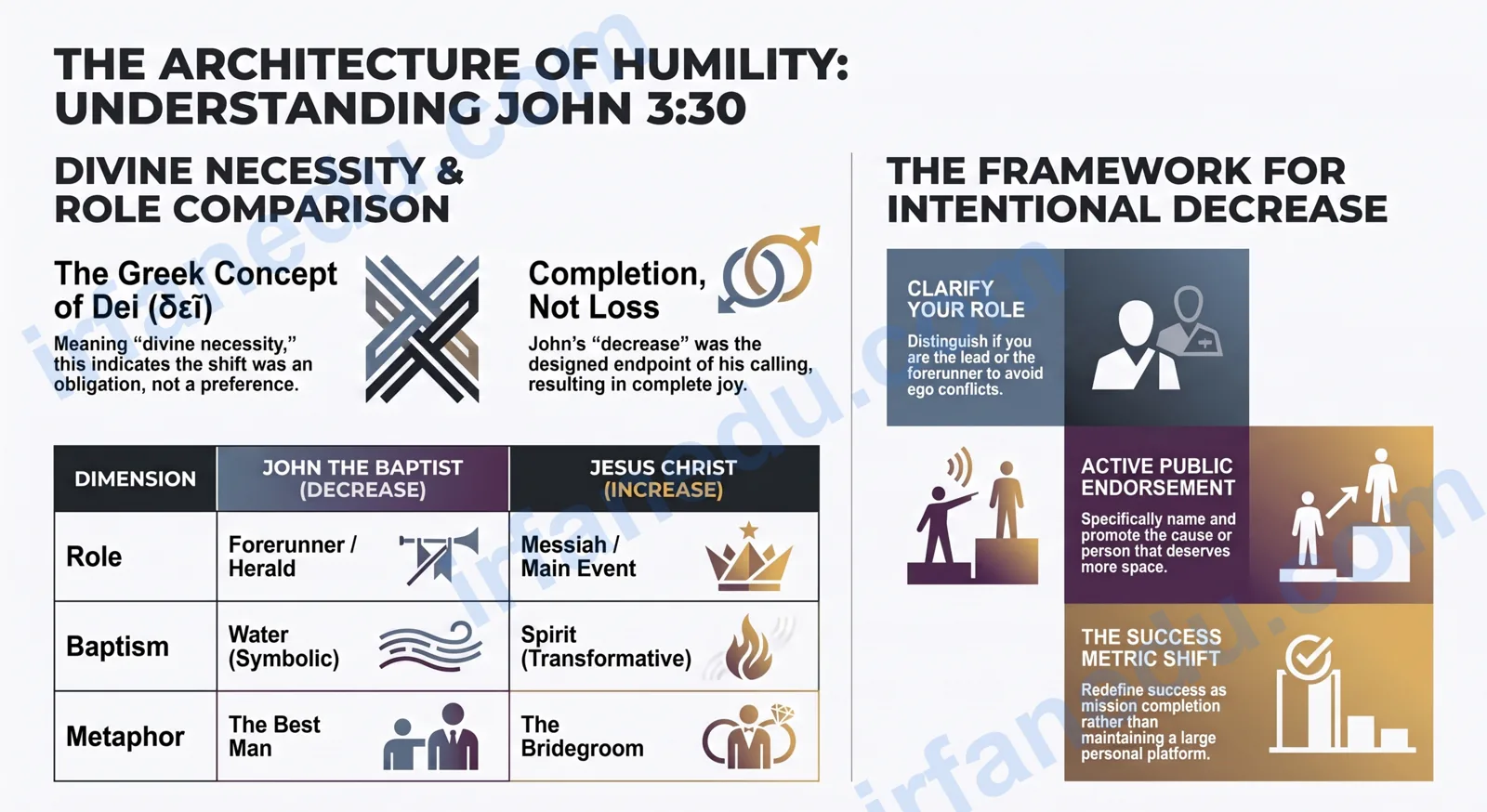
The single most important word in John 3:30 is the word translated “must.” In the original Greek, it is δεῖ (dei) — and it does not mean “should” or “probably will.” It means divine necessity. It is the same word used when Jesus says “the Son of Man must suffer” and “I must be about my Father’s business.”
This changes the entire emotional register of the verse. John is not saying “I suppose I should step back.” He is saying: “This is written into the architecture of reality. It cannot be otherwise.” His decrease is not reluctant — it is obedient to a plan he fully understands and embraces.
- Pronunciation: “day”
- Meaning: It is necessary; it must be; divine obligation
- Other uses: Luke 2:49 (“I must be in my Father’s house”), Luke 9:22 (“The Son of Man must suffer”)
- Contrast with: θέλω (thelō) = “I want/wish” — dei is stronger; it is not preference but necessity
In my experience teaching New Testament Greek to undergraduates, this single word distinction — dei vs. thelō — is the one that transforms students’ understanding of John 3:30 from a nice sentiment into a theological cornerstone.
John vs. Jesus: A Side-by-Side Comparison
One of the clearest ways to understand John 3:30 is to see exactly how the roles of John the Baptist and Jesus were designed to be different — and why that difference makes John’s “decrease” not a failure but a completion.
| Dimension | John the Baptist | Jesus Christ |
|---|---|---|
| Role | Forerunner / Herald | Messiah / Main Event |
| Mission | Prepare the way; call people to repentance | Fulfill the covenant; bring salvation |
| Baptism | Water baptism — symbolic repentance | Spirit baptism — transformative new life |
| Self-description | “I am not the Messiah” (John 1:20); “a voice crying in the wilderness” | “I am the way, the truth, and the life” (John 14:6) |
| Trajectory | Designed to decrease — mission complete at Jesus’s arrival | Designed to increase — mission eternal and expanding |
| Metaphor used | Friend of the bridegroom (best man) | The bridegroom |
| Emotional posture | “That joy is mine, and it is now complete” (John 3:29) | Receives the bride; the center of the celebration |
What this table makes clear is that John’s decrease was not an accident or a disappointment. It was the designed endpoint of his specific calling. He was built for a sprint, not a marathon — and he ran his sprint perfectly.
Visual: The Arc of Increase and Decrease
The relationship between John’s ministry and Jesus’s ministry can be visualized as two crossing trajectories — one rising, one descending by design.
  PROMINENCE
      |
  ████|  John the Baptist
  ████|██
  ████|████
  ████|██████  ← John 3:30 (crossing point)
  ████|████████████
      |████████████████  Jesus Christ
      |
      +------------------------------------→ TIME
      Baptism    John 3:30    Jesus's Ministry
      of Jesus   Moment       Expands
The crossing point — the moment of John 3:30 — is not a crisis. It is the fulfillment of the design. John’s line was always meant to arc downward after this point. Jesus’s line was always meant to continue rising.
Here is what I find most striking about John 3:30 after years of studying it: John said these words before his arrest and execution. He didn’t decrease reluctantly because circumstances forced him out. He chose decrease while he still had a platform, a following, and a voice. That is the harder and rarer thing. Most of us can accept decrease when we have no choice. John accepted it when he did have a choice — and called it joy. That is the part of this verse that I think most guides, including popular devotional ones, completely miss.
How to Apply “He Must Increase, I Must Decrease” in Real Life
The principle in John 3:30 has direct, practical implications far beyond its original biblical context. Here is a step-by-step framework for living it out — whether your context is faith, leadership, parenting, or mentorship.
- Clarify your role. Ask honestly: Am I the lead in this situation, or am I the forerunner? John knew his role with precision. Confusion about role is the root of most ego conflicts.
- Identify what “increase” looks like. What is the mission, the person, or the cause that genuinely deserves more space? Name it specifically — vague humility is just performance.
- Speak well of it publicly. John didn’t just step back quietly. He told his disciples, clearly and on record, that Jesus’s growth was right and good. Active endorsement is harder than passive withdrawal.
- Redefine your success metric. John’s success was not crowd size — it was mission completion. When you complete your forerunner role, that is a win, not a loss.
- Return to this posture daily. Humility is not a one-time declaration. John 3:30 describes a daily orientation, not a single event.
The best teachers I have known practice John 3:30 instinctively. They build students up to the point where the student surpasses them — and they celebrate that moment rather than feeling threatened by it. That is the teacher’s “decrease” and the student’s “increase.” It is the whole point of the job.
For a broader academic treatment of humility as a virtue across philosophical and religious traditions, the Britannica article on Humility provides useful comparative context.
Almost every popular explanation of John 3:30 frames it as a lesson in self-effacement — the idea that you should think less of yourself. But that is not what John models. John does not say “I am worthless” or “I was wrong to lead.” He says his joy is complete. He is not diminishing his past work; he is declaring it finished.
The real principle is role clarity, not self-erasure. John’s identity was never “the most important person in the room.” His identity was “the one sent ahead.” Once the one he was sent ahead of arrived, John’s identity was fully intact — and his mission was fully accomplished. Decrease, in this framework, is not loss. It is completion.
This distinction matters enormously for how you apply the verse. If you read it as “think less of yourself,” it produces false humility and resentment. If you read it as “know your role and complete it joyfully,” it produces clarity, peace, and genuine greatness.
Frequently Asked Questions About John 3:30
Who said “He must increase, I must decrease”?
What Does “He Must Increase” Mean in John 3:30?
What Does “I Must Decrease” Mean?
How Does John 3:30 Apply to Everyday Life?
Is John 3:30 Only for Religious Contexts?
Dr. Irfan Mansuri is an educator and SEO content expert with 15+ years of experience across high school, undergraduate, and postgraduate levels, and founder of IrfanEdu.com. I combine deep subject knowledge with proven teaching strategies to make complex ideas simple and genuinely useful for students, parents, and lifelong learners worldwide.
Sources & References
- Wikipedia — John the Baptist: Historical and theological background on John the Baptist’s role in the New Testament.
- Britannica — Humility: Comparative treatment of humility as a virtue across philosophical and religious traditions.
- Khan Academy — The Bible as Historical Source: Academic framing of biblical texts in historical context.
✍ Editorial note: This article was written and fact-checked by Dr. Irfan Mansuri. All biblical quotations are from the NIV (New International Version) unless otherwise noted. No statistics or quotes have been fabricated.