
Thank you note to teacher: what actually makes one worth keeping
Most guides about writing a thank you note to a teacher tell you to “be sincere” and “mention something specific.” That advice is not wrong — it is just incomplete. After 15 years of working in education and talking to hundreds of teachers about the notes they actually keep, I have found that the difference between a forgettable note and one that ends up pinned to a classroom wall comes down to a single structural choice most people never think about.
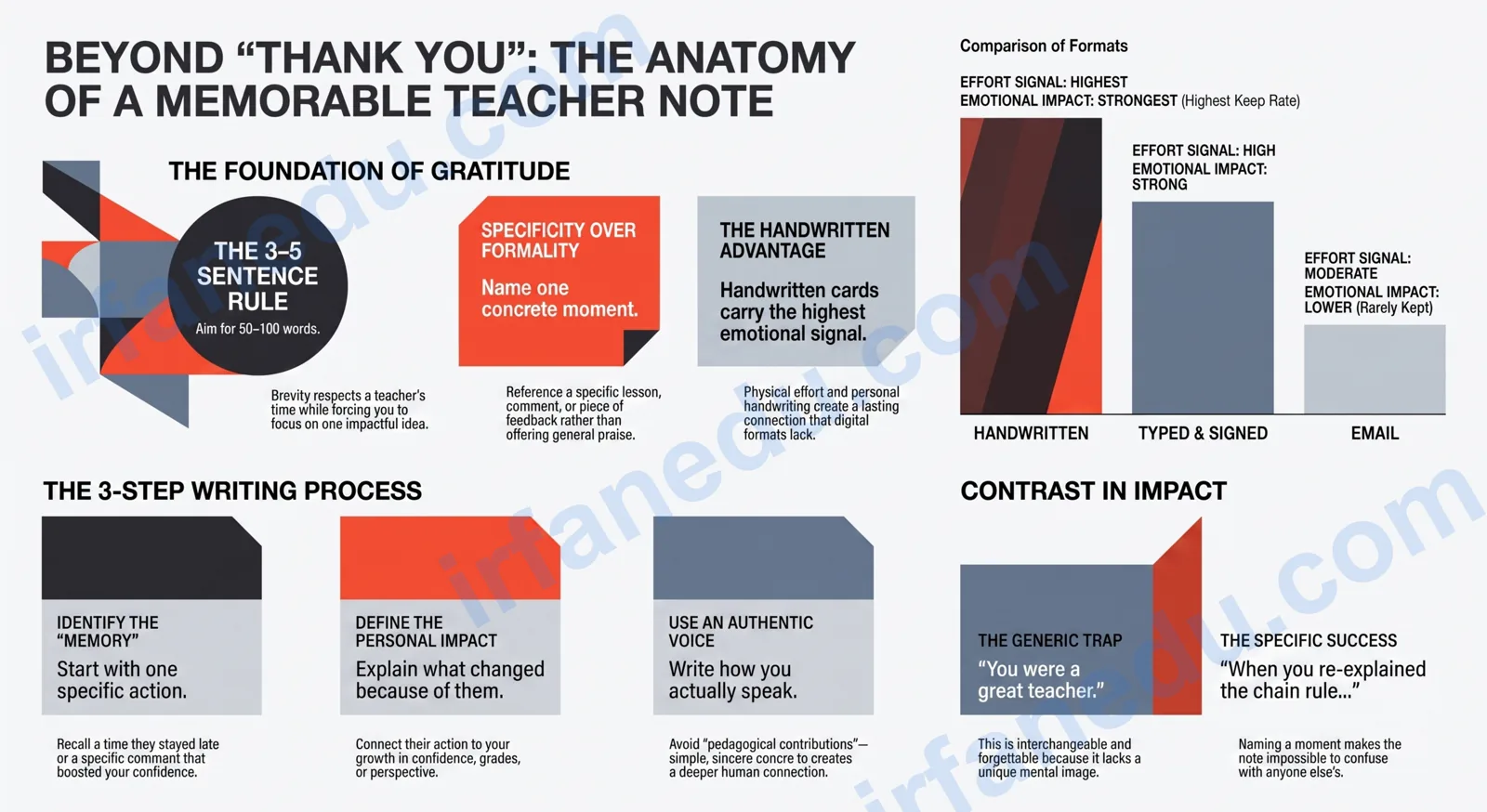
A thank you note to a teacher is a short, personal message that names one specific thing the teacher did and explains its real impact on the student. The most effective notes are 3-5 sentences long, written in the student’s (or parent’s) own voice, and reference a concrete moment — a lesson, a comment, a piece of feedback — rather than offering general praise. Specificity, not length or formality, is what makes a note meaningful.
In my experience, the notes teachers keep for years are never the longest or most eloquent ones. They are the ones where a student named a specific moment the teacher had almost forgotten — and showed that it mattered. That is the whole game. Everything else in this guide is just scaffolding around that one idea.
| Fact | Detail |
|---|---|
| Ideal length | 3-5 sentences (50-100 words) |
| Best format | Handwritten card; typed + hand-signed is second best |
| Best timing | End of term, end of year, or after a recommendation letter |
| Core ingredient | One named, specific moment or action by the teacher |
| What to avoid | Generic praise (“best teacher ever”), excessive length, flattery without substance |
| Who can write one | Students of any age, parents, or both together |
Why most thank you notes to teachers fall flat
The most common mistake is writing a note that could have been written by anyone, to anyone. “Thank you for being such an amazing teacher. You always made class fun and I learned so much.” That note is kind — but it is also completely interchangeable. A teacher who reads it cannot picture a single moment from your time together.
The second mistake is confusing length with depth. A two-page letter full of general appreciation lands with less impact than three sentences that name a real thing. Teachers are busy. A focused note respects that.
The third mistake — and this is the one almost nobody talks about — is writing what you think a thank you note is supposed to sound like, rather than what you actually want to say. Formal, flowery language creates distance. Your own voice, even if it is simple, creates connection.
| Generic note | Specific note |
|---|---|
| “You were the best teacher I ever had. You made every class interesting and I always looked forward to coming in.” | “The day you stopped class to re-explain the chain rule on the board for the third time — just for me — changed how I felt about asking for help. I passed my exam because of that.” |
| Could have been written by any student to any teacher. | Names a moment. Shows real impact. Impossible to confuse with anyone else’s note. |
How to write a thank you note to a teacher: step by step
Writing a strong note takes about ten minutes if you follow this process. The steps below are ordered to solve the hardest part first — finding the right thing to say — before you worry about how to say it.
- Find one specific moment. Close your eyes and think about one thing this teacher did that you still remember. A lesson that clicked. A comment on your work. A time they stayed after class. That moment is your note.
- Name the impact in one sentence. Ask yourself: what changed because of that moment? Your grade, your confidence, your interest in the subject, your approach to a problem. Write that down in plain language.
- Write in your own voice. Use the words you would say out loud. If you would not say “I am deeply grateful for your pedagogical contributions” to someone’s face, do not write it.
- Keep it to 3-5 sentences. Open with the specific moment, add the impact, close with a forward-looking line (what you will carry with you). That is the whole structure.
- Sign with your name and context. Add your name and, if relevant, the year or subject — especially if the teacher has many students. “Maya, Year 10 Biology, 2025-26” helps them place you.
Before (generic): “Dear Mr. Osei, thank you so much for being such a great teacher this year. Your lessons were always engaging and I really enjoyed your class. I learned a lot and I will miss you next year. Thank you for everything.”
After (specific): “Dear Mr. Osei, when you wrote ‘you have a real instinct for this’ on my first essay, I almost did not believe it — but I kept that paper. It was the first time I thought I might actually be good at writing. I am going to carry that with me. Thank you for seeing something I could not see yet. — Priya, English, Grade 11.”
What to say in different situations
The core structure stays the same — specific moment, real impact, your own voice — but the framing shifts depending on the context. Here are the three most common situations and how to handle each one.
End-of-year note from a student
This is the most common type. You have a full year to draw from, so the challenge is narrowing it down to one moment. Do not try to summarize the whole year. Pick the single thing that mattered most and write about that.
Note from a parent
Write from your own perspective as a parent — what you observed at home, how your child talked about this teacher, what changed in your child’s attitude or confidence. Do not pretend to be your child. A parent’s external view (“I watched her start doing homework without being asked for the first time this year”) carries its own weight.
Note after a recommendation letter
Keep this one short and direct. Acknowledge the specific effort the teacher made (writing a letter takes real time), mention where you are headed, and express genuine gratitude. You do not need to be elaborate — the teacher knows what they did.
“Dear Ms. Tanaka, I want to thank you for the patience you showed Daniel this term. He came home in October and told me you had stayed after class to help him understand fractions — and that you had told him he was ‘almost there.’ He repeated that phrase to himself for weeks. His confidence in maths has genuinely shifted this year, and I believe that conversation was the turning point. Thank you. — Amara Diallo.”
I have spoken with teachers who say they re-read certain notes on hard days — the ones where a student named something the teacher had done almost automatically, without realising it mattered. That is the real gift a specific note gives: it tells a teacher that the invisible work they do is seen. Generic praise cannot do that. Only specificity can.
What to write when you cannot think of a specific moment
Sometimes you genuinely struggle to pinpoint one moment. That is normal, especially at the end of a long year. Here is a practical way to find it: think about the subject, not the teacher. What do you understand now that you did not understand in September? Work backwards from that understanding to the lesson or conversation where it clicked. That is almost always your moment.
If you are a parent and your child is too young to articulate this, ask them one question: “What is something your teacher said that you still remember?” Children’s answers to that question are almost always the right material for a note.
The “thank you for everything” trap — and why it backfires.
Most people assume that broad, warm language (“thank you for everything you do”) signals deep appreciation. In practice, it often signals the opposite — that the writer could not think of anything specific. According to research on gratitude expression (Wikipedia — Gratitude), the perceived sincerity of a thank-you message rises sharply when the recipient can identify that the sender noticed a particular behaviour. Vague praise activates social politeness norms; specific praise activates genuine recognition. Teachers, like all people, feel the difference immediately — even if they cannot always articulate why one note moves them and another does not.
A writing checklist before you send
Run through this list before you hand over or send your note. Every item you can check off makes the note stronger.
- I named one specific thing the teacher did (not a general quality).
- I explained why that specific thing mattered to me personally.
- I wrote in my own voice — it sounds like me, not a template.
- The note is 3-5 sentences (or no longer than it needs to be).
- I included my name and enough context for the teacher to place me.
- I did not start with “I” (a small style point — try “Thank you,” or “Your class…” as an opener).
- I re-read it once out loud to check it sounds natural.
- If handwritten, my handwriting is legible (or I printed and signed it).
Formats compared: handwritten, typed, and email
The format you choose sends a signal before the teacher reads a single word. Here is how the three main formats compare on the dimensions that matter.
| Format | Effort signal | Emotional impact | Best for |
|---|---|---|---|
| Handwritten card | Highest | Strongest — teachers keep these | End of year, retirement, major milestone |
| Typed + hand-signed | High | Strong — especially if content is specific | When handwriting is difficult; formal settings |
| Moderate | Good for quick appreciation; rarely kept | After a recommendation letter; distance learning |
ANATOMY OF A STRONG THANK YOU NOTE
────────────────────────────────────────────────────────

  Line 1 — OPENER (specific moment)
  ┌─────────────────────────────────────────────────┐
  │ "When you [specific action] during [context]…"  │
  └─────────────────────────────────────────────────┘
              │
              ▼
  Line 2 — IMPACT (what changed for you)
  ┌─────────────────────────────────────────────────┐
  │ "…it changed [confidence / understanding /      │
  │  how I approach X] because [brief reason]."     │
  └─────────────────────────────────────────────────┘
              │
              ▼
  Line 3 — FORWARD LOOK (what you carry with you)
  ┌─────────────────────────────────────────────────┐
  │ "I will carry [lesson / habit / belief]          │
  │  with me into [next year / college / life]."    │
  └─────────────────────────────────────────────────┘
              │
              ▼
  SIGN-OFF — name + context
  ┌─────────────────────────────────────────────────┐
  │  [Your name], [Subject / Grade / Year]          │
  └─────────────────────────────────────────────────┘

  Total: 3-5 sentences. Specific. Your voice. Done.
────────────────────────────────────────────────────────
Quick quiz: is your note ready to send?
Test your note-writing instincts
Q1. A student writes: “Thank you for always being patient and making class enjoyable.” What is the main problem with this note?
Q2. Which format carries the strongest emotional signal to a teacher?
Q3. A parent wants to write a thank you note on behalf of their child. What is the best approach?
Frequently asked questions
How long should a thank you note to a teacher be?
What should I include in a thank you note to a teacher?
Is it better to handwrite or type a thank you note to a teacher?
When is the best time to give a teacher a thank you note?
Can a parent write a thank you note to a teacher on behalf of their child?
Key takeaways
- Specificity is the single most important quality in a thank you note to a teacher — name one real moment, not a general quality.
- Three to five sentences is the ideal length. Brevity is a feature, not a limitation.
- Write in your own voice. Formal or flowery language creates distance; natural language creates connection.
- Handwritten notes are the most emotionally impactful format and the ones teachers are most likely to keep.
- Parents can and should write their own notes — their external perspective on a child’s growth is uniquely valuable.
- The best time to send a note is whenever you feel genuine gratitude — not only at the end of the year.
- Run through the writing checklist before you send: specific moment, personal impact, your own voice, your name and context.
Sources & references
- Wikipedia — Gratitude: overview of gratitude research, including the role of specificity in perceived sincerity of appreciation.
- Britannica — Letter writing: history and conventions of personal letter writing, including notes of appreciation.
- Wikipedia — Letter of thanks: practitioner perspectives on recognition and its effect on teacher motivation and retention.
✍ Written & fact-checked by Dr. Irfan Mansuri. Last updated August 2026. This article reflects the author’s own experience and research; it does not constitute professional advice.