
Graphing Lines in Coordinate Geometry: Why Most Students Use the Wrong Form (And How to Fix It)
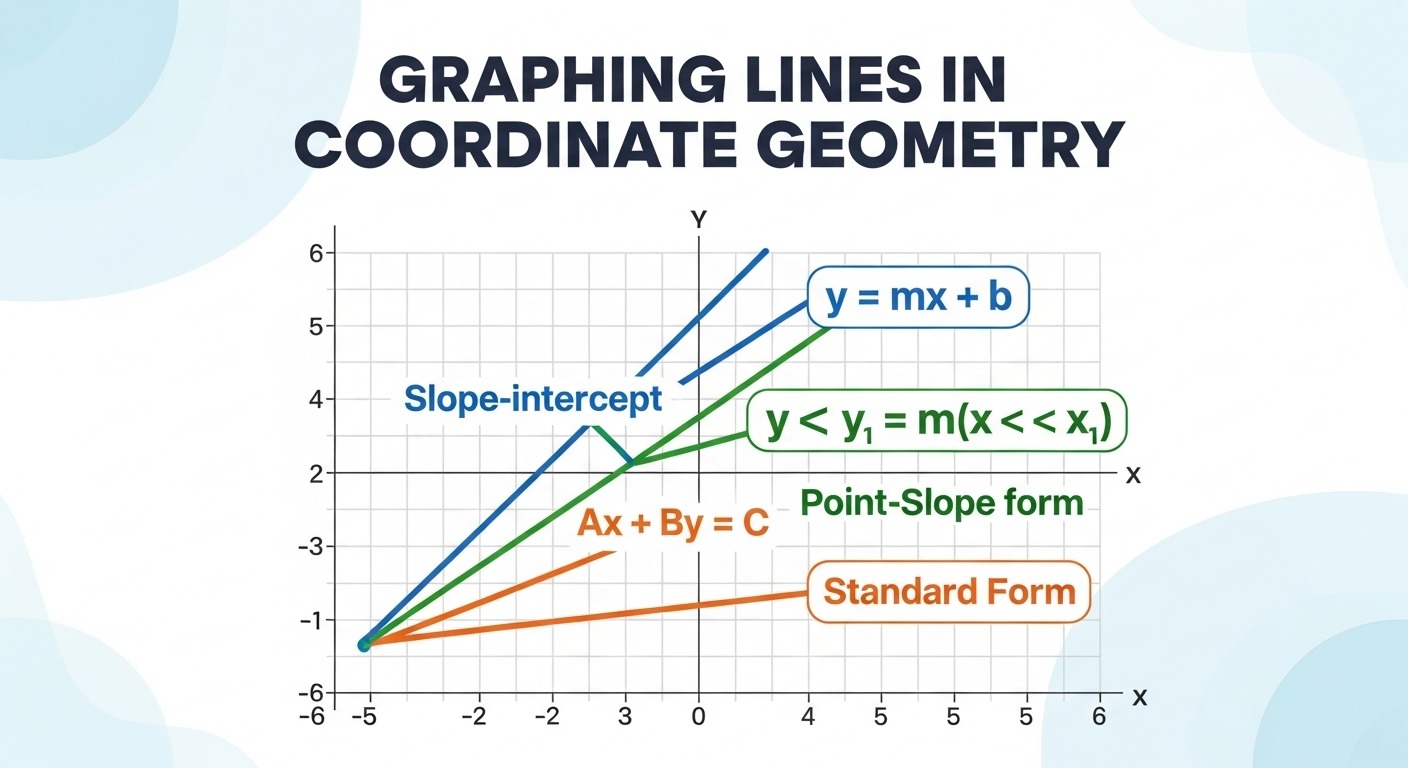
Here is a fact that surprises most students: there is no single “best” form for writing a linear equation. Slope-intercept form, point-slope form, and standard form all describe the exact same line — they are just different lenses for looking at it. Knowing when to use each form is the skill that separates students who struggle with coordinate geometry from those who master it.
For Grade 9–10 students, mastering all three forms is essential — not just for classroom tests, but for standardized exams like the SAT and ACT, where linear equations appear in nearly every math section. In real life, engineers use these equations to model slopes of roads, economists graph cost functions, and scientists plot experimental data — all using the same principles you are learning right now.
By the end of this guide, you will be able to:
- Identify and use slope-intercept form, point-slope form, and standard form confidently
- Graph any linear equation on a coordinate plane in under 2 minutes
- Convert between all three forms fluently
- Recognize which form to use for any given problem
- Avoid the 5 most common graphing mistakes students make
- Solve practice problems at easy, medium, and hard difficulty levels
- Slope-intercept form ($$y = mx + b$$) — best for graphing when slope and y-intercept are known
- Point-slope form ($$y – y_1 = m(x – x_1)$$) — best when you know the slope and one point
- Standard form ($$Ax + By = C$$) — best for finding intercepts and solving systems of equations
- All three forms represent the same line — they are interconvertible
- The slope $$m$$ measures steepness: positive = rises left to right, negative = falls left to right
What Is Graphing Lines in Coordinate Geometry?
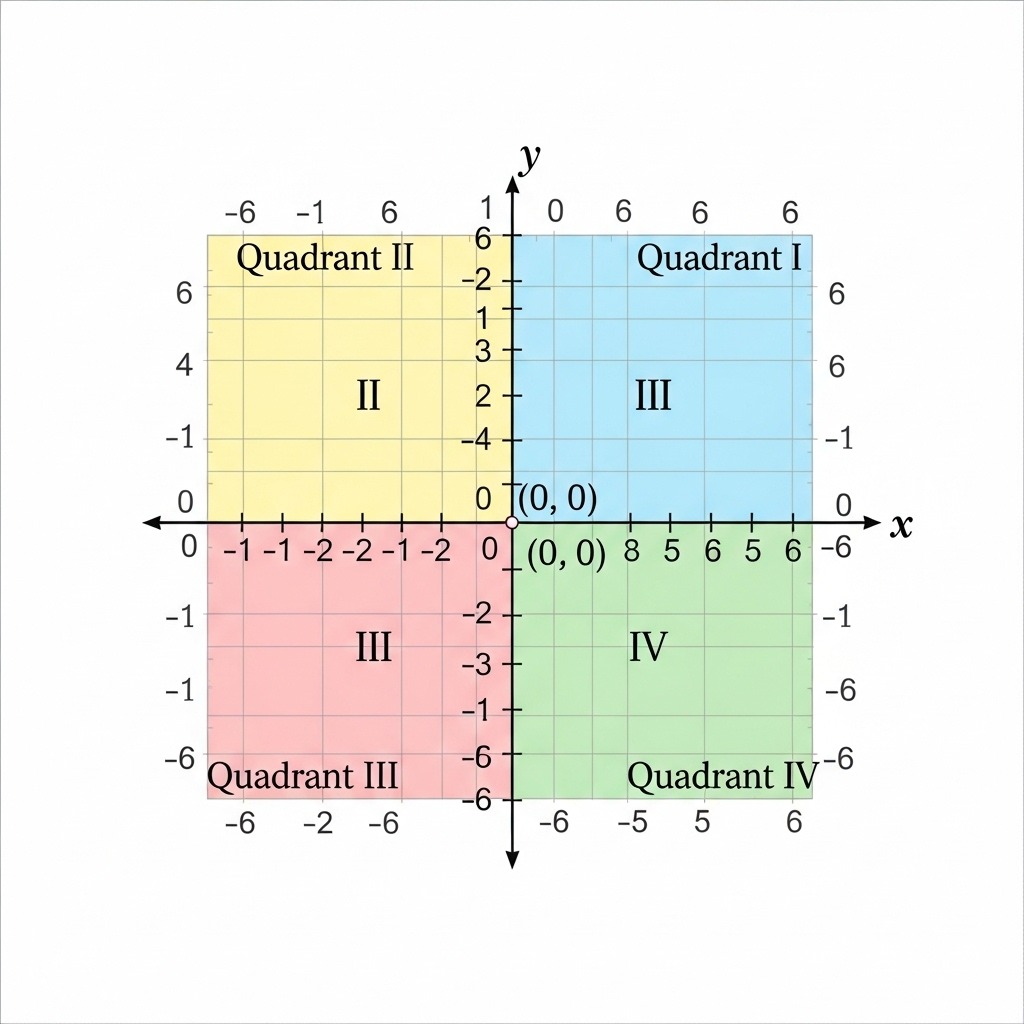
Coordinate geometry — also called analytic geometry — is the branch of mathematics that connects algebra and geometry by placing geometric shapes on a numbered grid called the coordinate plane. The coordinate plane has two perpendicular number lines: the horizontal x-axis and the vertical y-axis, which intersect at the origin (0, 0).
A line in coordinate geometry is the set of all points $$(x, y)$$ that satisfy a linear equation. The word “linear” comes from the Latin linearis — meaning “of a line.” Every linear equation, no matter what form it is written in, produces a perfectly straight line when graphed. This is what makes linear equations so powerful and predictable.
Key Vocabulary You Must Know
- Slope (m): The measure of a line’s steepness, calculated as $$m = \frac{rise}{run} = \frac{y_2 – y_1}{x_2 – x_1}$$
- Y-intercept (b): The point where the line crosses the y-axis; always has x-coordinate = 0, written as $$(0, b)$$
- X-intercept: The point where the line crosses the x-axis; always has y-coordinate = 0, written as $$(a, 0)$$
- Linear equation: An equation whose graph is a straight line; the highest power of any variable is 1
- Ordered pair: A point written as $$(x, y)$$ representing a location on the coordinate plane
Here is the surprising fact most textbooks skip: the slope of a line was first formalized by the French mathematician René Descartes in 1637 in his work La Géométrie. Before Descartes, geometry and algebra were completely separate fields. His invention of the coordinate system — which is why it is called the Cartesian plane — unified them permanently. Every time you graph a line, you are using a 400-year-old breakthrough.
Slope-Intercept Form (y = mx + b) Explained
Slope-intercept form is the most commonly taught form of a linear equation, and for good reason — it puts the two most useful pieces of graphing information front and center. The moment you see this form, you immediately know the slope and the y-intercept without any calculation. [2]
- m = slope (steepness and direction of the line)
- b = y-intercept (where the line crosses the y-axis)
- x and y = variables representing any point on the line
Understanding Slope in Depth
The slope $$m$$ tells you two things simultaneously: how steep the line is and which direction it travels. Think of slope like the grade of a road. A road with a 10% grade rises 10 feet for every 100 feet you travel forward. In math, we express this as a fraction:
| Slope Value | What the Line Does | Real-World Analogy |
|---|---|---|
| $$m > 0$$ (positive) | Rises from left to right ↗ | Walking uphill |
| $$m < 0$$ (negative) | Falls from left to right ↘ | Walking downhill |
| $$m = 0$$ | Perfectly horizontal → | Walking on flat ground |
| $$m$$ undefined | Perfectly vertical ↕ | A cliff face (not a function) |
| $$|m|$$ large (e.g., 5) | Very steep | A steep mountain trail |
| $$|m|$$ small (e.g., 0.1) | Nearly flat | A gentle ramp |
Use the mnemonic “My Bike”: m = slope (how steep your bike ride is), b = where you start (your starting point on the y-axis). The equation $$y = mx + b$$ literally says: “Start at b, then move with steepness m.”
Slope-intercept form is ideal when you need to graph a line quickly, when you are comparing two lines to determine if they are parallel (same slope, different b) or perpendicular (slopes are negative reciprocals), or when you are writing an equation from a graph. [3]
Point-Slope Form Explained
Point-slope form is the most flexible of the three forms — and the most underused. While slope-intercept form requires you to know the y-intercept, point-slope form works with any point on the line. This makes it the go-to form when you are given two points or a slope and a non-y-intercept point. [4]
- m = slope of the line
- (x₁, y₁) = any known point on the line
- x and y = variables representing any other point on the line
Where Does Point-Slope Form Come From?
Point-slope form is not a separate rule — it is derived directly from the definition of slope. If you have a known point $$(x_1, y_1)$$ and any other point $$(x, y)$$ on the line, the slope formula gives you:
Multiply both sides by $$(x – x_1)$$ and you get point-slope form: $$y – y_1 = m(x – x_1)$$. This is not a formula to memorize blindly — it is the slope formula rearranged. Understanding this connection makes point-slope form intuitive rather than arbitrary.
When to Use Point-Slope Form
- You are given the slope and one point that is not the y-intercept
- You are given two points and need to write the equation of the line
- You want to write the equation quickly without solving for b first
- You are working with tangent lines in early calculus (this form appears constantly)
Students often write point-slope form incorrectly as $$y + y_1 = m(x + x_1)$$. Remember: the formula uses subtraction — $$y – y_1 = m(x – x_1)$$. If your point is $$(3, -2)$$, the equation becomes $$y – (-2) = m(x – 3)$$, which simplifies to $$y + 2 = m(x – 3)$$. The sign change happens because of the double negative, not because the formula uses addition.
Point-slope form is especially powerful because it can be converted to slope-intercept form in two steps: distribute the slope, then add or subtract to isolate y. This flexibility makes it the preferred form for writing equations in many algebra courses. [1]
Standard Form (Ax + By = C) Explained
Standard form is the most structured of the three forms. It places both variables on the left side and the constant on the right. While it does not immediately reveal the slope, it makes finding x-intercepts and y-intercepts extremely fast — which is exactly what you need for graphing with the intercept method. [2]
Rules for standard form:
- A, B, and C must be integers (whole numbers — no fractions or decimals)
- A must be non-negative (A ≥ 0)
- A, B, and
- A, B, and C should have no common factors (the equation should be in simplest form)
- A and B cannot both equal zero at the same time
Finding Intercepts from Standard Form
The greatest strength of standard form is how quickly it lets you find both intercepts. You only need to substitute zero for one variable at a time — no rearranging required. This two-point method is the fastest way to graph a line from standard form.
| To Find | Set This Variable to Zero | Then Solve For | Result |
|---|---|---|---|
| X-intercept | Set $$y = 0$$ | $$x = C / A$$ | Point $$(C/A,\ 0)$$ |
| Y-intercept | Set $$x = 0$$ | $$y = C / B$$ | Point $$(0,\ C/B)$$ |
For the equation $$3x + 4y = 12$$:
- X-intercept: Set $$y = 0$$ → $$3x = 12$$ → $$x = 4$$ → point $$(4, 0)$$
- Y-intercept: Set $$x = 0$$ → $$4y = 12$$ → $$y = 3$$ → point $$(0, 3)$$
Plot $$(4, 0)$$ and $$(0, 3)$$, draw a line through them — done in under 60 seconds.
X-intercept: (4, 0) | Y-intercept: (0, 3)Converting Standard Form to Slope-Intercept Form
To find the slope from standard form, convert to slope-intercept form by isolating $$y$$. Starting from $$Ax + By = C$$: subtract $$Ax$$ from both sides to get $$By = -Ax + C$$, then divide everything by $$B$$ to get $$y = -\frac{A}{B}x + \frac{C}{B}$$. This tells you the slope is $$m = -\frac{A}{B}$$ and the y-intercept is $$b = \frac{C}{B}$$.
On the SAT and ACT, answer choices for linear equations are often written in standard form. If you see $$2x – 3y = 6$$ and need the slope, do not panic — just apply $$m = -A/B = -2/(-3) = 2/3$$. You can extract the slope in one step without rewriting the entire equation.
Standard form is also the preferred format for solving systems of linear equations using elimination, because having both variables on the same side makes it easy to add or subtract equations to cancel a variable.
How to Graph a Line: Step-by-Step Guide for All Three Forms
Graphing a linear equation is a systematic process. Once you recognize which form your equation is in, follow the matching method below. Each method produces the same line — you are just taking a different path to get there.
Method 1: Graphing from Slope-Intercept Form (y = mx + b)
-
Identify m and b from the equation.
In $$y = \frac{3}{4}x – 2$$, the slope is $$m = \frac{3}{4}$$ and the y-intercept is $$b = -2$$.
Common mistake: Students confuse the sign of b. In $$y = 2x – 5$$, b is $$-5$$, not $$+5$$. -
Plot the y-intercept on the y-axis.
Place your first point at $$(0, b)$$. For $$b = -2$$, plot the point $$(0, -2)$$ on the y-axis. This is your anchor point — everything else is built from here. -
Use the slope to find a second point.
Write the slope as a fraction: $$m = \frac{rise}{run}$$. From $$(0, -2)$$, move up 3 units (rise = 3) and right 4 units (run = 4) to reach the point $$(4, 1)$$.
Common mistake: Students move in the wrong direction. Rise is always vertical movement; run is always horizontal movement. -
Plot the second point and verify with a third.
Mark $$(4, 1)$$ on the grid. For accuracy, find one more point by repeating the rise/run from $$(4, 1)$$ to reach $$(8, 4)$$. Three points that are collinear confirm you have not made an error. -
Draw the line through all points.
Use a ruler to draw a straight line through your points. Add arrows at both ends to show the line extends infinitely in both directions.
When the slope is negative, like $$m = -\frac{2}{3}$$, you have two valid options: move down 2, right 3 OR move up 2, left 3. Both give you the correct next point. Choose whichever direction keeps you on the visible part of your graph.
Method 2: Graphing from Point-Slope Form
-
Identify the known point (x₁, y₁) and slope m.
In $$y – 4 = 3(x – 1)$$, the known point is $$(1, 4)$$ and the slope is $$m = 3$$.
Common mistake: Students read the signs incorrectly. In $$y – 4 = 3(x – 1)$$, the point is $$(+1, +4)$$ — both values are positive because the formula subtracts them. -
Plot the known point on the coordinate plane.
Place a dot at $$(1, 4)$$. This is your starting point. Unlike slope-intercept form, this point may not be on the y-axis — and that is perfectly fine. -
Use the slope to find additional points.
With $$m = 3 = \frac{3}{1}$$, move up 3 units and right 1 unit from $$(1, 4)$$ to reach $$(2, 7)$$. Also move in the reverse direction (down 3, left 1) to reach $$(0, 1)$$ — which is actually the y-intercept. -
Draw the line through all plotted points.
Connect the points with a straight line and add arrows at both ends. -
Verify by converting to slope-intercept form.
Distribute and simplify: $$y – 4 = 3(x – 1)$$ → $$y – 4 = 3x – 3$$ → $$y = 3x + 1$$. The y-intercept is $$(0, 1)$$, which matches the point you found in Step 3. ✓
Method 3: Graphing from Standard Form Using Intercepts
-
Find the x-intercept by setting y = 0.
For $$2x + 5y = 10$$: set $$y = 0$$ → $$2x = 10$$ → $$x = 5$$. Plot the point $$(5, 0)$$ on the x-axis. -
Find the y-intercept by setting x = 0.
Set $$x = 0$$ → $$5y = 10$$ → $$y = 2$$. Plot the point $$(0, 2)$$ on the y-axis.
Common mistake: Students forget to check if the intercepts are integers. If they are fractions, the intercept method still works — just plot the fractional point carefully. -
Draw the line through both intercepts.
Connect $$(5, 0)$$ and $$(0, 2)$$ with a straight line. Two points are always enough to define a unique line. -
Verify with a third point.
Pick any x-value, substitute into the original equation, and solve for y. For $$x = 5$$: $$2(5) + 5y = 10$$ → $$5y = 0$$ → $$y = 0$$. This gives $$(5, 0)$$, which is already on the line. Try $$x = 2.5$$: $$5 + 5y = 10$$ → $$y = 1$$ → point $$(2.5, 1)$$. Check it lies on your drawn line. ✓ -
Add arrows and label the line.
Extend the line beyond both intercepts with arrows. Label the line with its equation for clarity, especially when graphing multiple lines on the same plane.
Worked Examples: All Three Forms Solved Step-by-Step
The best way to master graphing lines is to work through complete examples at increasing difficulty levels. Study each step carefully — understanding why each step works is more valuable than memorizing the procedure.
Graph the line: $$y = 2x + 1$$
Step 1 — Identify slope and y-intercept:
$$m = 2$$ (slope) and $$b = 1$$ (y-intercept)
Step 2 — Plot the y-intercept:
Place a point at $$(0, 1)$$ on the y-axis.
Step 3 — Use slope to find next point:
$$m = 2 = \frac{2}{1}$$ → from $$(0, 1)$$, move up 2 and right 1 → new point: $$(1, 3)$$
Step 4 — Find a third point to verify:
From $$(1, 3)$$, move up 2 and right 1 → $$(2, 5)$$.
Check: $$y = 2(2) + 1 = 5$$ ✓
Step 5 — Draw the line through (0,1), (1,3), (2,5).
✅ Line passes through (0, 1), (1, 3), (2, 5) with slope = 2Write the equation and graph the line that passes through $$(−2, 5)$$ with slope $$m = -3$$.
Step 1 — Substitute into point-slope form:
$$y – y_1 = m(x – x_1)$$
$$y – 5 = -3(x – (-2))$$
$$y – 5 = -3(x + 2)$$
Step 2 — Plot the known point:
Place a dot at $$(-2, 5)$$ on the coordinate plane.
Step 3 — Use slope $$m = -3 = \frac{-3}{1}$$ to find more points:
From $$(-2, 5)$$: move down 3, right 1 → $$(-1, 2)$$
From $$(-1, 2)$$: move down 3, right 1 → $$(0, -1)$$
Step 4 — Convert to slope-intercept form to verify:
$$y – 5 = -3x – 6$$
$$y = -3x – 1$$
Y-intercept = $$(0, -1)$$ ✓ — matches Step 3.
Step 5 — Draw the line through (−2, 5), (−1, 2), (0, −1).
✅ Equation: y = −3x − 1 | Y-intercept: (0, −1)Graph the line: $$4x – 3y = 12$$ and find its slope.
Step 1 — Find the x-intercept (set y = 0):
$$4x – 3(0) = 12$$ → $$4x = 12$$ → $$x = 3$$
X-intercept: $$(3, 0)$$
Step 2 — Find the y-intercept (set x = 0):
$$4(0) – 3y = 12$$ → $$-3y = 12$$ → $$y = -4$$
Y-intercept: $$(0, -4)$$
Step 3 — Plot both intercepts and draw the line:
Plot $$(3, 0)$$ and $$(0, -4)$$. Draw a straight line through them.
Step 4 — Find the slope using the intercepts:
$$m = \frac{y_2 – y_1}{x_2 – x_1} = \frac{-4 – 0}{0 – 3} = \frac{-4}{-3} = \frac{4}{3}$$
Step 5 — Verify using the formula $$m = -A/B$$:
$$A = 4,\ B = -3$$ → $$m = -\frac{4}{-3} = \frac{4}{3}$$ ✓
Step 6 — Write in slope-intercept form:
$$-3y = -4x + 12$$ → $$y = \frac{4}{3}x – 4$$ ✓
Comparing All Three Forms: Which One Should You Use?
All three forms are mathematically equivalent — they describe the same line. The question is never “which form is correct?” but rather “which form is most useful for this specific problem?” Choosing the right form saves time and reduces errors.
| Form | Equation | Best Used When… | Immediately Reveals | Requires Conversion For |
|---|---|---|---|---|
| Slope-Intercept | $$y = mx + b$$ | Graphing quickly; comparing lines; writing from a graph | Slope (m) and y-intercept (b) | X-intercept |
| Point-Slope | $$y – y_1 = m(x – x_1)$$ | Given slope + any point; given two points; early calculus | Slope and one point on the line | Y-intercept, x-intercept |
| Standard Form | $$Ax + By = C$$ | Finding both intercepts; solving systems; integer coefficients needed | X-intercept and y-intercept (via substitution) | Slope (requires conversion) |
Converting Between All Three Forms
Being able to convert fluidly between forms is a core algebra skill. Here is the complete conversion map:
Point-Slope → Slope-Intercept: y − y₁ = m(x − x₁) → distribute m, then isolate y
Standard Form → Slope-Intercept: Ax + By = C → subtract Ax, divide by B → y = −(A/B)x + C/B
Starting with two points: $$(1, 3)$$ and $$(3, 7)$$
Step 1 — Find slope: $$m = \frac{7-3}{3-1} = \frac{4}{2} = 2$$
Point-Slope Form (using point $$(1, 3)$$):
$$y – 3 = 2(x – 1)$$
Slope-Intercept Form (distribute and isolate y):
$$y – 3 = 2x – 2$$ → $$y = 2x + 1$$
Standard Form (move x term to left side):
$$y = 2x + 1$$ → $$-2x + y = 1$$ → multiply by $$-1$$ → $$2x – y = -1$$
Common Mistakes Students Make with Graphing Lines (And How to Fix Them)
After years of teaching coordinate geometry, these are the five mistakes that appear most consistently on student work and tests. Each one has a clear, fixable cause.
What happens: A student sees slope $$m = \frac{3}{4}$$ and moves right 3, up 4 instead of up 3, right 4.
Why it happens: The fraction looks like “3 over 4” so students read it left-to-right as “right then up.”
Fix: Always read slope as rise OVER run — the numerator is vertical (rise), the denominator is horizontal (run). Write it out: “numerator = up/down, denominator = left/right.”
Memory tip: “Rise is on top because you rise UP.”
What happens: Given $$y – 3 = 2(x + 4)$$, a student identifies the point as $$(-3, 4)$$ instead of $$(−4, 3)$$.
Why it happens: The formula $$y – y_1 = m(x – x_1)$$ uses subtraction, so the signs of the point are the opposite of what appears in the equation.
Fix: Rewrite the equation explicitly: $$y – 3 = 2(x – (-4))$$. Now it is clear that $$x_1 = -4$$ and $$y_1 = 3$$.
Memory tip: “The point hides behind a negative sign — flip both coordinates.”
What happens: In $$y = 3x + 5$$, a student plots the first point at $$(5, 0)$$ on the x-axis instead of $$(0, 5)$$ on the y-axis.
Why it happens: Students confuse “intercept” with “the number 5” and place it on whichever axis comes to mind first.
Fix: The y-intercept is always on the y-axis, which means x = 0. The point is always $$(0, b)$$.
Memory tip: “b lives on the y-axis — both start with a vowel sound: ‘b’ and ‘y’.”
What happens: A student writes $$\frac{1}{2}x + 3y = 4$$ and calls it standard form.
Why it happens: Students do not realize that A, B, and C must be integers in standard form.
Fix: Multiply the entire equation by the LCD to clear fractions. Multiply $$\frac{1}{2}x + 3y = 4$$ by 2 → $$x + 6y = 8$$. Now it is valid standard form.
Memory tip: “Standard form is strict — integers only, no fractions allowed.”
What happens: A student plots two points, draws the line, but one point was calculated incorrectly — the line is wrong.
Why it happens: Two points always define a line, so students stop after two without checking.
Fix: Always find a third point as a check. If all three points are collinear (lie on the same line), your graph is correct. If the third point does not fit, recheck your calculations.
Memory tip: “Two points draw the line. Three points confirm it.”
Wrong vs. Right: Quick Reference
| Situation | ❌ Wrong Approach | ✅ Correct Approach |
|---|---|---|
| Slope $$m = 3/4$$ | Move right 3, up 4 | Move up 3, right 4 |
| Point in $$y + 2 = 5(x – 3)$$ | Point is $$(3, 2)$$ | Point is $$(3, -2)$$ |
| Y-intercept in $$y = 4x + 7$$ | Plot $$(7, 0)$$ | Plot $$(0, 7)$$ |
| Standard form with $$\frac{1}{3}x$$ | Leave as $$\frac{1}{3}x + y = 5$$ | Multiply by 3: $$x + 3y = 15$$ |
| Graphing verification | Stop after 2 points | Always find a 3rd point to verify |
Practice Problems: Test Your Graphing Lines Skills
Work through each problem independently before revealing the answer. Start with Easy, then challenge yourself with Medium and Hard. Each solution includes a full explanation — not just the answer.
Identify the slope and y-intercept of the line $$y = -\frac{1}{2}x + 6$$. Then describe the direction of the line.
Show Answer ▼
Slope: $$m = -\frac{1}{2}$$
Y-intercept: $$b = 6$$ → point $$(0, 6)$$
Direction: The slope is negative, so the line falls from left to right. The small absolute value (0.5) means it falls gently — not steeply.
To graph: Plot $$(0, 6)$$. Then from that point, move down 1 and right 2 (since $$m = -1/2 = -1 \div 2$$) to reach $$(2, 5)$$. Repeat to get $$(4, 4)$$. Draw the line through all three points.
Find the x-intercept and y-intercept of the line $$5x + 2y = 20$$. Use these to graph the line.
Show Answer ▼
X-intercept (set $$y = 0$$): $$5x = 20$$ → $$x = 4$$ → point $$(4, 0)$$
Y-intercept (set $$x = 0$$): $$2y = 20$$ → $$y = 10$$ → point $$(0, 10)$$
Slope check: $$m = -A/B = -5/2 = -2.5$$ (steeply falling line)
Graph: Plot $$(4, 0)$$ and $$(0, 10)$$. Draw a straight line through both points. The line falls steeply from upper-left to lower-right.
Write the equation of the line that passes through the points $$(2, -1)$$ and $$(6, 7)$$ in all three forms.
Show Answer ▼
Step 1 — Find slope:
$$m = \frac{7 – (-1)}{6 – 2} = \frac{8}{4} = 2$$
Step 2 — Point-Slope Form (using point $$(2, -1)$$):
$$y – (-1) = 2(x – 2)$$
$$\boxed{y + 1 = 2(x – 2)}$$
Step 3 — Slope-Intercept Form:
$$y + 1 = 2x – 4$$ → $$\boxed{y = 2x – 5}$$
Step 4 — Standard Form:
$$y = 2x – 5$$ → $$-2x + y = -5$$ → multiply by $$-1$$ → $$\boxed{2x – y = 5}$$
Verify: Plug $$(6, 7)$$ into $$2x – y = 5$$: $$2(6) – 7 = 12 – 7 = 5$$ ✓
Are the lines $$y = 3x – 4$$ and $$6x – 2y = 10$$ parallel, perpendicular, or the same line? Justify your answer.
Show Answer ▼
Line 1: $$y = 3x – 4$$ → slope $$m_1 = 3$$
Line 2: Convert $$6x – 2y = 10$$ to slope-intercept form:
$$-2y = -6x + 10$$ → $$y = 3x – 5$$ → slope $$m_2 = 3$$
Comparison: Both lines have slope $$m = 3$$ but different y-intercepts ($$-4$$ vs $$-5$$).
Conclusion: The lines are parallel — same slope, different y-intercepts means they never intersect. They are not the same line because $$-4 \neq -5$$.
A line passes through $$(-3, 8)$$ and is perpendicular to the line $$2x – 5y = 15$$. Write its equation in standard form.
Show Answer ▼
Step 1 — Find slope of given line:
$$2x – 5y = 15$$ → $$-5y = -2x + 15$$ → $$y = \frac{2}{5}x – 3$$ → slope $$m_1 = \frac{2}{5}$$
Step 2 — Find perpendicular slope:
Perpendicular slope = negative reciprocal of $$\frac{2}{5}$$ = $$-\frac{5}{2}$$
Step 3 — Write point-slope form using $$(-3, 8)$$ and $$m = -\frac{5}{2}$$:
$$y – 8 = -\frac{5}{2}(x – (-3))$$
$$y – 8 = -\frac{5}{2}(x + 3)$$
Step 4 — Convert to slope-intercept form:
$$y – 8 = -\frac{5}{2}x – \frac{15}{2}$$
$$y = -\frac{5}{2}x – \frac{15}{2} + 8 = -\frac{5}{2}x + \frac{1}{2}$$
Step 5 — Convert to standard form (multiply by 2 to clear fractions):
$$2y = -5x + 1$$ → $$5x + 2y = 1$$
Verify: Plug in $$(-3, 8)$$: $$5(-3) + 2(8) = -15 + 16 = 1$$ ✓
Answer: $$\boxed{5x + 2y = 1}$$
🧠 Quick Quiz: Test Your Graphing Lines Knowledge
1. What is the slope of the line $$y = -4x + 9$$?
2. Which form is BEST to use when you are given two points on a line and need to write its equation?
3. What are the x-intercept and y-intercept of the line $$3x + 6y = 18$$?
Frequently Asked Questions About Graphing Lines in Coordinate Geometry
What is slope-intercept form in coordinate geometry?
Slope-intercept form is written as $$y = mx + b$$, where $$m$$ is the slope (steepness) of the line and $$b$$ is the y-intercept (where the line crosses the y-axis). It is the most commonly used form for graphing lines because both key values — slope and y-intercept — are immediately visible from the equation without any calculation.
How do you graph a line using slope-intercept form?
To graph a line in slope-intercept form ($$y = mx + b$$): (1) Plot the y-intercept $$(0, b)$$ on the y-axis. (2) Use the slope $$m = rise/run$$ to find a second point — move up or down by the rise, then right or left by the run. (3) Find a third point to verify. (4) Draw a straight line through all points with arrows at both ends.
What is point-slope form and when should you use it?
Point-slope form is written as $$y – y_1 = m(x – x_1)$$, where $$m$$ is the slope and $$(x_1, y_1)$$ is a known point on the line. Use point-slope form when you are given the slope and one point that is not the y-intercept, or when you are given two points and need to write the equation quickly. It is also the standard form used for tangent lines in calculus.
What is standard form of a linear equation?
Standard form of a linear equation is $$Ax + By = C$$, where A, B, and C are integers and A is non-negative. Standard form is especially useful for finding x-intercepts and y-intercepts quickly using the intercept method: set $$y = 0$$ to find the x-intercept, and set $$x = 0$$ to find the y-intercept. It is also preferred for solving systems of equations by elimination.
What is the difference between slope-intercept form and standard form?
Slope-intercept form ($$y = mx + b$$) isolates y and makes the slope and y-intercept immediately visible — ideal for graphing and comparing lines. Standard form ($$Ax + By = C$$) keeps x and y on the same side and is better for finding both intercepts quickly and solving systems of equations. Both represent the same line and are interconvertible.
How do you convert point-slope form to slope-intercept form?
To convert from point-slope to slope-intercept form, distribute the slope and then isolate y. For example: $$y – 3 = 2(x – 1)$$ → distribute: $$y – 3 = 2x – 2$$ → add 3 to both sides: $$y = 2x + 1$$. The result is slope-intercept form with slope $$m = 2$$ and y-intercept $$b = 1$$.
What does the slope of a line tell you in coordinate geometry?
The slope measures a line’s steepness and direction. A positive slope means the line rises from left to right; a negative slope means it falls. A slope of zero means the line is horizontal; an undefined slope means it is vertical. The magnitude of the slope indicates steepness — a slope of 5 is much steeper than a slope of 0.2. Slope is calculated as $$m = (y_2 – y_1) \div (x_2 – x_1)$$.
📝 Summary: Key Takeaways About Graphing Lines in Coordinate Geometry
- Slope-intercept form ($$y = mx + b$$) reveals slope and y-intercept instantly — best for graphing and comparing lines
- Point-slope form ($$y – y_1 = m(x – x_1)$$) is most efficient when given a slope and any point, or two points
- Standard form ($$Ax + By = C$$) uses the intercept method for graphing and is preferred for systems of equations
- All three forms are equivalent and interconvertible — they describe the exact same line
- Slope $$m = rise/run$$ — positive slopes rise left to right, negative slopes fall left to right
- Always verify your graph with a third point — two points draw the line, three points confirm it
- To find slope from standard form: use $$m = -A/B$$ — no conversion needed
- Parallel lines share the same slope; perpendicular lines have slopes that are negative reciprocals
Ready to go deeper? Explore our complete guide: Coordinate Geometry: The Complete Guide for Grade 9–10 →

Sources and References
- Khan Academy. “Forms of Linear Equations Review.” Khan Academy Math — Algebra. Retrieved from khanacademy.org
- Study.com. “How to Graph a Line Given its Equation in Standard Form.” Study.com Skill Explanations. Retrieved from study.com
- Nipissing University. “Linear Equations Tutorial.” Calculus and Mathematics Resources. Retrieved from calculus.nipissingu.ca
- Expii. “Standard Form for Linear Equations — Definition & Examples.” Expii Math Topics. Retrieved from expii.com
📋 Editorial Standards: This content was written and reviewed by Irfan Mansuri (Ph.D., 10+ Years Teaching Experience). Last verified: March 5, 2026. IrfanEdu is committed to accuracy, curriculum alignment, and genuine educational value in all published content.
📐 Curriculum Alignment: This content aligns with CCSS.MATH.CONTENT.8.EE.B.5 (Graph proportional relationships, interpreting the unit rate as the slope) and CCSS.MATH.CONTENT.HSA.CED.A.2 (Create equations in two or more variables to represent relationships between quantities; graph equations on coordinate axes).