
NYS State Math Standards: The Complete Guide Every Student & Parent Needs 📐
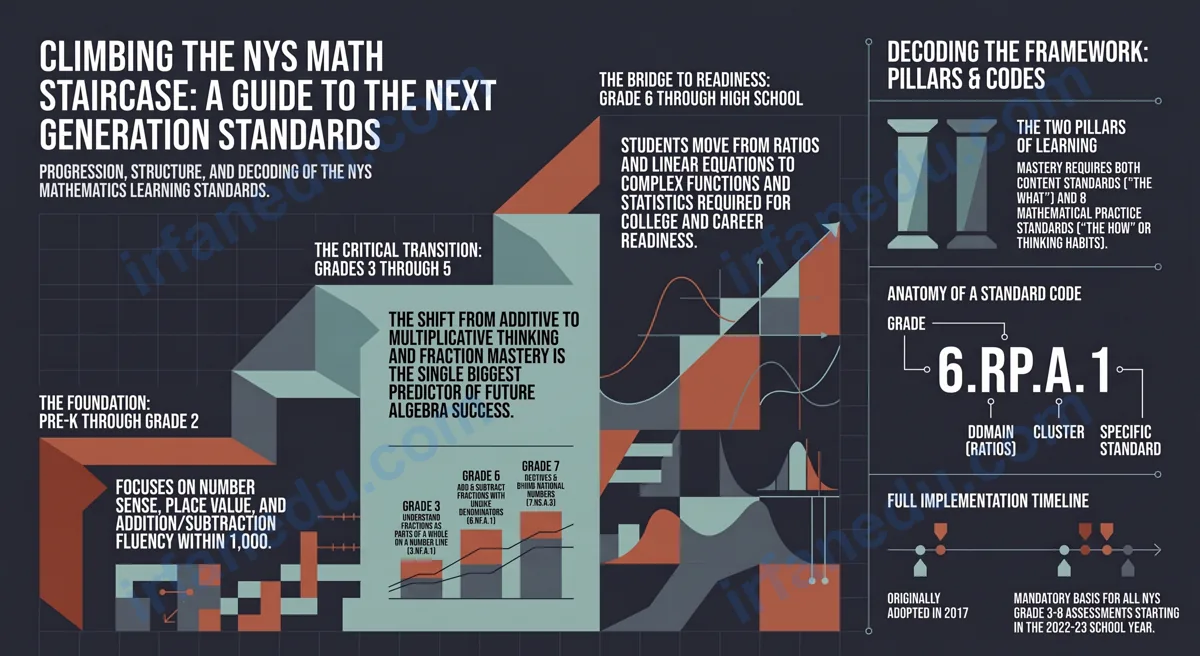
Before I explain a single standard, I want you to see the whole picture first. Most guides dump a wall of text on you. Instead, here is the NYS math learning staircase — the visual metaphor that finally made this framework click for me after years of teaching it:
🗺 THE NYS MATH STAIRCASE — Each Step Builds on the Last
Each band assumes mastery of the band below. Gaps at any step compound upward.
That staircase is the NYS math standards in one visual. Now let me walk you through every step in detail — with worked examples, what the standards actually demand, and the mistakes I see students make most often.
The NYS state math standards — officially the New York State Next Generation Mathematics Learning Standards — are a set of grade-by-grade learning expectations for K–12 students in New York. They define both the content students must master (arithmetic, algebra, geometry, statistics) and the mathematical practices (reasoning, problem-solving, communication) they must develop. These standards drive every state math test, curriculum, and teacher evaluation in New York.
- What the NYS Next Generation Math Standards are and how they differ from Common Core
- A grade-by-grade breakdown with real examples from each band
- How to decode a standard code like 6.RP.A.1
- The 8 Mathematical Practice Standards explained simply
- Common mistakes students make — and how to fix them
- How parents can actively support their child at home
The NYS state math standards are the official New York State Next Generation Mathematics Learning Standards for grades K–12. Adopted in 2017 and fully implemented in classrooms by 2020, they define what students must know in math each year — from counting in kindergarten to functions and statistics in high school. They include both content standards (what to learn) and 8 mathematical practice standards (how to think mathematically).
⚡ TL;DR – Quick Summary
- 📌 NYS math standards = Next Generation Mathematics Learning Standards, adopted 2017, implemented 2020.
- 📌 They cover grades Pre-K through 12 across five major content domains.
- 📌 They revise (not replace) Common Core — clearer language, better grade-level coherence.
- 📌 Every NYS state math test (Grades 3–8) maps directly to these standard codes.
- 📌 Eight Mathematical Practice Standards apply at every grade level alongside content.
- 📌 Gaps in early grades (especially fractions, place value) directly cause struggles in middle school algebra.
📋 Table of Contents
- What Are the NYS State Math Standards?
- Next Generation vs. Common Core: What Actually Changed?
- How Do You Read an NYS Math Standard Code?
- Grade-by-Grade Breakdown: What Students Learn at Each Level
- What Are the 8 Mathematical Practice Standards?
- What Most Guides Get Wrong About NYS Math Standards
- 💡 Unique Insight: The Hidden Bottleneck in the Standards
- Worked Example: Applying a Standard in the Classroom
- How Can Parents Support Their Child with NYS Math Standards?
- Quick Knowledge Check Quiz
- Practice Problems
- Frequently Asked Questions
What Are the NYS State Math Standards? 🧮
The NYS state math standards are the official learning expectations for every math student in New York State, from Pre-Kindergarten through Grade 12. They answer one question: what should a student know and be able to do in math by the end of each grade?
The full official name is the New York State Next Generation Mathematics Learning Standards (often abbreviated NGMLS or Next Gen Math Standards). New York adopted them in December 2017 after a two-year review process that involved thousands of teachers, parents, and math educators across the state.
The standards are organized around two equally important pillars:
- Content Standards — the specific math topics students must learn at each grade (e.g., fractions in Grade 3, linear equations in Grade 8).
- Mathematical Practice Standards — eight habits of mathematical thinking that apply at every grade level (e.g., “reason abstractly,” “construct viable arguments”).
Think of content standards as the what and practice standards as the how. A student who knows the content but cannot reason through an unfamiliar problem has only half the picture.
| Fact | Detail |
|---|---|
| Official Name | NY Next Generation Mathematics Learning Standards |
| Adopted | December 2017 |
| Full Implementation | 2020–2021 school year |
| Grades Covered | Pre-K through Grade 12 |
| Based On | 2010 Common Core State Standards (revised) |
| Governing Body | New York State Education Department (NYSED) |
| State Tests Aligned | Grades 3–8 Math Assessments (from 2022–23) |
| Practice Standards | 8 Mathematical Practice Standards (MP.1–MP.8) |
Next Generation vs. Common Core: What Actually Changed? 🔄
The NYS Next Generation Standards are a revision of Common Core, not a replacement — and understanding this distinction matters for parents who remember the Common Core debates of the early 2010s.
New York kept the same overall mathematical progression that research supports. What changed was the execution:
| Feature | Common Core (2010) | NYS Next Generation (2017) |
|---|---|---|
| Pre-K Standards | Not included | ✅ Added Pre-K standards |
| Language Clarity | Sometimes ambiguous | Rewritten for teacher clarity |
| Grade Placement | Some topics felt misplaced | Several topics shifted for coherence |
| Fluency Expectations | Implicit in some grades | Made explicit with grade-level targets |
| NY-Specific Context | National framework | Tailored to NY curriculum traditions |
| Standard Codes | e.g., 6.RP.1 | e.g., 6.RP.A.1 (cluster letter added) |
In my experience working with students and teachers across multiple states, the biggest practical change is the explicit cluster letter in the standard codes. When a teacher writes “6.RP.A.1” on a worksheet, students and parents can now immediately see they are in Cluster A of the Ratios domain — which makes it far easier to look up exactly what is expected. That small change in notation has real classroom impact.
How Do You Read an NYS Math Standard Code? 🔍
Every NYS math standard has a unique code, and once you know the formula, you can decode any standard in seconds. The code follows this structure:
  ┌──────────────────────────────────────────────────────────┐
  │                                                          │
  │   6  .  RP  .  A  .  1                                   │
  │   │     │      │     │                                   │
  │   │     │      │     └── Standard number within cluster  │
  │   │     │      └──────── Cluster letter (A, B, C...)     │
  │   │     └─────────────── Domain abbreviation             │
  │   └───────────────────── Grade level (K, 1–8, or HS)    │
  │                                                          │
  │   Reads as:                                              │
  │   "Grade 6, Ratios & Proportional Relationships,         │
  │    Cluster A, Standard 1"                                │
  │                                                          │
  │   COMMON DOMAIN CODES:                                   │
  │   OA = Operations & Algebraic Thinking                  │
  │   NBT = Number & Operations in Base Ten                 │
  │   NF  = Number & Operations — Fractions                 │
  │   RP  = Ratios & Proportional Relationships             │
  │   EE  = Expressions & Equations                         │
  │   G   = Geometry                                         │
  │   MD  = Measurement & Data                              │
  │   SP  = Statistics & Probability                        │
  │   F   = Functions                                        │
  │                                                          │
  └──────────────────────────────────────────────────────────┘
Step-by-Step: How to Look Up Any Standard
- Find the grade number — the digit(s) before the first dot (e.g., “6” = Grade 6; “HS” = High School).
- Identify the domain — the two-to-three letter abbreviation (e.g., “RP” = Ratios and Proportional Relationships).
- Identify the cluster — the single letter after the domain (e.g., “A” = first cluster group in that domain).
- Find the standard number — the final digit tells you the specific skill within that cluster.
- Look it up on NYSED.gov — enter the full code to read the exact expectation in official language.
When reviewing your child’s graded test or homework, look for the standard code printed in small text near each question. That code tells you exactly which skill needs more practice — no guessing required.
Grade-by-Grade Breakdown: What Do Students Learn at Each Level? 📊
The NYS standards organize K–12 math into five grade bands. Each band has a dominant focus — the one big idea that most of the year’s work builds toward.
Pre-K and Kindergarten: Building Number Sense
Students count objects to 20, compare groups (“more,” “fewer,” “equal”), name basic 2D and 3D shapes, and begin to understand addition as “putting together” and subtraction as “taking apart.” The Pre-K standards — added in the 2017 revision — focus on informal math language and hands-on exploration.
Grades 1–2: Place Value and Fluency Within 100
The dominant focus is place value and addition/subtraction fluency. By the end of Grade 2, students must add and subtract within 1,000 using strategies based on place value. They also measure length, tell time to the nearest five minutes, and work with simple bar graphs and picture graphs.
Standard: Add and subtract within 1000, using concrete models or drawings and strategies based on place value.
Sample Problem: 347 + 256 = ?
Student Approach (place value strategy):
300 + 200 = 500
40 + 50 = 90
7 + 6 = 13
500 + 90 + 13 = 603
Notice: the standard does not require the traditional algorithm here. It requires understanding place value. The algorithm comes in Grade 4 (4.NBT.B.4).
Grades 3–5: Multiplication, Division, and Fractions
This is the most critical band for long-term math success. Grade 3 introduces multiplication and division as related operations. Grade 4 builds fraction equivalence and decimal notation. Grade 5 extends fractions to all four operations and introduces volume.
In my experience teaching and tutoring, fraction understanding in Grades 4–5 is the single biggest predictor of algebra readiness in Grade 8. Students who cannot fluently add unlike fractions consistently struggle with rational expressions in high school.
Grades 6–8: The Bridge to Algebra
Grade 6 introduces ratios, negative numbers, and the coordinate plane. Grade 7 deepens proportional reasoning and introduces probability. Grade 8 is the gateway: students study linear equations, systems of equations, functions, and transformational geometry — all of which feed directly into high school Algebra I.
Standard: Solve linear equations with rational number coefficients, including equations whose solutions require expanding expressions using the distributive property and collecting like terms.
Problem: Solve for x: 3(2x – 4) = 2x + 8
Step 1: Expand: 6x – 12 = 2x + 8
Step 2: Subtract 2x from both sides: 4x – 12 = 8
Step 3: Add 12 to both sides: 4x = 20
Step 4: Divide by 4: x = 5
Check: 3(2·5 – 4) = 3(6) = 18. Right side: 2·5 + 8 = 18. ✅
High School: Algebra, Geometry, and Beyond
High school standards are organized by course, not grade. New York’s standard sequence is Algebra I → Geometry → Algebra II, with optional Pre-Calculus and Statistics courses. The Algebra I Regents exam, Geometry Regents, and Algebra II Regents all map directly to these standards.
| HS Course | Key Domains | NYS Regents Exam |
|---|---|---|
| Algebra I | Linear & quadratic functions, statistics, polynomials | Algebra I Regents |
| Geometry | Congruence, similarity, trigonometry, proofs, circles | Geometry Regents |
| Algebra II | Polynomials, exponentials, logarithms, trig functions | Algebra II Regents |
| Pre-Calculus | Limits, vectors, parametric equations (optional) | No Regents (elective) |
What Are the 8 Mathematical Practice Standards? 🧠
The 8 Mathematical Practice Standards (MP.1–MP.8) apply at every single grade level — they are the thinking habits NYS wants every math student to develop, regardless of the content being studied.
- MP.1 — Make sense of problems and persevere in solving them. Read the problem carefully, plan a strategy, and keep going when it gets hard.
- MP.2 — Reason abstractly and quantitatively. Move between concrete situations and abstract symbols — and know what the symbols mean.
- MP.3 — Construct viable arguments and critique the reasoning of others. Explain your thinking clearly and evaluate whether someone else’s reasoning holds up.
- MP.4 — Model with mathematics. Use equations, graphs, diagrams, or tables to represent real-world situations.
- MP.5 — Use appropriate tools strategically. Know when to use a ruler, calculator, graph paper, or mental math.
- MP.6 — Attend to precision. Use correct vocabulary, accurate calculations, and appropriate units.
- MP.7 — Look for and make use of structure. Spot patterns, properties, and shortcuts (e.g., noticing that a² – b² always factors as (a+b)(a–b)).
- MP.8 — Look for and express regularity in repeated reasoning. When you do the same type of calculation repeatedly, generalize it into a rule or formula.
Most students and parents focus entirely on the content standards and treat the practice standards as background noise. That is a mistake. In my experience, students who struggle on the NYS Grade 8 math test almost always fail on MP.1 (perseverance) and MP.3 (argumentation) — not because they lack content knowledge, but because they give up on multi-step problems and cannot explain their reasoning in writing. Practicing these habits explicitly, even for 10 minutes a day, produces measurable score gains.
What Most Guides Get Wrong About NYS Math Standards ⚠️
Most articles about NYS math standards simply list the domains and call it a day. That leaves students and parents with no actionable understanding. Here are three things most guides get wrong:
Standards are not a checklist to tick off. They describe depth of understanding, not surface exposure. Standard 3.NF.A.1 says students should understand a fraction 1/b as one part when a whole is divided into b equal parts. A student who can write the fraction but cannot draw a model or explain why 2/4 = 1/2 has not met the standard — even if they got the right answer on a worksheet.
Standards define the floor, not the ceiling. A student who masters Grade 5 fraction standards in Grade 4 should move forward, not wait. The standards describe minimum expectations — strong students should go deeper and further.
Each standard is designed to connect to standards above and below it. Standard 4.NF.B.3 (adding fractions with like denominators) is not a standalone skill — it is the foundation for 5.NF.A.1 (adding fractions with unlike denominators), which is the foundation for 7.NS.A.1 (adding rational numbers). Skip or rush any step and the whole staircase wobbles.
The real bottleneck in NYS math standards is not algebra — it is the transition from additive to multiplicative thinking in Grades 3–4.
Here is what I mean: addition and subtraction are additive — you combine or separate equal-sized groups. Multiplication and division are multiplicative — you scale. These are fundamentally different cognitive operations. Research in mathematics education (including work published by the National Council of Teachers of Mathematics) shows that students who do not fully internalize multiplicative thinking by Grade 4 hit a wall in Grade 6 when ratios and proportional reasoning demand it constantly.
The NYS standards address this with standards like 3.OA.A.1 (interpret products of whole numbers as total number of objects in groups) and 4.OA.A.2 (multiply or divide to solve word problems involving multiplicative comparison). But most tutoring programs skip straight to memorizing times tables — which is fluency without understanding. The fix is to spend time on why 3 × 4 means “3 groups of 4” before drilling the fact. That conceptual anchor makes everything from fractions to algebra land correctly.
Worked Example: Tracing a Concept Through the Standards 🔬
One of the most powerful ways to understand the NYS standards is to trace a single concept across grade levels. Let me trace fractions from Grade 1 to Grade 7:
| Grade | Standard | What Students Do |
|---|---|---|
| Grade 1 | 1.G.A.3 | Partition circles and rectangles into halves and quarters; use the words “half of” and “quarter of.” |
| Grade 2 | 2.G.A.3 | Partition shapes into 2, 3, or 4 equal shares; understand that equal shares of identical wholes need not have the same shape. |
| Grade 3 | 3.NF.A.1 | Understand a fraction 1/b as one part of a whole divided into b equal parts; place fractions on a number line. |
| Grade 4 | 4.NF.B.3 | Add and subtract fractions with like denominators; decompose fractions into sums of unit fractions. |
| Grade 5 | 5.NF.A.1 | Add and subtract fractions with unlike denominators, including mixed numbers. |
| Grade 6 | 6.NS.A.1 | Divide fractions by fractions; interpret and compute quotients of fractions. |
| Grade 7 | 7.NS.A.2 | Apply properties of operations to multiply and divide rational numbers (fractions, decimals, integers). |
Each row is one step on the staircase. A student who skips or rushes Grade 3 fraction concepts will feel the gap acutely in Grade 5 when unlike denominators appear — and again in Grade 6 when dividing fractions by fractions is introduced.
In my experience working with a group of Grade 7 students who were struggling with rational number operations, I traced their difficulty back to a single gap: they had memorized “keep-change-flip” for dividing fractions in Grade 6 but had no idea why it worked. They could not connect it to the meaning of division.
When I spent 20 minutes showing them that 3/4 ÷ 1/2 means “how many halves fit into three-quarters?” — using a number line — the algorithm suddenly made sense. Their accuracy on 7.NS.A.2 problems improved significantly within two sessions. The fix was not more practice; it was going back one step to 6.NS.A.1 and building the conceptual bridge.
How Can Parents Support Their Child with NYS Math Standards? 👨👩👧
Parents do not need to be math experts to help their child succeed. Here are five concrete actions that work:
- Download the grade-level standards document. The NYSED website publishes the full Next Generation Mathematics Learning Standards as a free PDF. Print the two pages for your child’s grade and keep them on the fridge.
- Ask about the standard code on homework. When your child brings home a worksheet, look for the standard code (e.g., 5.NF.A.1). Look it up. Now you know exactly what skill is being practiced — and you can ask targeted questions.
- Use real-world math daily. Cooking (fractions), grocery shopping (percentages), driving (distance/rate/time), and budgeting (operations) all map to specific NYS standards. Real-world context makes abstract standards concrete.
- Focus on the practice standards, not just answers. Ask “how did you figure that out?” instead of “is that right?” MP.3 (constructing arguments) is built through conversation, not worksheets.
- Address gaps early. If your child’s teacher flags a weak standard in Grade 4, do not wait. A Grade 4 fraction gap becomes a Grade 6 ratio crisis becomes a Grade 8 algebra failure. The staircase is unforgiving.
Sources & References
Reviewed by Dr. Irfan Mansuri. External links open in a new tab and are provided for further reading and verification.