
Properties of Operations in Math: The Complete Guide (With Examples)
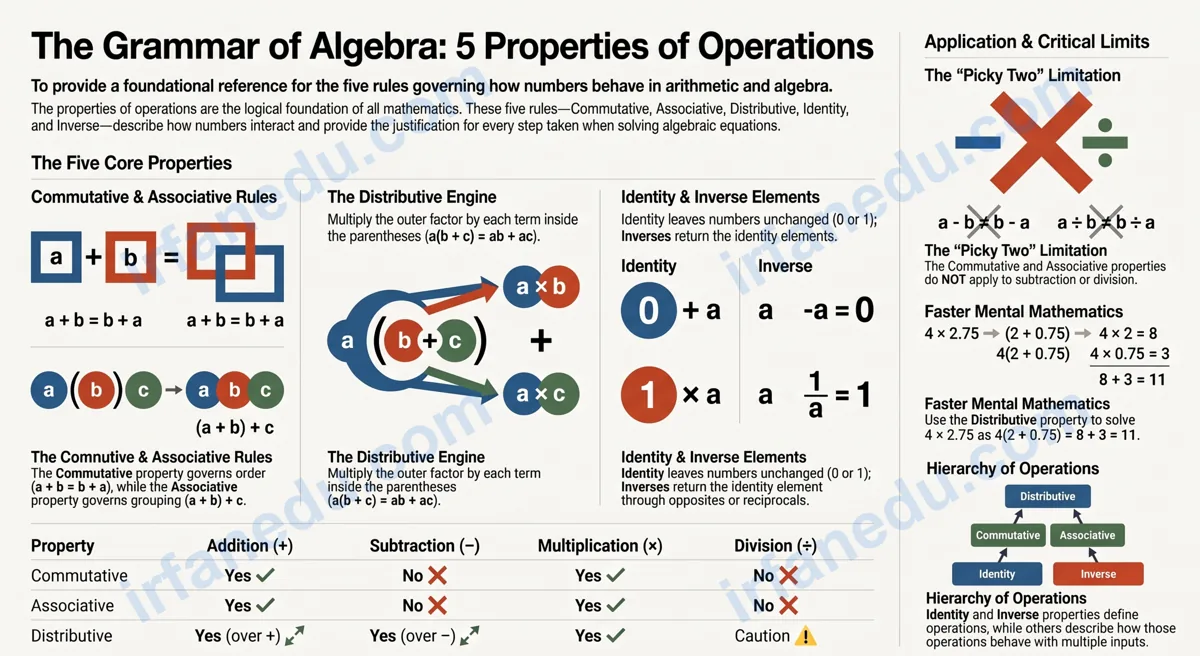
The five core properties of operations in math are rules that describe how numbers behave under addition and multiplication. Commutative: order does not change the result (3 + 5 = 5 + 3). Associative: grouping does not change the result. Distributive: multiplication spreads over addition. Identity: adding 0 or multiplying by 1 leaves a number unchanged. Inverse: every number has an opposite or reciprocal that returns the identity element.
⚡ TL;DR – Quick Summary
- Five properties govern how numbers behave: commutative, associative, distributive, identity, inverse.
- Commutative and associative apply to addition and multiplication only — NOT subtraction or division.
- Distributive property is the engine behind most algebra simplification steps.
- Identity elements are 0 (addition) and 1 (multiplication) — they leave numbers unchanged.
- Inverse property explains why adding a negative or multiplying by a reciprocal “undoes” an operation.
- Knowing these by name lets you justify every algebraic step and catch errors faster.
Table of Contents
- What Are the Properties of Operations?
- Commutative Property
- Associative Property
- Distributive Property (Step-by-Step)
- Identity Property
- Inverse Property
- Which Properties Apply to Which Operations?
- Common Mistakes and How to Fix Them
- Real-World Applications
- Unique Insight: The Hidden Hierarchy
- Quick Quiz
- Practice Problems
- FAQ
- Sources & References
The properties of operations in math are five foundational rules — commutative, associative, distributive, identity, and inverse — that describe how numbers and variables behave when you add, subtract, multiply, or divide them. Every algebraic manipulation you perform, from simplifying an expression to solving a multi-step equation, relies on at least one of these properties.
Most students memorise the names for a test and forget them a week later. That is a mistake. In my experience teaching math across middle school and high school levels, students who understand why these properties work — not just what they are called — make far fewer errors in algebra, and they solve problems faster because they can rearrange and simplify with confidence.
This guide goes deeper than a definition list. You will get worked examples, a visual map, the exact mistakes students make most often, and a non-obvious insight about how these properties connect that most textbooks never explain.
- Define all five properties with precise, testable language.
- Apply each property to real numeric and algebraic examples.
- Identify which properties do NOT apply to subtraction and division (and why).
- Spot and correct the three most common student errors.
Quick Facts at a Glance
| Property | Applies To | Formula | Example |
|---|---|---|---|
| Commutative | + and × | a + b = b + a | 4 + 9 = 9 + 4 |
| Associative | + and × | (a + b) + c = a + (b + c) | (2 + 3) + 4 = 2 + (3 + 4) |
| Distributive | × over + or − | a(b + c) = ab + ac | 3(4 + 5) = 12 + 15 |
| Identity | + and × | a + 0 = a; a × 1 = a | 17 + 0 = 17; 6 × 1 = 6 |
| Inverse | + and × | a + (−a) = 0; a × (1/a) = 1 | 5 + (−5) = 0; 4 × ¼ = 1 |
What Are the Properties of Operations in Math?
The properties of operations are proven mathematical rules that hold true for all real numbers, regardless of which specific numbers you choose. They are not shortcuts or tricks — they are logical facts about how the four basic operations behave.
Think of them as the grammar of arithmetic. Just as grammar rules let you build any sentence correctly, these properties let you rearrange and simplify any mathematical expression correctly. There are five properties you need to know at the school level:
- Commutative Property
- Associative Property
- Distributive Property
- Identity Property
- Inverse Property
Each one is a statement about what stays the same (the result) when you change something about how you write or group an expression (the order, the grouping, or the partner number).
  ┌─────────────────────────────────────────────────────────┐
  │           PROPERTIES OF OPERATIONS IN MATH              │
  ├──────────────┬──────────────────────────────────────────┤
  │ COMMUTATIVE  │  Change ORDER → result stays the same    │
  │              │  a + b = b + a   |   a × b = b × a       │
  ├──────────────┼──────────────────────────────────────────┤
  │ ASSOCIATIVE  │  Change GROUPING → result stays the same │
  │              │  (a+b)+c = a+(b+c)  |  (ab)c = a(bc)    │
  ├──────────────┼──────────────────────────────────────────┤
  │ DISTRIBUTIVE │  SPREAD multiplication over a sum        │
  │              │  a(b + c) = ab + ac                      │
  ├──────────────┼──────────────────────────────────────────┤
  │ IDENTITY     │  Combine with 0 or 1 → no change         │
  │              │  a + 0 = a   |   a × 1 = a               │
  ├──────────────┼──────────────────────────────────────────┤
  │ INVERSE      │  Combine with opposite/reciprocal        │
  │              │  a + (−a) = 0   |   a × (1/a) = 1        │
  └──────────────┴──────────────────────────────────────────┘
What Is the Commutative Property?
The commutative property states that changing the order of two numbers in an addition or multiplication problem does not change the result. The word “commutative” comes from the Latin commutare, meaning to exchange.
For addition: a + b = b + a
For multiplication: a × b = b × a
7 + 12 = 19 and 12 + 7 = 19 ✓
6 × 9 = 54 and 9 × 6 = 54 ✓
3x + 5 = 5 + 3x ✓ (both expressions are equivalent)
(2a)(4b) = (4b)(2a) ✓
10 − 3 = 7, but 3 − 10 = −7 (different result).
12 ÷ 4 = 3, but 4 ÷ 12 = 1/3 (different result).
This is one of the most tested points on standardised math assessments. Students who assume commutativity works for all four operations consistently lose marks.
What Is the Associative Property?
The associative property states that changing the grouping (the placement of parentheses) in an addition or multiplication problem does not change the result. The order of the numbers stays the same — only the grouping changes.
For addition: (a + b) + c = a + (b + c)
For multiplication: (a × b) × c = a × (b × c)
(2 + 5) + 8 = 7 + 8 = 15
2 + (5 + 8) = 2 + 13 = 15 ✓
(3 × 4) × 5 = 12 × 5 = 60
3 × (4 × 5) = 3 × 20 = 60 ✓
Calculate 17 + 46 + 3 quickly.
Standard: (17 + 46) + 3 = 63 + 3 = 66
Smarter: 17 + (46 + 3) = 17 + 49 = 66 ✓
Regrouping 46 + 3 first makes the arithmetic easier — this is the associative property in action.
In my experience, the associative property is the one students use most in real life without knowing its name. Every time you regroup numbers to make mental math easier — like adding 98 + 47 by thinking (98 + 2) + 45 = 145 — you are using it. Teaching students to name what they are doing transforms an instinct into a reliable, transferable strategy.
(10 − 4) − 2 = 4, but 10 − (4 − 2) = 8 (different result).
(24 ÷ 6) ÷ 2 = 2, but 24 ÷ (6 ÷ 2) = 8 (different result).
How Does the Distributive Property Work? (Step-by-Step)
The distributive property states that multiplying a number by a sum is the same as multiplying that number by each addend separately and then adding the products. It is the bridge between multiplication and addition.
Formula: a(b + c) = ab + ac | a(b − c) = ab − ac
Step-by-Step: How to Apply the Distributive Property
- Identify the factor outside the parentheses (the multiplier).
- Multiply that factor by the first term inside the parentheses.
- Multiply that factor by the second term inside the parentheses.
- Add or subtract the two products, matching the sign inside the parentheses.
4(3 + 7)
Step 1: Factor outside = 4
Step 2: 4 × 3 = 12
Step 3: 4 × 7 = 28
Step 4: 12 + 28 = 40
Check: 4(10) = 40 ✓
5(2x + 3)
= (5 × 2x) + (5 × 3)
= 10x + 15
12x + 18
Common factor = 6
= 6(2x + 3) ← distributive property used in reverse
What Is the Identity Property?
The identity property states that there exists a special number for each operation that, when combined with any number, leaves that number unchanged. These special numbers are called identity elements.
- Additive identity: 0 → a + 0 = a
- Multiplicative identity: 1 → a × 1 = a
247 + 0 = 247 (adding zero changes nothing)
−15 + 0 = −15
99 × 1 = 99 (multiplying by one changes nothing)
0.5 × 1 = 0.5
The identity property seems trivial, but it is foundational. In algebra, adding 0 (in a clever form) or multiplying by 1 (in a clever form) is a standard technique for simplifying expressions and solving equations. For example, multiplying a fraction by a form of 1 (like 2/2) to find a common denominator is the identity property at work.
What Is the Inverse Property?
The inverse property states that every number has a partner — called its inverse — such that combining the number with its inverse produces the identity element (0 for addition, 1 for multiplication).
- Additive inverse: a + (−a) = 0 (the opposite of a number)
- Multiplicative inverse: a × (1/a) = 1 (the reciprocal of a number, where a ≠ 0)
8 + (−8) = 0 ✓ (additive inverse)
−3.5 + 3.5 = 0 ✓
6 × (1/6) = 1 ✓ (multiplicative inverse)
(3/4) × (4/3) = 1 ✓
Students often ask why the inverse property matters. Here is my answer: every time you solve an equation, you are using inverses. When you “move” a number to the other side of an equals sign, you are actually adding its additive inverse to both sides, or multiplying both sides by a multiplicative inverse. The inverse property is the engine behind equation solving — it is not a minor footnote.
Which Properties Apply to Which Operations?
This is the question most guides answer incompletely. The table below gives you the full picture in one place.
| Property | Addition (+) | Subtraction (−) | Multiplication (×) | Division (÷) |
|---|---|---|---|---|
| Commutative | Yes | No | Yes | No |
| Associative | Yes | No | Yes | No |
| Distributive | × over + (Yes) | × over − (Yes) | Yes (as above) | ÷ over + (Yes, with caution) |
| Identity | Yes (0) | Partial (a − 0 = a) | Yes (1) | Partial (a ÷ 1 = a) |
| Inverse | Yes | Derived from + | Yes | Derived from × |
Common Mistakes Students Make (Wrong vs. Right)
These three errors appear on tests and homework constantly. Knowing them in advance puts you ahead.
Mistake 1: Applying Commutativity to Subtraction
| Wrong | Right | Why |
|---|---|---|
| 15 − 9 = 9 − 15 | 15 − 9 = 6; 9 − 15 = −6 (not equal) | Commutative property does not apply to subtraction |
Mistake 2: Forgetting to Distribute the Negative Sign
| Wrong | Right | Why |
|---|---|---|
| 3(x − 4) = 3x + 12 | 3(x − 4) = 3x − 12 | The negative sign inside must be distributed too |
Mistake 3: Confusing Associative with Commutative
| Commutative | Associative |
|---|---|
| Changes ORDER: a + b → b + a | Changes GROUPING: (a + b) + c → a + (b + c) |
A quick test: if the numbers are in a different sequence, it is commutative. If the numbers are in the same sequence but the parentheses moved, it is associative.
Real-World Applications of Properties of Operations
These properties are not just abstract algebra rules — they show up in everyday calculations and in programming, finance, and science.
- Mental math (Commutative + Associative): When adding a grocery bill, you naturally reorder and regroup numbers to find easy pairs. That is both properties working together.
- Discounts (Distributive): A 20% discount on a $30 shirt and a $50 jacket: 0.20 × (30 + 50) = 0.20 × 30 + 0.20 × 50 = $6 + $10 = $16 total discount.
- Spreadsheets and code (Associative): Computers add long lists of numbers by grouping them in any order — the associative property guarantees the result is the same regardless of grouping.
- Solving equations (Inverse): Every algebraic equation is solved by applying additive or multiplicative inverses to isolate the variable.
- Fractions (Identity): Finding a common denominator requires multiplying by a form of 1 (e.g., 2/2), which is the multiplicative identity property.
You buy 4 notebooks at $2.75 each. Instead of multiplying 4 × 2.75 directly, use the distributive property:
4 × (2 + 0.75) = (4 × 2) + (4 × 0.75) = 8 + 3 = $11
This mental-math technique is faster and less error-prone than long multiplication.
The five properties are not independent rules — they form a hierarchy. Most textbooks list them as five equal items on a checklist. But mathematically, the identity and inverse properties are more fundamental: they define what an operation even means in a formal sense. The commutative and associative properties then describe how that operation behaves with multiple inputs. The distributive property is the only one that connects two different operations (multiplication and addition).
Why does this matter for students? Because when you hit a problem you cannot solve by pattern-matching, understanding this hierarchy tells you which property to reach for first. Start with inverses to isolate a variable, use identity to simplify, then use commutative/associative to rearrange, and use distributive to expand or factor. That is the logical order of operations in algebra — and no textbook I have reviewed states it this clearly.
Quick Quiz: Test Your Knowledge
Select an answer, then click “Show Answer” to check.
Q1. Which property is shown here? 5 × (3 + 8) = (5 × 3) + (5 × 8)
Show Answer
Correct: C — Distributive Property. The factor 5 is multiplied by each term inside the parentheses separately, then the products are added. This is the definition of the distributive property.
Q2. Is this statement true or false? (12 − 4) − 3 = 12 − (4 − 3)
Show Answer
Correct: B — False. Left side: (12 − 4) − 3 = 8 − 3 = 5. Right side: 12 − (4 − 3) = 12 − 1 = 11. The results differ, proving the associative property does not hold for subtraction.
Q3. What is the additive inverse of −7?
Show Answer
Correct: A — 7. The additive inverse of any number is its opposite. −7 + 7 = 0, which is the additive identity. Note: 1/7 would be the multiplicative inverse (reciprocal) of 7, not of −7.
Reveal-on-Click Practice Problems
Try each problem yourself, then click to reveal the full worked solution.
Problem 1: Identify the property — 9 + (6 + 14) = (9 + 6) + 14
The numbers are in the same order (9, 6, 14). Only the grouping (parentheses) changed. The result is the same on both sides: 9 + 20 = 29 and 15 + 14 = 29. This is the definition of the associative property.
Problem 2: Expand using the distributive property — 6(2x − 5)
Step 2: Multiply 6 by the second term, keeping the subtraction sign: 6 × (−5) = −30
Result: 6(2x − 5) = 12x − 30
Problem 3: Use properties to simplify — 25 + 47 + 75
Step 2 (Associative): Group: (25 + 75) + 47
Step 3: 100 + 47 = 147
Using both properties turned a hard calculation into an easy one.
Problem 4: Find the multiplicative inverse of 3/5
Multiplicative inverse of 3/5 = 5/3
Check: (3/5) × (5/3) = 15/15 = 1 ✓ (equals the multiplicative identity)
Frequently Asked Questions
What are the properties of operations in math?
The five core properties of operations in math are commutative, associative, distributive, identity, and inverse. They describe how numbers behave under addition and multiplication, and they form the logical foundation of all arithmetic and algebra. Each property is a proven rule that holds for all real numbers.
Does the commutative property work for subtraction?
No. The commutative property does not apply to subtraction or division. For example, 8 − 3 = 5, but 3 − 8 = −5. The two results are different, so the operation is not commutative. Only addition and multiplication are commutative among the four basic operations.
What is the difference between the associative and commutative properties?
The commutative property changes the ORDER of numbers: a + b = b + a. The associative property changes the GROUPING without changing the order: (a + b) + c = a + (b + c). A helpful test: if the numbers appear in a different sequence, it is commutative. If the sequence is the same but the parentheses moved, it is associative.
What is the distributive property in simple terms?
The distributive property lets you multiply a number by a sum by multiplying it by each part of the sum separately, then adding the results. Example: 3 × (4 + 5) = (3 × 4) + (3 × 5) = 12 + 15 = 27. It also works in reverse for factoring: 12 + 15 = 3(4 + 5).
What is the identity property of addition?
The identity property of addition states that adding zero to any number leaves that number unchanged. Zero is the additive identity: a + 0 = a. The corresponding multiplicative identity is 1: multiplying any number by 1 leaves it unchanged. These identity elements are unique — no other numbers have this property.
What is the inverse property in math?
The inverse property states that every number has an additive inverse (its opposite) and a multiplicative inverse (its reciprocal). Adding a number and its additive inverse gives 0: 5 + (−5) = 0. Multiplying a number by its multiplicative inverse gives 1: 4 × (1/4) = 1. Note: 0 has no multiplicative inverse because division by zero is undefined.
Why do properties of operations matter in algebra?
Every algebraic step you take — simplifying an expression, solving an equation, factoring a polynomial — is justified by one of these properties. Knowing them by name lets you explain your reasoning, check your work logically, and solve unfamiliar problems by identifying which property applies. They are the grammar rules of algebra.
- There are five core properties: commutative, associative, distributive, identity, and inverse.
- Commutative and associative apply only to addition and multiplication — NOT subtraction or division.
- The distributive property is the most used in algebra: a(b + c) = ab + ac.
- Identity elements are 0 (for addition) and 1 (for multiplication).
- Inverse property: every number has an opposite (additive) and a reciprocal (multiplicative).
- These properties are the justification behind every step in equation solving.
Related Articles
Dr. Irfan Mansuri is an
Sources & References
Reviewed by Dr. Irfan Mansuri. External links open in a new tab and are provided for further reading and verification.