
Teenager Numbers Explained: What They Are, Why They’re Weird & How to Master Them
🔴 The Problem: Why Teenager Numbers Confuse Everyone
Picture a first-grader staring at the number 13 and confidently writing “31.” Sound familiar? It happens in classrooms around the world, every single day. Teenager numbers — the numbers from 13 to 19 — are the first real stumbling block in early math education, and most guides barely explain why they trip students up.
The confusion is not random. It is baked into the English language itself. The names “thirteen,” “fourteen,” and “fifteen” say the units digit before the tens digit — the exact opposite of how we read and write the numerals. That mismatch between spoken name and written form is the root cause of a mistake that can follow students for years.
In my experience teaching early numeracy, I have seen this specific confusion delay place-value understanding by entire school terms. The fix is not just memorisation — it is understanding why these numbers work the way they do. Once a student truly gets the structure, the confusion disappears fast.
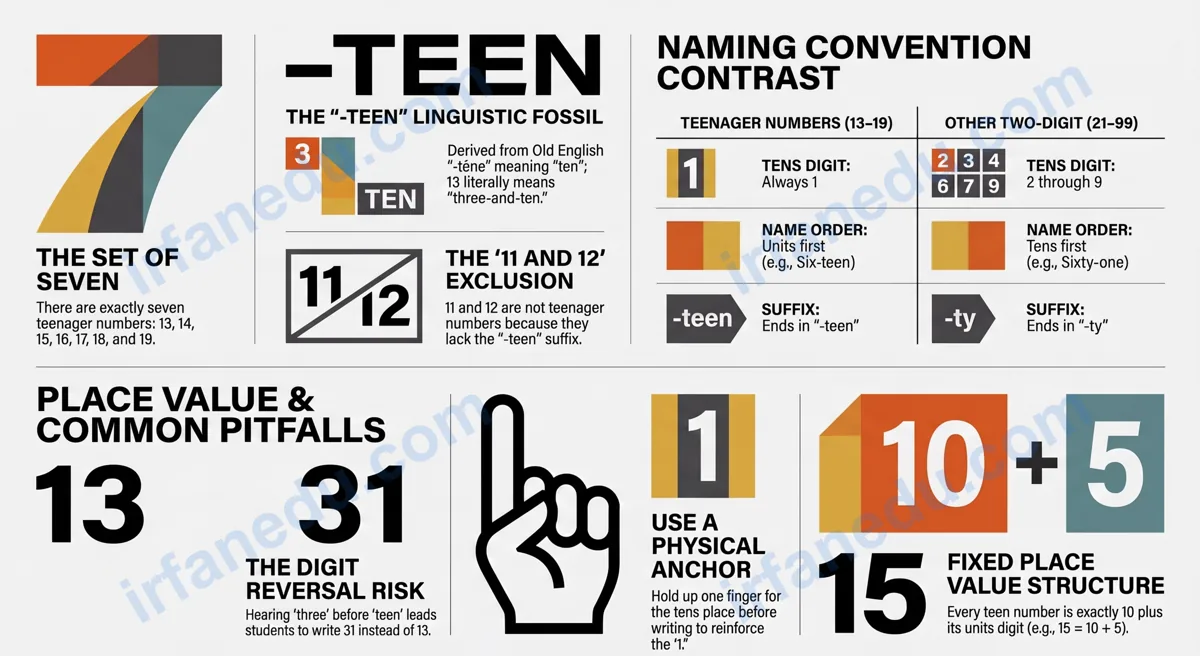
Teenager numbers are the seven whole numbers from 13 to 19. Each one is made of exactly one ten and some extra ones. Their names all end in “-teen,” an Old English word for “ten.” Understanding their place value — and why their names sound reversed — is the key to mastering early two-digit arithmetic.
- The exact definition of a teenager number
- Why their names sound “backwards” compared to how we write them
- How to break any teenager number into tens and ones
- The most common mistakes — and how to avoid them
- Real-world places where teenager numbers appear every day
⚡ TL;DR – Quick Summary
- 🔢 Teenager numbers = the 7 whole numbers from 13 to 19.
- 📖 The “-teen” suffix comes from Old English meaning “ten.”
- 🏗️ Every teenager number = 1 ten + units digit (e.g., 17 = 10 + 7).
- 🔄 Their names say the units digit first, then the tens — opposite of how we write them.
- ⚠️ The #1 mistake: writing 13 as “31” because students hear “three” before “ten.”
- ✅ Fix: always anchor the tens digit = 1 before writing any teenager number.
| Fact | Detail |
|---|---|
| Range | 13 to 19 (inclusive) |
| Count | 7 numbers |
| Tens digit | Always 1 |
| Units digit range | 3 to 9 |
| Suffix origin | Old English “-tēne” meaning “ten” |
| First teenager number | 13 (thirteen) |
| Last teenager number | 19 (nineteen) |
| Are 11 and 12 included? | No — they don’t end in “-teen” |
What Exactly Is a Teenager Number?
A teenager number is any whole number from 13 to 19. The term comes directly from the “-teen” suffix that ends each of their names: thirteen, fourteen, fifteen, sixteen, seventeen, eighteen, nineteen. That suffix traces back to the Old English word -tēne, which meant “ten.” So every “-teen” number is literally “three-and-ten,” “four-and-ten,” and so on.
There are exactly seven teenager numbers. They sit between 12 and 20 on the number line, forming a tight, consecutive group of two-digit numbers. Each one has a tens digit of 1 and a units digit between 3 and 9.
- 13 — Thirteen (3 + ten)
- 14 — Fourteen (4 + ten)
- 15 — Fifteen (5 + ten) — note the spelling change from “five”
- 16 — Sixteen (6 + ten)
- 17 — Seventeen (7 + ten)
- 18 — Eighteen (8 + ten) — note: one “e” is dropped
- 19 — Nineteen (9 + ten)
A common question I get from parents: “Are 11 and 12 teenager numbers?” The answer is no. Eleven and twelve do not end in “-teen.” Their names come from separate Old English roots — endleofan (one left over ten) and twelf (two left over ten). Teenager numbers start at 13, full stop.
Why Do Teenager Number Names Sound Backwards?
Teenager number names say the units digit first and the tens part second — the exact opposite of how we write the numeral. This is the single biggest source of confusion for young learners, and it is not a mistake; it is history.
Old English and the Germanic languages that shaped it counted in a “units-first” pattern. You said “three-and-ten” before you said “ten-and-three.” When English evolved, numbers like 21 eventually flipped to “twenty-one” (tens first), but the teen numbers were already so deeply embedded in everyday speech that they never changed. The result is a linguistic fossil sitting right in the middle of our number system.
Compare how we say versus how we write:
- Thirteen: we hear “THREE-teen” → but we write 13 (tens digit first)
- Sixteen: we hear “SIX-teen” → but we write 16 (tens digit first)
- Thirty-one: we hear “THIRTY-one” → and we write 31 (consistent!)
The teen numbers are the only group in English where the spoken name and the written order disagree.
In my experience, the single most effective fix for the “13 vs. 31” reversal is to teach students a physical anchor: hold up one finger on your left hand (the tens) before you write anything. That one finger represents the “1” in the tens place. Then add the units. It sounds simple, but this kinesthetic cue breaks the reversal habit faster than any worksheet I have ever seen.
What Is the Place Value of Teenager Numbers?
Every teenager number has a tens digit of 1 and a units digit from 3 to 9. This means every teenager number equals 10 plus its units digit — no exceptions.
 Number │ Tens Place │ Units Place │ Expanded Form
────────┼────────────┼─────────────┼───────────────
   13   │     1      │      3      │   10 + 3 = 13
   14   │     1      │      4      │   10 + 4 = 14
   15   │     1      │      5      │   10 + 5 = 15
   16   │     1      │      6      │   10 + 6 = 16
   17   │     1      │      7      │   10 + 7 = 17
   18   │     1      │      8      │   10 + 8 = 18
   19   │     1      │      9      │   10 + 9 = 19
────────┴────────────┴─────────────┴───────────────
  KEY:  Tens digit is ALWAYS 1. Units digit = 3–9.
This structure is not just a curiosity — it is the foundation of place value. When a student understands that 16 is literally “one group of ten and six loose ones,” they have grasped the core concept that makes all multi-digit arithmetic work. Teenager numbers are the training ground for that understanding.
How Do You Identify a Teenager Number? (Step-by-Step)
Identifying a teenager number takes five seconds once you know the process. Follow these steps every time.
- Check the range. Is the number between 13 and 19 (inclusive)? If yes, proceed. If no, it is not a teenager number.
- Confirm the tens digit is 1. Write the number. The left digit must be 1.
- Confirm the units digit is 3–9. The right digit must be between 3 and 9.
- Write the expanded form. Express it as 10 + units digit (e.g., 18 = 10 + 8).
- Match to the name. Connect the units digit to its “-teen” name using the table above.
- Is 15 between 13 and 19? Yes.
- Tens digit of 15 = 1. ✓
- Units digit of 15 = 5 (between 3 and 9). ✓
- Expanded form: 10 + 5 = 15. ✓
- Name: 5 → “five” + “-teen” → fifteen. ✓
Result: 15 is a teenager number.
- Is 12 between 13 and 19? No (12 is below 13).
Result: 12 is NOT a teenager number. Stop at step 1.
Worked Examples: Teenager Numbers in Real Math Problems
Knowing what teenager numbers are is one thing. Seeing them work inside actual math problems is where understanding becomes skill. Here are three original worked examples I use with my own students.
Example 1: Addition Crossing Into the Teens
Step 1: Start with 9. Add 1 to make 10. You have used 1 of your 7.
Step 2: You have 6 left to add. 10 + 6 = 16.
Step 3: 16 is a teenager number (1 ten + 6 ones). ✓
Answer: 9 + 7 = 16
Example 2: Subtraction From a Teenager Number
Step 1: Break 18 into its place value: 10 + 8.
Step 2: Subtract 5 from the units part: 8 − 5 = 3.
Step 3: Bring back the ten: 10 + 3 = 13.
Answer: 18 − 5 = 13 (also a teenager number!)
Example 3: Ordering Teenager Numbers on a Number Line
Since all four are teenager numbers, all have a tens digit of 1. Compare only the units digits: 3, 5, 7, 9.
Order: 13, 15, 17, 19
Tip: when all numbers share the same tens digit, the units digit alone decides the order.
Common Mistakes Students Make With Teenager Numbers
These are the four mistakes I see most often. Each one has a clear fix.
| Mistake | Wrong | Correct | Why It Happens |
|---|---|---|---|
| Digit reversal | Writes 13 as “31” | 13 (tens digit 1 first) | Name says “three” before “teen” |
| Including 11 and 12 | Says 11 is a teen number | Teen numbers start at 13 | 11 and 12 are in the same decade |
| Spelling “fifteen” as “fiveteen” | Fiveteen | Fifteen | “Five” changes to “fif” before “-teen” |
| Spelling “eighteen” as “eighteeen” | Eighteeen | Eighteen (one ‘e’ dropped) | “Eight” + “teen” → one ‘e’ is removed |
The spelling irregularities in “fifteen” and “eighteen” trip up even strong spellers. My favourite mnemonic: “Five lost a letter to become fif-teen, and eight lost a letter to become eigh-teen.” Framing it as the number “losing” something makes the exception memorable rather than arbitrary.
Teenager Numbers vs. Other Two-Digit Numbers: What Makes Them Different?
Teenager numbers are unique among two-digit numbers because their spoken names reverse the digit order. No other group of two-digit numbers in English does this. The table below makes the contrast clear.
| Feature | Teenager Numbers (13–19) | Other Two-Digit Numbers (21–99) |
|---|---|---|
| Tens digit | Always 1 | 2 through 9 |
| Name order | Units first, then “teen” (three-teen) | Tens first, then units (thirty-one) |
| Expanded form | 10 + units (e.g., 10 + 6) | Tens + units (e.g., 30 + 1) |
| Digit reversal risk | High — name misleads | Low — name matches write order |
| Suffix | All end in “-teen” | End in “-ty” (twenty, thirty…) |
| Count in set | 7 numbers | 79 numbers |
Notice the “-teen” vs. “-ty” distinction. “Thirteen” and “thirty” sound similar but mean very different things. Thirteen = 13 (one ten + three ones). Thirty = 30 (three tens + zero ones). This is the most dangerous confusion in early numeracy, and it is worth drilling explicitly.
Where Do Teenager Numbers Appear in Real Life?
Teenager numbers are everywhere once you start looking. Recognising them in context makes them more memorable and gives students a reason to care.
- 🕐 Telling time: “It is 7:13” — the 13 in the minutes is a teenager number.
- 🌡️ Temperature: A cool autumn day might be 15°C (59°F) — 15 is a teenager number.
- 🏀 Sports scores and jersey numbers: Jersey #14, a score of 17–13 — both use teenager numbers.
- 📅 Dates: The 13th, 14th, 15th, 16th, 17th, 18th, or 19th of any month.
- 🛒 Shopping: “$16 for a book” — counting change from $20 requires knowing 20 − 16 = 4.
- 📏 Measurement: A piece of wood 18 cm long. A 13-inch laptop screen.
Most explanations of teenager numbers focus entirely on the “-teen” suffix and stop there. But there is a deeper structural issue that almost no guide addresses: teenager numbers are the only numbers in English where the place value order and the linguistic order are permanently misaligned.
In German, this misalignment extends all the way to 99 — “einundzwanzig” (one-and-twenty) for 21. English fixed the reversal for 21–99 centuries ago, but never went back to fix the teens. This means English-speaking students face a one-time exception zone between 13 and 19 that does not exist in languages like Mandarin Chinese, where 十三 (shí sān, “ten-three”) for 13 perfectly mirrors the written numeral. Research in math education suggests this linguistic mismatch is one reason East Asian students historically outperform English-speaking peers on early place-value tasks — not because of any cognitive difference, but because their number words are transparent: the language tells you exactly what the number means. Knowing this, teachers and parents can compensate by explicitly narrating the place value (“one ten and three ones”) every time they say “thirteen,” bridging the gap the language creates.
🧠 Quick Quiz: Test Your Teenager Number Knowledge
Q1. Which of the following is NOT a teenager number?
Show Answer
✅ B) 12. Twelve is not a teenager number. Teenager numbers run from 13 to 19. Twelve does not end in “-teen” and falls below the range.
Q2. What is the expanded form of 16?
Show Answer
✅ C) 10 + 6. Every teenager number equals 10 (one ten) plus its units digit. 16 = 1 ten + 6 ones = 10 + 6.
Q3. How many teenager numbers are there in total?
Show Answer
✅ D) 7. The seven teenager numbers are: 13, 14, 15, 16, 17, 18, and 19.
✏️ Practice Problems (Reveal on Click)
Problem 1: Write the expanded form of 14.
Problem 2: A student writes “31” when asked to write “thirteen.” What went wrong?
Problem 3: List all teenager numbers between 14 and 18 (inclusive).
Problem 4: True or False — The number 20 is a teenager number.
Problem 5: What teenager number equals 10 + 9?
❓ Frequently Asked Questions
What are teenager numbers?
Why are 11 and 12 not teenager numbers?
How many teenager numbers are there?
What is the place value of teenager numbers?
Sources & References
Written and fact-checked by Dr Irfan Mansuri. External links open in a new tab and are provided for further reading and verification.