
Fractions on a Number Line Worksheet: Free Printable PDF + Answer Key
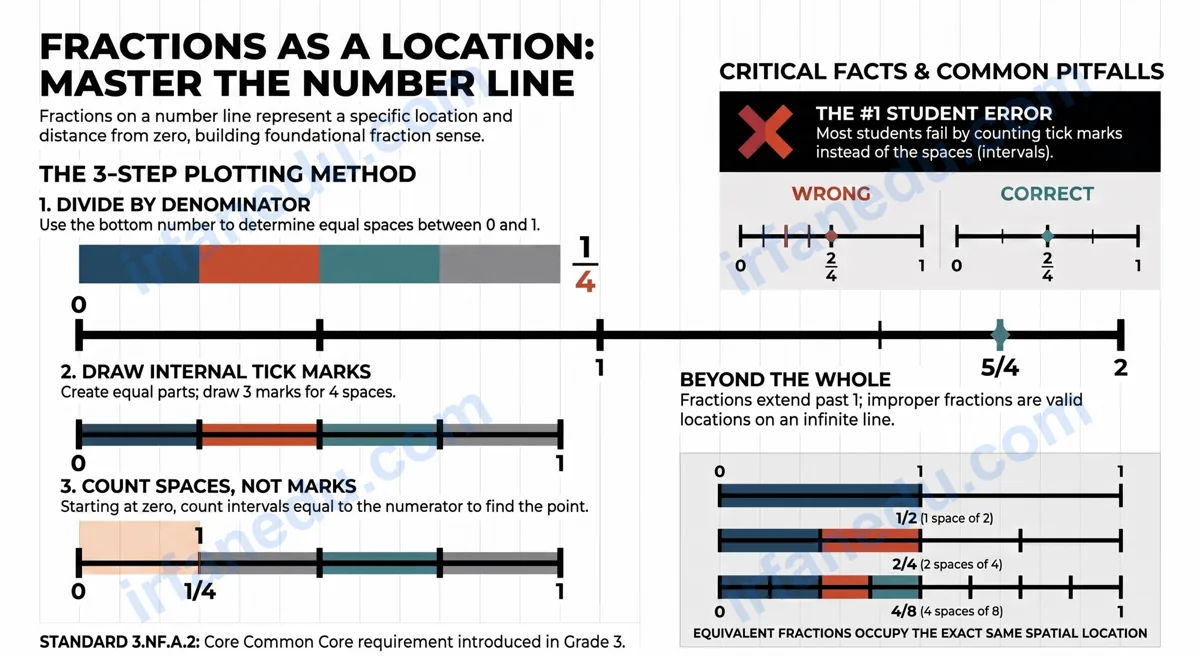
A fractions on a number line worksheet teaches students to place fractions like 1/2, 3/4, and 5/8 at exact positions on a divided number line. This visual approach builds genuine fraction sense — not just symbol manipulation — and is a foundational skill in the Grade 3-5 math curriculum.
If your student can name a fraction but freezes when asked to show it on a line, this page is exactly what you need. I have taught this concept to hundreds of students, and the same two misunderstandings come up every single time. This lesson tackles both head-on, then gives you a free printable worksheet with a full answer key so you can practise immediately.
- A clear explanation of what fractions on a number line actually mean
- A 4-step method with 3 fully worked examples
- A wrong-vs-right mistakes table
- 10 practice problems (on-page + free printable PDF with answer key)
- A 3-question quiz to check understanding
Free Printable PDF Worksheet: 10 problems, increasing difficulty, with a separate answer key. Print it, work through it, then self-check.
TL;DR – Quick Summary
- The denominator tells you how many equal parts to draw on the line.
- The numerator tells you how many spaces to count from zero.
- Count spaces, not tick marks — this is the #1 student error.
- Equivalent fractions land on the same point on the number line.
- Fractions greater than 1 extend past the 1 mark on the line.
- The free PDF worksheet has 10 problems plus a full answer key.
Quick Facts
| Fact | Detail |
|---|---|
| Skill name | Fractions on a number line |
| Grade level | Grades 3-5 (introduced Grade 3) |
| Common Core standard | 3.NF.A.2, 4.NF.A.1 |
| Key vocabulary | Numerator, denominator, interval, tick mark, unit fraction |
| Prerequisite skills | Counting, equal parts, basic fraction notation |
| Worksheet problems | 10 (easy to hard) |
| PDF includes | Questions + separate answer key |
What Are Fractions on a Number Line?
A fraction on a number line is a point that represents a part of a whole distance. The whole distance is the segment from 0 to 1. The denominator tells you how many equal parts that segment is divided into. The numerator tells you how many of those parts you count from 0.
This is different from the “pizza slice” model most students learn first. With pizza, a fraction is a shape. On a number line, a fraction is a location. Both models are correct, but the number line model is more powerful because it shows fractions as numbers with size and order, not just parts of a picture.
MY POV: In my experience teaching fractions, students who only learn the pizza model hit a wall when they reach comparing fractions or adding them. The number line forces them to think about magnitude — “how big is this fraction?” — which is the real foundation of fraction fluency. I always introduce the number line model by the end of Grade 3, even if it feels harder at first.
Why does this skill matter?
Fractions on a number line build three critical understandings at once. First, fractions are numbers, not just parts of shapes. Second, fractions have a fixed size that can be compared. Third, equivalent fractions occupy the same point, making the concept of equivalence visual and concrete.
Without this foundation, students struggle with fraction comparison, addition, and eventually algebra, where the number line becomes the basis for understanding all real numbers.
How to Plot a Fraction on a Number Line: 4 Steps
Follow these four steps every time. They work for any fraction, whether it is a simple unit fraction or a complex improper fraction.
-
Read the denominator.
Look at the bottom number of the fraction. This is the number of equal parts you need to create on the number line between 0 and 1. -
Draw equal tick marks.
Divide the segment from 0 to 1 into that many equal parts by drawing tick marks. If the denominator is 4, draw 3 internal tick marks to create 4 equal spaces. -
Count spaces from 0 (not tick marks).
Starting at 0, count spaces equal to the numerator. Do not count the 0 mark itself. Each space is one unit fraction (1/denominator). -
Mark and label the point.
Place a filled dot at the end of your final counted space. Write the fraction next to it. You are done.
Visual: Number Lines for 1/2, 3/4, and 5/8
Plotting 1/2  (denominator = 2, count 1 space)
|---------|---------|
0        1/2        1
          ^
          Mark here

Plotting 3/4  (denominator = 4, count 3 spaces)
|-----|-----|-----|-----|
0    1/4   2/4   3/4    1
                  ^
                  Mark here

Plotting 5/8  (denominator = 8, count 5 spaces)
|-|-|-|-|-|-|-|-|
0 1 2 3 4 5 6 7  1
(eighths)   ^
            5/8 = here (5th space)
Worked Examples
Example 1: Plot 2/3 on a number line from 0 to 1
Step 1: Denominator = 3. Divide the line into 3 equal parts.
Step 2: Draw 2 internal tick marks, creating 3 equal spaces.
Step 3: Numerator = 2. Count 2 spaces from 0.
Step 4: Place a dot at the end of the 2nd space. Label it 2/3.
Result: 2/3 is two-thirds of the way from 0 to 1. It is closer to 1 than to 0.
Example 2: Identify the fraction at the 5th tick mark on a line divided into 8 parts
Given: Number line from 0 to 1, divided into 8 equal parts. A point is at the 5th tick mark.
Denominator: 8 (the line has 8 equal parts).
Numerator: 5 (the point is at the 5th space from 0).
Answer: The fraction is 5/8.
Check: 5/8 = 0.625, which is between 1/2 (0.5) and 3/4 (0.75). That matches the position on the line.
Example 3: Number line from 0 to 2, divided into 6 equal parts — what is the 3rd tick mark?
Key insight: The whole is now 2, not 1. Each of the 6 equal parts represents 2/6 = 1/3 of the total distance. But we label fractions by their position from 0.
Each space = 2/6 = 1/3. The 3rd tick mark = 3 spaces x (2/6) = 6/6 = 1. But wait — let us think in terms of the denominator of the subdivisions.
Simpler approach: Each space = 1/3 of 1 whole (since 6 parts over a distance of 2 = 3 parts per whole). The 3rd tick = 3/3 = 1. Alternatively, if we label each space as 1/3, the 3rd tick is 3/3 = 1. In simplest form: 1 (or 3/3).
Practical rule: When the number line goes past 1, label each tick as (tick number)/(parts per whole unit). Here, 3 parts per unit, so tick 3 = 3/3 = 1.
MY POV: Example 3 is the one most worksheets skip, and it is exactly where students fall apart in Grade 4. A number line from 0 to 2 is not harder — it just requires identifying “parts per whole unit” first. I always ask students: “How many tick marks fit inside just the 0-to-1 section?” That one question unlocks the whole problem. In my experience, students who practise this version score significantly better on fraction comparison tasks later.
Common Mistakes Students Make (Wrong vs. Right)
These four errors account for the vast majority of wrong answers on fraction number line problems. Recognising them is half the battle.
| Wrong (Common Error) | Right (Correct Approach) |
|---|---|
| Counting tick marks instead of spaces. For 3/4, marking the 3rd tick mark (which is actually the 4th position from 0). | Count spaces (intervals) from 0. The 3rd space ends at the 3rd tick mark — but you count the spaces, not the marks. |
| Treating the denominator as the number of tick marks to draw (drawing 4 marks for fourths, creating 5 spaces). | The denominator = number of equal PARTS (spaces). For fourths, draw 3 internal tick marks to create 4 equal spaces. |
| Placing 1/2 at the first tick mark on a line divided into 4 parts (confusing 1/2 with 1/4). | Redraw the line with 2 equal parts for 1/2, or recognise that 1/2 = 2/4 and land on the 2nd tick mark of a fourths line. |
| Assuming fractions cannot go past 1 on a number line. | Extend the line. 5/4 is one space past 1 on a fourths number line. Improper fractions are valid locations. |
Unique Insight — What Most Worksheets Get Wrong
Most fractions-on-a-number-line worksheets only ask students to plot fractions between 0 and 1. This accidentally teaches students that fractions live between 0 and 1 — a misconception that causes real confusion when they encounter improper fractions and mixed numbers in Grade 4. A better approach is to include at least two problems where the number line extends to 2 or 3, so students see that fractions are points on the entire number line, not just the 0-to-1 segment. I have included exactly this type of problem in the worksheet below (problems 6 and 10). This single addition makes the worksheet more aligned with how Grade 4 fraction standards actually build on Grade 3 skills.
Build your math foundation with formulas for every shape and theorem.
On-Page Practice Worksheet: Fractions on a Number Line
Work through these 10 problems in order. They start easy and get progressively harder. You do not need to print anything — answer on paper, then reveal the answer key below. The free PDF version (with a clean printable layout) is available via the download button.
- A number line goes from 0 to 1 and is divided into 2 equal parts. What fraction does the middle point represent?
- A number line goes from 0 to 1 and is divided into 4 equal parts. What fraction is at the 3rd tick mark?
- Plot 2/3 on a number line from 0 to 1. How many equal parts do you divide the line into, and which tick mark do you label?
- A number line from 0 to 1 is divided into 8 equal parts. Which tick mark represents 5/8?
- What fraction is exactly halfway between 0 and 1/4 on a number line divided into eighths?
- A number line goes from 0 to 2 and is divided into 6 equal parts. What fraction (in simplest form) does the 3rd tick mark represent?
- On a number line from 0 to 1 divided into 6 equal parts, which two tick marks are equivalent to 1/3 and 2/3?
- A number line from 0 to 1 is divided into 10 equal parts. Plot 0.7 as a fraction. What fraction does it equal?
- Two number lines both go from 0 to 1. The first is divided into 4 parts; the second into 8 parts. Which tick marks on each line represent the same point as 1/2?
- A number line from 0 to 3 is divided into 12 equal parts. What fraction (in simplest form) does the 9th tick mark represent?
Show Answer Key
- 1/2
- 3/4
- Divide into 3 equal parts; label the 2nd tick mark as 2/3
- The 5th tick mark
- 1/8
- 1/2 (3/6 simplified)
- 1/3 is at the 2nd tick mark (2/6); 2/3 is at the 4th tick mark (4/6)
- 7/10
- 2nd tick on the 4-part line (2/4); 4th tick on the 8-part line (4/8)
- 3/4 (9/12 simplified)
Want a clean printable version? Download the free PDF — same 10 problems with a separate answer key section, formatted for easy printing.
Quick Check: 3-Question Quiz
1. A number line from 0 to 1 is divided into 6 equal parts. A point is at the 4th tick mark. What fraction is it?
2. Which of the following is the most common mistake when plotting fractions on a number line?
3. On a number line from 0 to 1 divided into 4 parts, which point is equivalent to 1/2?
Reveal-on-Click Practice Problems
Practice: A number line from 0 to 1 has 5 equal parts. Where is 3/5?
Denominator = 5, so divide into 5 parts. Numerator = 3, so count 3 spaces. The point 3/5 is 60% of the way from 0 to 1.
Practice: Two fractions, 2/6 and 1/3, are plotted on the same number line. Do they land on the same point?
2/6 simplifies to 1/3 (divide numerator and denominator by 2). On a number line divided into sixths, 2/6 is the 2nd tick mark. On a line divided into thirds, 1/3 is the 1st tick mark. Both points are at exactly the same location: one-third of the way from 0 to 1.
Practice: A number line goes from 0 to 1 and is divided into 8 parts. Which tick marks represent 1/4 and 3/4?
Convert to eighths: 1/4 = 2/8 (2nd space), 3/4 = 6/8 (6th space). This shows that equivalent fractions always land on the same point regardless of which denominator you use.
Frequently Asked Questions
How do you plot a fraction on a number line?
Divide the segment from 0 to 1 into equal parts equal to the denominator. Then count spaces equal to the numerator from 0 and place a dot there. For 3/4, divide into 4 parts and mark the end of the 3rd space. Always count spaces, not tick marks.
What grade level is fractions on a number line?
Fractions on a number line are introduced in Grade 3 under Common Core standard 3.NF.A.2. The skill extends into Grade 4 (equivalent fractions, 4.NF.A.1) and Grade 5 (fractions on a coordinate plane). Most standardised tests for grades 3-5 include at least one number line fraction problem.
Why do students struggle with fractions on a number line?
The most common error is counting tick marks instead of spaces. Students also confuse the denominator with the total number of visible marks. A third issue is the assumption that fractions only exist between 0 and 1, which breaks down when they encounter improper fractions. Practising with number lines that extend past 1 fixes this early.
What is the difference between a unit fraction and a non-unit fraction on a number line?
A unit fraction has a numerator of 1 (e.g., 1/4) and lands on the very first tick mark after 0. A non-unit fraction has a numerator greater than 1 (e.g., 3/4) and lands further along the line. Every non-unit fraction is a multiple of the corresponding unit fraction — 3/4 is three copies of 1/4.
How do you show equivalent fractions on a number line?
Draw two number lines of equal length, stacked vertically. Divide the top line into fewer parts (e.g., halves) and the bottom into more parts (e.g., fourths). Tick marks that align vertically represent equivalent fractions — 1/2 lines up with 2/4, 3/6, and 4/8. This visual proof is more convincing than any rule.
Can fractions on a number line be greater than 1?
Yes. Extend the number line past 1. On a line divided into thirds, the 4th tick mark is
Sources & References
Reviewed by Dr. Irfan Mansuri. External links open in a new tab and are provided for further reading and verification.