
🧠 Can You Solve This?
A student needs to earn at least 80 points on a final exam to pass a course. She already has 47 points. How many more points does she need?
Reveal the answer
Let x = additional points needed. The inequality is: 47 + x ≥ 80. Subtract 47 from both sides: x ≥ 33. She needs at least 33 more points. Keep reading — you’ll learn exactly how to set up and solve problems like this in under two minutes. 🎯
Inequalities from Word Problems: The Step-by-Step Guide That Actually Sticks
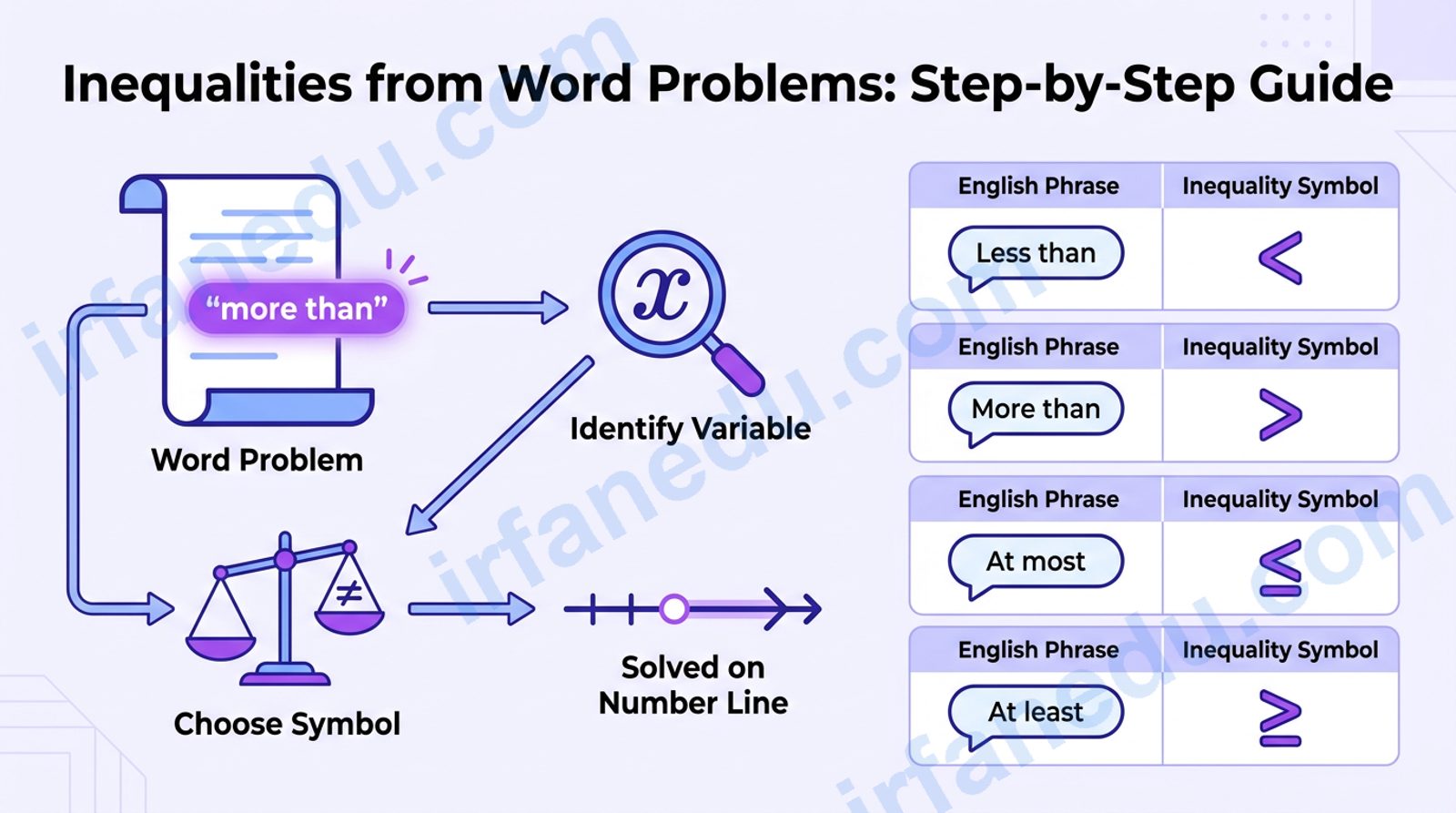
Most students can solve an inequality once it’s written in symbols. The real struggle is getting there — reading a paragraph of words and knowing exactly which symbol to write and where. In my experience teaching algebra to hundreds of middle and high school students, this translation step is where 90% of the mistakes happen, not the arithmetic.
To write an inequality from a word problem, you identify the unknown, find the key comparison phrase (such as “at least” or “no more than”), choose the correct inequality symbol, build the algebraic expression, and solve it using inverse operations.
By the end of this guide, you will be able to translate any inequality word problem into algebra, solve it confidently, and avoid the three most common errors that cost students marks. You will also get worked examples, a phrase-to-symbol reference table, and reveal-on-click practice problems to test yourself.
How to identify inequality keywords • How to assign variables correctly • The 5-step translation process • When to flip the inequality sign • How to check your answer makes sense
Identify the unknown variable, locate the key comparison phrase (“at least,” “no more than,” “fewer than,” etc.), translate it into the correct inequality symbol (≥, ≤, >, <), write the full algebraic inequality, then solve using inverse operations. Always check that your answer makes sense in the real-world context of the problem.
Why Word Problems Feel Harder Than They Are
Inequality word problems feel intimidating because they mix two skills at once: reading comprehension and algebra. But here is the truth — once you know the signal phrases, the translation becomes almost mechanical.
The confusion usually comes from one source: students treat word problems as one big block of text instead of a structured puzzle. In my experience, the moment a student learns to hunt for the comparison phrase first — before doing any math — their accuracy jumps immediately.
Think of it this way. The word problem is a story. Your job is to find the one sentence that says how two quantities relate. That sentence contains a phrase like “no more than” or “at least.” That phrase is your inequality symbol in disguise.
I have seen students spend five minutes re-reading a word problem when all they needed to do was circle the comparison phrase in the first 10 seconds. I now teach a “circle first, calculate second” habit — and it cuts confusion in half. Try it on the self-test problem at the top of this page.
The Key Phrases That Signal an Inequality
Every inequality word problem contains at least one signal phrase that maps directly to a symbol. Memorise this table and you have solved half the problem before writing a single number.
| English Phrase | Symbol | Meaning | Boundary Included? |
|---|---|---|---|
| at least / minimum / no less than | ≥ | Greater than or equal to | ✅ Yes |
| at most / maximum / no more than / does not exceed | ≤ | Less than or equal to | ✅ Yes |
| more than / greater than / exceeds / above | > | Strictly greater than | ❌ No |
| fewer than / less than / below / under | < | Strictly less than | ❌ No |
| between (inclusive) | ≤ x ≤ | Compound inequality, both ends included | ✅ Yes (both) |
| between (exclusive) | < x < | Compound inequality, both ends excluded | ❌ No (neither) |
Print this table, stick it in your notebook, and refer to it every time you start a new problem. After about 20 practice problems, you will not need it anymore.
The 5-Step Process for Translating Any Inequality Word Problem
Follow these five steps in order and you will translate any inequality word problem correctly, every time.
- Read the whole problem once without writing anything. Get the big picture — what is the situation?
- Identify the unknown — the quantity you need to find. Write: “Let x = ___” in plain English before you do any algebra.
- Find and circle the comparison phrase — the signal word or phrase from the table above.
- Translate into an algebraic inequality — replace the phrase with the correct symbol and write the full expression.
- Solve and check — use inverse operations to isolate the variable, then substitute a value from your solution back into the original problem to confirm it makes sense.
That’s the complete framework. Now let’s apply it to real examples so you can see exactly how each step works.
Worked Example 1: The Savings Problem (≥)
This is the most common type you will see in class and on standardised tests.
Marcus wants to save at least $150 for a new pair of headphones. He already has $47 saved. If he saves $12 each week, how many weeks does he need to save?
Step-by-step solution:
Step 1 — Identify the unknown: Let w = number of weeks Marcus saves.
Step 2 — Find the signal phrase: “at least $150” → symbol is ≥
Step 3 — Build the inequality: Current savings + (weekly savings × weeks) ≥ 150
47 + 12w ≥ 150
Step 4 — Solve:
12w ≥ 150 − 47
12w ≥ 103
w ≥ 103 ÷ 12
w ≥ 8.58…
Step 5 — Interpret in context: Since weeks must be whole numbers, Marcus needs to save for at least 9 weeks.
Check: 47 + 12(9) = 47 + 108 = 155 ≥ 150 ✅
Notice Step 5 — interpreting in context. This is a step many guides skip, but it is essential. The algebra gives you 8.58, but you cannot save for a fraction of a week, so you round up to 9. Always ask: does my answer make sense in the real world?
  Weeks:   0    2    4    6    8   8.58  9    10   12
           |----|----|----|----|----[====|===========>
                                        ^
                              w ≥ 8.58 (round up to 9 weeks)

  ● Closed circle at 8.58 means 8.58 is included in the algebra.
  ● In context (whole weeks only), the answer is w ≥ 9.
Worked Example 2: The Speed Limit Problem (<)
This type uses a strict inequality — the boundary value is NOT included.
A school zone has a speed limit of 20 mph. A driver is travelling at a speed that is 3 mph more than twice the speed of a cyclist. For the driver to stay under the speed limit, what must the cyclist’s speed be?
Step-by-step solution:
Step 1 — Identify the unknown: Let c = cyclist’s speed in mph.
Step 2 — Signal phrase: “under the speed limit” → strictly less than → <
Step 3 — Build the inequality: Driver’s speed = 2c + 3. For the driver to stay under 20 mph:
2c + 3 < 20
Step 4 — Solve:
2c < 20 − 3
2c < 17
c < 8.5
Step 5 — Interpret: The cyclist must be travelling at less than 8.5 mph for the driver to stay under the speed limit.
Check: If c = 8, driver speed = 2(8) + 3 = 19 < 20 ✅. If c = 8.5, driver speed = 20 — not under the limit ✅ (correctly excluded).
“At least” does NOT always mean you use ≥ on the left side of the inequality. The direction of the symbol depends on which side your variable lands on after you build the expression — not just on the phrase itself.
Here is the trap: if the problem says “the cost must be at least $50” and your variable ends up on the right side of the expression, you write 50 ≤ cost, which is mathematically identical to cost ≥ 50 — but students who memorise “at least = ≥” without understanding direction sometimes write it backwards and get the wrong solution set.
The fix: always rewrite the inequality so the variable is on the left before you solve. Then the symbol direction is unambiguous. This one habit eliminates an entire category of error that most algebra guides never mention.
Worked Example 3: The Compound Inequality (Budget Range)
Compound inequalities appear when a value must stay within a range — between a minimum and a maximum.
A theme park charges different prices based on age. Children aged between 5 and 12 years inclusive pay the child rate. Write a compound inequality to represent the ages that qualify.
Signal phrase: “between 5 and 12 years inclusive” → both endpoints included → ≤ on both sides
5 ≤ a ≤ 12
where a = child’s age in years.
Interpretation: Any child aged 5, 6, 7, 8, 9, 10, 11, or 12 qualifies. A child aged 4 or 13 does not.
Common Mistakes — And How to Fix Them
These are the three errors I see most often when students set up inequalities from word problems.
“At least 18” means 18 IS allowed → x ≥ 18. “More than 18” means 18 is NOT allowed → x > 18. These look similar in English but produce different solution sets. A student who writes x > 18 when the problem says “at least 18” will exclude the boundary value and lose marks.
When you multiply or divide both sides by a negative number, the inequality sign flips direction. For example: −3x < 12 → x > −4 (sign flips). This rule applies to inequalities only, not equations, and it trips up even strong students under exam pressure.
If the algebra gives x ≥ 2.3 but x must be a whole number (people, weeks, items), you must round appropriately. For “at least” situations, round up. For “at most” situations, round down. Ignoring this step is technically correct algebra but wrong real-world reasoning — and many teachers mark it wrong.
Mistake 3 is the one that genuinely surprises students when they lose marks. They show perfect algebra and still get the question wrong because they wrote “x ≥ 2.3” instead of “x ≥ 3 weeks.” In my experience, this is not a math error — it is a habit error. Train yourself to always write one final sentence: “In context, this means ___.” That sentence is worth marks.
Real-World Applications: Where Inequalities Actually Appear
Inequalities are not just a school exercise. They describe constraints in real decisions every day.
- 🛒 Shopping budgets: “I can spend no more than $200 on school supplies” → total cost ≤ 200
- 🏋️ Health targets: “A doctor recommends at least 150 minutes of exercise per week” → minutes ≥ 150
- 🚗 Speed limits: “Drive under 60 mph on this road” → speed < 60
- 📦 Shipping weight: “A package must weigh no more than 50 lbs to qualify for standard shipping” → weight ≤ 50
- 🎓 Grade requirements: “You need at least a 70% average to pass” → average ≥ 70
- 🌡️ Temperature ranges: “Store between 2°C and 8°C” → 2 ≤ T ≤ 8
Every one of these is an inequality word problem in disguise. The skill you are building here transfers directly to science, economics, and everyday decision-making.
Reveal-on-Click Practice Problems
Try each problem on your own first, then click to reveal the full solution. 📝
Problem 1 — The Part-Time Job: Aisha earns $9.50 per hour at a part-time job. She wants to earn more than $190 this week. How many hours must she work?
Let h = hours worked.
Signal phrase: “more than $190” → strictly greater than → >
Inequality: 9.50h > 190
Solve: h > 190 ÷ 9.50 → h > 20
Answer: Aisha must work more than 20 hours. Since she cannot work a fraction of an hour in most jobs, she needs at least 21 full hours.
Check: 9.50 × 21 = $199.50 > $190 ✅
Problem 2 — The Elevator: An elevator has a maximum capacity of 800 kg. Five people with an average weight of 72 kg are already inside. What is the maximum weight of one more person who can enter?
Let p = weight of the additional person in kg.
Current load = 5 × 72 = 360 kg
Signal phrase: “maximum capacity of 800 kg” → does not exceed → ≤
Inequality: 360 + p ≤ 800
Solve: p ≤ 800 − 360 → p ≤ 440
Answer: The additional person can weigh at most 440 kg.
Check: 360 + 440 = 800 ≤ 800 ✅
Problem 3 — The Test Score: A student scored 62, 75, and 80 on three tests. What score does she need on the fourth test to have an average of at least 75?
Let s = score on the fourth test.
Signal phrase: “at least 75” → ≥
Inequality: (62 + 75 + 80 + s) ÷ 4 ≥ 75
Multiply both sides by 4: 217 + s ≥ 300
Solve: s ≥ 300 − 217 → s ≥ 83
Answer: She needs to score at least 83 on the fourth test.
Check: (62 + 75 + 80 + 83) ÷ 4 = 300 ÷ 4 = 75 ≥ 75 ✅
Problem 4 — The Compound Range: A refrigerator must keep food at a safe temperature. Food is safe when stored between 34°F and 40°F inclusive. Write and interpret the compound inequality.
Let T = temperature in °F.
Signal phrase: “between 34°F and 40°F inclusive” → both endpoints included
Compound inequality: 34 ≤ T ≤ 40
Interpretation: Any temperature from 34°F to 40°F (including exactly 34 and exactly 40) keeps food safe. Below 34°F risks freezing; above 40°F risks bacterial growth.
This is a real food safety standard referenced by the FDA’s food storage guidelines.
Frequently Asked Questions
What is the difference between “at least” and “more than” in an inequality?
“At least” means greater than or equal to (≥), so the boundary value is included. “More than” means strictly greater than (>), so the boundary value is excluded. For example, “at least 18 years old” translates to x ≥ 18, while “more than 18 years old” translates to x > 18. The difference matters because it changes which values are valid solutions.
Do you flip the inequality sign when solving word problems?
You flip the inequality sign only when you multiply or divide both sides by a negative number. Adding, subtracting, multiplying, or dividing by a positive number does not change the direction of the inequality sign. This rule is the same whether you are solving a word problem or a pure algebra inequality.
How do I know which variable to use in an inequality word problem?
Identify the unknown quantity — the thing the problem asks you to find or limit. Assign it a letter (usually x or n). Write a short definition like “let x = the number of hours worked” before you build the inequality. This keeps your reasoning clear and helps you interpret the final answer correctly in context.
Can an inequality word problem have more than one answer?
Yes. Unlike equations, inequalities usually have infinitely many solutions — a whole range of values. The solution is expressed as an inequality (e.g. x ≥ 5) or shown on a number line, not as a single number. In context, you may also need to restrict to whole numbers or positive values only, which narrows the practical answer set.
What are the most common key phrases that signal an inequality?
Common phrases include: “at least” (≥), “no more than” / “at most” (≤), “more than” / “greater than” (>), “fewer than” / “less than” (<), “minimum” (≥), “maximum” (≤), “does not exceed” (≤), and “exceeds” (>). Learning these signal phrases is the single most effective shortcut for solving inequality word problems quickly and accurately.
✅ Key Takeaways
- Inequality word problems always contain a signal phrase — find it first before doing any algebra.
- “At least” and “minimum” map to ≥; “at most” and “maximum” map to ≤; “more than” maps to >; “fewer than” maps to <.
- Follow the 5-step process: read, define the variable, find the phrase, translate, solve and check.
- Flip the inequality sign only when multiplying or dividing by a negative number.
- Always interpret your answer in context — round appropriately when the variable must be a whole number.
- Compound inequalities (between a min and max) use two symbols: a ≤ x ≤ b or a < x < b.
Sources & References
- Khan Academy — Writing Inequalities: Word Problems (6th Grade Math)
- Wikipedia — Inequality (Mathematics)
- U.S. Food & Drug Administration — Are You Storing Food Safely? (referenced in Practice Problem 4)
✍ This article was written and fact-checked by Dr. Irfan Mansuri. All examples are original. Statistics and definitions are verified against the sources listed above. Last reviewed: August 2026.