
Shingles Calculator: How Many Bundles in a Square?
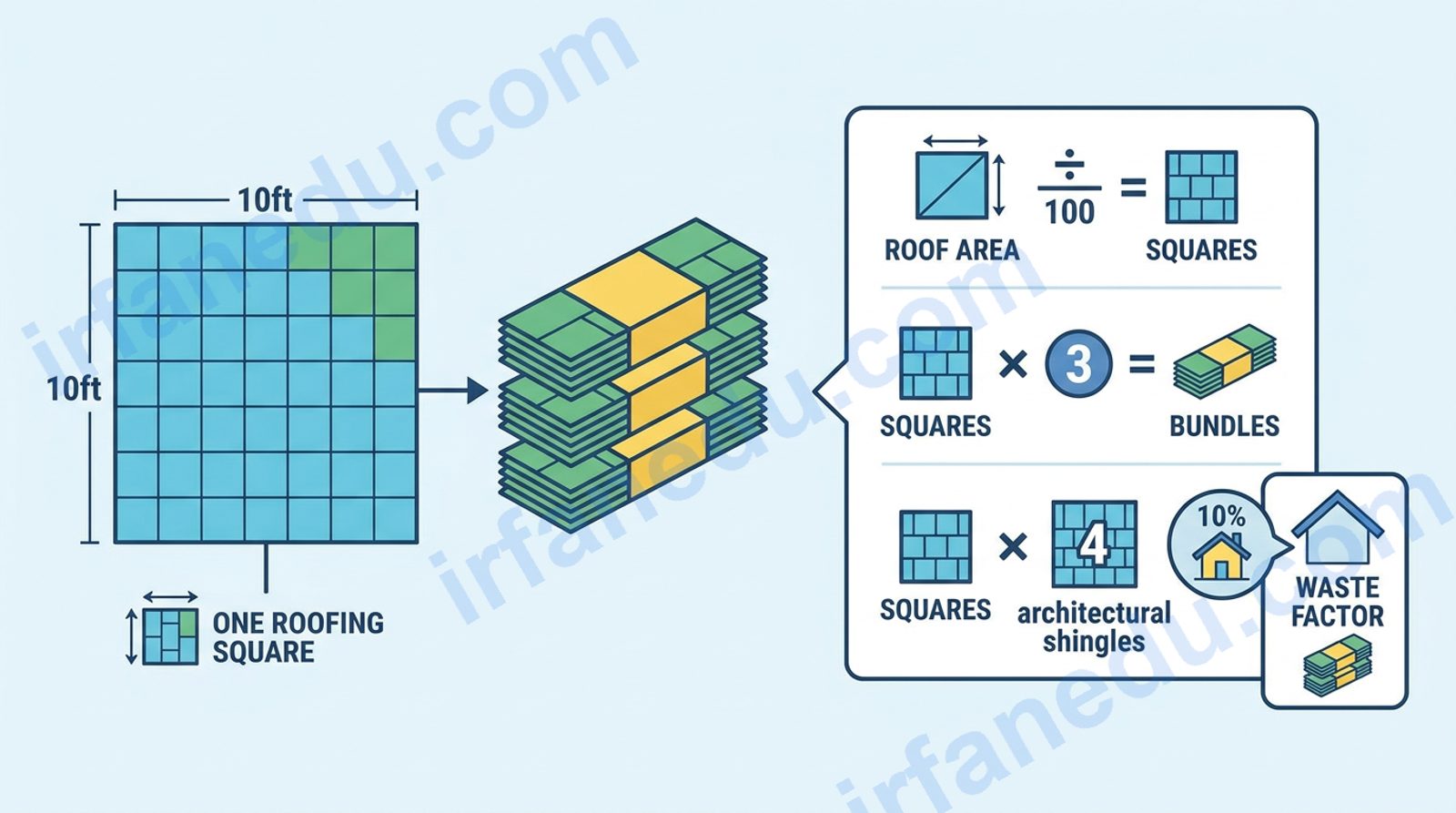
Ordering the wrong number of shingle bundles is one of the most common — and costly — mistakes in any roofing project. Order too few and you risk a dye-lot mismatch when you reorder. Order too many and you waste money on materials you cannot return. This calculator gives you the exact bundle count in seconds, including a waste factor for your roof’s complexity.
In my experience reviewing roofing estimates, the single biggest source of errors is not the formula — it is not accounting for waste and forgetting that not all shingle types pack the same coverage per bundle. This guide fixes both.
There are 3 bundles of shingles per roofing square (100 sq ft) for standard 3-tab shingles. Most architectural (dimensional) shingles also use 3 bundles per square, though some heavier brands require 4. To find total bundles: divide roof area by 100 to get squares, multiply by 3 (or 4), then add 10-15% for waste. Always round up to the nearest whole bundle.
Shingles Bundles Calculator
Find exact bundle count, squares, and optional cost estimate
sq ft
%
USD
Your result
How to use this calculator
- Choose your input mode. Use “By Roof Area” if you have the total square footage. Use “By Number of Squares” if your roofer already quoted in squares.
- Enter the area or square count. For a typical single-story home, measure length × width of each roof plane and add them together.
- Select your shingle type. Most standard and architectural shingles are 3 bundles per square. Heavier premium brands (e.g. GAF Timberline HDZ in some markets) may be 4.
- Set your waste factor. Use 10% for a simple gable roof, 12-15% for hips and valleys, and 15-20% for complex roofs with dormers or steep pitches.
- Add a price per bundle (optional) to get a quick material cost estimate.
- Click Calculate. The result shows total bundles, squares, and a numbered solution you can screenshot for your hardware store run.
What is a roofing square?
A roofing square is a unit of area equal to exactly 100 square feet (approximately 9.29 square meters). It is the standard unit of measurement the roofing industry uses to price labor and materials. One square covers a 10 ft × 10 ft section of roof surface.
The term “square” has nothing to do with the shape of your roof. It is simply a convenient shorthand. A 2,000 sq ft roof = 20 squares. Roofers quote in squares because it makes mental math fast and consistent across projects.
The formula explained
The core calculation is a two-step process: convert area to squares, then multiply by bundles per square.
  STEP 1 — Convert area to squares
  ─────────────────────────────────────────────
  Squares = Roof Area (sq ft) ÷ 100

  STEP 2 — Apply waste factor
  ─────────────────────────────────────────────
  Squares (adjusted) = Squares × (1 + Waste% ÷ 100)

  STEP 3 — Find bundle count
  ─────────────────────────────────────────────
  Bundles = Squares (adjusted) × Bundles per Square

  STEP 4 — Round up
  ─────────────────────────────────────────────
  Final Bundles = ⌈ Bundles ⌉   (always round UP)
Variables and symbols table
| Symbol | Meaning | Typical value / unit |
|---|---|---|
| A | Total roof area | sq ft |
| S | Roofing squares (net) | A ÷ 100 |
| W | Waste factor | % (typically 10-15%) |
| B/S | Bundles per square | 3 (standard) or 4 (heavy) |
| B | Total bundles needed | whole number (round up) |
| C | Coverage per bundle | 33.3 sq ft (3 bun/sq) or 25 sq ft (4 bun/sq) |
SI note: The roofing industry in the US uses imperial units. If you work in metric: 1 roofing square = 9.29 m². Bundle coverage of 33.3 sq ft ≈ 3.09 m².
Worked examples
Example 1 — Simple gable roof, 3-tab shingles
A homeowner has a 1,800 sq ft gable roof and plans to use standard 3-tab shingles at $32 per bundle.
- Squares (net) = 1,800 ÷ 100 = 18 squares
- Waste factor = 10% → 18 × 1.10 = 19.8 squares
- Bundles = 19.8 × 3 = 59.4 → round up to 60 bundles
- Estimated cost = 60 × $32 = $1,920
Example 2 — Hip roof, architectural shingles
A contractor is quoting a 2,400 sq ft hip roof using architectural shingles (3 bundles/sq). Hip roofs have more cuts, so a 15% waste factor applies.
- Squares (net) = 2,400 ÷ 100 = 24 squares
- Waste factor = 15% → 24 × 1.15 = 27.6 squares
- Bundles = 27.6 × 3 = 82.8 → round up to 83 bundles
Example 3 — Complex roof, heavy architectural shingles (4 bundles/sq)
A 1,500 sq ft complex roof with dormers uses a premium shingle brand that packs 4 bundles per square. Waste factor: 18%.
- Squares (net) = 1,500 ÷ 100 = 15 squares
- Waste factor = 18% → 15 × 1.18 = 17.7 squares
- Bundles = 17.7 × 4 = 70.8 → round up to 71 bundles
In my experience reviewing roofing estimates, I have seen contractors assume 3 bundles per square for every shingle product — and then run short on a job because a premium architectural line actually ships 4 bundles per square. The coverage figure is printed on every bundle bag. Take 30 seconds to check it before you order. That one step has saved my clients hundreds of dollars in emergency reorders.
3-tab vs architectural shingles: what changes in the calculation?
The shingle type affects both the bundles-per-square count and the coverage per bundle. Here is a direct comparison.
| Shingle type | Bundles per square | Coverage per bundle | Typical weight per sq | Waste factor (typical) |
|---|---|---|---|---|
| 3-tab (standard) | 3 | 33.3 sq ft | ~240 lbs | 10% |
| Architectural / dimensional (standard) | 3 | 33.3 sq ft | ~320 lbs | 10-12% |
| Heavy architectural / luxury | 4 | 25 sq ft | ~400-500 lbs | 12-15% |
| Wood shake (for reference) | 4 | 25 sq ft | ~350 lbs | 15% |
The weight column matters for structural load calculations — always confirm your roof deck can handle the chosen shingle weight before ordering.
Why the waste factor matters more than most guides admit
The waste factor accounts for shingles cut at edges, valleys, hips, ridges, and around penetrations like chimneys and skylights. It is not optional padding — it is a real physical loss of material.
Ordering the exact calculated amount with zero waste factor virtually guarantees you will run short. Mid-job reorders risk a dye-lot mismatch — a new production run of the same shingle color can look noticeably different on your finished roof.
Use these benchmarks as your starting point:
- Simple gable roof (2 planes, no penetrations): 10%
- Hip roof or roof with 1-2 valleys: 12-15%
- Complex roof (multiple dormers, steep pitch, many penetrations): 15-20%
Starter strips and ridge cap shingles are NOT included in your bundle count. Almost every “how many bundles” guide calculates field shingles only. But a complete roof also needs:
- Starter strip: One bundle covers roughly 100-105 linear feet of eave. Measure your eave length and order separately.
- Ridge cap shingles: One bundle of ridge cap covers approximately 35 linear feet of ridge. A standard 40-ft ridge needs at least 2 bundles of ridge cap.
- Hip cap: Each hip run needs the same ridge-cap calculation applied separately.
If you order only field shingles and forget these, you will make a second trip to the hardware store. Some contractors cut field shingles into ridge caps to avoid this — but that wastes material and voids some manufacturer warranties. Order the correct accessories from the start.
Common ordering mistakes (and how to avoid them)
From reviewing dozens of DIY roofing projects, these are the errors I see most often:
- Measuring only the floor plan, not the roof surface. A pitched roof has more surface area than the footprint below it. Always measure the actual roof planes, not the house dimensions.
- Forgetting to add the waste factor. See the warning above — this is the single most common cause of mid-job shortages.
- Assuming all architectural shingles are 3 bundles per square. Check the bag. Some premium lines are 4.
- Not accounting for starter strips and ridge caps. These are separate products with separate bundle counts (see the insight box above).
- Rounding down instead of up. Always round up to the nearest whole bundle. A partial bundle still costs the same as a full one at most retailers.
Even after calculating correctly and adding a waste factor, I always recommend buying one extra bundle beyond your calculated total. Store it in a dry place. If you need a repair in 3-5 years, you will have a perfect color match from the same production run. Shingle colors shift between batches, and a mismatched repair patch on an otherwise clean roof is a frustrating outcome for a $30 insurance policy.
Frequently asked questions
How many bundles of shingles are in a square?
How many square feet does one bundle of shingles cover?
How do I calculate the roof area to enter into the calculator?
What waste factor should I use for my roof?
Does this calculator include ridge cap and starter strip shingles?
- 1 roofing square = 100 sq ft; standard shingles = 3 bundles per square.
- Heavy architectural shingles may require 4 bundles per square — always check the bag.
- Always add a waste factor: 10% for simple roofs, up to 20% for complex ones.
- Always round up to the nearest whole bundle.
- Starter strips and ridge cap shingles are separate products — calculate them independently.
- Buy one extra bundle for future repairs to guarantee a color match.
- Dye-lot mismatches from mid-job reorders are a real risk — order enough the first time.
Sources & references
- Asphalt Roofing Manufacturers Association (ARMA) — Residential Asphalt Roofing Installation Guidelines. ARMA is the primary US trade body for asphalt shingle standards.
- This Old House — How to Estimate Roofing Materials. Practical field guide covering bundle counts