
Addition word problems: complete guide with examples
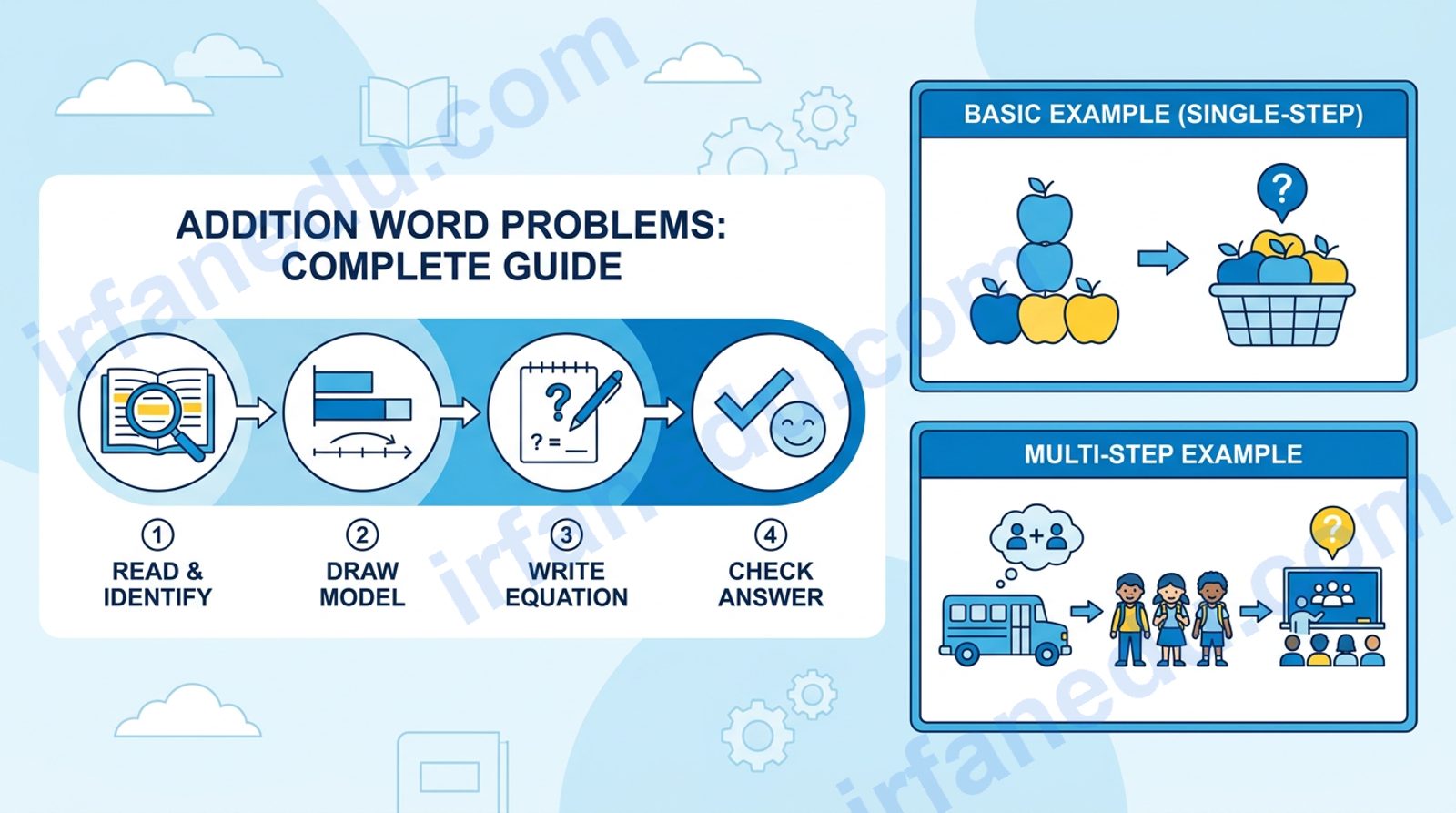
Addition word problems in 60 seconds
An addition word problem gives you a math story and asks you to find a total. You spot the keyword (total, altogether, combined, in all), write the equation Part + Part = Whole, solve it, and label the answer. That four-step loop works for every addition problem from Grade 1 through middle school.
An addition word problem is a math story that asks you to find a total by combining two or more quantities. To solve one: identify the keyword (total, altogether, combined, in all, more than), draw a bar model showing Part + Part = Whole, write the addition equation, then calculate and label your answer with its unit.
- Addition word problems ask you to combine quantities to find a total.
- Keywords like total, altogether, combined, in all signal addition.
- A bar model (part-part-whole) is the fastest visual tool for any level.
- Multi-step problems need one equation per step, solved in order.
- The most common mistake is adding when the problem actually wants a difference.
- Label every answer with its unit — a number alone is an incomplete answer.
What is an addition word problem?
An addition word problem is a written math scenario that requires you to combine two or more numbers to find a total. The numbers represent real-world quantities — apples, dollars, kilometers, students — and the problem asks for their sum.
The underlying structure is always the same: Part + Part = Whole. One or both parts are given; you find the whole. This structure is called the part-part-whole model, and recognizing it instantly tells you which operation to use.
Every addition word problem, at every grade level, maps onto Part + Part = Whole. If you can identify the two parts and the missing whole, you have already solved 80% of the problem.
Addition word problems appear in every grade from 1 through 6 and beyond. At lower grades the numbers are small whole numbers. At higher grades the same structure appears with multi-digit numbers, decimals, fractions, and even algebraic expressions.
What keywords signal addition in a word problem?
Addition keywords are the words in a problem that tell you to combine quantities. Spotting them is the single fastest skill you can build for word problems.
Here are the most common addition signal words, grouped by meaning:
- Combining: total, altogether, combined, in all, sum, both
- Joining: added to, plus, and, put together, joined
- Increasing: more than, increased by, gained, earned, received
- Counting on: how many in all, how many altogether, how many total
“More than” is a keyword that confuses students at every level. “Maria has 5 more than Jake” means you ADD 5 to Jake’s amount to get Maria’s. But “how many more” is a subtraction question. The word “more” alone does not guarantee addition — read the full sentence before deciding.
In my experience tutoring students, keyword confusion is the single biggest source of wrong operation choices. Teaching students to read the whole sentence before circling a keyword eliminates most of those errors.
How do you solve an addition word problem step by step?
Use this five-step method every time. It works for basic single-step problems and scales up to multi-step problems without any changes.
- Read the whole problem once. Do not solve yet. Understand the story and what is being asked.
- Identify the quantities and the question. Underline every number and circle the addition keyword.
- Draw a bar model. Sketch two labeled boxes (the parts) and one larger box (the whole). Write known values; mark the unknown with a “?”.
- Write the equation. Translate the bar model directly: Part + Part = ?
- Solve and label. Calculate the sum and write the answer with its unit (apples, dollars, cm, etc.).
The bar model step is the one most students skip — and skipping it is why they get stuck on harder problems. Even a rough sketch takes ten seconds and prevents almost every setup error.
Worked examples (basic to advanced)
Example 1: Basic single-step (Grade 1–2)
Problem: Lena has 8 red crayons and 6 blue crayons. How many crayons does she have in all?
Keyword: “in all” → addition.
Bar model: Part 1 = 8 (red) | Part 2 = 6 (blue) | Whole = ?
Equation: 8 + 6 = ?
Answer: 8 + 6 = 14 crayons.
Example 2: Two-digit numbers (Grade 2–3)
Problem: A bookstore sold 47 books on Saturday and 38 books on Sunday. What was the total number of books sold over the weekend?
Keyword: “total” → addition.
Equation: 47 + 38 = ?
Working: 47 + 38 = 47 + 30 + 8 = 77 + 8 = 85 books.
Example 3: Decimals (Grade 4–5)
Problem: Priya spent $12.75 on lunch and $4.50 on a snack. How much did she spend altogether?
Keyword: “altogether” → addition.
Equation: $12.75 + $4.50 = ?
Working: Align decimal points: 12.75 + 4.50 = $17.25.
Example 4: Fractions (Grade 5–6)
Problem: A recipe needs 2/3 cup of flour and 1/4 cup of oats. What is the combined amount?
Keyword: “combined” → addition.
Equation: 2/3 + 1/4 = ?
Working: LCD = 12. 8/12 + 3/12 = 11/12 cup.
Visual model: how a bar model works
A bar model makes the Part + Part = Whole structure visible. Here is how Example 2 looks as a bar model diagram:
  WHOLE (Total books sold = ?)
 ┌─────────────────────────────────────┐
 │                  ?                  │
 └─────────────────────────────────────┘
       ↑                    ↑
 ┌───────────┐        ┌───────────┐
 │  Saturday │        │  Sunday   │
 │   47 books│        │  38 books │
 └───────────┘        └───────────┘
      Part 1                Part 2

  Equation:  47  +  38  =  85 books  ✓
Draw this sketch before writing any equation. It takes under 15 seconds and makes the operation choice obvious — especially when problems get longer and more complex.
Types of addition word problems compared
Not all addition problems look the same. Knowing the four main types helps you recognize the structure even when the keywords are hidden.
| Type | What it looks like | Example signal | Grade range |
|---|---|---|---|
| Join / Combine | Two separate groups brought together | “altogether”, “combined”, “in all” | 1–3 |
| Part-part-whole | Two known parts; find the whole | “total”, “how many in all” | 1–4 |
| Change / Increase | A quantity grows over time | “gained”, “received”, “increased by” | 2–5 |
| Compare (additive) | One quantity is more than another by a given amount | “X more than”, “exceeds by” | 3–6 |
The “Compare (additive)” type trips up the most students because it uses the word “more” — which many students associate only with subtraction. If the problem tells you how much more one quantity is and asks for the larger quantity, you add.
Common mistakes and how to fix them
These are the four errors I see most often when students work through addition word problems. Each one has a simple fix.
Mistake 1: Choosing the wrong operation
Students see “more” and subtract, or see “left” and add. Fix: always read the full sentence and ask “am I combining or separating?” before picking an operation.
Mistake 2: Forgetting to label the answer
“85” is wrong. “85 books” is right. A number without a unit is an incomplete answer on any test or homework assignment.
Mistake 3: Misaligning decimal points
Writing 12.75 + 4.5 without aligning the decimal point leads to 12.75 + 45 = 57.75 — a classic error. Always write decimals in a column with the decimal points lined up.
Mistake 4: Ignoring extra information
Some problems include a number you do not need. Students add every number they see. Fix: after identifying the question, ask “does this number help me answer it?” before including it in the equation.
In my experience, Mistake 4 — adding irrelevant numbers — is actually more common than wrong operation choice at the Grade 3–5 level. Curriculum materials rarely include distractor numbers in early word problems, so students never learn to filter them out. When they hit standardized tests that deliberately include extra data, their scores drop. I recommend introducing at least one “extra information” problem per week from Grade 3 onward.
The bar model is not just a visual aid — it is a problem-solving tool that changes how you read. Most guides treat bar models as a drawing you make after you have already decided to add. That is backwards. When you draw the bar model before choosing an operation, you force yourself to label what is known and what is unknown. That labeling process is what reveals the operation — not the keywords. Keywords fail on “compare” problems and multi-step problems where the signal word is buried or absent. The bar model never fails, because it maps the mathematical structure directly. Teach the model first; the keywords become a shortcut, not a crutch.
How do you solve multi-step addition word problems?
A multi-step addition problem requires two or more separate calculations before you reach the final answer. The key is to treat each step as its own mini-problem.
- Read and identify all quantities. List every number and what it represents.
- Identify how many steps are needed. Each separate question within the problem is one step.
- Solve Step 1 first. Write and solve the first equation. Label the intermediate answer.
- Use the Step 1 answer in Step 2. The intermediate answer becomes a new “part” in the next equation.
- Label the final answer. Make sure it answers the original question.
Problem: On Monday, a library checked out 124 books. On Tuesday it checked out 89 books. On Wednesday it checked out 57 books. How many books were checked out in total over the three days?
Step 1: 124 + 89 = 213 books (Monday + Tuesday)
Step 2: 213 + 57 = 270 books (running total + Wednesday)
Answer: 270 books were checked out over the three days.
Note: You could also add all three at once: 124 + 89 + 57 = 270. Both approaches are correct. The two-step method is safer when numbers are large.
Practice problems with solutions
Try each problem on your own, then click to reveal the full worked solution.
Problem 1 (Basic): Sam collected 34 stamps and his sister collected 29 stamps. How many stamps do they have altogether?
Equation: 34 + 29 = ?
Working: 34 + 29 = 34 + 20 + 9 = 54 + 9 = 63
Answer: 63 stamps.
Problem 2 (Decimals): A runner completed a course in 14.38 seconds on the first attempt and 13.95 seconds on the second. What is the combined time for both attempts?
Equation: 14.38 + 13.95 = ?
Working: Align decimals: 14.38 + 13.95 = 28.33
Answer: 28.33 seconds.
Problem 3 (Compare): Aiden has 15 marbles. Ben has 7 more marbles than Aiden. How many marbles does Ben have?
Equation: 15 + 7 = ?
Answer: 22 marbles.
Note: “more than” here signals addition, not subtraction — this is the compare-type problem. The question asks for Ben’s total, so you add.
Problem 4 (Multi-step): A school raised $345 in Week 1, $278 in Week 2, and $412 in Week 3. What was the total amount raised?
Step 2: 623 + 412 = 1,035
Answer: $1,035.
Problem 5 (Fractions): A painter used 1/3 of a can of paint on the first wall and 2/5 of a can on the second wall. How much paint was used in total?
Equation: 1/3 + 2/5 = ?
LCD = 15: 5/15 + 6/15 = 11/15
Answer: 11/15 of a can.
Frequently asked questions
What are addition word problems?
What keywords signal addition in a word problem?
How do you solve a multi-step addition word problem?
What is the difference between a bar model and a number line for addition?
Can addition word problems involve decimals or fractions?
- Every addition word problem maps onto Part + Part = Whole.
- Keywords (total, altogether, combined, in all) signal addition — but read the full sentence before deciding.
- Draw a bar model before writing the equation; it reveals the structure even when keywords are absent.
- Multi-step problems need one labeled equation per step, solved in sequence.
- Always label your answer with its unit — a bare number is an incomplete answer.
- The “compare” type (X more than Y) uses addition even though “more” can suggest subtraction.
- The same five-step method works for whole numbers, decimals, and fractions.
Sources & references
- Khan Academy — Addition and subtraction word problems (Grade 1). Khan Academy Math.
- Carpenter, T. P., Fennema, E., Franke, M. L., Levi, L., & Empson, S. B. (2015). Children’s Mathematics: Cognitively Guided Instruction. Heinemann. (Source for part-part-whole model classification of addition problem types.)
- Wikipedia — Word problem (mathematics education). Wikimedia Foundation.
Editorial note: This article was written and fact-checked by Dr. Irfan Mansuri. All examples are original. No statistics or studies were fabricated. Last reviewed August 2026.