
How Do You Find the Volume of a Triangular Pyramid?
✓ Expert Reviewed by Dr. Irfan Mansuri | Last Updated: July 2026
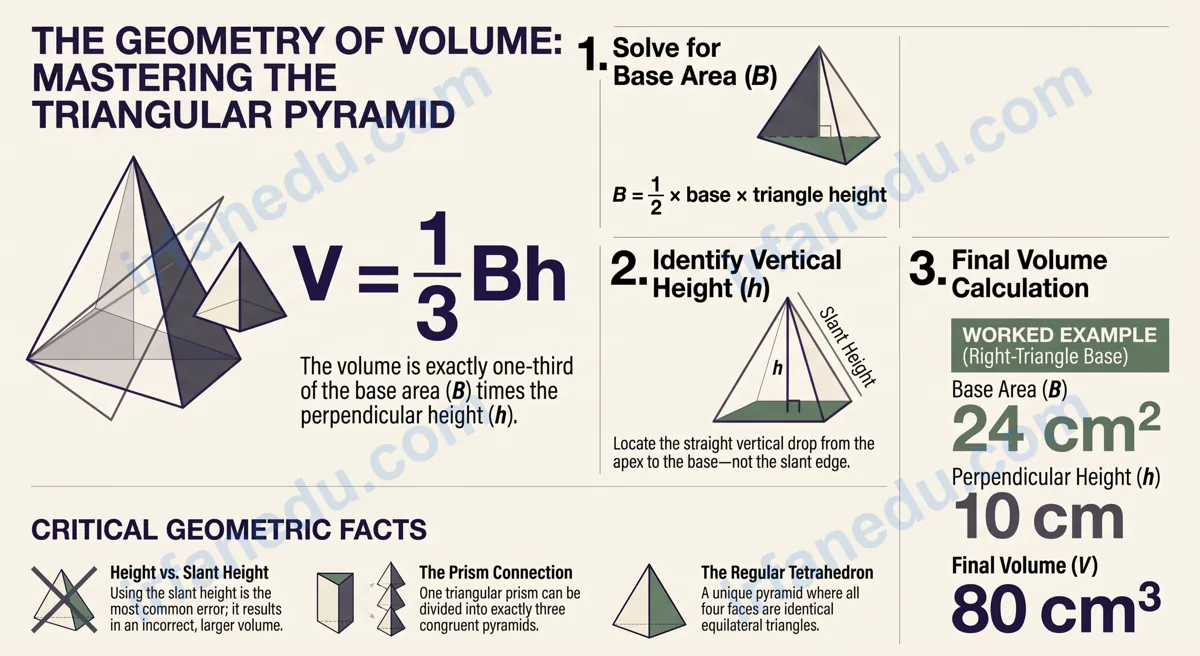
Table of Contents
- Worked Example: Solved Step by Step
- Quick Answer
- TL;DR Summary
- What Is a Triangular Pyramid?
- The Volume Formula Explained
- Step-by-Step Method
- More Worked Examples
- Common Mistakes (and How to Fix Them)
- Triangular vs. Other Pyramids
- Real-World Applications
- Unique Insight
- Practice Quiz
- Practice Problems
- FAQ
- Key Takeaways
- Sources & References
Start Here: A Fully Solved Example
Before I explain any theory, let me show you the whole process in action. Once you see a complete solution, the formula will make perfect sense.
Example Problem
A triangular pyramid has a base that is a right triangle with legs 6 cm and 8 cm. The pyramid’s perpendicular height is 10 cm. Find its volume.
Step 1 — Find the area of the triangular base (B).
The base is a right triangle, so its area is straightforward:
B = ½ × base × height of triangle = ½ × 6 × 8 = 24 cm²
Step 2 — Identify the pyramid’s perpendicular height (h).
The problem states h = 10 cm. This is the vertical distance from the base to the tip (apex) — not the slant edge.
Step 3 — Apply the volume formula.
V = ⅓ × B × h = ⅓ × 24 × 10 = ⅓ × 240 = 80 cm³
Answer: The volume is 80 cm³.
That is the complete process. Every triangular pyramid problem follows those same three steps. Now let me explain why the formula works and how to handle trickier variations.
To find the volume of a triangular pyramid, use V = (1/3) × B × h, where B is the area of the triangular base and h is the perpendicular height. Calculate B first using the triangle area formula, then multiply by h and divide by 3. The result is always in cubic units.
- Understand what “perpendicular height” means (and why it is not the slant height)
- Apply the two-step formula confidently on any triangular pyramid
- Avoid the three most common errors students make
- Solve problems involving equilateral, right-triangle, and scalene bases
⚡ TL;DR – Quick Summary
- Formula: V = (1/3) × B × h — always divide by 3.
- B is the triangular base area: (1/2) × base × triangle height.
- h is the perpendicular height, NOT the slant edge length.
- A regular tetrahedron is a special triangular pyramid with 4 equal faces.
- Volume is always in cubic units (cm³, in³, m³).
- One prism = three identical pyramids — that is why the factor is 1/3.
| Property | Detail |
|---|---|
| Shape name | Triangular pyramid (tetrahedron if all faces equal) |
| Number of faces | 4 (1 triangular base + 3 triangular lateral faces) |
| Number of vertices | 4 |
| Number of edges | 6 |
| Volume formula | V = (1/3) × B × h |
| Base area formula | B = (1/2) × b × hb |
| Regular tetrahedron edge a | V = (a³ × √2) / 12 |
| Units | Always cubic (cm³, m³, in³) |
What Is a Triangular Pyramid?
A triangular pyramid is a 3D solid with a triangular base and three triangular faces that meet at a single point called the apex. It has 4 faces, 4 vertices, and 6 edges.
The most symmetric version — where all four faces are identical equilateral triangles — is called a regular tetrahedron. In everyday geometry problems, though, the base triangle is often a right triangle or a scalene triangle, and the lateral faces are not equal.
Visual: Triangular Pyramid Structure
           Apex (A)
            /|\
           / | \
          /  |  \
         / h |   \
        /    |    \
       /_____|_____\
      C-------M-----B
      |   Base      |
      |  Triangle   |
      |_____________|

  h  = perpendicular height (apex to base)
  M  = foot of the perpendicular on the base
  B,C = base triangle vertices
  Slant edge ≠ h  (common mistake!)
The key measurement you need is the perpendicular height — the straight vertical drop from the apex down to the base plane. This is different from the slant height, which runs along the face of the pyramid.
Why Does the Volume Formula Use One-Third?
The formula V = (1/3) × B × h comes from a geometric proof: any triangular prism with the same base and height can be divided into exactly three congruent pyramids.
A triangular prism has volume Vprism = B × h. Since three identical pyramids fill that prism, each pyramid holds exactly one-third of the prism’s volume. That is where the 1/3 factor comes from — not an arbitrary rule, but a provable geometric fact.
In my experience teaching 3D geometry, students who understand why the 1/3 appears never forget the formula. Those who just memorize it often write V = B × h on a test and lose easy marks. Take 30 seconds to picture three pyramids fitting inside one prism — it is worth it.
The same 1/3 rule applies to any pyramid, regardless of the base shape. A square pyramid, pentagonal pyramid, or triangular pyramid all use V = (1/3) × B × h. The only thing that changes is how you calculate B.
Step-by-Step: How Do You Find the Volume of a Triangular Pyramid?
Follow these five steps every time, and you will get the right answer.
- Identify the base triangle’s dimensions. Find the base length (b) and the height of the triangle (hb) — the perpendicular height inside the triangle, not the pyramid’s height.
- Calculate the base area (B). Use B = (1/2) × b × hb. For special triangles (equilateral, right), use the appropriate shortcut.
- Identify the pyramid’s perpendicular height (h). This is the vertical distance from the base plane to the apex. Confirm it is perpendicular, not slant.
- Apply the formula. V = (1/3) × B × h. Multiply B by h first, then divide by 3.
- State the answer in cubic units. If all lengths were in cm, the volume is in cm³.
More Worked Examples: Three Different Base Types
The base triangle can take many forms. Here are three examples covering the most common types you will see on tests.
Example 2: Equilateral Triangle Base
Problem: A pyramid has an equilateral triangular base with side 6 cm. The pyramid’s height is 9 cm. Find the volume.
Step 1 — Base area of an equilateral triangle with side a:
B = (√3 / 4) × a² = (√3 / 4) × 36 = 9√3 ≈ 15.59 cm²
Step 2 — Apply the volume formula:
V = (1/3) × 9√3 × 9 = 27√3 ≈ 46.77 cm³
Example 3: Scalene Triangle Base (Using Heron’s Formula)
Problem: The base triangle has sides 5 cm, 7 cm, and 8 cm. The pyramid’s height is 12 cm.
Step 1 — Find the base area using Heron’s formula.
Semi-perimeter: s = (5 + 7 + 8) / 2 = 10
B = √(s(s-a)(s-b)(s-c)) = √(10 × 5 × 3 × 2) = √300 = 10√3 ≈ 17.32 cm²
Step 2 — Volume:
V = (1/3) × 10√3 × 12 = 40√3 ≈ 69.28 cm³
Example 4: Regular Tetrahedron (All Edges Equal)
Problem: A regular tetrahedron has all edges = 4 cm. Find its volume.
For a regular tetrahedron with edge a, the shortcut formula is:
V = (a³ × √2) / 12 = (64 × 1.4142) / 12 = 90.51 / 12 ≈ 7.54 cm³
You can verify this by first finding B = (√3/4) × 16 ≈ 6.928 cm², then h = 4 × √(2/3) ≈ 3.266 cm, then V = (1/3) × 6.928 × 3.266 ≈ 7.54 cm³. Both routes agree.
Common Mistakes Students Make (Wrong vs. Right)
These are the errors I see most often when students attempt triangular pyramid problems. Knowing them in advance is a genuine advantage.
| Mistake | Wrong Approach | Correct Approach |
|---|---|---|
| Using slant height instead of perpendicular height | V = (1/3) × B × slant edge | Use the vertical height h from apex to base plane |
| Forgetting the 1/3 factor | V = B × h (prism formula) | V = (1/3) × B × h |
| Confusing base triangle height with pyramid height | Using pyramid height h inside the base area formula | Use hb (triangle’s own height) for B, and h for the pyramid |
| Wrong units | Answering in cm² (area units) | Volume is always cm³ or equivalent cubic unit |
| Mixing unit systems | Base in cm, height in mm | Convert all measurements to the same unit first |
The single most common error I have seen across hundreds of student papers is using the slant edge in place of the perpendicular height. If a problem gives you an edge length and calls it “height,” stop and check: is it truly perpendicular to the base? If the problem says “the apex is directly above the centroid,” then yes — but if it just gives you an edge length, you likely need the Pythagorean theorem to find the true vertical height.
How Does a Triangular Pyramid Compare to Other Pyramids?
The formula V = (1/3) × B × h applies to all pyramids. The only difference is how you calculate B for each base shape.
| Pyramid Type | Base Shape | Base Area Formula | Volume Formula |
|---|---|---|---|
| Triangular pyramid | Triangle | (1/2) × b × hb | (1/3) × (1/2)bhb × h |
| Square pyramid | Square | s² | (1/3) × s² × h |
| Rectangular pyramid | Rectangle | l × w | (1/3) × lw × h |
| Pentagonal pyramid | Pentagon | (5/4) × s² × cot(36°) | (1/3) × Bpentagon × h |
The triangular pyramid is unique because it has the fewest faces of any pyramid — and it is the only pyramid where every face (including the base) is a triangle.
Real-World Applications of Triangular Pyramid Volume
Triangular pyramids appear in architecture, engineering, and nature more often than most students expect.
- Architecture: The Louvre Pyramid in Paris is a square pyramid, but many modern roof structures use triangular pyramid trusses to distribute load efficiently.
- Packaging design: Toblerone chocolate boxes are triangular prisms, but the end caps of certain packaging are triangular pyramids — designers calculate their volume to minimize material waste.
- Crystallography: Tetrahedral molecular geometry (like methane, CH₄) follows the same spatial relationships as a regular tetrahedron.
- Engineering: Structural engineers calculate the volume of pyramid-shaped soil excavations to estimate material removal costs.
- Game design: 3D modelers use tetrahedra as the base mesh unit for complex shapes — knowing volume helps with physics simulations.
[IMAGE: Louvre Pyramid in Paris at sunset, illustrating a real-world pyramid structure | ALT: Glass pyramid structure at the Louvre museum Paris showing triangular pyramid geometry in architecture]
Most textbooks teach the triangular pyramid formula as a standalone rule. What they rarely mention is this: the 1/3 factor is not specific to pyramids — it is a consequence of Cavalieri’s Principle, which states that two solids with equal cross-sectional areas at every height have equal volumes.
This means you can use the same logic to derive the volume of a cone (V = (1/3)πr²h). The triangular pyramid and the cone are governed by the same underlying geometric principle. Once you see this connection, you never need to memorize the cone formula separately — you already understand it.
Practical implication for students: On a test, if you blank on the cone formula, reason from the pyramid formula. Both are (1/3) × base area × height. The base area just changes from a triangle to a circle.
Quick Check: Test Your Understanding
Select an answer — correct ones turn green, wrong ones are crossed out.
1. A triangular pyramid has base area 30 cm² and perpendicular height 6 cm. What is its volume?
Hint: V = (1/3) × 30 × 6
2. The base of a triangular pyramid is a right triangle with legs 4 cm and 5 cm. The pyramid’s height is 9 cm. What is the volume?
Hint: B = (1/2)(4)(5) = 10; V = (1/3)(10)(9)
3. Which measurement is NOT used in the triangular pyramid volume formula?
Hint: The formula only needs B and h (perpendicular).
Reveal-on-Click Practice Problems
Try each problem yourself before clicking to reveal the solution.
Problem 1: A triangular pyramid has a base triangle with base 10 cm and triangle height 6 cm. The pyramid’s height is 15 cm. Find the volume.
Step 1: B = (1/2) × 10 × 6 = 30 cm²
Step 2: V = (1/3) × 30 × 15 = (1/3) × 450 = 150 cm³
Problem 2: A regular tetrahedron has all edges = 6 cm. Find its volume. (Use V = a³√2 / 12)
Step 1: a³ = 6³ = 216
Step 2: V = (216 × 1.4142) / 12 = 305.47 / 12 ≈ 25.46 cm³
Problem 3: The volume of a triangular pyramid is 120 cm³ and its base area is 36 cm². Find the perpendicular height.
Rearrange the formula: h = 3V / B = (3 × 120) / 36 = 360 / 36 = 10 cm
Problem 4: A triangular pyramid has a base that is an equilateral triangle with side 8 cm. Its height is 5 cm. Find the volume.
Step 1: B = (√3/4) × 64 = 16√3 ≈ 27.71 cm²
Step 2: V = (1/3) × 27.71 × 5 ≈ (1/3) × 138.56 ≈ 46.19 cm³
Frequently Asked Questions
What is the formula for the volume of a triangular pyramid?
What is the difference between a triangular pyramid and a tetrahedron?
Why is the volume of a pyramid one-third of a prism?
How do you find the height of a triangular pyramid if it is not given?
What units do you use for pyramid volume?
Can the formula V = (1/3) × B × h be used for any pyramid shape?
How is the volume of a triangular pyramid different from the volume of a triangular prism?
Key Takeaways
- The volume formula for any triangular pyramid is V = (1/3) × B × h.
- Calculate the base area first: B = (1/2) × b × hb.
- Always use the perpendicular height, not the slant height or edge length.
- A regular tetrahedron uses the shortcut V = (a³√2) / 12.
- The 1/3 factor exists because one prism equals three congruent pyramids.
- The same formula structure applies to all pyramids — only B changes.
- Volume is always in cubic units; area is in square units.