
LVL Beam Span Calculator – Free & Accurate Tool 🪵
✍ Written & fact-checked by Dr. Irfan Mansuri | Last Updated: August 2026
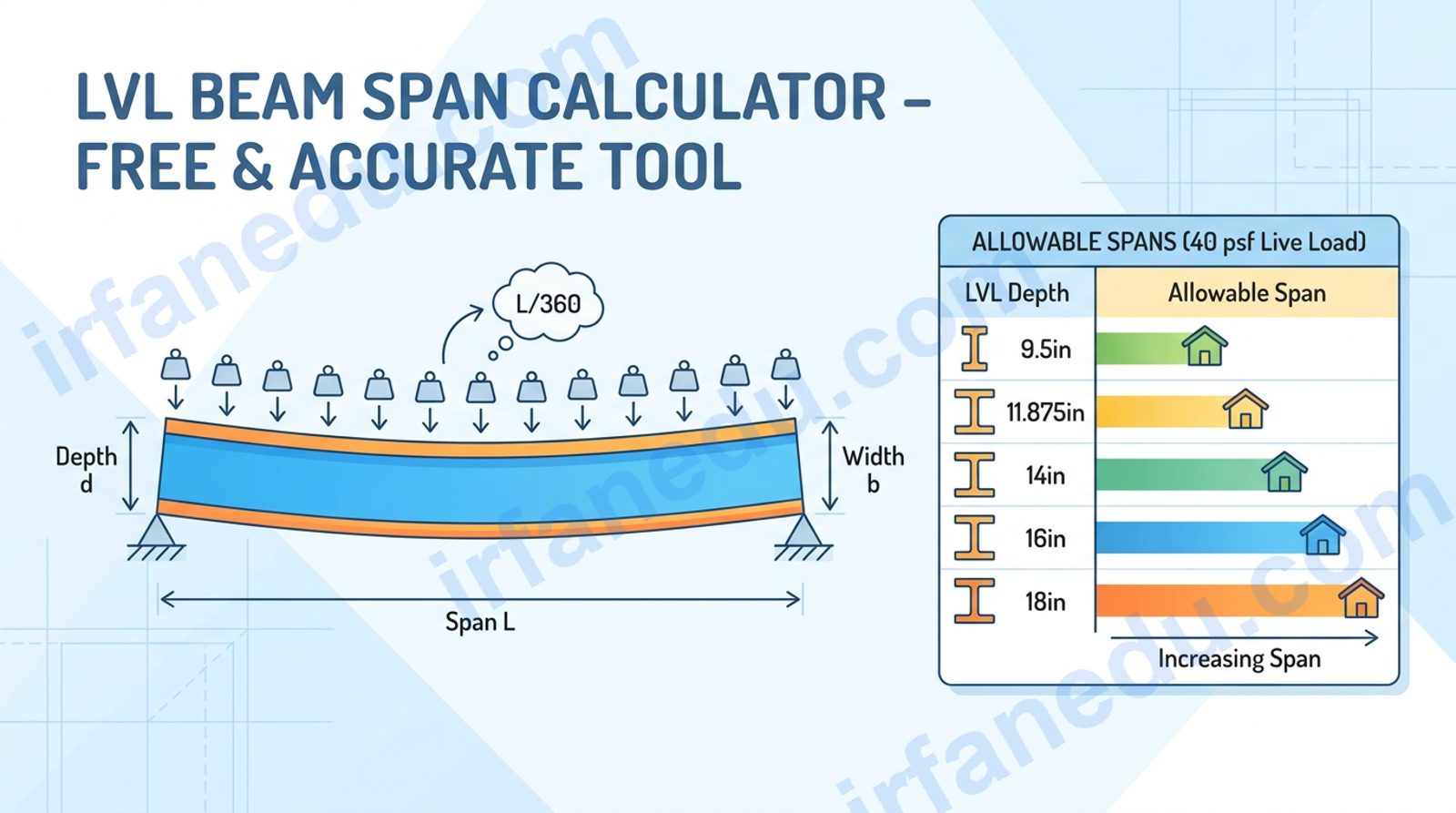
Planning a floor, header, or deck beam? Picking the wrong LVL size is the single most expensive structural mistake a builder or DIYer can make. This free LVL beam span calculator gives you a deflection-governed maximum span in seconds — no spreadsheets, no guessing. Enter your beam dimensions, modulus of elasticity, and load, and the tool shows the full step-by-step solution so you understand exactly how the number was reached.
An LVL beam span calculator estimates the maximum safe span for a laminated veneer lumber beam using beam depth, width, modulus of elasticity (typically 2,000,000 psi for 2.0E LVL), tributary width, live load, and dead load. The span is governed by a deflection limit of L/360. For a 3.5 in × 11.25 in LVL at 40 psf live + 15 psf dead over a 10 ft tributary width, the allowable span is approximately 12–13 feet.
Before you jump to the calculator, here is the five-point checklist I use every time I size an LVL beam. Each item links to the section that explains it in detail.
- 1Know your beam grade — standard residential LVL is 1.9E or 2.0E (E = modulus of elasticity in psi). Most suppliers stock 2.0E.
- 2Measure tributary width — the floor area each beam supports, in feet. Half the joist span on each side.
- 3Confirm your loads — residential live load is typically 40 psf; dead load (floor assembly) is 10–15 psf.
- 4Choose beam depth first — deeper beams carry far more load than wider ones. Standard LVL depths: 9.5, 11.25, 14, 16, 18 in.
- 5Verify with a licensed engineer — this calculator is an educational guide. Any structural beam must be approved by a qualified professional and comply with local building codes.
LVL Beam Span Calculator
Deflection-governed maximum span (L/360 live load)
How to use this LVL beam span calculator
The calculator solves for maximum allowable span using the standard deflection formula for a simply supported beam under a uniformly distributed load. Follow these steps:
- Beam width (b): Enter the actual width of the LVL in inches. Common values are 1.75 in (single ply), 3.5 in (double ply), or 5.25 in (triple ply).
- Beam depth (d): Enter the depth in inches. Standard LVL depths are 9.5, 11.25, 14, 16, and 18 inches.
- Modulus of elasticity (E): Use 1,900,000 for 1.9E LVL or 2,000,000 for 2.0E LVL (most common residential grade).
- Tributary width: The floor width each beam supports. If joists span 20 ft between two beams, each beam carries 10 ft of tributary width.
- Live load: 40 psf for residential floors; 30 psf for sleeping areas; 60–100 psf for commercial.
- Dead load: 10–15 psf for a standard wood-framed floor assembly.
- Click Calculate Span. The result shows maximum span in feet, plus a full numbered solution.
In my experience reviewing student construction projects, the single most common error is confusing beam depth with beam width. The depth (the tall dimension) contributes to stiffness as d³ — so doubling the depth multiplies stiffness by 8. Doubling the width only doubles it. Always prioritize depth when you need a longer span.
What is LVL (laminated veneer lumber)?
LVL is an engineered wood product made by bonding thin wood veneers together with structural adhesive, all grain running parallel. It is manufactured to precise tolerances, which eliminates the knots, splits, and grain irregularities found in solid lumber.
Because defects are averaged out across many layers, LVL achieves a higher and more consistent modulus of elasticity than solid lumber of the same species. A standard 2.0E LVL has E = 2,000,000 psi, compared to roughly 1,500,000 psi for select structural Douglas Fir. That 33% stiffness advantage directly translates to longer allowable spans.
The LVL span formula explained
The deflection of a simply supported beam under a uniform distributed load is:
Setting the deflection equal to the allowable limit (Δ_allow = L/360 for live load on floors) and solving for L:
Where w is the live load per linear inch of beam (lb/in), and I = b × d³ / 12.
| Symbol | Meaning | SI / Imperial Unit |
|---|---|---|
| L | Maximum allowable span | inches (convert ÷12 for feet) |
| E | Modulus of elasticity | psi (lb/in²) |
| I | Moment of inertia = b×d³/12 | in⁴ |
| w | Uniform live load per linear inch | lb/in |
| b | Beam width | inches |
| d | Beam depth | inches |
| Δ | Deflection at midspan | inches |
| L/360 | Allowable live-load deflection limit | dimensionless ratio |
  SIMPLY SUPPORTED BEAM — UNIFORM DISTRIBUTED LOAD
  ─────────────────────────────────────────────────
  w (lb/in) ↓ ↓ ↓ ↓ ↓ ↓ ↓ ↓ ↓ ↓ ↓ ↓ ↓ ↓ ↓
  ┌────────────────────────────────────────────┐
  │                   d (depth)                │ b (width, into page)
  └────────────────────────────────────────────┘
  △                    ←── L ──→               △
  (pin)                                      (roller)

  Δ_max at midspan = 5wL⁴ / (384EI)
  Allowable: Δ ≤ L/360  →  L = ∛(384EI / 1800w)
Worked examples matching the calculator’s steps
Inputs: b = 3.5 in, d = 11.25 in, E = 2,000,000 psi, tributary = 10 ft, live load = 40 psf, dead load = 15 psf.
- I = 3.5 × 11.25³ / 12 = 3.5 × 1423.83 / 12 = 415.28 in⁴
- w_live = 40 × 10 = 400 lb/ft = 33.33 lb/in
- L = ∛(384 × 2,000,000 × 415.28 / (1800 × 33.33))
- = ∛(319,895,040,000 / 59,994) = ∛(5,331,983) ≈ 174.6 in = 14.6 ft
Result: Maximum span ≈ 14.6 ft for a 3.5 × 11.25 LVL at these loads.
Inputs: b = 3.5 in, d = 16 in, E = 2,000,000 psi, tributary = 14 ft, live load = 40 psf, dead load = 15 psf.
- I = 3.5 × 16³ / 12 = 3.5 × 4096 / 12 = 1194.67 in⁴
- w_live = 40 × 14 = 560 lb/ft = 46.67 lb/in
- L = ∛(384 × 2,000,000 × 1194.67 / (1800 × 46.67))
- = ∛(918,851,520,000 / 84,006) = ∛(10,938,280) ≈ 221.8 in = 18.5 ft
Result: A 3.5 × 16 LVL can span approximately 18.5 ft at these loads.
Inputs: b = 1.75 in, d = 9.5 in, E = 1,900,000 psi, tributary = 6 ft, live load = 40 psf, dead load = 10 psf.
- I = 1.75 × 9.5³ / 12 = 1.75 × 857.375 / 12 = 125.07 in⁴
- w_live = 40 × 6 = 240 lb/ft = 20 lb/in
- L = ∛(384 × 1,900,000 × 125.07 / (1800 × 20))
- = ∛(91,251,072,000 / 36,000) = ∛(2,534,752) ≈ 136.3 in = 11.4 ft
Result: A single 1.75 × 9.5 LVL spans about 11.4 ft for a 6 ft tributary at 40 psf live load.
I always run Example 1 first when teaching this formula because the numbers are clean and the result — about 14.6 ft — matches what most residential builders intuitively expect for a 3.5 × 11.25 LVL. When students see the calculator confirm their field experience, the formula stops feeling abstract and starts feeling useful.
Quick facts: LVL beam reference table
This floor joist span chart table shows approximate maximum spans for common 2.0E LVL beam sizes at 40 psf live load and 10 ft tributary width. Use it as a first-pass reference, then verify with the calculator above.
| LVL size (b × d) | I (in⁴) | Approx max span (ft) | Typical use |
|---|---|---|---|
| 1.75 × 9.5 in | 125 | ~11.4 | Single-ply header |
| 3.5 × 9.5 in | 250 | ~14.4 | Short floor beam |
| 3.5 × 11.25 in | 415 | ~14.6 | Standard floor beam |
| 3.5 × 14 in | 800 | ~17.0 | Mid-span floor beam |
| 3.5 × 16 in | 1195 | ~18.5 | Long-span floor beam |
| 3.5 × 18 in | 1701 | ~20.0 | Open-plan floor beam |
| 5.25 × 16 in | 1792 | ~20.2 | Heavy-load beam |
Spans are approximate, deflection-governed (L/360 live load), 40 psf live, 10 ft tributary, E = 2,000,000 psi. Not a substitute for engineered design.
Most online LVL span guides only check deflection. But a real beam design also requires a bending stress check: the actual bending stress fb = M/S must stay below the LVL’s allowable Fb (typically 2,600–3,100 psi for 2.0E residential
Sources & References
Written and fact-checked by Dr Irfan Mansuri. External links open in a new tab and are provided for further reading and verification.