
DMV Permit Practice Test: How to Pass on Your First Try
✍ Written & fact-checked by Dr. Irfan Mansuri | Last Updated: August 2026
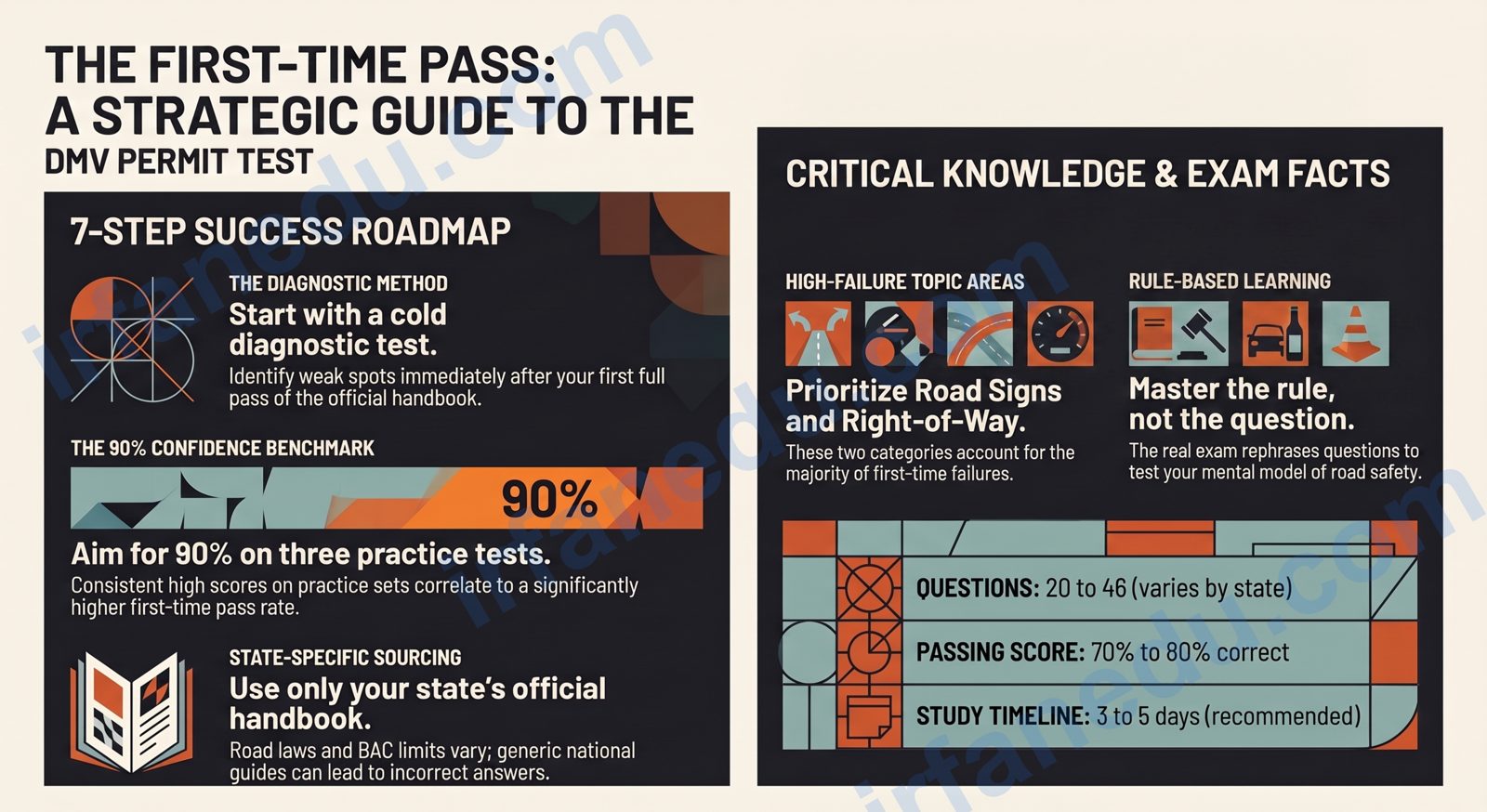
The DMV permit practice test is a free, online simulation of the official written driving knowledge exam. It tests your knowledge of road signs, traffic laws, right-of-way rules, and safe driving behaviors — the exact same topics covered on the real test. Students who score 90% or above on three or more full practice tests before their appointment pass the real exam at a significantly higher rate than those who study only from the handbook.
Here is the result first: you can pass your DMV permit test on the first attempt — and the fastest path there is not reading the handbook cover-to-cover twice. It is taking targeted practice tests, diagnosing your weak spots, and drilling those specific areas. This guide reverse-engineers that outcome and shows you exactly how to get there.
- What the DMV permit practice test covers and how it mirrors the real exam
- A 7-step prep plan that takes you from zero to test-ready
- The 6 topic areas most likely to appear on your test
- Which free and paid resources are actually worth your time
- The most common mistakes that cause first-time failures — and how to avoid them
A DMV permit practice test is a free online simulation of the official written driving knowledge exam required to get a learner’s permit. It covers road signs, traffic laws, right-of-way rules, and safe driving behaviors. Scoring 80% or higher on 3 to 5 full practice tests before your real appointment is the most reliable strategy to pass on your first attempt.
📌 Quick Summary
- The DMV permit test is a written knowledge exam required before you can drive with a learner’s permit.
- Most states use 20 to 46 questions; you need 70-80% correct to pass.
- Practice tests draw from the same question bank as the real exam.
- Take 3 to 5 full practice tests and target 90%+ before your appointment.
- Road signs and right-of-way rules are the most commonly failed topic areas.
- Your state’s official driver handbook is the single most important study resource.
What Is the DMV Permit Practice Test?
The DMV permit practice test is a simulated version of the official written knowledge exam administered by your state’s Department of Motor Vehicles (or equivalent licensing authority). It is designed to test whether a new driver understands the rules of the road before they are allowed to drive with a learner’s permit.
The real test is not a trick exam. Every question on it comes directly from your state’s official driver handbook. Practice tests replicate that question pool, giving you a safe environment to identify gaps before the real appointment counts.
The DMV permit test is not a driving skills test — that comes later, as a separate road test. The permit test is purely written (or computer-based at the DMV office) and covers knowledge, not physical driving ability.
Quick Facts: DMV Permit Test at a Glance
| Fact | Detail |
|---|---|
| Test Format | Multiple-choice, computer-based at the DMV office |
| Number of Questions | 20 to 46 (varies by state) |
| Passing Score | 70% to 80% correct (varies by state) |
| Time Limit | 25 to 60 minutes (most states have no strict time limit) |
| Cost | Included in the permit application fee (typically $5–$35) |
| Retake Policy | 1 to 7 day waiting period after a failure (state-dependent) |
| Languages Available | English + up to 30+ other languages at most DMVs |
| Primary Study Source | Your state’s official driver handbook (free download) |
What to Expect on the Real DMV Permit Exam
The real DMV permit exam is administered on a computer terminal at your local DMV office. You will answer multiple-choice questions — typically with 3 or 4 answer options — covering road signs, traffic laws, and safe driving behaviors.
Most questions present a scenario: “You are approaching an intersection and the traffic light turns yellow. What should you do?” You select the best answer from the options given. There are no essay questions, no diagrams to draw, and no calculations.
What the Test Does NOT Cover
- Physical driving skills (that is the separate road test)
- Vehicle mechanics or engine maintenance
- Navigation or map reading
- Insurance policy details
Practice Test vs Real Test: Key Differences
Understanding what differs between a practice test and the real exam helps you prepare more accurately. The table below shows the most important distinctions.
| Feature | Practice Test | Real DMV Test |
|---|---|---|
| Location | Online, any device | DMV office terminal |
| Cost | Free (most platforms) | Included in permit fee |
| Immediate Feedback | Yes — see right/wrong instantly | No — score shown at end only |
| Retakes | Unlimited, anytime | Waiting period required |
| Question Pool | Drawn from same handbook topics | Official state question bank |
| Exact Questions | Not identical to real test | Official, standardized |
| Stress Level | Low — no consequences | Higher — official record |
| Best Use | Diagnosis + repetition | Final assessment |
Step-by-Step Prep Plan: How to Pass the DMV Permit Test
This 7-step plan is the most efficient path from zero knowledge to a passing score. Follow it in order — skipping steps, especially Step 1, is the most common reason students fail.
-
Get Your State’s Official Driver Handbook
Download the free PDF from your state’s DMV website. This is the only source the real test questions are drawn from. Do not rely on a generic “national” handbook — road laws vary by state. -
Read the Handbook Actively (One Full Pass)
Read it once from start to finish. Highlight or note road signs, speed limits, right-of-way rules, and DUI/DWI penalties. Do not skip the sections on parking or special vehicles — they appear on the test more than most students expect. -
Take One Diagnostic Practice Test
Take a full practice test without reviewing further. Your score on this cold run tells you exactly which topic areas need the most work. Treat it as a map, not a grade. -
Study Your Weak Areas by Topic
Go back to the handbook sections that correspond to your missed questions. Focus hardest on road signs and right-of-way — these two areas account for the majority of first-time failures. -
Take 3 to 5 More Practice Tests (Different Sets)
Use different practice test sets each time so you are not memorizing question order. Aim for 90% or above on each test before you consider yourself ready. Scoring 80% on practice tests typically correlates with a borderline pass on the real exam. -
Review Every Wrong Answer Immediately
After each practice test, read the explanation for every question you got wrong before moving on. Understanding the rule behind the answer matters far more than memorizing the answer itself. -
Schedule Your DMV Appointment and Arrive Prepared
Book your appointment online (most DMVs allow this). Bring your required documents. Read every question fully on the real test before selecting an answer — rushing is the most common cause of avoidable errors.
  DMV PERMIT TEST — 5-DAY STUDY TIMELINE
  ─────────────────────────────────────────────────────────
  Day 1  │  Read handbook Chapters 1-3 (signs, signals)
  Day 2  │  Read handbook Chapters 4-6 (laws, right-of-way)
         │  Take Diagnostic Practice Test → note weak areas
  Day 3  │  Re-read weak sections + Take Practice Test #2
  Day 4  │  Take Practice Tests #3 and #4 (different sets)
         │  Review all wrong answers with explanations
  Day 5  │  Final Practice Test #5 → aim for 90%+
         │  Quick review of road signs flashcards
  Test   │  Arrive early, read each question fully, stay calm
  ─────────────────────────────────────────────────────────
  Target: 90%+ on practice = strong pass on real exam
The 6 Topic Areas You Must Know
Every DMV permit test question falls into one of six topic categories. Knowing which categories carry the most weight helps you allocate your study time efficiently.
1. Road Signs and Signals
Road sign questions are the single most common category on the permit test. You must recognize signs by shape and color, not just text. A red octagon always means stop. A yellow diamond always means warning. Practice identifying signs without reading the words — the real test sometimes shows sign shapes without labels.
2. Right-of-Way Rules
Right-of-way questions are the most commonly missed. They test scenarios: who goes first at a four-way stop, who yields when merging, and what to do when an emergency vehicle approaches. The rule of thumb: yield to whoever arrived first, or to the vehicle on the right when in doubt.
3. Speed Limits and Safe Following Distance
Know the default speed limits for residential streets, school zones, and highways in your state. The 3-second following distance rule applies in normal conditions; increase to 4 to 6 seconds in rain, fog, or heavy traffic.
4. Traffic Laws and Procedures
This covers lane changes, turning procedures, U-turns, and passing rules. Pay attention to where U-turns are prohibited and the correct procedure for turning left at a multi-lane intersection.
5. Alcohol, Drugs, and Impaired Driving
DUI/DWI questions appear on every state’s permit test. Know the legal blood alcohol concentration (BAC) limit (0.08% for adults in most US states; 0.00-0.02% for drivers under 21), the consequences of refusal to take a breathalyzer test, and the definition of implied consent.
6. Special Situations and Sharing the Road
This includes rules for school buses (when to stop, when you do not need to), railroad crossings, bicyclists, pedestrians, and driving in adverse weather. These questions are less frequent but are often the ones that trip up otherwise well-prepared students.
Free vs Paid DMV Practice Test Resources: Which Is Worth It?
You do not need to spend money to pass the DMV permit test. But not all free resources are equal. Here is a direct comparison of the main options.
| Resource | Cost | State-Specific | Explanations | Verdict |
|---|---|---|---|---|
| State DMV Official Site | Free | Yes | Limited | Best starting point |
| DMV.org Practice Tests | Free | Yes | Yes | Good for extra reps |
| Zutobi / Aceable | Paid ($15–$30) | Yes | Yes | Worth it if you failed before |
| Generic “National” Sites | Free | No | Varies | Risky — laws vary by state |
| Your State’s Driver Handbook | Free | Yes | Yes (full context) | Most important resource |
Common Mistakes That Cause First-Time Failures
Most first-time failures are not caused by lack of intelligence — they are caused by specific, avoidable preparation mistakes. Here are the most frequent ones I see.
- Skipping the driver handbook entirely and relying only on practice tests. Practice tests are a diagnostic tool, not a replacement for the source material.
- Memorizing answers without understanding the rule. The real test rephrases questions. If you know the rule, the phrasing does not matter.
- Using a non-state-specific practice test. Road laws vary. A practice test not calibrated to your state can teach you the wrong answer.
- Taking only one or two practice tests. One test is not enough to identify all weak areas. Three to five tests give you a reliable picture.
- Cramming the night before. Spaced study over 3 to 5 days produces significantly better retention than a single long session.
- Rushing through questions on the real test. Read every word. Many questions hinge on a single word like “always,” “never,” or “except.”
Most guides tell you to “study the handbook and take practice tests.” That is correct but incomplete. The real insight is this: your diagnostic practice test score is more valuable than your final practice test score. Students who score 60% on their first cold practice test and then systematically target each missed topic area consistently outperform students who score 75% on their first test and then just repeat the same practice test until they memorize it. The mechanism matters: you are building a mental model of road rules, not a lookup table of memorized answers. The real exam will rephrase questions. Your mental model will not fail you; a memorized answer bank will.
In my experience working with students preparing for high-stakes tests, the DMV permit test is one of the most underestimated exams people take. Because it is not an academic test, many students assume casual preparation is enough. The ones who fail are almost always the ones who took two practice tests, scored 78%, and assumed that was sufficient. The ones who pass confidently are the ones who treated it like any other exam: systematic study, multiple diagnostic rounds, and deliberate review of every wrong answer. The subject matter is not difficult. The preparation discipline is what separates a first-time pass from a second appointment.
Quick Knowledge Check
Test your understanding with these three questions. Select an answer to see instant feedback.
DMV Permit Test — 3-Question Check
1. At a four-way stop, two cars arrive at exactly the same time. Who has the right of way?
2. What is the legal BAC limit for adult drivers (21+) in most US states?
3. A yellow diamond-shaped road sign indicates:
Frequently Asked Questions
How Many Questions Are on the DMV Permit Test?
Are DMV Permit Practice Tests the Same as the Real Test?
How Many Practice Tests Should I Take Before the Real Exam?
What Happens If I Fail the Permit Test?
Is the DMV Permit Test Available in Languages Other Than English?
Key Takeaways
- The DMV permit test is a written knowledge exam drawn entirely from your state’s official driver handbook.
- Most states require 70-80% correct to pass; scoring 90%+ on practice tests gives you a comfortable margin.
- Take 3 to 5 full practice tests using state-specific resources — not generic national sites.
- Road signs and right-of-way rules are the most commonly failed topic areas; prioritize them.
- Understand the rule behind each answer, not just the answer itself — the real test rephrases questions.
- Spaced study over multiple days outperforms cramming every time.
- Your diagnostic (first cold) practice test score is your most valuable planning tool.