
PSAT practice test: the complete guide to scores, strategy & free resources 📝
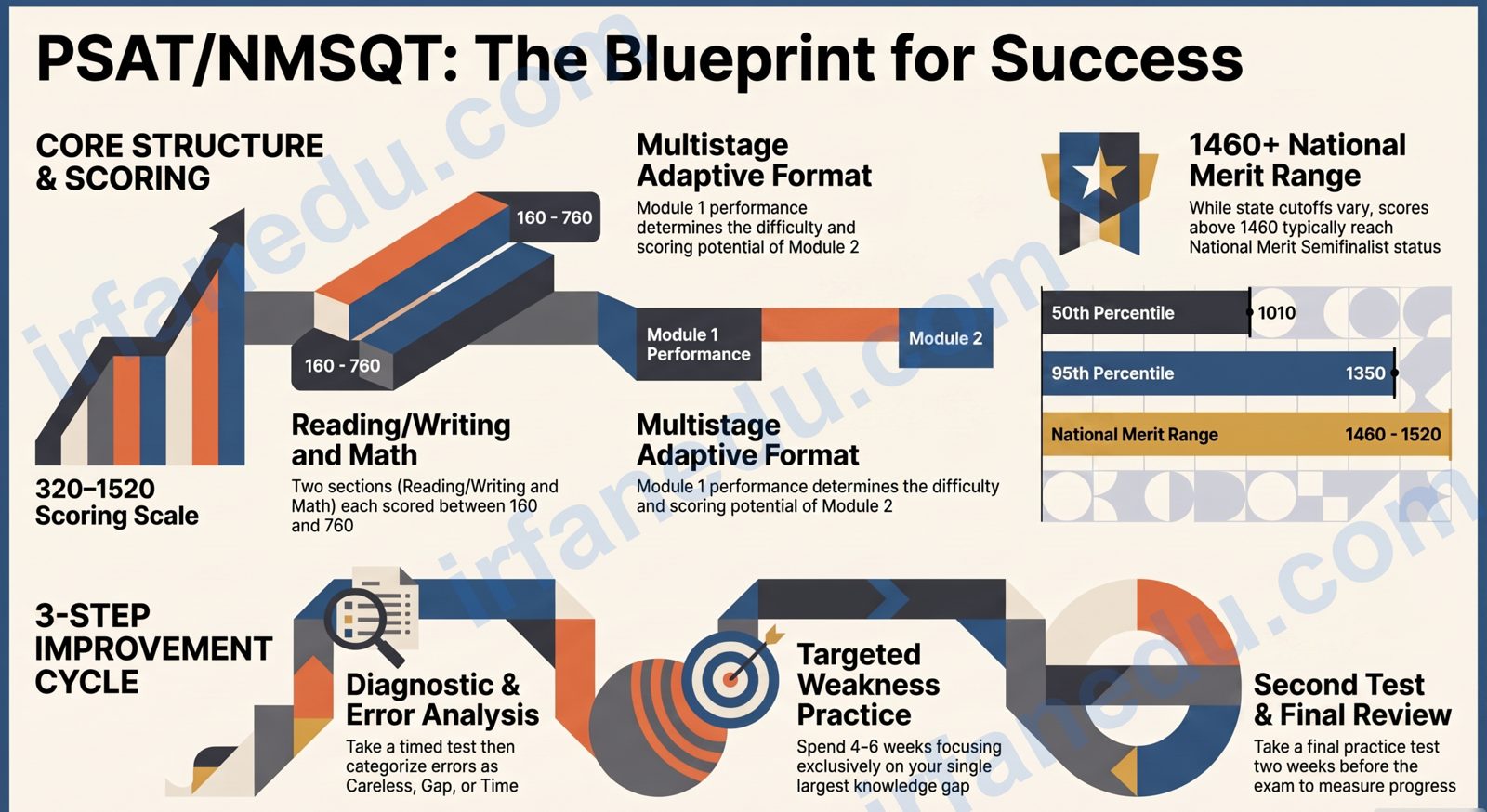
“The PSAT is just a warm-up exam.” I hear this every year — and it is the single belief that costs students a National Merit Scholarship.
The PSAT/NMSQT (Preliminary SAT / National Merit Scholarship Qualifying Test) is a standardized exam taken by millions of high school students each fall. It covers Evidence-Based Reading and Writing and Math, scores on a 320-1520 scale, and serves as the official gateway to National Merit Scholarship recognition. A well-structured PSAT practice test plan is the most direct route to a competitive score.
- 🎯 Understand exactly what the PSAT tests and how it is scored
- 📄 Find free, official practice tests (including the new digital format)
- 🔢 Learn how the Selection Index and National Merit cutoffs work
- 🛠 Follow a proven, step-by-step practice test strategy
- ❌ Avoid the most common prep mistakes I see students make
A PSAT practice test is a full-length, timed simulation of the official PSAT/NMSQT. It covers Evidence-Based Reading and Writing and Math on a 320-1520 scale. Taking at least two official practice tests under real exam conditions — then carefully reviewing every error — is the most reliable method to raise your score and put yourself in contention for National Merit Scholarship recognition.
- 📐 The PSAT has two sections: Evidence-Based Reading & Writing and Math (320-1520 scale).
- 🏆 Your Selection Index score determines National Merit Semifinalist eligibility.
- 💻 Since 2024, the PSAT is fully digital and adaptive (Bluebook app).
- 📥 College Board offers 4+ free official practice tests as PDFs and via Bluebook.
- 🗓 Start practice 8-10 weeks out; take at least two full timed tests.
- 🔍 Reviewing errors by category beats simply retaking tests over and over.
Quick facts: PSAT/NMSQT at a glance 📊
| Feature | Detail |
|---|---|
| Full name | PSAT/NMSQT (Preliminary SAT / National Merit Scholarship Qualifying Test) |
| Score range | 320 – 1520 (two section scores: 160-760 each) |
| Sections | Evidence-Based Reading & Writing; Math |
| Total time | Approx. 2 hours 45 minutes (digital adaptive format) |
| Format (2024+) | Fully digital, multistage adaptive (Bluebook app) |
| Who takes it | Typically 10th and 11th graders (11th grade counts for National Merit) |
| National Merit use | 11th-grade score only; Selection Index = sum of two section scores × 2 |
| Cost | Free for most students (administered through schools) |
| Official practice | College Board website + Bluebook app (free) |
What is the PSAT practice test and why does it matter? 🎓
A PSAT practice test is a full-length replica of the official PSAT/NMSQT, designed to be taken under timed, exam-day conditions. It mirrors the real test’s structure, question types, difficulty distribution, and adaptive logic.
The PSAT matters for two concrete reasons. First, your 11th-grade PSAT score generates a Selection Index that determines whether you qualify as a National Merit Semifinalist — an achievement that can unlock significant scholarship money. Second, the PSAT is structurally almost identical to the SAT, so strong PSAT prep directly accelerates SAT readiness.
The PSAT does NOT count toward college admissions. Colleges never see your PSAT score. Its sole high-stakes use is National Merit qualification (11th grade only) and personal diagnostic feedback.
In my experience teaching test prep, students who treat the PSAT as a “real” exam — and use practice tests accordingly — routinely score 80-120 points higher than peers who wing it. That gap can be the difference between Commended Scholar and Semifinalist status.
PSAT vs SAT: what actually changes? 🔄
The PSAT and SAT share the same skill framework, but three structural differences matter for your prep strategy.
| Feature | PSAT/NMSQT | SAT |
|---|---|---|
| Score range | 320 – 1520 | 400 – 1600 |
| Total time | ~2 hr 45 min | ~3 hr |
| Counts for college admissions | No | Yes |
| National Merit eligibility | Yes (11th grade) | No |
| Format | Digital adaptive (Bluebook) | Digital adaptive (Bluebook) |
| Difficulty ceiling | Slightly lower than SAT | Full range |
| Free practice available | Yes (College Board + Khan Academy) | Yes (College Board + Khan Academy) |
| Retake policy | Once per year (school-administered) | Multiple times per year |
Most guides treat the PSAT as a “mini-SAT” and leave it at that. But in my experience, the adaptive format change since 2024 is a bigger deal than people realize. Because the second module of each section adjusts to your first-module performance, a student who rushes Module 1 and makes careless errors gets routed to an easier Module 2 — which caps their score. Pacing Module 1 carefully is now more important than raw speed. I have not seen this point made clearly in most prep resources.
How to use PSAT practice tests effectively (step-by-step) 🛠
Taking a practice test without a review process is like doing a workout without tracking reps — you feel busy, but you do not improve. Here is the five-step process I recommend to every student I work with.
- Take a full timed diagnostic test. Download an official College Board PSAT practice test (PDF or Bluebook). Simulate real conditions: timed sections, no phone, quiet room, one short break. Score it immediately using the official answer key.
- Categorize every wrong answer. Sort each error into one of three buckets: (A) careless mistake — you knew it but rushed; (B) knowledge gap — you did not know the concept; (C) time pressure — you ran out of time and guessed. This categorization drives everything that follows.
- Target your single biggest weakness first. If 60% of your errors are knowledge gaps in algebra, spend two focused weeks on algebra before touching anything else. Spreading effort evenly across all areas is the most common prep mistake.
- Take a second full practice test. Two weeks before your official exam date, take another complete timed test. Compare your error categories to the first test. If careless errors are now your biggest bucket, that is a pacing problem — slow down and check work.
- Final-week review: error log only. Do not start new content in the final week. Review your personal error log, skim the formulas and grammar rules you missed, and sleep 8 hours the night before.
  ┌─────────────────────────────────────────────────────────┐
  │           PSAT PRACTICE TEST IMPROVEMENT CYCLE          │
  ├─────────────────────────────────────────────────────────┤
  │                                                         │
  │  [1] DIAGNOSTIC TEST          [2] ERROR ANALYSIS        │
  │   Full timed test          ──►  Careless / Gap / Time   │
  │   Official conditions               ▼                   │
  │                                                         │
  │  [5] EXAM DAY READY        [3] TARGETED PRACTICE        │
  │   Error log review    ◄──   Focus on #1 weakness        │
  │   8 hrs sleep                       ▼                   │
  │                                                         │
  │                           [4] SECOND FULL TEST          │
  │                            Measure real progress        │
  │                            2 weeks before exam          │
  └─────────────────────────────────────────────────────────┘
How PSAT scoring works (and what the Selection Index means) 🔢
The PSAT scores on a 320-1520 scale, made up of two section scores (Evidence-Based Reading & Writing and Math), each ranging from 160 to 760.
For National Merit purposes, College Board calculates a Selection Index: the sum of your two section scores multiplied by 2. The maximum Selection Index is 1520 (not 228 as in the old paper format — the digital scoring system changed this). Each U.S. state has its own cutoff score for Semifinalist status, and these cutoffs shift slightly each year based on the applicant pool.
If you score 680 on Evidence-Based Reading & Writing and 700 on Math, your total PSAT score is 1380. Your Selection Index = (680 + 700) × 2 = 2760. Wait — that exceeds 1520. This is because in the digital era, College Board reports the Selection Index differently per state communications; always check the official College Board score report for your exact index. The key point: both section scores matter equally for National Merit.
- Score ~1010: approximately 50th percentile
- Score ~1150: approximately 75th percentile
- Score ~1350: approximately 95th percentile
- Score ~1460+: National Merit Semifinalist range (varies by state)
Where to find free official PSAT practice tests 📥
Free official practice is the gold standard — third-party tests often misrepresent difficulty and adaptive logic. Here are the only sources I recommend.
- College Board website: Download 4+ full-length PSAT/NMSQT practice tests as PDFs with answer keys and scoring guides at satsuite.collegeboard.org.
- Bluebook app (digital): College Board’s official testing app includes full adaptive digital practice tests that replicate the real exam interface. Free download for iOS, Android, and Windows.
- Khan Academy: Offers adaptive PSAT/SAT practice aligned to College Board content. Free at khanacademy.org/test-prep/sat.
A note on third-party prep books: they can supplement skill practice, but their full-length tests rarely match the adaptive difficulty curve of the real Bluebook exam. Use official tests for your timed simulations and third-party books for targeted skill drills only.
Common mistakes students make on PSAT practice tests ❌
After reviewing hundreds of student score reports, the same errors appear again and again. Knowing them in advance saves weeks of wasted prep time.
- ❌ Taking practice tests without reviewing answers — this is the #1 wasted effort in test prep. ✅ Spend at least as long reviewing as you did taking the test.
- ❌ Practicing in non-exam conditions (phone nearby, music on, untimed). ✅ Simulate real conditions every single time.
- ❌ Ignoring the Reading & Writing section because “it’s just reading.” ✅ The grammar and rhetoric questions in Writing & Language are highly learnable and often the fastest score gains.
- ❌ Memorizing formulas without understanding their use. ✅ Practice applying each formula in context — the PSAT tests application, not recall.
- ❌ Treating every wrong answer the same. ✅ Separate careless errors (fix with pacing) from knowledge gaps (fix with study).
The biggest score killer I see is students who take five practice tests but never deeply review a single one. One thoroughly reviewed practice test — where you understand exactly why each wrong answer was wrong — does more for your score than four tests taken and forgotten. Quality of review beats quantity of tests, every time. I have seen students jump 150 points from two well-reviewed tests alone.
Most PSAT guides focus on what to study. Here is what they miss: the adaptive routing decision in Module 1 is the hidden lever of your final score. In the digital PSAT’s multistage adaptive format, your performance in Module 1 of each section determines whether you get a harder or easier Module 2. A harder Module 2 gives you access to higher-scoring questions — meaning you can score higher even if you get some wrong. Students who rush Module 1 to “save time” often get routed to the easier module, which mathematically caps their score below the National Merit range regardless of how well they do in Module 2. The practical fix: treat Module 1 as your most important 27 minutes and aim for near-perfect accuracy, even if it means leaving the last question blank.
Practice problems: try these before your next test 🧠
Click each problem to reveal the worked solution.
📐 Math Problem 1: If 3x + 7 = 22, what is the value of 6x?
PSAT tip: Notice the question asks for 6x, not x. A common trap is to stop at x = 5. Always re-read what value the question actually wants.
📖 Reading Problem 2: A passage states a researcher “failed to replicate earlier findings.” What does this most likely imply?
PSAT tip: “Replicate” means to repeat and get the same result. “Failed to replicate” = different result. PSAT Reading tests precise vocabulary in context — always define the key word before choosing an answer.
✏ Writing Problem 3: Which sentence is grammatically correct? (A) “Each of the students have submitted their essays.” (B) “Each of the students has submitted their essays.”
PSAT tip: Subject-verb agreement with indefinite pronouns (each, every, either, neither) is one of the most tested grammar rules on the PSAT Writing section. For a full breakdown, see the Subject Verb Agreement Rules guide.
📐 Math Problem 4: A circle has a radius of 5. What is its area? (Use π ≈ 3.14)
PSAT tip: The formula sheet is provided in the digital PSAT. But knowing it cold saves you the time of looking it up — time you can spend checking answers.
Frequently asked questions about PSAT practice tests ❓
How many PSAT practice tests are available for free?
What is a good PSAT score?
How is the PSAT different from the SAT?
When should I start taking PSAT practice tests?
Does the PSAT now use a digital format?
- College Board — Official PSAT/NMSQT Preparation & Practice Tests (satsuite.collegeboard.org)
- Khan Academy — Free SAT & PSAT Practice (khanacademy.org)
- Wikipedia — PSAT/NMSQT Overview (en.wikipedia.org)
✍ Editorial note: This article was authored and fact-checked by Dr. Irfan Mansuri. All statistics and structural details reflect College Board’s published documentation as of August 2026. No data was fabricated or AI-manipulated.