
Attorneys for traffic: your complete guide to hiring a traffic lawyer
✍ Written & fact-checked by Dr. Irfan Mansuri | Last Updated: August 2026
Fact vs fiction: common myths about traffic attorneys
Before anything else, let me clear up the misinformation that stops most people from making a smart decision about legal help. The table below captures the six most damaging myths I hear from students and first-time drivers — and the reality behind each one.
| Myth (what people believe) | Fact (what is actually true) |
|---|---|
| Traffic attorneys are only for serious crimes like DUI. | Attorneys handle everything from speeding tickets to licence suspensions — not just criminal charges. |
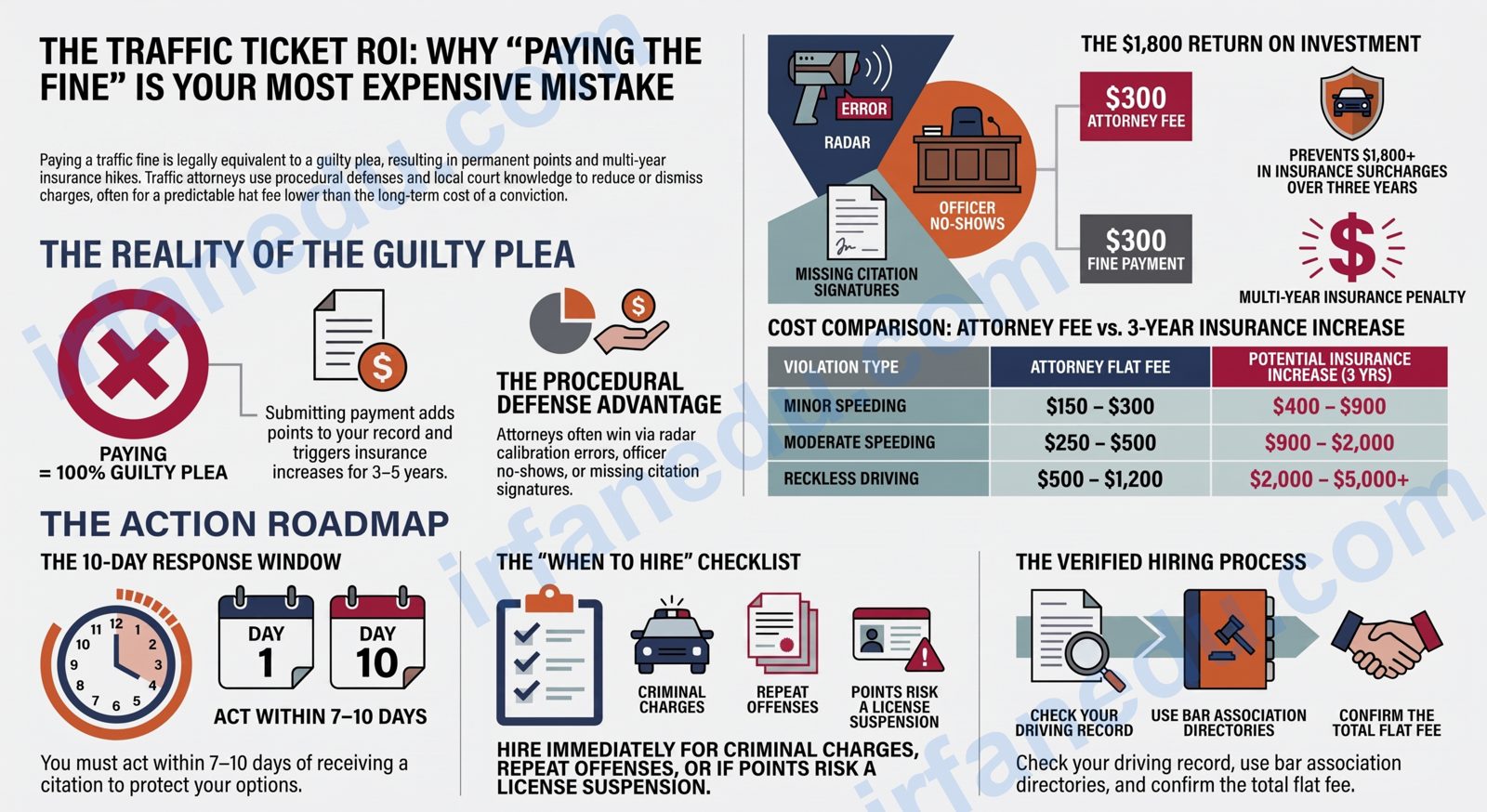
| Hiring a lawyer always costs more than just paying the fine. | A $300 attorney fee can prevent thousands in insurance premium increases over 3–5 years. |
| If you were speeding, there is no defence. | Procedural errors, uncalibrated radar guns, and officer no-shows get tickets dismissed regularly. |
| You must attend court yourself even with an attorney. | In most jurisdictions, your attorney appears on your behalf and you never need to enter the courtroom. |
| All traffic lawyers charge by the hour and get expensive fast. | Most traffic attorneys charge a flat fee — you know the total cost upfront before agreeing to anything. |
| Paying the fine quickly closes the case cleanly. | Paying the fine is a guilty plea. It adds points to your record and can raise your insurance for years. |
An attorney for traffic violations is a licensed lawyer who represents clients in traffic court. They fight speeding tickets, reckless driving charges, DUI citations, and licence suspensions. Their job is to reduce your fine, prevent points on your driving record, and protect your insurance premiums — or get the charge dismissed entirely.
Whether you just received your first speeding ticket or you are facing a more serious charge, understanding how traffic attorneys work — and when they are worth the cost — is genuinely useful knowledge. I have spent years explaining legal processes to students, and the single biggest mistake I see is paying a fine without understanding what that payment actually means for your record.
- You will learn exactly what a traffic attorney does and does not do.
- You will know when hiring one makes financial sense and when it does not.
- You will get a step-by-step process for finding and hiring the right lawyer.
- You will understand the real cost — both of the attorney and of NOT hiring one.
⚡ TL;DR
- Traffic attorneys fight citations in court — they are not just for DUI cases.
- Paying a fine = a guilty plea that adds points and raises insurance premiums.
- Most charge a flat fee of $150–$500 for minor violations.
- Hire one when points, licence suspension, or criminal charges are at risk.
- Common defences include radar errors, procedural defects, and officer no-shows.
- Find attorneys via your bar association’s referral directory, not random ads.
Table of Contents
- Fact vs fiction: common myths
- What is an attorney for traffic violations?
- Quick facts
- When should you hire a traffic attorney?
- What does a traffic attorney actually do?
- How to hire a traffic attorney: step-by-step
- How much does a traffic attorney cost?
- Common defences traffic attorneys use
- Self-representation vs attorney: comparison
- Unique insight
- Pre-hire checklist
- Quick knowledge check
- Frequently asked questions
- Key takeaways
- Related articles
- About the author
- Sources & references
What is an attorney for traffic violations?
A traffic attorney is a lawyer who specialises in the area of law that governs how people operate vehicles on public roads. They represent clients at every level of traffic court, from a simple speeding ticket to a felony vehicular charge.
Traffic law sits at the intersection of civil and criminal law. Minor infractions — running a stop sign, a small speeding ticket — are civil matters. Reckless driving, driving under the influence, and hit-and-run are criminal matters. A qualified traffic attorney knows both sides and adjusts their strategy accordingly.
The term “traffic attorney” is often used interchangeably with “traffic ticket lawyer” or “traffic violation lawyer.” They all refer to the same professional. Some attorneys focus exclusively on traffic cases; others handle traffic as part of a broader criminal defence or personal injury practice.
Quick Facts
| Also called | Traffic ticket lawyer, traffic violation attorney, traffic court lawyer |
| Typical flat fee (minor) | $150 – $500 |
| Typical flat fee (serious) | $500 – $2,000+ |
| Free consultation? | Yes — most offer one |
| Do you attend court? | Usually not — attorney appears for you |
| Common outcomes | Dismissal, reduced charge, deferred adjudication, traffic school |
| Best time to hire | Within 7–10 days of receiving the citation |
When should you hire a traffic attorney?
You should hire a traffic attorney any time the consequences of a conviction go beyond a small fine. The decision comes down to four factors: the severity of the charge, your current driving record, the potential insurance impact, and whether criminal penalties are possible.
Here is a practical decision framework. If you answer “yes” to any of the following, hiring an attorney is almost certainly worth it:
- The ticket carries licence points that could push you toward suspension.
- The charge is reckless driving, DUI, or any criminal traffic offence.
- You already have points on your record from a previous violation.
- You drive for work and a licence suspension would cost you your job.
- Your insurance company has already flagged you as a high-risk driver.
- The fine is over $500 (the attorney fee may be comparable, but the insurance savings are not).
On the other hand, if it is your first-ever minor infraction, the fine is under $150, and no points attach to the violation in your jurisdiction, paying the fine or attending traffic school is often the simpler path. The key is knowing the difference — and most people do not, because they never check whether their specific violation carries points.
What does a traffic attorney actually do?
A traffic attorney performs four core functions: case review, negotiation, court representation, and record management. Each one has a direct impact on your outcome.
Case review: The attorney reads your citation carefully, checks the officer’s notes, requests radar calibration records, and looks for procedural errors. Many tickets contain small errors — wrong date, wrong vehicle description, missing officer signature — that can lead to dismissal.
Negotiation: Before a case ever reaches a judge, the attorney negotiates with the prosecutor. The goal is a plea to a lesser charge — for example, converting a speeding ticket to a non-moving violation like “improper equipment,” which carries no points and does not appear on a standard driving record check.
Court representation: If the case goes to trial, the attorney cross-examines the officer, challenges the evidence, and presents your defence. You typically do not need to appear at all for minor violations.
Record management: After a favourable outcome, the attorney can advise on expungement or record sealing where applicable, so the incident does not follow you for years.
  Did you receive a traffic citation?
             |
             v
  Is it a criminal charge (DUI, reckless driving)?
       YES ──────────────────────> HIRE AN ATTORNEY immediately
       |
       NO
       |
       v
  Does the violation carry licence points?
       YES ──────────────────────> STRONGLY consider an attorney
       |
       NO
       |
       v
  Is this your second+ offence in 3 years?
       YES ──────────────────────> Consult an attorney
       |
       NO
       |
       v
  Is the fine under $150 and no points at risk?
       YES ──────────────────────> Pay fine or attend traffic school
       NO  ──────────────────────> Get a free consultation first
How to hire a traffic attorney: step-by-step
Hiring a traffic attorney is simpler than most people expect. Follow these six steps to find a qualified lawyer quickly and avoid overpaying.
- Assess the charge severity. Determine whether the ticket is a minor infraction, a moving violation with points, or a criminal charge. This sets your budget and urgency.
- Check your driving record. Request your current record to see existing points. Many jurisdictions let you do this online for a small fee. Knowing your point total changes the conversation with any attorney.
- Search a verified legal directory. Use your country or state bar association’s referral service, or a verified directory like Avvo or Martindale-Hubbell. Avoid random ads — verify the attorney is licensed in your jurisdiction.
- Book a free consultation. Bring your citation, driving record, and any evidence (dashcam footage, photos of road conditions). Ask the attorney directly: “What outcome do you expect, and what does your flat fee cover?”
- Compare two or three attorneys. Do not hire the first one you speak to. Compare fees, experience in your specific court, and communication style. A $50 price difference matters far less than local court experience.
- Hire and respond to the court deadline. Once hired, your attorney files a not-guilty plea before the response deadline on your citation. Missing this deadline removes your options — act within 7–10 days of receiving the ticket.
How much does a traffic attorney cost?
Most traffic attorneys charge a flat fee, not an hourly rate. The flat fee covers everything: consultation, filing, negotiation, and court appearances. You know the total cost before you agree to anything.
| Violation type | Typical fine | Attorney flat fee | Potential insurance increase (3 yrs) |
|---|---|---|---|
| Minor speeding (1–15 mph over) | $100 – $200 | $150 – $300 | $400 – $900 |
| Moderate speeding (16–30 mph over) | $200 – $500 | $250 – $500 | $900 – $2,000 |
| Reckless driving | $500 – $1,500 | $500 – $1,200 | $2,000 – $5,000+ |
| DUI / DWI (first offence) | $1,000 – $5,000+ | $1,500 – $5,000+ | $5,000 – $15,000+ |
| Licence suspension hearing | Varies | $300 – $800 | Significant if not contested |
The insurance column is the number most people ignore. A single speeding conviction can raise your annual premium by $300–$700 per year for three to five years. An attorney who charges $300 and gets the ticket dismissed saves you $900–$3,500 in insurance costs alone. That is the real return on investment.
Common defences traffic attorneys use
Traffic attorneys do not just argue that you were not speeding. They use a range of technical and procedural defences that most drivers do not know exist.
Radar and LIDAR calibration errors: Speed-measuring devices must be calibrated regularly. If the officer cannot produce calibration records, the speed reading is inadmissible. Experienced attorneys routinely request these records as a first step.
Officer absence: If the issuing officer does not appear at the scheduled hearing, the case is typically dismissed. Attorneys know how to schedule hearings strategically to maximise this possibility.
Procedural defects in the citation: A ticket with the wrong date, wrong vehicle plate, or missing required information can be challenged. Courts have strict rules about what a valid citation must contain.
Necessity defence: In rare cases, a driver can argue they violated a traffic law to prevent a greater harm — for example, speeding to get an injured passenger to a hospital. This is a narrow defence but a real one.
Improper signage: If a speed limit sign was obscured, missing, or non-compliant with road standards, the attorney can argue you had no reasonable notice of the limit.
Negotiated plea to a non-moving violation: Even without a full dismissal, an attorney can often negotiate the charge down to a non-moving violation — like “improper equipment” or “failure to maintain lane” — that carries no points and does not trigger insurance increases.
Self-representation vs hiring a traffic attorney
Choosing between representing yourself and hiring an attorney is a real decision with measurable consequences. This table compares the two paths honestly.
| Factor | Self-representation | Hiring a traffic attorney |
|---|---|---|
| Upfront cost | Fine only ($100 – $500+) | Fine + attorney fee ($150 – $500 flat) |
| Long-term insurance cost | High — conviction adds points | Low — often avoids points entirely |
| Court appearance required? | Yes, in most cases | Usually no — attorney appears for you |
| Knowledge of local court rules | Limited | High — attorney knows the judges and prosecutors |
| Chance of dismissal or reduction | Low without legal knowledge | Significantly higher |
| Time investment | High — research, court visits | Low — attorney handles everything |
| Best for | First-time, no-points, low-fine tickets | Points at risk, repeat offences, criminal charges |
What most guides get wrong: paying a fine is not “closing the case” — it is entering a guilty plea. Almost every article about traffic tickets frames paying the fine as the “easy” option. What they fail to explain is that in virtually every jurisdiction, submitting payment is legally equivalent to entering a guilty plea. That plea is entered into your driving record and reported to your insurance company at your next renewal. The fine disappears in days; the insurance surcharge stays for three to five years. In my experience explaining legal processes to students, this single misunderstanding is the most expensive mistake first-time drivers make. Before you pay any traffic fine, spend 15 minutes getting a free consultation — most traffic attorneys offer one at no charge, and you may discover the ticket is dismissible on procedural grounds alone.
Pre-hire checklist: before you contact a traffic attorney
Use this checklist to prepare before your first consultation. Arriving prepared saves time and helps the attorney give you an accurate assessment.
- Locate your citation and note the response deadline (usually printed on the ticket).
- Write down the exact violation code listed on the ticket — not just the description.
- Request a copy of your current driving record from your licensing authority.
- Note any evidence you have: dashcam footage, photos, witness names.
- Check whether the violation carries licence points in your jurisdiction.
- Look up your current insurance premium so you can calculate the cost of a conviction.
- Prepare two or three questions for the attorney: expected outcome, flat fee, court experience.
- Confirm the attorney is licensed and in good standing with your bar association.
Quick knowledge check
1. Paying a traffic fine without contesting it is legally equivalent to:
2. Most traffic attorneys charge:
3. Which of the following is a valid defence a traffic attorney might use?
Frequently asked questions about traffic attorneys
What does an attorney for traffic violations actually do?
Is it worth hiring a traffic attorney for a speeding ticket?
How much does a traffic attorney cost?
Can a traffic attorney get my ticket dismissed?
Do I need an attorney for a minor traffic ticket?
What is the difference between a traffic attorney and a DUI attorney?
How do I find a good traffic attorney?
Key takeaways
- A traffic attorney is a licensed lawyer who fights citations, reduces charges, and protects your driving record.
- Paying a fine without contesting it is a guilty plea — it adds points and raises your insurance premiums.
- Most traffic attorneys charge a flat fee ($150–$500 for minor violations) and appear in court for you.
- Hire an attorney when points, licence suspension, or criminal charges are at risk — the long-term savings almost always outweigh the fee.
- Common defences include radar calibration errors, officer absence, and procedural defects in the citation.
- Act within 7–10 days of receiving the ticket — missing the response deadline eliminates your options.
- Find attorneys through your bar association’s referral service, not random online ads.