
Rigid transformation explained: types, rules, and worked examples
Start here: a fully solved example
Before I define anything, I want you to see a rigid transformation in action. Once you watch it work, the definition will feel obvious rather than abstract.
Problem: Triangle ABC has vertices A(1, 2), B(4, 2), and C(4, 5). Translate it 3 units right and 2 units down. Find the image vertices and confirm the side lengths are preserved.
Step 1 — Write the translation rule. Moving right means adding to x; moving down means subtracting from y.
Rule: (x, y) → (x + 3, y − 2)
Step 2 — Apply the rule to each vertex.
- A(1, 2) → A'(1+3, 2−2) = A'(4, 0)
- B(4, 2) → B'(4+3, 2−2) = B'(7, 0)
- C(4, 5) → C'(4+3, 5−2) = C'(7, 3)
Step 3 — Verify side lengths are unchanged.
- AB = |4−1| = 3 units. A’B’ = |7−4| = 3 units. Same.
- BC = |5−2| = 3 units. B’C’ = |3−0| = 3 units. Same.
- AC = distance formula: √[(4−1)² + (5−2)²] = √18 ≈ 4.24 units. A’C’ = √[(7−4)² + (3−0)²] = √18 ≈ 4.24 units. Same.
The triangle slid to a new position. Its shape and size did not change at all. That is the entire idea of a rigid transformation.
  y
  5 |        C(4,5)
  4 |        |
  3 |        |              C'(7,3)
  2 |  A(1,2)--B(4,2)       |
  1 |                       |
  0 +--A'(4,0)--B'(7,0)-----+--------> x
    0   1   2   3   4   5   6   7

  Triangle ABC  (original, green)
  Triangle A'B'C' (image, teal)
  Rule applied: (x,y) → (x+3, y−2)
What is a rigid transformation?
A rigid transformation is a function that maps every point of a geometric figure to a new position while keeping all distances and angle measures exactly the same. The original figure and its image are always congruent. Rigid transformations are also called isometries or congruence transformations.
The word “rigid” is the key. Think of the figure as a stiff piece of cardboard. You can slide it, spin it, or flip it over — but you cannot stretch it, squish it, or bend it. The cardboard stays the same; only its position or orientation changes.
Core definition: A transformation T is rigid if and only if for every pair of points P and Q in the pre-image, the distance PQ equals the distance P’Q’ in the image. This property is called distance preservation or isometry.
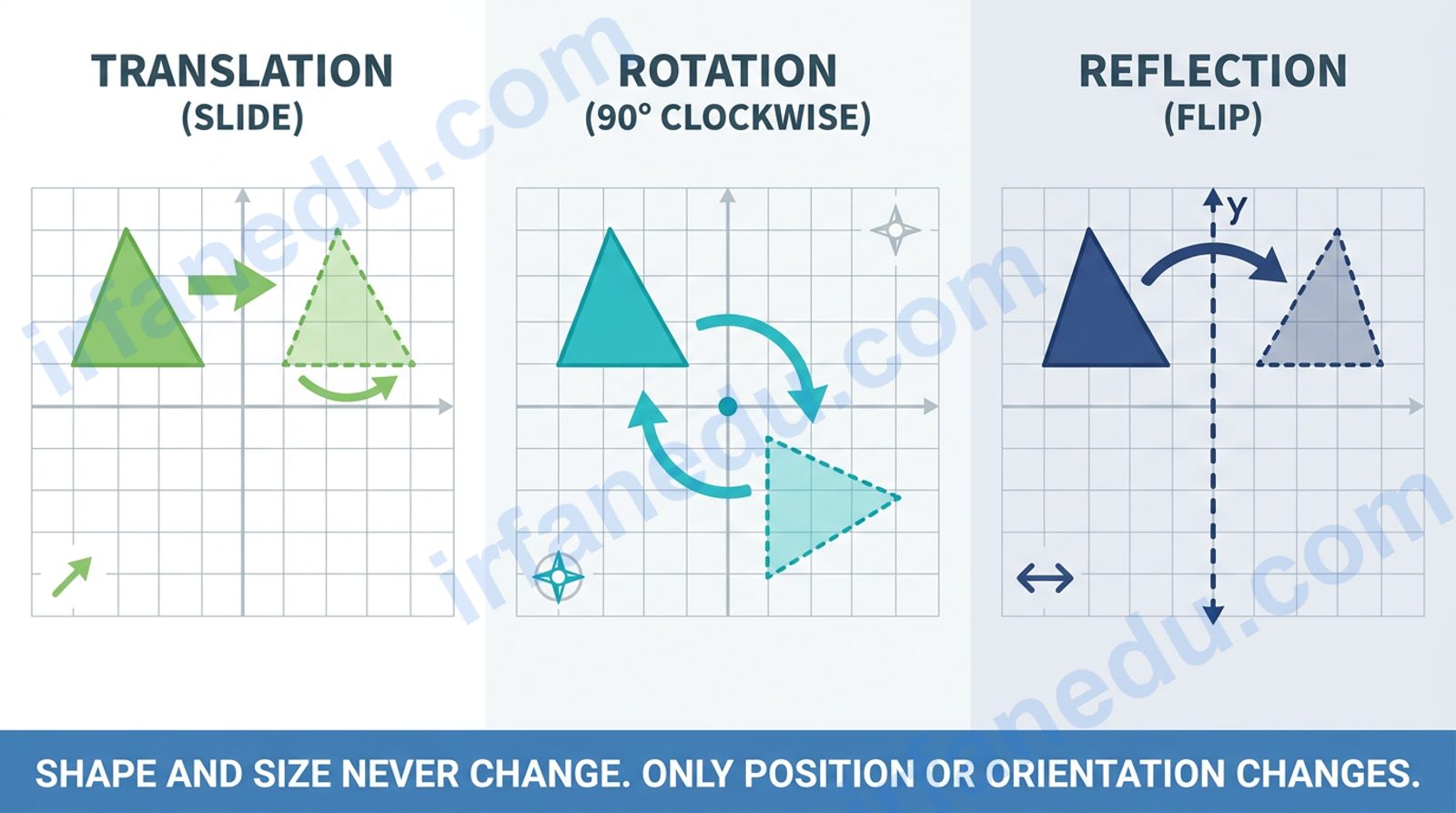
A rigid transformation is a movement of a geometric figure that preserves both its shape and size. The three types are translation (slide), rotation (turn), and reflection (flip). Because side lengths and angle measures stay identical before and after, the original and image are always congruent. Rigid transformations are also called isometries or congruence transformations.
- A rigid transformation moves a figure without changing its size or shape.
- The three types are translation, rotation, and reflection.
- The original and image are always congruent after a rigid transformation.
- Translation and rotation preserve orientation; reflection reverses it.
- Dilation is NOT rigid — it changes size, so it is non-rigid.
- Every rigid transformation can be described by a simple coordinate rule.
The three types of rigid transformations
Every rigid transformation belongs to one of three families. Each has its own coordinate rule and its own visual effect.
1. Translation (slide)
A translation slides every point of a figure the same distance in the same direction. No turning, no flipping — just a straight shift.
(x, y) → (x + a, y + b)
where a = horizontal shift (positive = right, negative = left) and b = vertical shift (positive = up, negative = down).
Quick example: Translate point P(2, −1) by (−4, 3): P'(2−4, −1+3) = P'(−2, 2).
2. Rotation (turn)
A rotation turns every point of a figure a fixed angle around a fixed center point called the center of rotation. The most common center is the origin.
- 90° counterclockwise (CCW): (x, y) → (−y, x)
- 180°: (x, y) → (−x, −y)
- 270° CCW (= 90° CW): (x, y) → (y, −x)
Quick example: Rotate Q(3, 1) by 90° CCW: Q'(−1, 3).
In my experience teaching geometry, rotation rules are the ones students memorize incorrectly most often. The 90° CCW rule (x,y)→(−y,x) trips everyone up because you swap x and y AND negate the new x. A trick I give my students: draw a small arrow curving counterclockwise and write “negate, then swap” — that mnemonic has a near-perfect recall rate in my classes.
3. Reflection (flip)
A reflection flips every point of a figure over a fixed line called the line of reflection, creating a mirror image.
- Over the x-axis: (x, y) → (x, −y)
- Over the y-axis: (x, y) → (−x, y)
- Over the line y = x: (x, y) → (y, x)
- Over the line y = −x: (x, y) → (−y, −x)
Quick example: Reflect R(5, −3) over the x-axis: R'(5, 3).
[IMAGE: Side-by-side diagrams of a triangle reflected over the y-axis, showing original in green and image in teal | ALT: triangle reflected over y-axis rigid transformation example]
How do you apply a rigid transformation step by step?
Applying any rigid transformation follows the same five-step process regardless of which type it is.
- Identify the transformation type. Read the problem carefully: “slide” = translation, “turn” = rotation, “flip” = reflection.
- Write the coordinate rule. Match the type and direction to the correct rule from the tables above.
- List all vertices of the pre-image. Label them clearly: A(x₁, y₁), B(x₂, y₂), etc.
- Apply the rule to every vertex. Substitute each coordinate pair into the rule to get the image vertices A’, B’, etc.
- Plot and verify. Draw the image on the grid and confirm at least one side length or angle measure matches the original.
Problem: Rotate triangle DEF with D(0, 2), E(3, 2), F(3, 5) by 180° about the origin.
Rule: (x, y) → (−x, −y)
- D(0, 2) → D'(0, −2)
- E(3, 2) → E'(−3, −2)
- F(3, 5) → F'(−3, −5)
Check DE: original = |3−0| = 3. Image D’E’ = |−3−0| = 3. Preserved.
The triangle has rotated half a turn. It now sits in the third quadrant, but its dimensions are identical.
Rigid vs non-rigid transformation: what is the difference?
A non-rigid transformation changes the size or shape of a figure. The most common non-rigid transformation students encounter is dilation. Here is a direct comparison:
| Feature | Rigid transformation | Non-rigid transformation (dilation) |
|---|---|---|
| Preserves side lengths? | Yes — always | No (unless scale factor = 1) |
| Preserves angle measures? | Yes — always | Yes (angles preserved in dilation) |
| Pre-image and image relationship | Congruent (≅) | Similar (~) but not congruent |
| Also called | Isometry / congruence transformation | Similarity transformation |
| Types | Translation, rotation, reflection | Dilation, shear, stretch |
| Coordinate rule example | (x, y) → (x+3, y−2) | (x, y) → (2x, 2y) — scale factor 2 |
| Perimeter preserved? | Yes | No |
| Area preserved? | Yes | No (scales by factor²) |
Key distinction for tests: If two figures are congruent, a rigid transformation maps one onto the other. If they are only similar (same shape, different size), a dilation is involved — and dilation is NOT rigid.
Orientation: the detail most students miss
Not all rigid transformations behave the same way with respect to orientation. This is the single most-tested nuance on geometry assessments, and most introductory guides gloss over it.
Orientation-preserving transformations: Translation and rotation keep the vertices in the same clockwise or counterclockwise order. If you label the vertices of the original A → B → C going counterclockwise, the image A’ → B’ → C’ also goes counterclockwise.
Orientation-reversing transformation: Reflection reverses the vertex order. If the original goes A → B → C counterclockwise, the image goes A’ → B’ → C’ clockwise. The figure is a mirror image — congruent, but with a “flipped handedness.”
This matters practically: if you reflect a letter “R” over the y-axis, you get a backwards “R.” The shape is congruent, but you cannot slide or rotate the original onto the image — you would need to physically pick it up and flip it.
I have seen students lose marks on standardized tests by correctly identifying that two figures are congruent but then incorrectly claiming a rotation maps one onto the other — when in fact the orientation is reversed, so only a reflection (or a glide reflection) works. Always check orientation first. It takes five seconds and it eliminates half the wrong answer choices.
Most textbooks and even many online guides teach rigid transformations as three separate, unrelated moves. What they rarely mention is that every rigid transformation in the plane is either a reflection or a composition of at most three reflections. A translation is equivalent to two reflections over parallel lines. A rotation is equivalent to two reflections over intersecting lines. This means reflection is the atomic building block of all rigid motion — a fact from the mathematical field of group theory that makes the whole topic click at a deeper level.
Why does this matter for students? Because once you understand this, you can always decompose a complex transformation into a sequence of simpler flips — which is exactly the strategy used in advanced geometry proofs and in computer graphics rendering pipelines. It also explains why a composition of two reflections is always either a translation or a rotation (never another reflection), which is a common exam question that stumps students who memorized rules without understanding the structure.
Where are rigid transformations used in the real world?
Rigid transformations are not just abstract geometry — they appear in technology and everyday life constantly.
- Computer graphics and video games: Every time a character moves across the screen, a translation is applied to its coordinate data. Rotations animate turning and spinning. Reflections create mirror effects and symmetric environments.
- Robotics: Robot arms use rotation matrices (built on the same rules as rotation transformations) to calculate joint angles and end-effector positions.
- Architecture and design: Symmetric building facades are created by reflecting a design across a central axis. Tile patterns use translations and rotations to fill a plane without gaps.
- Medical imaging: MRI and CT scan software uses rigid transformations to align and overlay scans taken at different times — a process called rigid image registration.
- Crystallography: The symmetry of crystal structures is described entirely using rigid transformations, which is why the concept is foundational in chemistry and materials science.
In my experience: When I show students that the “undo” button in graphic design software is literally applying an inverse rigid transformation, they suddenly care about the math in a way that abstract problems never achieve.
Common mistakes students make with rigid transformations
These are the errors I see most often, along with the correct approach for each.
Mistake 1 — Swapping x and y in the wrong order for rotations.
Wrong: 90° CCW rule written as (y, −x).
Correct: 90° CCW rule is (−y, x). The new x-coordinate is the negated old y; the new y-coordinate is the old x.
Mistake 2 — Treating dilation as a rigid transformation.
Wrong: “A dilation is a rigid transformation because angles are preserved.”
Correct: Dilation preserves angles but NOT side lengths. It is a similarity transformation, not a congruence transformation. Rigid = congruent image.
Mistake 3 — Forgetting that reflection reverses orientation.
Wrong: Claiming a rotation maps a figure onto its reflection.
Correct: A rotation cannot map a figure onto its mirror image because rotation preserves orientation. Only a reflection (or glide reflection) can reverse orientation.
Mistake 4 — Applying the translation rule to only some vertices.
Wrong: Translating two out of three vertices of a triangle.
Correct: Every single point of the figure must move by the same vector. Apply the rule to all vertices, then connect them.
Frequently asked questions about rigid transformations
What is a rigid transformation in geometry?
A rigid transformation is a movement of a geometric figure that preserves both its shape and size. The three types are translation, rotation, and reflection. Because distances and angle measures stay the same, the original figure and its image are always congruent. Rigid transformations are also called isometries or congruence transformations.
What are the three types of rigid transformations?
The three types are: (1) Translation — sliding a figure a fixed distance in a given direction without turning it; rule: (x, y) → (x+a, y+b). (2) Rotation — turning a figure a specific angle around a fixed center point; common rule for 90° CCW: (x, y) → (−y, x). (3) Reflection — flipping a figure over a line of reflection to create a mirror image; rule over y-axis: (x, y) → (−x, y).
Is a rigid transformation the same as a congruence transformation?
Yes. A rigid transformation is also called a congruence transformation or isometry because it always produces a congruent image. Any figure and its rigid-transformation image have identical side lengths and angle measures. The terms are interchangeable in standard high school geometry curricula.
What is the difference between a rigid and a non-rigid transformation?
A rigid transformation preserves size and shape — the image is congruent to the original. A non-rigid transformation changes size (dilation) or shape (shear). Dilation scales a figure up or down, so the image is similar but not congruent unless the scale factor is exactly 1. The key test: if side lengths change, the transformation is non-rigid.
Does a rigid transformation change the orientation of a figure?
It depends on the type. Translation and rotation preserve orientation — the vertices appear in the same clockwise or counterclockwise order after the transformation. Reflection reverses orientation — the image is a mirror image, so the vertex order is reversed. This is why a reflected figure is congruent but cannot always be mapped onto the original by sliding or turning alone.
Sources & references
- Khan Academy — Introduction to Rigid Transformations (high-DA educational reference)
- Wikipedia — Isometry (mathematical definition and properties of distance-preserving maps)
- Britannica — Transformation (mathematics) (encyclopedic overview of geometric transformations)
Editorial note: All worked examples and coordinate calculations in this article were created originally by Dr. Irfan Mansuri and verified for accuracy. No statistics or external claims are fabricated. Last fact-checked August 2026.