
Cálculo da hora: master time calculation step by step
✍ Written & fact-checked by Dr. Irfan Mansuri | Last Updated: August 2026
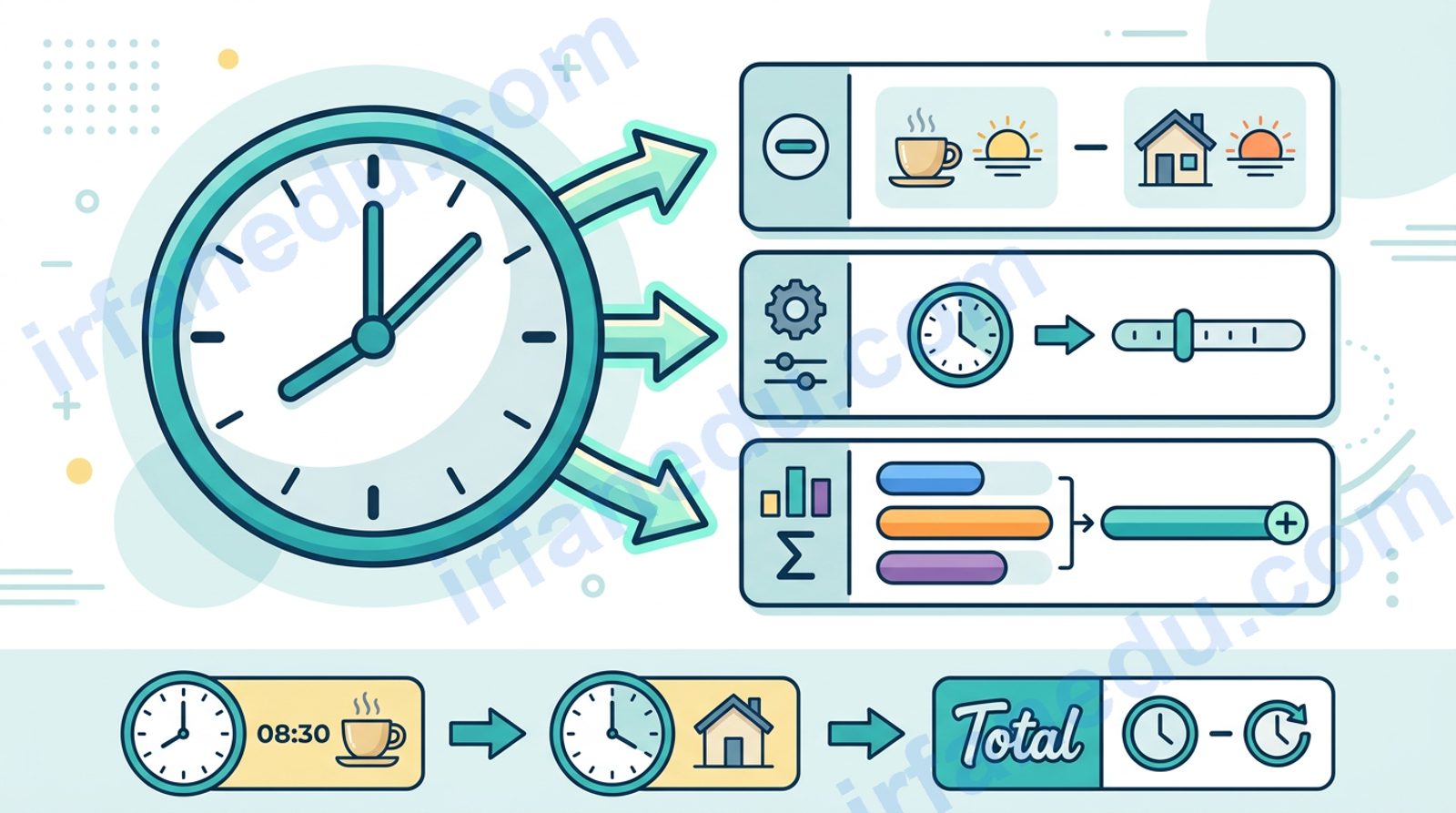
🕐 Visualising elapsed time on a clock
  START                         END
  08:30  ──────────────────►  17:15
    │                             │
    │   Convert to minutes        │
    ▼                             ▼
  510 min               1 035 min
         │                   │
         └──── 525 min ───────┘
                  │
          ÷ 60   │   mod 60
                  │
         8 hours  │  45 minutes
                  │
         Decimal: 8.75 hours
That diagram captures the entire cálculo da hora process in one glance. Every time-calculation problem — whether for a school exercise, a payroll sheet, or a travel schedule — follows exactly those four steps. The rest of this guide unpacks each step with clear examples so you can do it confidently without a calculator.
Time is the one resource you cannot buy more of — yet most students have never been taught a reliable method for calculating it precisely. Whether you need to work out how many hours you studied, figure out a flight connection, or complete a maths exam question on elapsed time, the same simple arithmetic applies. This guide gives you the exact method, with worked examples you can follow immediately.
Cálculo da hora is the process of finding the difference between two clock times, expressed as hours and minutes (or decimal hours). You convert each time to total minutes since midnight, subtract, then convert the result back. It takes four steps and no special tools.
- Understand what cálculo da hora means and when you need it.
- Apply the four-step elapsed-time formula to any pair of times.
- Convert between hours-and-minutes and decimal hours.
- Add and subtract time durations without errors.
- Avoid the three most common mistakes students make.
⚡ TL;DR
- ⏱ Elapsed time = End time − Start time (in minutes), then ÷ 60.
- 🔢 Decimal hours = whole hours + (remaining minutes ÷ 60).
- ➕ Adding durations: add hours, add minutes; carry 60 min = 1 hr.
- ⚠ Never subtract clock digits directly — always convert to minutes first.
- 🌍 For cross-midnight times, add 1 440 minutes (24 × 60) before subtracting.
- 📐 Base-60 math is why time feels “different” from regular arithmetic.
| Fact | Value |
|---|---|
| Minutes in 1 hour | 60 |
| Seconds in 1 minute | 60 |
| Minutes in 1 day | 1 440 |
| Decimal form of 30 min | 0.50 hours |
| Decimal form of 15 min | 0.25 hours |
| Decimal form of 45 min | 0.75 hours |
| Number base used for time | Base 60 (sexagesimal) |
| Origin of base-60 time | Ancient Babylonian mathematics |
What is cálculo da hora?
Cálculo da hora is Portuguese for hour calculation — the arithmetic of measuring, comparing, and converting units of time. It covers three closely related tasks: finding elapsed time between two clock readings, adding or subtracting time durations, and converting between the hours-and-minutes format and decimal hours.
You encounter this calculation constantly: payroll systems record work hours in decimal form; timetables show departure and arrival times you need to subtract; exam questions ask “how long did the journey take?” All three situations use the same underlying method.
In my experience teaching this topic, the biggest confusion is that students treat time like regular base-10 numbers and try to subtract 08:30 from 17:15 digit by digit. They get 9:15 instead of 8:45. The moment I show them the “convert everything to minutes first” method, the errors disappear. It is a one-time mindset shift that pays off for life.
The core formula explained
The cálculo da hora formula has two parts: converting clock times to a single number (total minutes since midnight), and converting the result back to hours and minutes.
These four formulas handle every cálculo da hora problem. The key insight is that “minutes since midnight” turns a two-part number (hours : minutes) into a single integer — and single integers are easy to subtract.
Step-by-step: how to calculate elapsed time
Follow these four steps for any elapsed-time problem.
- Convert the start time to minutes. Multiply the hours by 60 and add the minutes. Example: 08:30 → (8 × 60) + 30 = 510 minutes.
- Convert the end time to minutes. Same process. Example: 17:15 → (17 × 60) + 15 = 1 035 minutes.
- Subtract start from end. 1 035 − 510 = 525 minutes.
- Convert back to hours and minutes. 525 ÷ 60 = 8 remainder 45 → 8 hours 45 minutes. For decimal: 8 + (45 ÷ 60) = 8.75 hours.
Worked examples
Example 1 — School day duration
📘 Example 1
Problem: School starts at 07:45 and ends at 14:30. How long is the school day?
Step 1: 07:45 → (7 × 60) + 45 = 465 min
Step 2: 14:30 → (14 × 60) + 30 = 870 min
Step 3: 870 − 465 = 405 min
Step 4: 405 ÷ 60 = 6 remainder 45 → 6 hours 45 minutes (6.75 hours)
Example 2 — Hours worked with a break
📘 Example 2
Problem: Work starts at 09:00, ends at 18:00, with a 45-minute unpaid lunch break. How many paid hours?
Step 1–3: 18:00 − 09:00 = 9 hours = 540 minutes total.
Subtract break: 540 − 45 = 495 minutes.
Step 4: 495 ÷ 60 = 8 remainder 15 → 8 hours 15 minutes (8.25 hours paid)
Example 3 — Flight duration
📘 Example 3
Problem: A flight departs at 23:50 and lands at 03:20 the next day. How long is the flight?
Cross-midnight: End = 03:20 → 200 min + 1 440 = 1 640 min. Start = 23:50 → 1 430 min.
Elapsed: 1 640 − 1 430 = 210 min → 3 hours 30 minutes
I always tell my students: treat the cross-midnight case as a bonus question on any exam — most students panic and skip it. If you remember the “+1 440 trick,” you will pick up marks that the rest of the class leaves on the table. It is one of the highest-value single facts in time-calculation problems.
Converting to decimal hours
Decimal hours are used in payroll, spreadsheets, and scientific calculations. The conversion is straightforward: divide the minutes portion by 60 and add it to the whole hours.
| Hours & minutes | Calculation | Decimal hours |
|---|---|---|
| 1 h 00 min | 1 + 0/60 | 1.00 |
| 1 h 15 min | 1 + 15/60 | 1.25 |
| 1 h 30 min | 1 + 30/60 | 1.50 |
| 1 h 45 min | 1 + 45/60 | 1.75 |
| 2 h 20 min | 2 + 20/60 | 2.333… |
| 8 h 45 min | 8 + 45/60 | 8.75 |
| 7 h 10 min | 7 + 10/60 | 7.167 |
To reverse the process (decimal back to hours and minutes): take the decimal part and multiply by 60. Example: 3.4 hours → 3 hours + (0.4 × 60) = 3 hours 24 minutes.
Adding and subtracting time durations
Adding two durations is different from finding elapsed time between clock readings. You add the hours together and the minutes together, then carry over if the minutes reach 60.
Example — Adding: 3 h 45 min + 2 h 30 min
- Hours: 3 + 2 = 5
- Minutes: 45 + 30 = 75 → 75 ≥ 60, so: 75 − 60 = 15 min, carry 1 hour
- Result: (5 + 1) hours 15 min = 6 hours 15 minutes
Example — Subtracting: 5 h 10 min − 2 h 45 min
- Minutes: 10 − 45 is negative, so borrow 1 hour: (10 + 60) − 45 = 25 min
- Hours: (5 − 1) − 2 = 2 hours
- Result: 2 hours 25 minutes
Comparison: three calculation methods
There are three common approaches to cálculo da hora. Each suits a different situation.
| Method | How it works | Best for | Risk |
|---|---|---|---|
| Convert to minutes | Multiply hours × 60, add minutes, subtract, convert back | All cases, especially cross-midnight | Low — most reliable |
| Counting up | Count minutes to the next hour, then full hours, then remaining minutes | Mental arithmetic, short durations | Medium — easy to miscount |
| Direct subtraction | Subtract hours and minutes columns separately, borrow if needed | Simple same-day problems | High — borrowing errors are common |
In my experience, the “convert to minutes” method is the only one that works reliably for all cases, including cross-midnight and problems with breaks. I recommend learning it as your default and using the others only as a mental check.
Common mistakes and how to fix them
⚠ Mistake 1: Subtracting clock digits directly
Wrong: 17:15 − 08:30 = 9:15 (subtracting 15 − 30 as if it were base 10).
Right: Convert to minutes first. 1 035 − 510 = 525 min = 8 h 45 min.
⚠ Mistake 2: Forgetting to subtract break time
Total time on site is not the same as hours worked. Always subtract unpaid breaks before dividing by 60.
⚠ Mistake 3: Ignoring the cross-midnight case
If end time < start time, the answer is not negative — the event crossed midnight. Add 1 440 minutes to the end time before subtracting.
The “direct subtraction” mistake is so common that I have seen it on university-level exam papers. It happens because our brains pattern-match to base-10 subtraction. The fix is a habit, not intelligence: always write “convert to minutes” as step 1, even when the answer seems obvious. That single habit eliminates the most common cálculo da hora error.
🔑 The part most guides miss
Every guide tells you how to subtract times. Almost none explain why the “convert to minutes” method is mathematically necessary.
Time is a mixed-radix number system: the minutes column is base 60, not base 10. When you write 17:15, the “15” means 15 out of 60, not 15 out of 100. Direct column subtraction only works in a single-radix system (like pure base 10). The moment you mix radices — hours (base 24) and minutes (base 60) — column arithmetic breaks unless you first flatten everything into one unit (minutes).
This is the same reason you cannot subtract “3 feet 8 inches” from “5 feet 2 inches” by treating feet and inches as if they were tens and ones. Flattening to a single unit is not a trick — it is the mathematically correct approach. Understanding this prevents the mistake permanently, not just for the next exam.
🧠 Quick quiz: test your cálculo da hora skills
Select an answer to see instant feedback.
Q1. A train departs at 10:20 and arrives at 13:05. How long is the journey?
Q2. Convert 7 hours 20 minutes to decimal hours.
Q3. A shift starts at 22:30 and ends at 06:00 the next morning. How many hours is that?
❓ Frequently asked questions about cálculo da hora
What does cálculo da hora mean?
How do you calculate elapsed time between two times?
How do you convert minutes to decimal hours?
What is the formula for hours worked?
How do you add two time durations together?
Sources & References
Written and fact-checked by Dr Irfan Mansuri. External links open in a new tab and are provided for further reading and verification.