
ServSafe practice test: pass food safety certification on your first try 🍽️
Before you read a single study tip, look at these two test-takers. One passed the ServSafe Manager exam first try. The other failed by three questions and had to pay to retest. The difference was not intelligence — it was knowing what the exam actually tests.
✅ Test-taker who passed
- Memorized the temperature danger zone and all safe cooking temps
- Took 3 timed practice tests, reviewed wrong answers by topic
- Understood why each answer is correct, not just which letter
- Knew HACCP’s 7 principles cold
❌ Test-taker who failed
- Skimmed the textbook once without practice questions
- Guessed on temperature questions (“I work in a kitchen, I know this”)
- Confused sanitizing with cleaning throughout
- Ran out of time on the last 12 questions
This guide gives you everything the passing test-taker had: the right facts, realistic practice questions, and a contrast-driven breakdown of the traps the exam sets for you.
🎯 The Short Version
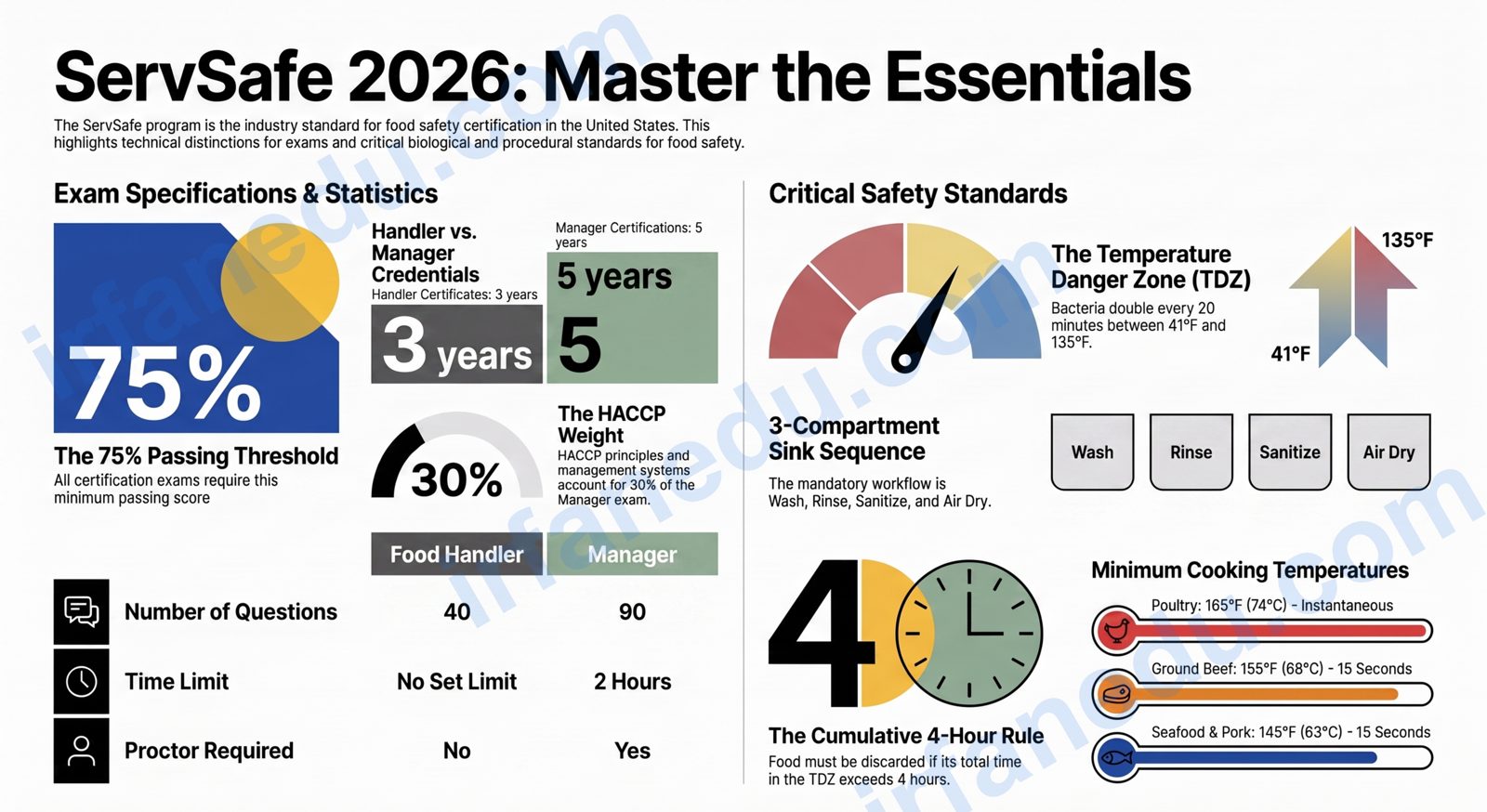
- 🍔 Food Handler exam: 40 questions, need 30 correct (75%) to pass
- 👨💼 Manager exam: 90 questions, need 68 correct (75%), proctored
- 🌡️ Danger zone is 41°F–135°F; bacteria double every 20 minutes inside it
- 🧼 Cleaning removes dirt; sanitizing kills pathogens — the exam tests both
- 📋 HACCP has exactly 7 principles; know them in order
- ⏱️ Take at least 3 timed practice tests before your real exam date
| Fact | Food Handler | Manager |
|---|---|---|
| Number of questions | 40 | 90 |
| Passing score | 75% (30/40) | 75% (68/90) |
| Time limit | No set limit (online) | 2 hours |
| Proctored? | No | Yes |
| Certificate validity | 3 years | 5 years |
| Retake fee | Varies by provider | Varies by provider |
What is the ServSafe exam, and who needs it? 🎓
The ServSafe program is a food safety training and certification program administered by the National Restaurant Association Educational Foundation (NRAEF). It is recognized by most health departments across the United States and accepted in many countries as proof that food service workers understand safe food handling.
Two main certifications exist. The Food Handler certificate is for front-line workers: servers, prep cooks, dishwashers, and anyone who touches food. The Manager Certification is for supervisors and owners who are responsible for a food safety management system in their establishment. Many jurisdictions legally require at least one certified manager per food service operation.
📌 Who must take ServSafe?
Requirements vary by location, but as of 2026 more than 30 U.S. states require food handler training for all employees, and many cities require a certified food protection manager on-site during all operating hours. Check your local health department for the exact rule in your area.
What topics does the ServSafe practice test cover? 📚
The ServSafe exam tests six core content areas. Knowing their weight on the exam tells you where to spend your study time.
| Topic area | Approx. % of Manager exam | Key concepts to know |
|---|---|---|
| Providing safe food | ~15% | FAT TOM, biological/chemical/physical hazards |
| Personal hygiene | ~9% | Handwashing steps, illness reporting, glove use |
| Purchasing, receiving & storage | ~14% | Receiving temps, FIFO, labeling |
| Preparation & cooking | ~18% | Minimum internal temps, thawing methods, cooling |
| Cleaning & sanitizing | ~14% | Sanitizer concentrations, three-compartment sink |
| Food safety management (HACCP) | ~30% | 7 HACCP principles, active managerial control |
HACCP and food safety management make up nearly a third of the Manager exam. If you are short on time, prioritize that section above all others.
Good answer vs. bad answer: how ServSafe questions are designed 🔍
ServSafe questions are written to catch common kitchen assumptions. The exam does not test what you do at work — it tests what the textbook says you should do. Here are two real-style contrast pairs that show the pattern.
✅ Correct reasoning
Q: A food handler has a sore throat with a fever. What should the manager do?
A: Exclude the food handler from the operation.
Why: A sore throat with fever can indicate a reportable illness. ServSafe requires exclusion (not just restricted duties) until a medical release is obtained.
❌ Common wrong answer
Q: A food handler has a sore throat with a fever. What should the manager do?
A: Restrict the food handler to non-food-contact tasks.
Why it’s wrong: Restriction applies to milder symptoms. A fever combined with a sore throat triggers the exclusion rule — the employee must leave the premises.
✅ Correct reasoning
Q: What is the correct order of steps in a three-compartment sink?
A: Wash → Rinse → Sanitize → Air dry.
Why: Sanitizer only works on a surface already free of food debris. Rinsing before sanitizing removes soap that would neutralize the sanitizer.
❌ Common wrong answer
Q: What is the correct order of steps in a three-compartment sink?
A: Rinse → Wash → Sanitize → Dry with a towel.
Why it’s wrong: Washing must come before rinsing. Towel-drying after sanitizing recontaminates the surface — air drying is required.
Key temperatures every ServSafe test-taker must memorize 🌡️
Temperature questions appear on every ServSafe exam. Memorize this table before you take a single practice test.
| Situation | Temperature (°F) | Temperature (°C) |
|---|---|---|
| Danger zone (lower limit) | 41°F | 5°C |
| Danger zone (upper limit) | 135°F | 57°C |
| Ground beef (minimum cook) | 155°F for 15 sec | 68°C |
| Poultry (minimum cook) | 165°F for <1 sec | 74°C |
| Pork / seafood / eggs (min cook) | 145°F for 15 sec | 63°C |
| Roasts (minimum cook) | 145°F for 4 min | 63°C |
| Hot holding | 135°F or above | 57°C or above |
| Cold holding | 41°F or below | 5°C or below |
| Cooling: first 2 hours | 135°F → 70°F | 57°C → 21°C |
| Cooling: next 4 hours | 70°F → 41°F | 21°C → 5°C |
  SERVSAFE TEMPERATURE LADDER
  ──────────────────────────────────────────
  165°F (74°C) ▲  Poultry — instant kill
  155°F (68°C) ▲  Ground beef — 15 sec
  145°F (63°C) ▲  Pork, seafood, eggs
  ──────────────────────────────────────────
  135°F (57°C) ┐  ← HOT HOLDING minimum
               │
    ⚠️  DANGER  │  Bacteria double ~every 20 min
      ZONE     │  Max 4 hours total in this range
               │
   41°F (5°C)  ┘  ← COLD HOLDING maximum
  ──────────────────────────────────────────
   32°F (0°C)  ▼  Freezing point
How to prepare for the ServSafe exam: a step-by-step plan 📋
Follow these six steps in order. Each one builds on the last, and skipping step 4 is the single most common reason people fail.
- Choose your exam level. Confirm whether your employer or local law requires the Food Handler or Manager exam before you buy any materials.
- Study the five FDA risk factors. These are: poor personal hygiene, improper holding temperatures, inadequate cooking, contaminated equipment, and food from unsafe sources. The exam returns to these repeatedly.
- Memorize the temperature table above. Write it out by hand three times. Temperature questions are the easiest points to win — or lose.
- Take at least three timed practice tests. Timing yourself matters. Manager exam candidates get 90 seconds per question on average. Practice under that constraint.
- Review wrong answers by topic, not by question. If you miss two cooling questions, re-read the entire cooling chapter — not just those two questions. Errors cluster by knowledge gap.
- Register and sit the exam. Book at ServSafe.com, bring valid photo ID, and arrive 15 minutes early for proctored sessions.
💡 Unique Insight: the “4-hour rule” trap most guides explain wrong
Almost every ServSafe study guide tells you food cannot stay in the danger zone for more than 4 hours. What most guides fail to mention is that this is a cumulative timer — not a per-session timer. If a chicken breast sat at room temperature for 2 hours during prep, then was refrigerated, then came back out for 1.5 hours of service, it has only 30 minutes left before it must be discarded — even though no single session exceeded 2 hours. The exam tests this cumulative interpretation directly. I have seen students answer “safe” on a question like this because they checked each session individually rather than adding them up. Add the times first, then judge.
The 7 HACCP principles you must know cold 🔒
HACCP (Hazard Analysis Critical Control Points) is a systematic approach to identifying and controlling food safety hazards. It accounts for roughly 30% of the Manager exam, so treat this list as a memorization priority.
- Conduct a hazard analysis — identify biological, chemical, and physical hazards at each step.
- Identify critical control points (CCPs) — the steps where a hazard can be prevented or eliminated.
- Establish critical limits — the min/max values (usually temperatures) that must be met at each CCP.
- Establish monitoring procedures — define how and how often CCPs are checked.
- Identify corrective actions — what to do when a critical limit is not met.
- Verify the system works — confirm the HACCP plan is effective through testing and review.
- Record-keeping and documentation — maintain logs that prove the system is being followed.
⚠️ Common exam trap: HACCP vs. Active Managerial Control
The exam distinguishes between a full HACCP plan (required for complex operations) and Active Managerial Control (AMC), which is the day-to-day manager behavior that addresses the five FDA risk factors. AMC does not require a written HACCP plan. Many candidates confuse the two and answer HACCP questions with AMC answers and vice versa.
Personal hygiene rules the exam loves to test 🧼
Personal hygiene questions are straightforward if you know the rules precisely. The exam exploits vague knowledge by offering answers that are “almost right.”
- Handwashing takes 20 seconds of scrubbing with soap — not a quick rinse.
- Hands must be washed after: using the restroom, handling raw meat, touching the face/hair, taking out garbage, handling chemicals, and returning from a break.
- Single-use gloves do not replace handwashing — wash hands before putting gloves on.
- Bare-hand contact with ready-to-eat food is prohibited unless the operation has a written variance and alternative procedure on file.
- Illness reporting: employees must report jaundice, vomiting, diarrhea, sore throat with fever, or a diagnosed illness caused by Salmonella Typhi, Shigella, E. coli O157:H7, Hepatitis A, or Norovirus.
✅ Pro tip: the “Big 6” pathogens
ServSafe refers to the six pathogens that require employee exclusion as the “Big 6”: Norovirus, Hepatitis A, Salmonella Typhi, E. coli O157:H7, Shigella spp., and Nontyphoidal Salmonella. Know all six by name — the exam uses the full scientific names.
🧪 Quick ServSafe practice quiz — test yourself now
Select an answer to see instant feedback.
Q1. What is the minimum internal cooking temperature for poultry?
Q2. A food handler washes, rinses, and sanitizes a cutting board. What must happen next?
Q3. Which of the following is the correct FIRST step in the HACCP process?
Reveal-on-click practice problems 🎯
Work through each question on your own, then click to reveal the full explanation. These cover the question types that trip up the most test-takers.
Problem 1: A pot of chili was cooked to 165°F and placed in a walk-in cooler at 8:00 PM. By 10:00 PM it has cooled to 80°F. Is this acceptable under ServSafe cooling rules?
Answer: No — it is a violation.
ServSafe’s two-step cooling rule requires food to drop from 135°F to 70°F within the first 2 hours. The chili started at 165°F and only reached 80°F after 2 hours — it needed to be at or below 70°F by 10:00 PM. The manager must take corrective action (reheat to 165°F and re-cool faster using an ice bath or blast chiller, or discard the food).
Problem 2: A delivery of raw chicken arrives at 48°F. Should the manager accept or reject it?
Answer: Reject the delivery.
Raw poultry must be received at 41°F (5°C) or lower. A temperature of 48°F means the chicken has been in the danger zone during transport. Accepting it creates a food safety risk and a liability. The manager should refuse the shipment, document the rejection, and notify the supplier.
Problem 3: A food handler cuts raw beef, then uses the same (unwashed) knife to slice tomatoes. What hazard has occurred?
Answer: Cross-contamination.
Raw beef can carry pathogens like E. coli O157:H7. Transferring those pathogens to ready-to-eat tomatoes via an unwashed knife is a classic cross-contamination scenario. The tomatoes will not be cooked again, so the pathogens will reach the consumer. The correct procedure: wash, rinse, and sanitize the knife (or use a separate color-coded knife) before cutting ready-to-eat foods.
Frequently asked questions about the ServSafe practice test ❓
How many questions are on the ServSafe Food Handler test?
How many questions are on the ServSafe Manager exam?
What topics does the ServSafe exam cover?
How long is a ServSafe certificate valid?
Can I take the ServSafe exam online?
What is the temperature danger zone in ServSafe?
✅ Key takeaways
- The Food Handler exam has 40 questions; the Manager exam has 90 — both require 75% to pass.
- Temperature knowledge wins or loses the exam: memorize the danger zone, cooking temps, and cooling rules.
- The 4-hour danger zone rule is cumulative — add up all time out of temperature control, not just the last session.
- HACCP has 7 principles in a fixed order; know them well enough to recite them without prompts.
- Cleaning removes dirt; sanitizing kills pathogens — the exam tests both the difference and the sequence.
- Take at least 3 timed practice tests and review errors by topic cluster, not by individual question.
- The “Big 6” pathogens require employee exclusion — know all six by their scientific names.
Sources & References
Written and fact-checked by Dr Irfan Mansuri. External links open in a new tab and are provided for further reading and verification.