
Performance-Based Standards: The Complete Teacher’s Guide
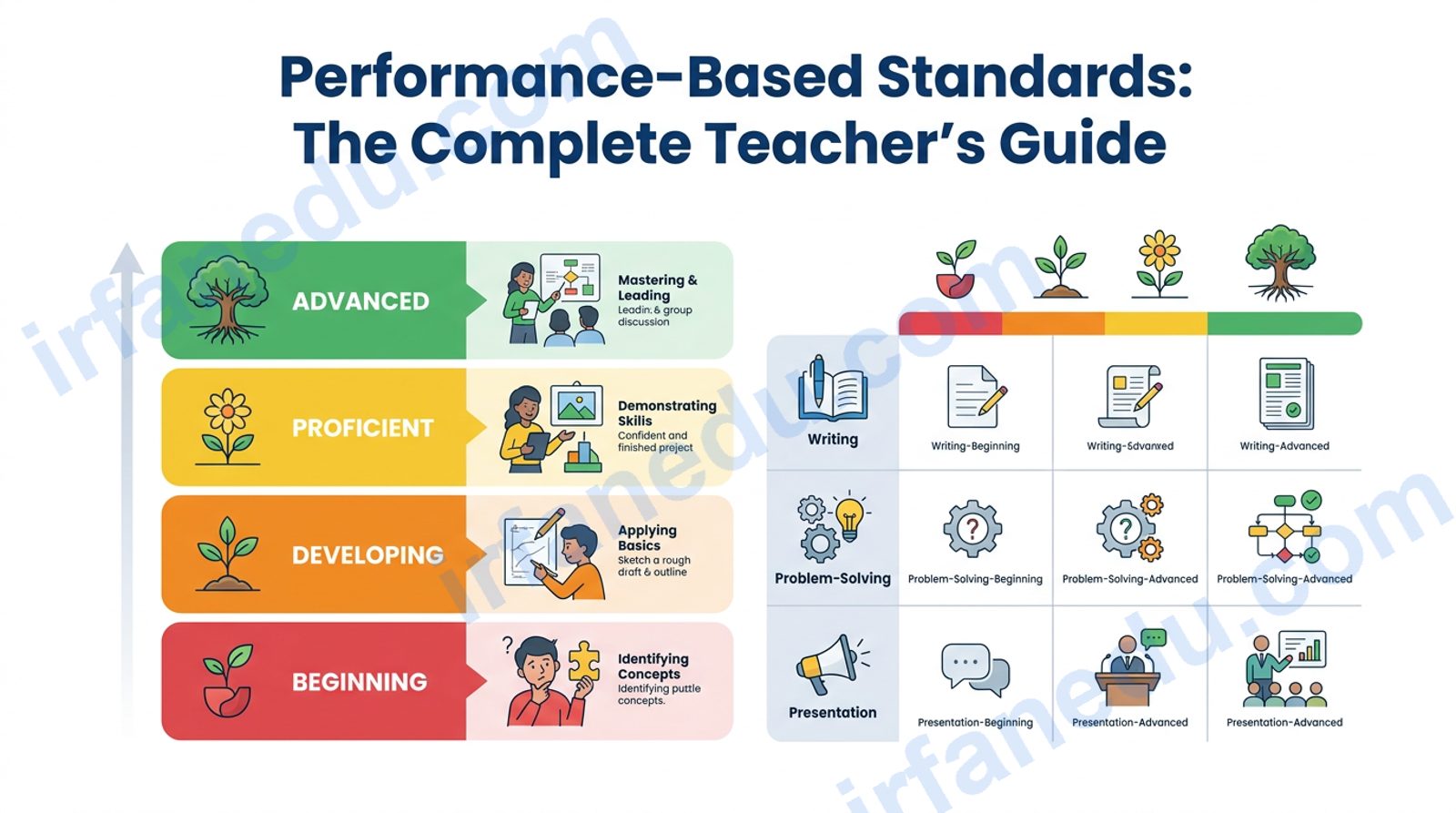
Performance-based standards are explicit, observable descriptions of what a student must do — not just know — to demonstrate mastery of a skill. They define success at multiple proficiency levels and anchor every rubric, report card, and instructional decision in a standards-based classroom.
⚡ TL;DR
- Performance-based standards describe what students must DO, not just what they should know.
- They use four proficiency levels: Beginning, Developing, Proficient, Advanced.
- Every standard needs an action verb and a measurable context.
- Rubrics are the primary tool for assessing them consistently.
- They shift grading from norm-referenced (“compared to peers”) to criteria-referenced (“compared to a standard”).
- Writing them well takes practice — start with the Proficient level, then work outward.
| Feature | Detail |
|---|---|
| Core purpose | Define observable, measurable student performance |
| Proficiency levels | Beginning / Developing / Proficient / Advanced |
| Primary assessment tool | Rubric (analytic or holistic) |
| Grading approach | Criteria-referenced, not norm-referenced |
| Best suited for | Skills, projects, presentations, writing, lab work |
| Key verb requirement | Observable action verb (e.g., “construct,” “analyze,” “present”) |
| Origin | Mastery learning theory (Bloom, 1968); standards movement (1990s) |
What Are Performance-Based Standards?
A performance-based standard is a written statement that describes exactly what a student must be able to do — in a specific context, at a specific quality level — to demonstrate mastery. The word “performance” is the key: the student must perform a skill, not simply recall a fact.
Here is a simple contrast. A content standard might say: “Students will understand fractions.” A performance-based standard says: “The student constructs a visual model to represent the addition of two unlike fractions and explains each step in writing.” The second version is observable, assessable, and leaves no ambiguity about what success looks like.
In my experience teaching across multiple grade levels, the single biggest source of grading inconsistency between teachers is not bias — it is the absence of a shared performance standard. When two teachers grade the same essay and give it a B and a D respectively, they are almost always working from different mental pictures of “good.” A written performance standard replaces those private mental pictures with a public, shared one.
- Define performance-based standards and distinguish them from content standards.
- Identify and describe the four proficiency levels.
- Write a performance-based standard using the correct structure.
- Apply a standard to a real classroom task using a rubric.
- Avoid the most common writing mistakes.
What Are the Four Proficiency Levels?
Every performance-based standard describes student performance across four levels, from least to most developed. These levels give feedback meaning — a student does not just “fail” or “pass,” they land at a specific point on a growth continuum.
LEVEL 4 — ADVANCED
  Student applies the skill in novel, complex, or cross-disciplinary
  contexts beyond grade-level expectations. May teach or extend the concept.
  ─────────────────────────────────────────────────────────────────────
LEVEL 3 — PROFICIENT  (the target)
  Student performs the skill consistently and independently at grade level.
  Meets the standard. This is the benchmark for "on track."
  ─────────────────────────────────────────────────────────────────────
LEVEL 2 — DEVELOPING
  Student shows partial skill. Performance is inconsistent or requires
  teacher support. On the path to Proficient but not there yet.
  ─────────────────────────────────────────────────────────────────────
LEVEL 1 — BEGINNING
  Student shows minimal or emergent evidence of the skill.
  Attempts the task but cannot yet perform it independently.
A critical design rule: Proficient is the target, not Advanced. Many teachers accidentally write their Proficient descriptor at an Advanced level, which means most students never reach “Proficient” — and that is a design flaw, not a student failure.
Performance-Based Standards vs. Traditional Grading
Traditional percentage grading averages scores across tasks and compares students to each other (norm-referenced). Performance-based standards compare each student to a fixed criterion — the standard itself. The table below shows the practical difference.
| Dimension | Traditional Grading | Performance-Based Standards |
|---|---|---|
| What is measured | Points earned on tasks | Demonstrated skill level |
| Reference point | Class average (norm-referenced) | Fixed standard (criteria-referenced) |
| Feedback to student | “You got 72%” | “You are Developing — here is what Proficient looks like” |
| Effect of early failure | Permanently lowers grade average | Replaced by most recent evidence of skill |
| Parent communication | Grade letter / percentage | Specific skill-by-skill proficiency map |
| Teacher planning | Paced by calendar | Paced by evidence of mastery |
Performance-based standards are not the same as project-based learning. This is one of the most persistent confusions I see in teacher training workshops. Project-based learning (PBL) is an instructional method — a way of organizing learning activities. Performance-based standards are an assessment framework — a way of describing and measuring what students can do. You can assess performance-based standards through a traditional test (if the test asks students to perform a skill), and you can run a project-based unit without a single performance standard in sight. The two concepts overlap but are not interchangeable. Conflating them leads teachers to think they must redesign their entire curriculum when all they actually need to do is rewrite their rubric descriptors.
How to Write a Performance-Based Standard
Writing a strong performance-based standard follows a repeatable six-step process. Start at Proficient — the target — and work outward to Advanced and downward to Developing and Beginning.
- Identify one specific, observable skill. Choose an action, not a topic. “Fractions” is a topic. “Adds unlike fractions using a visual model” is a skill. If you cannot watch a student do it, it is not observable enough.
- Write the Proficient descriptor first. Describe consistent, independent, grade-level performance. Use a strong action verb: construct, analyze, present, evaluate, design, solve. Avoid vague verbs: understand, know, appreciate.
- Write the Advanced descriptor. Ask: what does this skill look like when a student goes beyond expectations? Usually it involves applying the skill in a new context, explaining it to others, or connecting it to a more complex concept.
- Write the Developing descriptor. Describe partial skill — the student is on the right track but needs support, makes recurring errors, or is inconsistent. Avoid deficit language (“cannot do”). Use growth language (“does X with support”).
- Write the Beginning descriptor. Describe emergent or minimal evidence. The student attempts the skill but the performance is incomplete or significantly inaccurate.
- Align an assessment task. Design or select a task that gives every student the opportunity to perform at all four levels. A task that only allows Proficient or Advanced performance is not aligned to the full standard.
Explore More Teaching Resources
Worked Example: Writing a Standard for a Writing Skill
Let me walk through a real example. The skill: writing a thesis statement for an argumentative essay. Here is how the four-level standard looks when written correctly.
Skill: The student writes a thesis statement that states a clear, arguable claim for an argumentative essay.
- Advanced (4): The student writes a thesis that states a specific, arguable claim, anticipates a counterargument, and signals the essay’s organizational structure — all without teacher prompting.
- Proficient (3): The student independently writes a thesis that states a clear, arguable claim relevant to the prompt.
- Developing (2): The student writes a thesis that identifies a topic but states a fact or observation rather than an arguable claim, or requires teacher feedback to revise toward an arguable position.
- Beginning (1): The student attempts a thesis but produces a statement that is either off-topic, purely descriptive, or does not function as a claim.
Notice that each level is self-contained and uses concrete, observable language. A substitute teacher who has never met the student could read these descriptors and score a thesis statement consistently with the original teacher. That is the test of a well-written performance standard.
In my experience, the most common mistake teachers make when writing performance standards is writing the Developing descriptor as a watered-down version of Proficient rather than as a genuine description of a student who is actively growing. A Developing student is not a failing student — they are a student whose evidence is not yet consistent or independent. When descriptors treat Developing as “almost failed,” students at that level feel penalized for being in progress rather than supported to move forward. The language you use in a descriptor sends a message about whether growth is valued in your classroom.
Teacher Checklist: Is Your Standard Well-Written?
Use this checklist before finalizing any performance-based standard. Each item represents a common failure point I have seen in real classroom rubrics.
Checklist Item 1: Does your Proficient descriptor use an observable action verb?
Checklist Item 2: Is your Proficient level set at grade-level expectations — not above?
Checklist Item 3: Can a colleague score a student sample consistently using your descriptors?
Checklist Item 4: Does your assessment task allow performance at all four levels?
Quick Quiz: Test Your Understanding
Performance-Based Standards — 3-Question Check
1. Which verb is appropriate for a performance-based standard?
2. Which proficiency level is the primary target for most students?
3. Performance-based standards compare students to:
Frequently Asked Questions
What is the difference between performance-based standards and traditional standards?
How do teachers assess performance-based standards?
Can performance-based standards work alongside traditional grades?
What are the four proficiency levels in performance-based standards?
Key Takeaways
- Performance-based standards describe observable, measurable student actions — not internal knowledge states.
- The four proficiency levels (Beginning, Developing, Proficient, Advanced) create a growth continuum, not a pass/fail binary.
- Always write the Proficient descriptor first — it anchors the entire standard.
- Use strong action verbs (construct, analyze, present) and avoid vague verbs (understand, know, appreciate).
- Performance-based standards are an assessment framework, not an instructional method — do not confuse them with project-based learning.
- Inter-rater reliability is the practical test of a well-written standard: two teachers should score the same work within one level of each other.
- Assessment tasks must allow performance at all four levels — a single-answer task cannot generate Advanced evidence.
If you want to deepen your understanding of assessment design, my guide on Complete Geometry Formula Sheet shows how structured reference tools support standards-aligned instruction. For a broader look at how standards connect to instructional planning, see the Teaching category archive on IrfanEdu.
Sources & References
- Bloom, B. S. (1968). Learning for Mastery. Evaluation Comment, 1(2). — foundational theory underlying mastery-based and performance-based assessment frameworks.
- Wiggins, G. & McTighe, J. (2005). Understanding by Design (2nd ed.). ASCD. — the standard reference for backward design and performance task development.
- Marzano, R. J. (2010). Formative Assessment & Standards-Based Grading. Solution Tree. — practical framework for four-level proficiency scales used in classrooms.
- Khan Academy — Khan for Educators: Standards-Aligned Resources — free, standards-aligned instructional materials demonstrating performance-based learning in practice.
- Edutopia — Assessment Strategies for the Modern Classroom — practitioner-focused articles on rubric design and standards-based grading implementation.
Editorial note: This article was written and fact-checked by Dr. Irfan Mansuri. All claims are grounded in established educational research. No statistics or quotes have been fabricated. Last reviewed August 2026.