
Proportion Calculator: Solve A/B = C/D for Any Missing Value
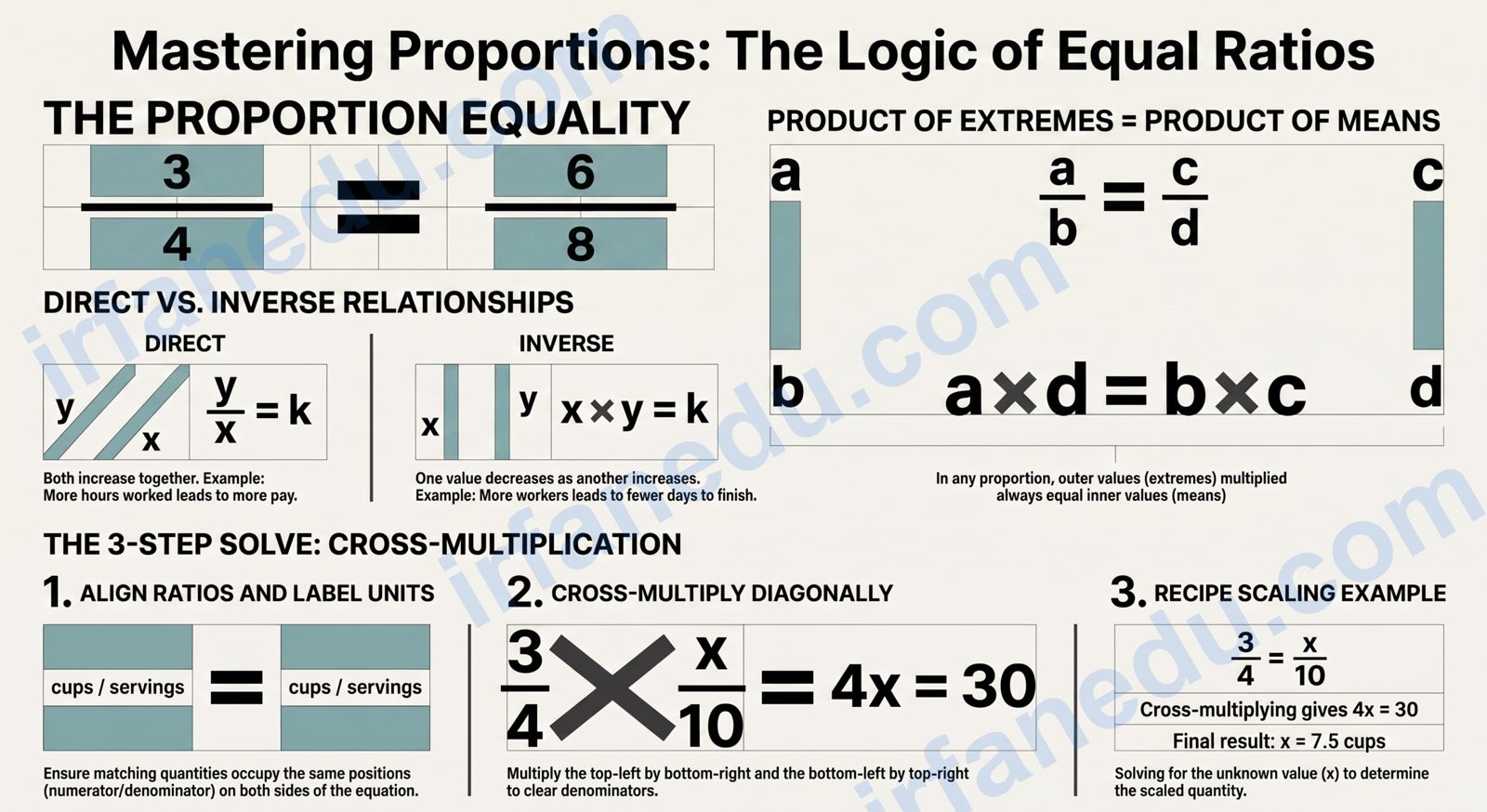
Start with a real number: a recipe calls for 3 cups of flour for every 4 servings, and you need 10 servings. How much flour? Set up 3/4 = x/10, cross-multiply to get 4x = 30, and divide: x = 7.5 cups. That is a proportion at work — and the calculator below handles every variation of that calculation instantly.
A proportion states that two ratios are equal: a/b = c/d. To find a missing value, cross-multiply (a × d = b × c) and divide both sides by the known multiplier. For example, if 3/4 = 9/x, then 3x = 36, so x = 12. Any one of the four values — A, B, C, or D — can be the unknown.
🎯 The Short Version
- A proportion is two equal ratios: a/b = c/d.
- Cross-multiply to solve: a × d = b × c.
- Any single unknown can be isolated by dividing both sides.
- Denominators can never be zero — the calculator flags this.
- Use proportions for scaling, conversion, and ratio problems.
Table of Contents
Select the unknown variable, then fill in the three known values.
Unknown: A | Proportion: ? / B = C / D
Step-by-Step Solution
How to Use This Calculator
- Pick your unknown: click Solve for A, B, C, or D. The grayed-out field is what the calculator will find.
- Enter the three known values in the remaining fields. Decimals and negatives are accepted.
- Click Calculate (or press Enter in any field) to see the answer and a numbered solution.
- Click Reset to clear everything and start fresh.
What Is a Proportion?
A proportion is an equation stating that two ratios are equal. Written formally: a/b = c/d, where a, b, c, and d are numbers and neither b nor d equals zero. The four numbers are called the terms of the proportion; a and d are the extremes, while b and c are the means.
Proportions are distinct from ratios. A ratio (e.g., 3:4) simply compares two quantities. A proportion asserts that two separate ratios are equivalent — for example, 3/4 = 6/8 is a proportion because both ratios simplify to 0.75.
Direct vs. Inverse Proportion
| Type | Relationship | Formula | Example |
|---|---|---|---|
| Direct | Both quantities increase/decrease together | y/x = k (constant) | More hours worked → more pay |
| Inverse | One increases as the other decreases | x × y = k (constant) | More workers → fewer days to finish |
The Proportion Formula Explained
Cross-multiplication: multiply the numerator of each fraction by the denominator of the other, then set the products equal.
Variables and Symbols
| Symbol | Meaning | Position |
|---|---|---|
| a | First numerator (extreme) | Top-left |
| b | First denominator (mean) | Bottom-left |
| c | Second numerator (mean) | Top-right |
| d | Second denominator (extreme) | Bottom-right |
The rule “product of extremes = product of means” is a direct consequence of cross-multiplication: a × d (extremes) = b × c (means).
    a       c
   ─── = ───
    b       d

   Cross-multiply diagonally:

    a ╲   ╱ c
       × ×
    b ╱   ╲ d

   a × d  =  b × c

   To solve for A:  A = (b × c) / d
   To solve for B:  B = (a × d) / c
   To solve for C:  C = (a × d) / b
   To solve for D:  D = (b × c) / a
Worked Examples
Example 1 — Solve for D: 3/4 = 9/D
- Write the proportion: 3/4 = 9/D
- Cross-multiply: 3 × D = 4 × 9
- 3D = 36
- Divide both sides by 3: D = 36 / 3
- D = 12
Check: 3/4 = 0.75 and 9/12 = 0.75. Correct.
Example 2 — Recipe Scaling: 3/4 = x/10 (cups of flour for 10 servings)
- Write the proportion: 3/4 = x/10
- Cross-multiply: 3 × 10 = 4 × x
- 30 = 4x
- Divide both sides by 4: x = 30 / 4
- x = 7.5 cups
Check: 3/4 = 0.75 and 7.5/10 = 0.75. Correct.
Common Mistakes When Solving Proportions
Mistake 1: Adding Instead of Cross-Multiplying
Wrong: For 2/3 = x/9, students sometimes write x = 2 + 6 = 8.
Right: Cross-multiply: 2 × 9 = 3 × x → 18 = 3x → x = 6.
Mistake 2: Mixing Up Which Values Are Numerators and Denominators
Wrong: Writing 4/3 = 9/x instead of 3/4 = 9/x when the original ratio is 3 to 4.
Right: Always keep the same quantity in the numerator position on both sides.
Mistake 3: Forgetting to Check for Zero Denominators
If B or D equals zero, the proportion is undefined. Always verify that no denominator is zero before solving.
In my experience teaching proportions across middle school and university prep, the single biggest stumbling block is not the algebra — it is setting up the proportion correctly in the first place. Students rush to cross-multiply before checking whether they have placed matching quantities in matching positions. I always tell my students: label your units on both sides before touching the numbers. If the left side is “cups per serving,” the right side must also be “cups per serving.” That one habit eliminates about 80% of proportion errors I see.
Most guides teach cross-multiplication as a rote trick, but here is what they miss: cross-multiplication is actually just multiplying both sides of the equation by the same value (b × d) to clear the fractions. When you see a/b = c/d, multiply both sides by bd: you get a × d = b × c. Understanding why it works — not just that it works — means you can reconstruct the method from scratch on any exam, even if you forget the shortcut. This also explains why the method fails when b = 0 or d = 0: you cannot multiply both sides by zero and preserve equality.
Frequently Asked Questions
What is a proportion in math?
How do you solve a proportion?
What is cross-multiplication?
Can a proportion have a zero in the denominator?
What is the difference between a ratio and a proportion?
Where are proportions used in real life?
What is a direct proportion?
What is an inverse proportion?
Key Takeaways
- A proportion is two equal ratios: a/b = c/d.
- Cross-multiplication (a × d = b × c) solves for any single unknown.
- Cross-multiplication works because it multiplies both sides by b × d to clear fractions.
- Denominators (b and d) can never be zero.
- Always label units before setting up a proportion to avoid position errors.
- Direct proportions have a constant ratio; inverse proportions have a constant product.
- The calculator above handles all four solve-for modes with step-by-step output.