
Parallel and Perpendicular Lines: Identifying Slopes and Equations in Coordinate Geometry
By Dr. Irfan Mansuri | Category: Coordinate Geometry | 📖 ~3,200 words | ⏱ 12 min read
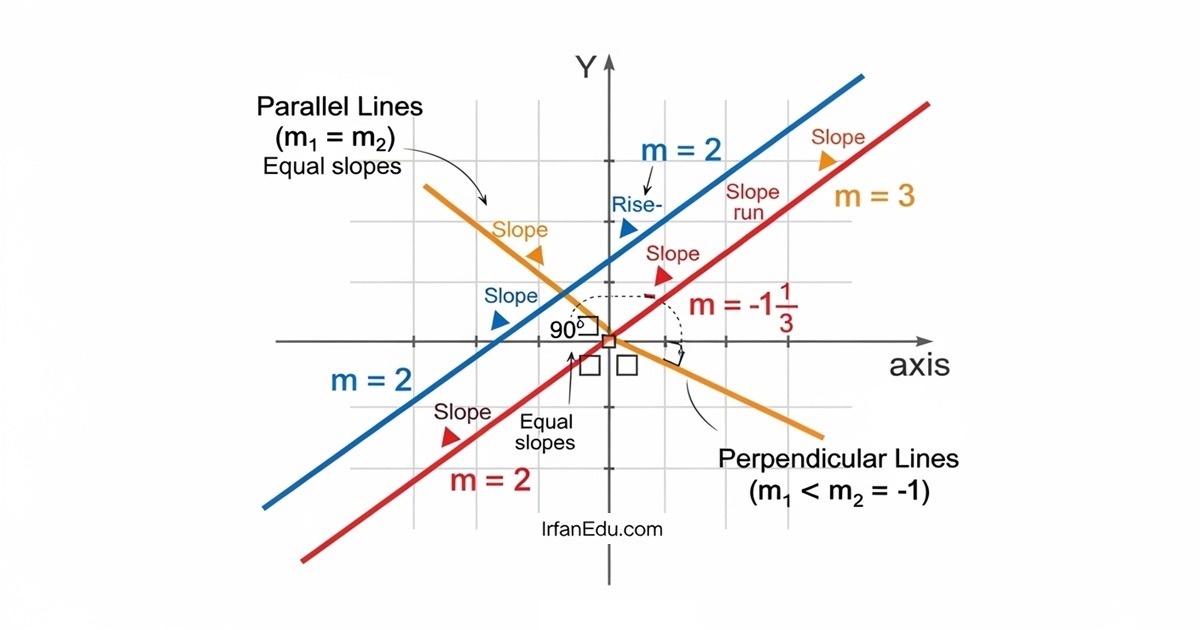
Introduction: Two Line Types That Power All of Geometry
Picture two railway tracks stretching across the Indian plains — they run side by side for hundreds of kilometres and never touch. Now picture the corner of your room where the wall meets the floor. That sharp, clean 90° angle? That is perpendicular geometry in action.
Parallel and perpendicular lines are not abstract ideas locked inside a textbook. They show up in architecture, road design, computer graphics, engineering blueprints, and even the grid of your smartphone screen. Understanding how to identify their slopes and write their equations is one of the most practical skills in coordinate geometry — and once you see the logic behind it, it clicks instantly.
In this guide, I break down everything: what these lines are, how their slopes relate, how to write their equations from scratch, and how to apply this knowledge to real problems. Whether you are a Class 10 student in India preparing for board exams or a high school student in the USA working through Algebra II, this article is built for you. [[1]](#__1) [[2]](#__2)
| Feature | Parallel Lines | Perpendicular Lines |
|---|---|---|
| Slope Relationship | Equal slopes (m₁ = m₂) | Negative reciprocals (m₁ × m₂ = −1) |
| Intersection | Never intersect | Intersect at exactly 90° |
| Y-Intercept | Must be different | Can be anything |
| Symbol | ∥ (e.g., l ∥ m) | ⊥ (e.g., AB ⊥ CD) |
| Real-World Example | Railway tracks, bookshelf edges | Road intersections, room corners |
| Key Formula | y = mx + c₁ and y = mx + c₂ | m₂ = −1/m₁ |
What Are Parallel Lines in Coordinate Geometry?
Parallel lines are two or more straight lines that lie in the same plane and never intersect, no matter how far they extend in either direction. The distance between them stays constant throughout — they never get closer or farther apart. [[1]](#__1)
In coordinate geometry, parallel lines are represented using the symbol ∥. If line l is parallel to line m, you write it as l ∥ m. The most important property that defines parallel lines on a coordinate plane is their slope.
The Slope Rule for Parallel Lines
Two non-vertical lines are parallel if and only if they have the same slope and different y-intercepts. If the y-intercepts were also equal, the lines would be identical — the same line, not two separate parallel lines. [[2]](#__2)
The standard form of a line is y = mx + c, where m is the slope and c is the y-intercept. For two parallel lines:
Line 1:
y = m·x + c₁Line 2:
y = m·x + c₂Where m₁ = m₂ (same slope) and c₁ ≠ c₂ (different y-intercepts)
Worked Example: Parallel Line Equation
Problem: Find the equation of a line parallel to y = 4x − 3 that passes through the point (2, 12).
Step 1: Identify the slope of the given line. Here, m = 4.
Step 2: Since parallel lines share the same slope, the new line also has m = 4.
Step 3: Use the point-slope formula: y − y₁ = m(x − x₁)
Substituting (2, 12): y − 12 = 4(x − 2) → y = 4x + 4
Answer: The equation of the parallel line is y = 4x + 4. [[1]](#__1)
► MY POV
In my experience teaching coordinate geometry, the most common mistake I see students make is confusing “same slope” with “same line.” I always tell my students: check the y-intercept first. If both the slope and y-intercept match, you have one line — not two parallel ones. That single check saves a lot of confusion on exam day.
What Are Perpendicular Lines in Coordinate Geometry?
Perpendicular lines are two lines that intersect each other at exactly 90 degrees — a right angle. At their point of intersection, they form four right angles. In notation, if line AB is perpendicular to line CD, you write it as AB ⊥ CD. [[1]](#__1)
Perpendicular lines are also called orthogonal lines in advanced mathematics. You see them everywhere: the x-axis and y-axis of a coordinate plane are perpendicular, the sides of a square are perpendicular to each other, and the walls of a building meet the floor perpendicularly.
The Slope Rule for Perpendicular Lines
This is where it gets interesting. Two non-vertical lines are perpendicular if their slopes are negative reciprocals of each other. The mathematical test is simple and powerful: [[2]](#__2)
m₁ × m₂ = −1
OR
m₂ = −1 / m₁If the product of two slopes equals −1, the lines are perpendicular.
For example, if one line has a slope of 4, the perpendicular line must have a slope of −1/4. Check: 4 × (−1/4) = −1. ✓ [[2]](#__2)
If a line has a slope of −3, the perpendicular slope is 1/3. Check: −3 × (1/3) = −1. ✓
A special case: when one line is vertical (undefined slope), the line perpendicular to it is horizontal with a slope of zero. [[0]](#__0)
Worked Example: Perpendicular Line Equation
Problem: Find the equation of a line perpendicular to y = 2x − 6 that passes through the point (4, 1).
Step 1: The slope of the given line is m = 2.
Step 2: The perpendicular slope is m₂ = −1/2 (negative reciprocal of 2).
Step 3: Use point-slope form: y − 1 = −½(x − 4)
Expanding: y − 1 = −½x + 2 → y = −½x + 3
Answer: The equation of the perpendicular line is y = −½x + 3. [[2]](#__2)
How to Identify Parallel and Perpendicular Lines: A Step-by-Step Method
Identifying whether two lines are parallel, perpendicular, or neither comes down to one thing: comparing their slopes. Here is the exact process I use and teach.
Step 1: Convert to Slope-Intercept Form
Always rewrite both equations in the form y = mx + b. This makes the slope immediately visible. If an equation is given as 3x + 6y = 12, rearrange it: 6y = −3x + 12 → y = −½x + 2. The slope is −½. [[0]](#__0)
Step 2: Extract and Compare Slopes
Once both lines are in slope-intercept form, pull out the m values and compare:
- If m₁ = m₂ and the y-intercepts differ → the lines are parallel.
- If m₁ × m₂ = −1 → the lines are perpendicular.
- If neither condition is true → the lines are neither parallel nor perpendicular.
Worked Example: Identify the Relationship
Problem: Are the lines y = −8x + 5 and y = ⅛x − 1 parallel, perpendicular, or neither?
Step 1: Slopes are m₁ = −8 and m₂ = ⅛.
Step 2: Check for parallel: −8 ≠ ⅛. Not parallel.
Step 3: Check for perpendicular: −8 × ⅛ = −1. ✓
Answer: The lines are perpendicular. [[2]](#__2)
Parallel vs. Perpendicular vs. Neither: Full Comparison
Students often mix up these three categories under exam pressure. This comparison table gives a clear, side-by-side breakdown so the differences stick. [[0]](#__0) [[2]](#__2)
| Criteria | Parallel (∥) | Perpendicular (⊥) | Neither |
|---|---|---|---|
| Slope Test | m₁ = m₂ | m₁ × m₂ = −1 | Neither condition met |
| Angle of Intersection | No intersection (0°) | Exactly 90° | Any other angle |
| Example Lines | y=3x+1 & y=3x−5 | y=2x+1 & y=−½x+3 | y=2x+1 & y=3x+1 |
| Y-Intercept | Must differ | Any value | Any value |
| Real-World Analogy | Train tracks | Road crossings | Diagonal fence posts |
Understanding the Slope Formula: The Foundation of It All
Before you can identify parallel or perpendicular lines, you need a firm grip on the slope formula. Slope (m) measures the steepness and direction of a line. It is calculated as “rise over run” — how much the line moves vertically for every unit it moves horizontally. [[0]](#__0)
m = (y₂ − y₁) / (x₂ − x₁)Where (x₁, y₁) and (x₂, y₂) are any two points on the line.
Four Types of Slope
- Positive slope: Line rises from left to right (e.g., m = 3).
- Negative slope: Line falls from left to right (e.g., m = −2).
- Zero slope: Horizontal line — no rise, only run (e.g., y = 5).
- Undefined slope: Vertical line — no run, only rise (e.g., x = 3).
From my experience, students who struggle with parallel and perpendicular lines almost always have a shaky understanding of slope itself. Mastering the slope formula first makes everything else fall into place. [[0]](#__0)
Parallel and Perpendicular Lines in India and USA Curricula
This topic appears prominently in both the Indian and American school systems, though the framing differs slightly.
India: CBSE and ICSE Boards
In India, parallel and perpendicular lines in coordinate geometry are introduced in Class 10 under the CBSE curriculum and revisited in Class 11 under the chapter “Straight Lines.” The NCERT textbook covers slope conditions, point-slope form, and the standard form of a line. Students are expected to derive equations of parallel and perpendicular lines and verify them algebraically. This topic carries significant weight in board examinations and JEE Foundation papers.
USA: Common Core and ACT/SAT
In the United States, this topic falls under the Common Core State Standards for Grade 8 and High School Geometry. It also appears heavily in Algebra I and Algebra II courses. The ACT Math section regularly tests slope relationships between parallel and perpendicular lines, and the SAT includes coordinate geometry questions that require writing equations given a point and a parallel or perpendicular condition. [[0]](#__0)
💡 PRO TIP FOR EXAM STUDENTS
On both CBSE board exams and the SAT, the most tested question type is: “Find the equation of a line passing through point (a, b) and parallel/perpendicular to a given line.” Master this one question type and you will handle 80% of related exam questions with confidence.
What Others Miss: Deeper Insights on Slopes and Line Equations
The Special Case of Vertical and Horizontal Lines
Most guides stop at the standard slope rules. But here is what they often skip: vertical lines have an undefined slope, and horizontal lines have a slope of zero. These two are always perpendicular to each other — but you cannot use the formula m₁ × m₂ = −1 because undefined × 0 is not a valid operation. [[0]](#__0)
The rule is simpler: any vertical line (x = a) is perpendicular to any horizontal line (y = b). Keep this in mind for tricky exam questions.
Parallel Lines in Standard Form
When lines are given in standard form Ax + By = C, you can identify parallel lines without converting to slope-intercept form. Two lines A₁x + B₁y = C₁ and A₂x + B₂y = C₂ are parallel if A₁/A₂ = B₁/B₂ ≠ C₁/C₂. This shortcut saves time on multiple-choice exams. [[1]](#__1)
The Negative Reciprocal Trick
Finding the perpendicular slope is a two-step process that students often rush: first flip the fraction (take the reciprocal), then change the sign (make it negative). Do both steps every time, in that order. For a slope of 3/4, the reciprocal is 4/3, and the negative reciprocal is −4/3. [[2]](#__2)
► MY POV
In my view, the negative reciprocal rule is the single most elegant relationship in introductory coordinate geometry. I find it remarkable that just multiplying two slopes and checking for −1 tells you whether two lines meet at a perfect right angle. When I first saw this in school, it felt like a magic trick. Now I use it as a teaching hook — it genuinely surprises students and makes the concept memorable.
Common Mistakes Students Make (And How to Avoid Them)
After reviewing hundreds of student solutions, I have identified the most frequent errors in this topic. Avoid these and your accuracy will jump immediately.
-
Mistake 1: Forgetting to check the y-intercept for parallel lines.
Two lines with the same slope but the same y-intercept are the same line — not parallel. Always verify that c₁ ≠ c₂. [[2]](#__2) -
Mistake 2: Only flipping without negating the slope.
The perpendicular slope requires both steps: flip AND negate. Doing only one step gives the wrong answer every time. -
Mistake 3: Not converting to slope-intercept form first.
Trying to compare slopes from standard form (Ax + By = C) without converting leads to errors. Always rewrite as y = mx + b before extracting the slope. [[0]](#__0) -
Mistake 4: Applying the product rule to vertical/horizontal lines.
The formula m₁ × m₂ = −1 does not apply when one line is vertical. Use the geometric rule instead: vertical ⊥ horizontal. -
Mistake 5: Using the wrong point in the point-slope formula.
When writing the equation of a new line, use the given point — not the y-intercept of the original line. The original y-intercept belongs to the original line only.
Key Lessons and Actionable Takeaways
Here is a clean summary of everything covered in this guide — the exact points I would highlight if I were preparing a student for an exam tomorrow.
- Parallel lines share the same slope and have different y-intercepts. The formula is m₁ = m₂, c₁ ≠ c₂. [[1]](#__1)
- Perpendicular lines have slopes that are negative reciprocals of each other. The test is m₁ × m₂ = −1. [[2]](#__2)
- Always convert equations to slope-intercept form (y = mx + b) before comparing slopes. [[0]](#__0)
- To write the equation of a parallel or perpendicular line, use the point-slope formula: y − y₁ = m(x − x₁).
- Vertical lines (undefined slope) are always perpendicular to horizontal lines (zero slope). The product rule does not apply here.
- Practice the negative reciprocal in two steps: flip the fraction first, then change the sign.
Frequently Asked Questions (FAQs)
Q1. What is the slope of a line parallel to y = 5x + 3?
The slope of the parallel line is 5. Parallel lines always share the same slope. The y-intercept will be different from 3, depending on the specific point the new line passes through. [[2]](#__2)
Q2. How do I find the slope of a line perpendicular to y = −4x + 7?
The slope of the given line is −4. The perpendicular slope is the negative reciprocal: flip −4 to get −1/4, then negate to get 1/4. Check: −4 × 1/4 = −1. ✓ [[2]](#__2)
Q3. Are two lines with the same slope always parallel?
Not always. If two lines have the same slope AND the same y-intercept, they are the same line — not two separate parallel lines. Parallel lines must have the same slope and different y-intercepts. [[1]](#__1)
Q4. Can a vertical line be parallel to a horizontal line?
No. A vertical line and a horizontal line are always perpendicular to each other, not parallel. Vertical lines have undefined slopes, and horizontal lines have zero slopes. They meet at a 90° angle. [[0]](#__0)
Q5. How do I write the equation of a line perpendicular to 2x + 4y = 8 passing through (0, 3)?
First, convert: 4y = −2x + 8 → y = −½x + 2. Slope = −½.
Perpendicular slope = 2 (negative reciprocal of −½).
Using point (0, 3): y − 3 = 2(x − 0) → y = 2x + 3. [[2]](#__2)
Q6. Where are parallel and perpendicular lines used in real life?
They appear everywhere: railway tracks and road lanes (parallel), building corners and road intersections (perpendicular), computer graphics rendering, architectural blueprints, engineering design, and even the layout of printed circuit boards. [[1]](#__1)
Q7. What is the product of slopes of two perpendicular lines?
The product of the slopes of two perpendicular lines is always −1. This is the definitive mathematical test for perpendicularity. If m₁ × m₂ = −1, the lines are perpendicular. [[2]](#__2)
Conclusion: Master the Slope, Master the Lines
Parallel and perpendicular lines are among the most visually intuitive and mathematically satisfying topics in coordinate geometry. The rules are clean, the logic is tight, and the applications stretch from your classroom notebook all the way to the buildings, roads, and technology around you.
To summarize what I covered: parallel lines share equal slopes with different y-intercepts, perpendicular lines carry slopes that are negative reciprocals of each other, and identifying either type starts with converting equations to slope-intercept form. [[0]](#__0) [[1]](#__1) [[2]](#__2)
From my experience, the students who master this topic fastest are the ones who practice writing equations — not just identifying relationships. So grab a notebook, pick any two points, draw a line, and challenge yourself to write the equation of a parallel and perpendicular line through a new point. Do that ten times, and this topic becomes second nature.
Ready to Go Deeper Into Coordinate Geometry?
Explore more step-by-step guides, solved examples, and exam-focused lessons on IrfanEdu.com.
Visit IrfanEdu.com →Dr. Irfan Mansuri
Dr. Irfan Mansuri is an educator, researcher, and digital content expert specializing in mathematics, coordinate geometry, and STEM education. With years of experience teaching students across India and internationally, he founded IrfanEdu.com to make high-quality math education accessible to every learner. His content is trusted by students preparing for CBSE, ICSE, JEE, SAT, and ACT examinations.
🔗 Connect on LinkedInSources & References
- CK-12 Foundation. Parallel and Perpendicular Lines in the Coordinate Plane. CK-12 Geometry – Second Edition. ck12.org
- GeeksforGeeks. Parallel and Perpendicular Lines. Mathematics Section. geeksforgeeks.org
- Lumen Learning. Slopes of Parallel and Perpendicular Lines. Developmental Math Emporium. lumenlearning.com
- PrepScholar. Lines and Slopes: ACT Math Geometry Review and Practice. prepscholar.com
- Wikipedia — Perpendicular