
Long Division Calculator – Solve with Steps Instantly
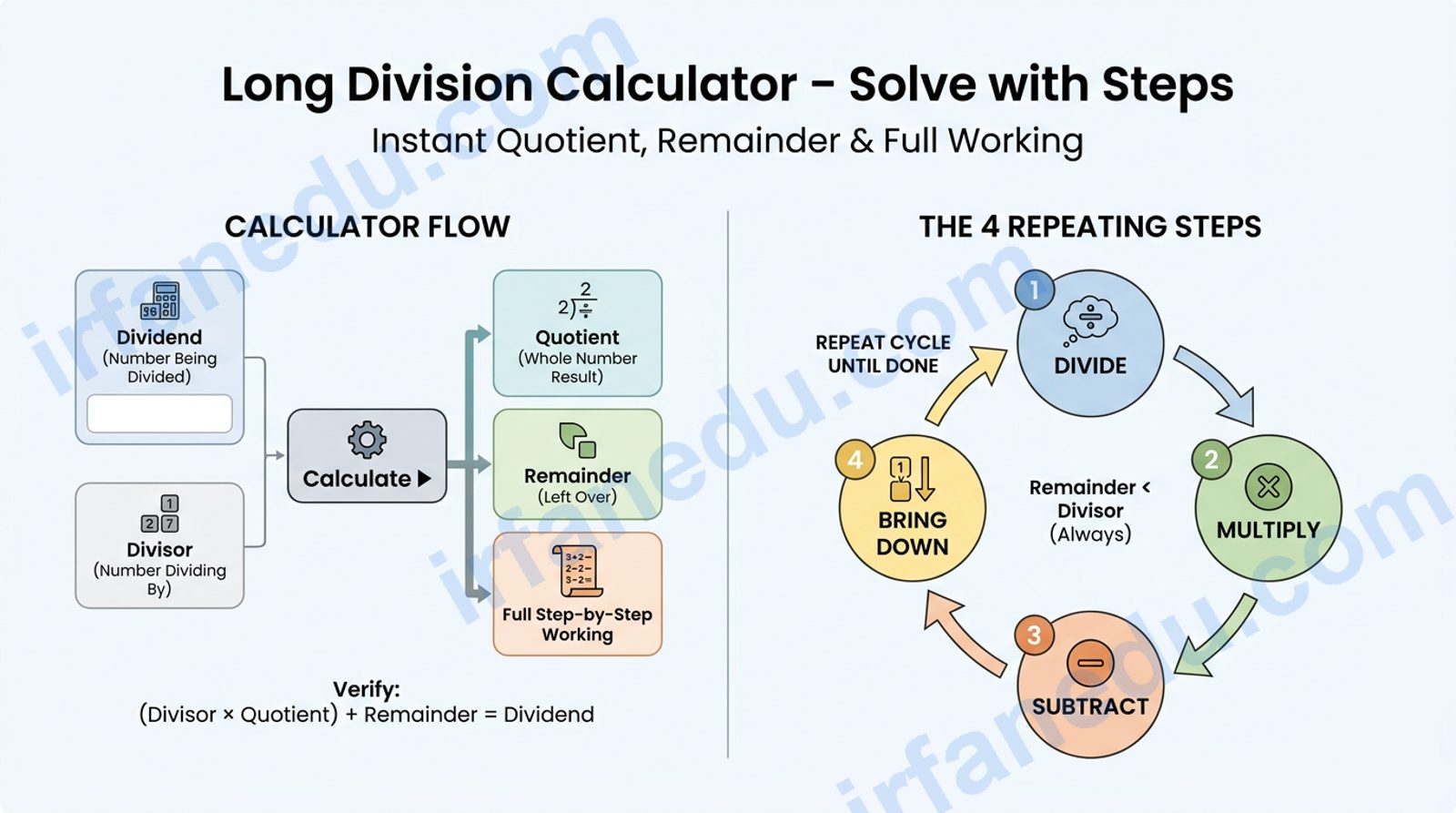
Struggling to divide a large number by hand? This long division calculator gives you the quotient, remainder, and every step of the working in one click. Type your dividend and divisor below, hit Calculate, and the result appears instantly.
Long division divides a dividend by a divisor using four repeating steps — Divide, Multiply, Subtract, Bring Down — applied to each digit in turn. The result is a whole-number quotient and a remainder. The relationship is always: Dividend = (Divisor × Quotient) + Remainder. For example, 845 ÷ 4 = quotient 211, remainder 1.
- Long division breaks a large dividend into digit-by-digit steps.
- Four steps repeat: Divide → Multiply → Subtract → Bring Down.
- The remainder is always smaller than the divisor.
- Verify any answer: (Divisor × Quotient) + Remainder = Dividend.
- This free calculator shows the full working, not just the answer.
Long Division Calculator
Enter any two whole numbers → get quotient, remainder & full steps
whole number ≥ 0
whole number ≥ 1
Step-by-step working
How to use this calculator
-
Enter the dividend — the number you want to divide — in the first field. Example: 845.
-
Enter the divisor — the number you are dividing by — in the second field. Example: 4.
-
Click Calculate (or press Enter). The quotient, remainder, decimal result, and full step-by-step working appear instantly.
-
Check the verify line at the bottom of the steps: (Divisor × Quotient) + Remainder must equal the original dividend.
-
Click Reset to clear everything and start a new problem.
What is long division?
Long division is a written arithmetic method for dividing any number by another, showing every intermediate step. It is the standard algorithm taught in schools worldwide for dividing numbers too large to handle mentally.
The method processes the dividend one digit at a time from left to right. At each position, you ask: “How many times does the divisor fit into the current working number?” That answer becomes one digit of the quotient. The leftover after the final step is the remainder.
Long division is defined formally as: given integers a (dividend) and b (divisor, b > 0), there exist unique integers q (quotient) and r (remainder) such that a = bq + r and 0 ≤ r < b. This is the Division Algorithm, a foundational theorem in number theory.
The formula explained
Dividend = (Divisor × Quotient) + Remainder
Or: a = (b × q) + r where 0 ≤ r < b
| Symbol | Meaning | Example (845 ÷ 4) |
|---|---|---|
| a | Dividend — the number being divided | 845 |
| b | Divisor — the number dividing by | 4 |
| q | Quotient — the whole-number result | 211 |
| r | Remainder — what is left over (always < b) | 1 |
SI units & dimensions: Long division is a pure arithmetic operation with no physical units. When applied to real-world quantities (e.g. dividing 845 metres by 4), the quotient inherits the same unit (metres) and the remainder is also in that unit.
Worked examples
- Bring down 8. Working number = 8. 8 ÷ 4 = 2; 2 × 4 = 8; 8 − 8 = 0.
- Bring down 4. Working number = 04. 4 ÷ 4 = 1; 1 × 4 = 4; 4 − 4 = 0.
- Bring down 5. Working number = 05. 5 ÷ 4 = 1; 1 × 4 = 4; 5 − 4 = 1.
- Result: Quotient = 211, Remainder = 1.
- Verify: (4 × 211) + 1 = 844 + 1 = 845 ✔
        2  1  1  R 1
      ┌─────────────
  4   │  8  4  5
        8           ← 2 × 4
        ─
           4
           4        ← 1 × 4
           ─
              5
              4     ← 1 × 4
              ─
              1     ← remainder
- Bring down 1. Working = 1. 1 < 13, so quotient digit = 0; remainder = 1.
- Bring down 5. Working = 15. 15 ÷ 13 = 1; 1 × 13 = 13; 15 − 13 = 2.
- Bring down 4. Working = 24. 24 ÷ 13 = 1; 1 × 13 = 13; 24 − 13 = 11.
- Bring down 7. Working = 117. 117 ÷ 13 = 9; 9 × 13 = 117; 117 − 117 = 0.
- Result: Quotient = 119, Remainder = 0.
- Verify: (13 × 119) + 0 = 1,547 ✔
Common mistakes in long division
Forgetting to write a zero when the divisor doesn’t fit. If the working number is smaller than the divisor, the quotient digit for that position is 0. Many students skip writing it, which shifts all following digits and gives a wrong answer.
Leaving a remainder larger than the divisor. If your remainder ≥ divisor, you underestimated the quotient digit. Go back and increase it by 1 (or more) until the remainder is smaller than the divisor.
Not verifying the answer. Always multiply quotient × divisor and add the remainder. If you don’t get the original dividend back, there is an error somewhere in the steps.
Long division vs short division: which should you use?
Short division is a condensed version of long division where you carry remainders mentally rather than writing them out. Here is when each method is better:
| Feature | Long division | Short division |
|---|---|---|
| Shows all working | Yes — every step written out | No — carries done mentally |
| Best for divisors | Any size, especially ≥ 10 | Single-digit divisors (2–9) |
| Error-checking | Easy — each step visible | Harder — steps are hidden |
| Speed | Slower but reliable | Faster for simple problems |
| Learning value | High — builds deep understanding | Medium — relies on mental math |
| Exam use | Required when “show working” is asked | Acceptable for quick checks |
Most guides treat long division as a purely mechanical procedure — but the real insight is that it is a greedy algorithm. At each step you choose the largest quotient digit that keeps the product ≤ the working number. This greedy choice is what guarantees the remainder is always less than the divisor. Understanding this principle means you can extend the same logic to polynomial long division, binary division in computer science, and even modular arithmetic — all of which use the identical “divide, multiply, subtract, bring down” loop. The algorithm is not just an arithmetic trick; it is the computational backbone of how processors perform integer division at the hardware level.
In my experience teaching arithmetic to students across multiple grade levels, the single biggest barrier to mastering long division is not the calculation itself — it is the fear of making a wrong estimate for the quotient digit. I tell my students: make your best guess, check it with the multiply-and-subtract step, and adjust if needed. That mindset shift — from “I must get it right first time” to “I can correct it in the next step” — reduces anxiety and speeds up learning dramatically. The calculator above is a great tool for checking your manual work, but I strongly recommend doing the steps by hand first and then verifying with the tool.
Frequently asked questions about long division
What is long division?
What is the formula for long division?
Can the remainder be larger than the divisor?
What happens when the divisor is larger than the dividend?
How do I check a long division answer?
Does this calculator handle decimals?
- Khan Academy — Long Division Review
- Wikipedia — Long Division
- Wikipedia — Euclidean Division (Division Algorithm)
✍ Written &