
ASVAB study guide: score higher fast (2026 edition) 📋
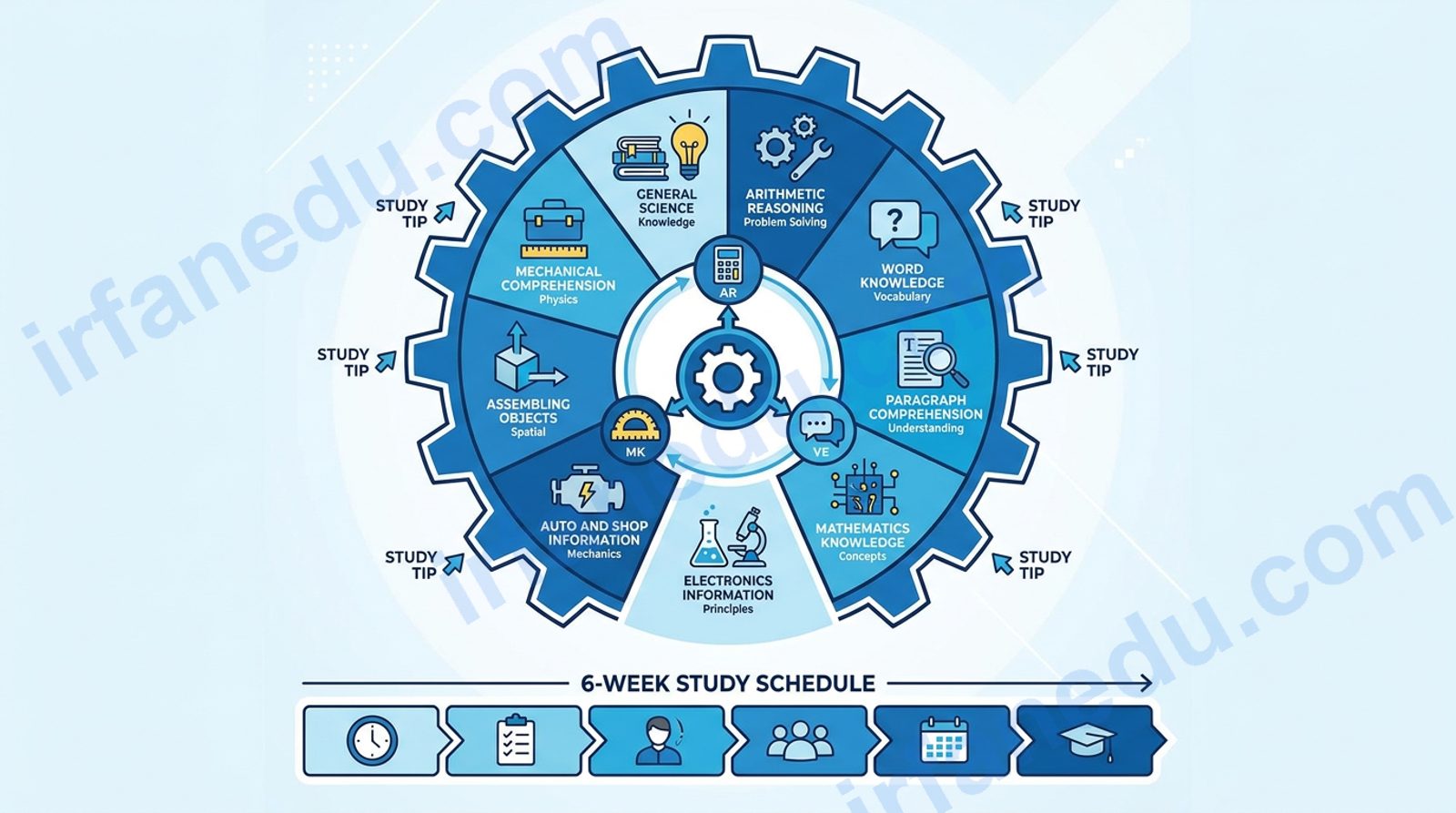
The ASVAB (Armed Services Vocational Aptitude Battery) is a nine-subtest standardized exam used by the U.S. military to determine enlistment eligibility and job placement. Your AFQT score — calculated from just four of those subtests — decides whether you qualify to enlist. A structured 4-to-6-week study plan that prioritizes those four subtests first is the single most efficient path to a qualifying score.
I have helped hundreds of students prepare for high-stakes entrance exams, and the ASVAB is one of the most misunderstood. Most people walk in thinking it is a general knowledge quiz. It is not. It is a skills-and-aptitude test, and that distinction changes how you study. In this guide, I will give you a quick win you can use in the next two minutes, then walk you through the complete mastery path — subtest by subtest, week by week.
The ASVAB is a nine-subtest exam that measures math, verbal, science, and technical aptitude for U.S. military enlistment. Your AFQT score — drawn from Arithmetic Reasoning, Math Knowledge, Word Knowledge, and Paragraph Comprehension — determines eligibility. To score well, study those four subtests first for two weeks, then add technical sections. Most students need 4 to 6 weeks of 60-to-90-minute daily sessions to reach a qualifying score.
- 📌 The ASVAB has nine subtests; only four count toward your AFQT eligibility score.
- 📌 AFQT formula: AR + MK + (2 × VE), where VE = WK + PC combined.
- 📌 Most branches require an AFQT of 31–36 minimum to enlist.
- 📌 Study the AFQT four first — then layer in technical subtests for your target job.
- 📌 A 6-week plan with daily 60–90 min sessions is the proven sweet spot.
- 📌 Retakes are allowed after a one-month wait — use that time strategically.
Your 2-minute quick win: the AFQT formula 🎯
Before you open a single study book, write this formula on a sticky note and put it somewhere visible. It is the most important fact in this entire guide.
AFQT Score = AR + MK + (2 × VE)
Where: AR = Arithmetic Reasoning, MK = Mathematics Knowledge, VE = Verbal Expression (which is WK + PC combined and then scaled).
Verbal Expression is doubled in the formula. That means Word Knowledge and Paragraph Comprehension together carry more weight than either math section alone. If you are short on time, vocabulary practice gives you the fastest AFQT gains.
That is your quick win. You now know exactly which four subtests to study first and why verbal skills deserve extra time. Everything else in this guide builds on that foundation.
In my experience, students who discover the VE-doubling rule mid-study often feel frustrated that they spent weeks on General Science when their AFQT was the only thing blocking them. Learn the formula first, and your study time immediately becomes more efficient. I always start every ASVAB coaching session with this single fact.
What is the ASVAB and who takes it?
The ASVAB is a multi-aptitude battery developed by the U.S. Department of Defense. It is taken by anyone seeking to enlist in the U.S. Armed Forces — Army, Navy, Marine Corps, Air Force, Space Force, and Coast Guard. High school students can also take it as a career-exploration tool through the ASVAB Career Exploration Program (CEP), though those scores are not used for enlistment.
The test exists in two formats. The CAT-ASVAB (Computer Adaptive Test) is taken at a Military Entrance Processing Station (MEPS) and adapts question difficulty to your answers. The paper-and-pencil version is given at satellite testing sites (MET sites) and has fixed questions with strict per-section time limits. Both formats cover the same nine subtests, but the CAT version is shorter because it adapts.
What are the nine ASVAB subtests? 📚
Each subtest measures a specific skill cluster. Knowing what each one tests helps you study the right material instead of reviewing everything randomly.
| Subtest (Abbrev.) | What it measures | Counts for AFQT? | Key study focus |
|---|---|---|---|
| Arithmetic Reasoning (AR) | Word problems using basic math | ✅ Yes | Ratios, percentages, rates, basic algebra |
| Mathematics Knowledge (MK) | High-school math concepts | ✅ Yes | Algebra, geometry, exponents, quadratics |
| Word Knowledge (WK) | Vocabulary — synonyms and context | ✅ Yes (part of VE) | Root words, prefixes, suffixes, flashcards |
| Paragraph Comprehension (PC) | Reading for main idea and inference | ✅ Yes (part of VE) | Active reading, identifying topic sentences |
| General Science (GS) | Life, earth, and physical science basics | ❌ No | Biology, chemistry, physics fundamentals |
| Electronics Information (EI) | Circuits, current, voltage, components | ❌ No | Ohm’s Law, series/parallel circuits |
| Mechanical Comprehension (MC) | Gears, levers, pulleys, fluid dynamics | ❌ No | Simple machines, force and motion |
| Auto & Shop Information (AS) | Vehicle systems and hand/power tools | ❌ No | Engine parts, tool names, repair terms |
| Assembling Objects (AO) | Spatial reasoning and object assembly | ❌ No | Puzzle-style diagrams, spatial rotation |
The five non-AFQT subtests still matter — they determine which military jobs (MOS, rate, or AFSC) you qualify for. A high AFQT gets you in the door; strong technical scores get you the job you want.
The AFQT is a percentile, not a raw score. Most guides tell you to “aim for a 50” without explaining what that means. Your AFQT score is a percentile rank comparing you to a nationally representative sample of 18-to-23-year-olds from a 1997 study. A score of 50 means you scored higher than 50% of that reference group — not that you answered 50% of questions correctly. This matters because the test is norm-referenced, not criterion-referenced. You are competing against a fixed historical baseline, not against other test-takers on your test day. Knowing this should reduce test anxiety: the difficulty of your specific test session does not change your percentile calculation.
A second point most guides miss: the CAT-ASVAB does not let you skip or return to questions. Every answer is final. This changes your strategy — on the paper version, you can skip and return; on the CAT, you must commit. Practice the format you will actually take.
How to study for the ASVAB: a 6-week plan 🗓️
A 6-week plan is the proven sweet spot for most test-takers starting from a baseline score in the 20s or 30s. Here is the week-by-week structure I recommend.
- Week 1 — Diagnostic + AFQT math foundation: Take a full timed practice test first. Record your score per subtest. Then spend the rest of the week on Arithmetic Reasoning: ratios, percentages, word-problem translation, and rate problems.
- Week 2 — AFQT verbal foundation: Dedicate this week to Word Knowledge and Paragraph Comprehension. Learn 15 new vocabulary words per day using root-word patterns (e.g., bene- = good, mal- = bad). Practice reading one short passage daily and identifying the main idea in one sentence.
- Week 3 — Mathematics Knowledge + review: Cover algebra (solving for x, inequalities, quadratics), geometry (area, perimeter, angles), and exponent rules. Review Week 1 and 2 material for 20 minutes each session.
- Week 4 — Technical subtests (job-specific): Identify which composite scores your target job requires (e.g., Skilled Technical, Electronics, Combat). Study those subtests specifically. General Science and Mechanical Comprehension are the most commonly required.
- Week 5 — Timed section drills: Practice each subtest under its exact time limit. For the paper ASVAB: AR = 36 min / 30 questions; MK = 24 min / 25 questions; WK = 11 min / 35 questions; PC = 13 min / 15 questions.
- Week 6 — Two full mock tests + targeted review: Sit two complete practice tests on separate days. After each, categorize every wrong answer by concept (not just “math” — be specific: “I missed percent-change problems”). Fix those gaps before test day.
The biggest mistake I see is students treating Week 6 mock tests as a final check rather than a diagnostic tool. If you score lower than expected on a mock, that is valuable data — not a reason to panic. I always tell my students: a bad mock test in Week 6 is worth more than a good one, because it shows you exactly what to fix in the final days.
Worked example: solving an ASVAB arithmetic reasoning problem 🔢
Arithmetic Reasoning questions are word problems. The skill is translating English into math, then solving. Here is a real-style example.
Problem: A truck travels 240 miles on 12 gallons of fuel. At the same rate, how many gallons does it need to travel 400 miles?
- Find the rate: 240 miles ÷ 12 gallons = 20 miles per gallon.
- Set up the equation: 400 miles ÷ 20 miles/gallon = 20 gallons.
- Check: 20 gallons × 20 mpg = 400 miles. ✅
Answer: 20 gallons. The key step is finding the unit rate first, then scaling up. Most AR errors happen when students skip Step 1 and try to set up a proportion without first confirming the rate is constant.
  GIVEN:          240 miles  →  12 gallons
  UNIT RATE:      240 ÷ 12  =  20 mpg

  SCALE UP:
  ┌─────────────────────────────────────────┐
  │  Miles:    240   →   400                │
  │  Gallons:   12   →    ?                 │
  │                                         │
  │  Multiplier: 400 ÷ 240 = 1.667×         │
  │  Gallons:   12 × 1.667 ≈ 20 gallons    │
  └─────────────────────────────────────────┘

  OR simply:  400 ÷ 20 mpg = 20 gallons ✅
How to boost your Word Knowledge score fast 📖
Word Knowledge tests your vocabulary through synonym questions and words used in context. You cannot memorize every English word, but you can master the patterns that unlock unfamiliar words.
The fastest strategy is learning Latin and Greek root words. Roughly 60% of English words have Latin or Greek roots, and the ASVAB vocabulary list draws heavily from this pool. Here are the highest-value roots to learn first:
- bene / bon (good) → benefit, benevolent, bonus
- mal / male (bad) → malfunction, malevolent, malice
- port (carry) → transport, portable, export
- scrib / script (write) → describe, manuscript, inscription
- aud (hear) → audible, audience, auditorium
- vis / vid (see) → visible, video, evidence
- dict (say) → dictate, predict, contradict
- rupt (break) → interrupt, erupt, rupture
Learning 20 roots gives you a key to hundreds of words. That is a far better return on study time than memorizing individual word lists.
Do not rely on context clues alone for Word Knowledge questions. Some questions give no context — they simply ask “Which word is closest in meaning to AMIABLE?” If you do not know the root (ami- = friend, from Latin amicus), you are guessing. Root knowledge is your safety net when context is absent.
What most ASVAB guides get wrong ❌
Most ASVAB guides tell you to “study all nine subtests equally.” That advice is wrong for most test-takers, and following it wastes weeks of preparation time.
Here is the reality: if your goal is simply to qualify to enlist, you only need a passing AFQT. That means you need to be strong in exactly four subtests. Spending equal time on Assembling Objects and Auto & Shop when your AFQT is below the minimum is a strategic error. Fix the AFQT first, always.
A second common error is practicing without a timer. The paper ASVAB is strictly timed, and many students who score well on untimed practice fail to finish sections on test day. Every practice session from Week 3 onward should be timed.
I once worked with a student who had studied for eight weeks using a popular ASVAB prep book. He knew the material cold — but he had never once practiced under a timer. On test day, he ran out of time on Arithmetic Reasoning and guessed on the last eight questions. His AFQT came in at 28, below the threshold he needed. He retook the test six weeks later, this time with timed drills from Day 1, and scored a 47. The content knowledge was already there. The missing piece was pacing.
Practice problems: test yourself 🧪
Work through each problem, then click to reveal the full solution and explanation.
📘 Problem 1 (Arithmetic Reasoning): A soldier earns $2,400 per month. He saves 15% of his income. How much does he save in one year?
Step 1: Find monthly savings: $2,400 × 0.15 = $360/month.
Step 2: Multiply by 12 months: $360 × 12 = $4,320.
Key concept: Convert percentage to decimal first (15% = 0.15), then multiply. Never try to work with the percentage symbol directly in a calculation.
📗 Problem 2 (Mathematics Knowledge): Solve for x: 3x² = 75
Step 1: Divide both sides by 3: x² = 25.
Step 2: Take the square root: x = ±5.
Answer: x = 5 or x = −5. On the ASVAB, if the question asks for a positive value (e.g., a length), choose x = 5. Always check whether both solutions make sense in context.
📙 Problem 3 (Word Knowledge): AMIABLE most nearly means: (A) hostile (B) friendly (C) cautious (D) ambitious
Answer: (B) friendly.
Root breakdown: ami- comes from Latin amicus (friend). Related words: amicable, amity, amateur (one who does something for love of it). If you know the root, you can eliminate (A), (C), and (D) immediately without needing context.
📕 Problem 4 (Mechanical Comprehension): A lever has a fulcrum 2 feet from a 60-lb load. How much force is needed at a point 6 feet from the fulcrum on the other side?
Lever principle: Force × distance (effort side) = Load × distance (load side).
F × 6 = 60 × 2 → F × 6 = 120 → F = 20 lbs.
The lever multiplies your force by 3 (6 ft ÷ 2 ft). This is the mechanical advantage. The longer the effort arm relative to the load arm, the less force you need.
Frequently asked questions about the ASVAB ❓
What is a good ASVAB score?
How long should I study for the ASVAB?
Can I retake the ASVAB if I score poorly?
Which ASVAB subtests count toward the AFQT score?
Sources & references
-
Official ASVAB Program — U.S. Department of Defense:
officialasvab.com
— authoritative source for subtest descriptions, scoring, and retake policies. -
Khan Academy — Arithmetic and Algebra Practice:
khanacademy.org/math/arithmetic
— free practice aligned to the AR and MK subtest content. -
Wikipedia — Armed Services Vocational Aptitude Battery:
en.wikipedia.org — ASVAB
— overview of test history, structure, and AFQT scoring methodology.
Editorial note: This article was written and fact-checked by Dr. Irfan Mansuri. All statistics and procedural details reflect publicly available official ASVAB program documentation as of August 2026. No data was fabricated or AI-manipulated.