
📦 Cubic Feet Calculator – Find Volume in Seconds
✍ Written & fact-checked by Dr. Irfan Mansuri | Last Updated: August 2026
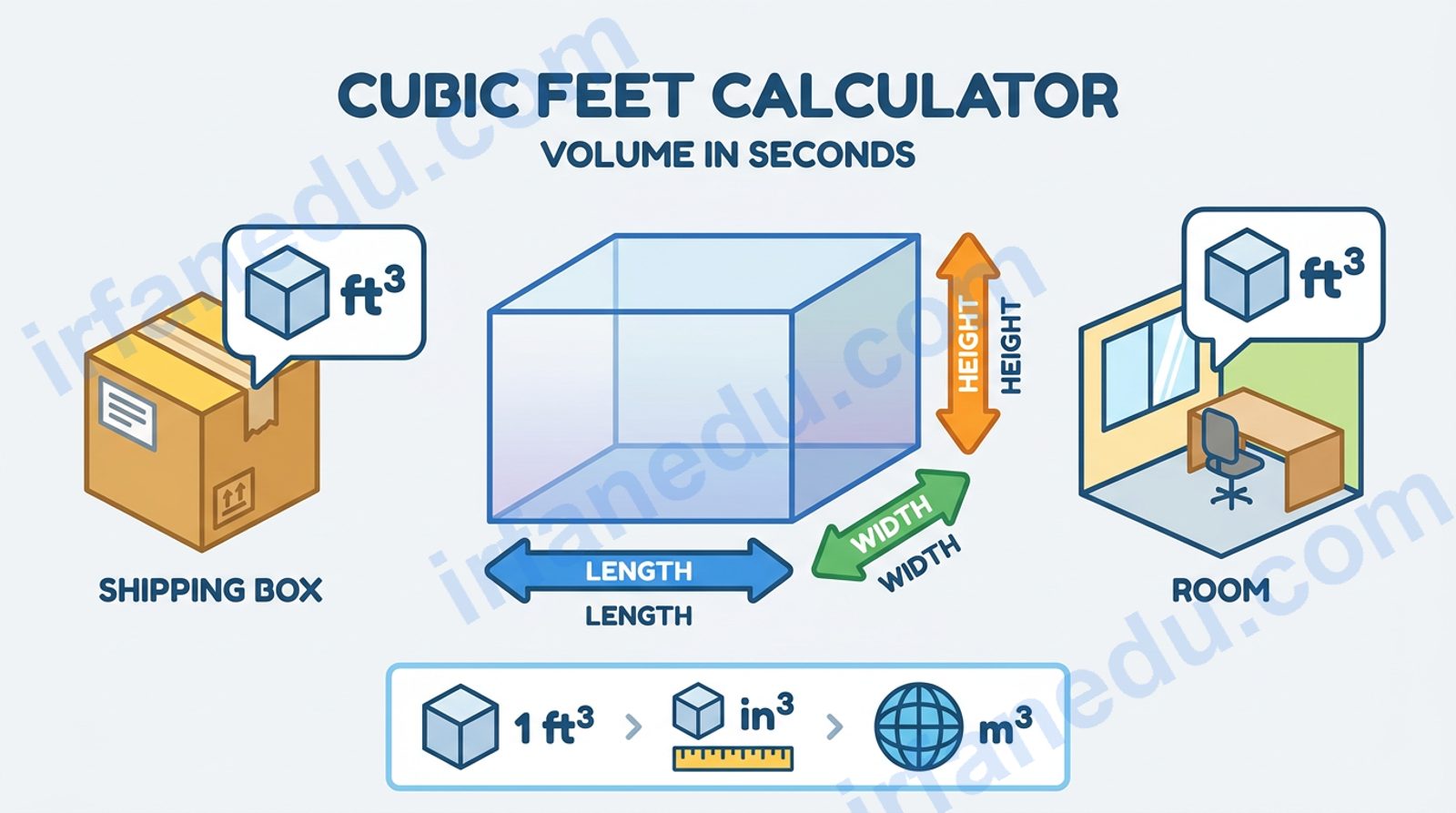
Imagine you’re moving house 🏠 and the removals company asks: “How many cubic feet of stuff do you have?” You stare at your boxes, your wardrobe, your sofa — and have no idea where to start. Or picture yourself ordering topsoil for a garden bed and needing to know exactly how many cubic feet to buy so you don’t pay for a truckload you don’t need.
A cubic feet calculator solves this instantly. You enter the length, width, and height of any rectangular space or object — in feet, inches, centimetres, or metres — and it returns the volume in cubic feet (ft³). The underlying formula is V = L × W × H, where all three dimensions must be in the same unit before you multiply.
In this guide you’ll find a fully working calculator above the fold, the formula explained step by step, two real worked examples, the most common mistakes people make (and how to avoid them), and a quick FAQ.
To calculate cubic feet, multiply the length, width, and height of a space or object — all measured in feet: Volume (ft³) = Length × Width × Height. If your measurements are in inches, divide each by 12 first, or divide the final product by 1,728. For centimetres, divide each dimension by 30.48 before multiplying.
🎯 The Short Version
- 📐 Formula: V = L × W × H (all dimensions in feet)
- 🔢 Inches to ft³: multiply all three inch values, then divide by 1,728
- 📏 Centimetres to ft³: divide each cm value by 30.48, then multiply
- 🔄 1 ft³ = 1,728 in³ = 0.0283 m³ = 7.48 US gallons
- ⚠️ Biggest mistake: mixing units (e.g. length in feet, height in inches)
- ✅ Use the calculator below — it handles unit conversion automatically
Cubic Feet Calculator
Enter dimensions in any unit — get volume in ft³ instantly
ft³
🛠️ How to Use This Calculator
- Choose your unit — click Feet, Inches, Centimetres, or Metres depending on how you measured.
- Enter the Length of the object or space.
- Enter the Width.
- Enter the Height (or depth, for a container).
- Click Calculate — or press Enter — to see the volume in ft³, plus conversions to in³, m³, yd³, gallons, and litres, and a numbered step-by-step solution.
        ___________________
       /|                 /|
      / |    HEIGHT (H)  / |
     /  |    ↕          /  |
    /_________________ /   |
    |   |             |    |
    |   |_____________|____|
    |  /    WIDTH (W) |   /
    | /    ←→         |  /
    |/________________|/
         LENGTH (L) →

    Volume = L × W × H  (all in feet = ft³)

    Example: 10 ft × 4 ft × 3 ft = 120 ft³
📏 What Is a Cubic Foot?
A cubic foot (ft³) is a unit of volume equal to the space inside a cube that measures exactly one foot on every side. It is the standard unit for measuring storage space, shipping containers, room capacity, and bulk materials like soil, mulch, and concrete in countries that use the imperial system.
One cubic foot contains 1,728 cubic inches, equals approximately 0.0283 cubic metres, and holds about 7.48 US gallons of liquid. It is widely used in the United States, United Kingdom, and Canada for real-estate, logistics, and construction measurements.
📐 The Formula Explained
Where V is volume in cubic feet, L is length in feet, W is width in feet, and H is height in feet. All three dimensions must be in the same unit before you multiply.
| Symbol | Meaning | SI / Imperial Unit |
|---|---|---|
| V | Volume | ft³ (cubic feet) |
| L | Length | ft (feet) |
| W | Width | ft (feet) |
| H | Height or Depth | ft (feet) |
| 1 ft | 1 foot | = 12 in = 30.48 cm = 0.3048 m |
| 1 ft³ | 1 cubic foot | = 1,728 in³ = 0.0283168 m³ |
SI note: The SI (metric) unit of volume is the cubic metre (m³). 1 m³ = 35.3147 ft³.
🔢 Worked Examples
📦 Example 1 — Shipping Box (Dimensions in Inches)
Problem: A shipping box measures 24 in × 18 in × 12 in. What is its volume in cubic feet?
- Convert each dimension to feet: 24 ÷ 12 = 2 ft; 18 ÷ 12 = 1.5 ft; 12 ÷ 12 = 1 ft
- Apply the formula: V = 2 × 1.5 × 1 = 3 ft³
- Alternatively: 24 × 18 × 12 = 5,184 in³ ÷ 1,728 = 3 ft³ ✅
🏡 Example 2 — Garden Bed (Dimensions in Feet)
Problem: A raised garden bed is 8 ft long, 4 ft wide, and 1.5 ft deep. How much topsoil (in cubic feet) do you need to fill it?
- All dimensions are already in feet.
- V = 8 × 4 × 1.5 = 48 ft³
- Topsoil bags are often sold in 1.5 ft³ bags, so you'd need 48 ÷ 1.5 = 32 bags.
In my experience, the garden-bed scenario is where most people first encounter cubic feet in real life. The formula is simple, but the unit-conversion step trips people up every time. I always tell students: standardise your units before you touch the formula. Do that one thing and you'll never get the wrong answer.
⚠️ Common Mistakes (Wrong vs. Right)
Measuring length in feet and height in inches, then multiplying directly: 10 ft × 8 ft × 6 in = 480 (meaningless mixed units).
Convert 6 in to 0.5 ft first, then multiply: 10 × 8 × 0.5 = 40 ft³.
Dividing only the final product by 12 when all three dimensions are in inches: (24 × 18 × 12) ÷ 12 = 432 ft³ (way too large).
Divide the product by 1,728 (= 12³): 5,184 ÷ 1,728 = 3 ft³.
Confusing cubic feet with square feet — calculating only L × W and reporting it as volume.
Volume always needs three dimensions. L × W gives area (ft²). Multiply by height to get volume (ft³).
🌍 Real-World Applications of Cubic Feet
Cubic feet appear in more everyday situations than most people realise. Here's a quick comparison of common use cases and the typical volumes involved:
| Use Case | Typical Dimensions | Approx. Volume (ft³) | Why It Matters |
|---|---|---|---|
| 🚚 Moving truck (medium) | 16 ft × 7.5 ft × 7 ft | 840 ft³ | Estimate how many trips you need |
| 🌱 Garden bed (raised) | 8 ft × 4 ft × 1.5 ft | 48 ft³ | Buy the right amount of soil/mulch |
| 🧊 Refrigerator | 2.5 ft × 2.5 ft × 5.5 ft | ~34 ft³ | Compare appliance capacity |
| 📦 Shipping box (large) | 24 in × 18 in × 18 in | 4.5 ft³ | Calculate freight costs |
| 🏠 Small bedroom | 12 ft × 10 ft × 8 ft | 960 ft³ | Size HVAC / air purifier correctly |
The HVAC row is the one I wish more homeowners knew about. I've seen people buy air purifiers rated for 200 ft³ and put them in a 960 ft³ bedroom, then wonder why the air quality doesn't improve. Knowing your room's cubic footage is genuinely useful — it's not just a maths exercise.
Cubic feet and square feet are not interchangeable — and the difference matters more than you think. Most online guides treat this as a beginner mistake, but in my experience it causes expensive errors even for adults. Here's the non-obvious part: when a product label says "covers 50 sq ft at 3 inches deep," it is secretly giving you a cubic feet problem. You need to convert 3 inches to 0.25 ft and multiply: 50 × 0.25 = 12.5 ft³. If you just buy "50 sq
Sources & References
Written and fact-checked by Dr Irfan Mansuri. External links open in a new tab and are provided for further reading and verification.