
Dosage calculation: the complete step-by-step guide for students
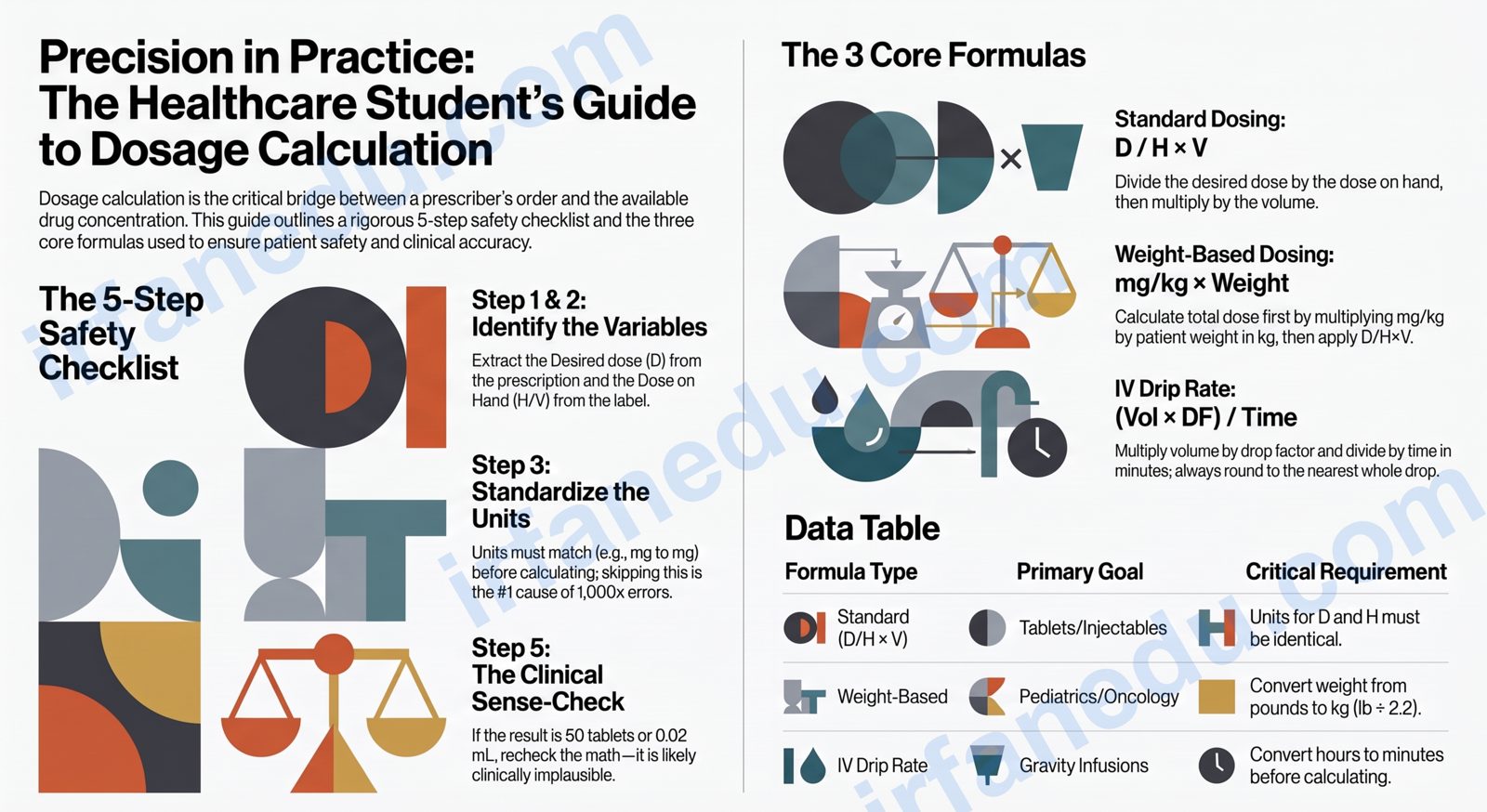
Dosage calculation is the mathematical process of determining the exact amount of a medication to give a patient based on the prescription, the available drug concentration, and — where relevant — the patient’s body weight. Every nursing, pharmacy, and allied-health student must master it before clinical practice.
If you have ever stared at a drug label and a prescription and felt completely lost, you are not alone. In my 15+ years of teaching healthcare math, dosage calculation is the topic students fear most — and the one that matters most. Get it right and you protect patients. Get it wrong and the consequences are serious.
This guide gives you a practical, checklist-first approach: I start with the five-step action checklist you can use on any dosage problem, then I unpack each step with worked examples, a comparison of the three main formulas, and a practice quiz. By the end, you will be able to solve any standard dosage problem confidently.
- ✅ Understand the D/H × V formula and when to use it
- ✅ Apply weight-based dosing (mg/kg) correctly
- ✅ Calculate IV drip rates without confusion
- ✅ Spot and fix the unit-conversion errors that trip most students up
- ✅ Pass dosage calculation tests with a structured, repeatable method
Dosage calculation is the process of working out the correct amount of medication to give a patient. The core formula is: Dose = (Desired dose ÷ Dose on hand) × Volume on hand. For weight-based drugs, multiply the prescribed dose (mg/kg) by the patient’s weight in kilograms. Always confirm units match before you calculate.
⚡ In Short
- 🟢 Core formula: D/H × V — desired dose divided by dose on hand, times volume on hand.
- 🟢 Weight-based dose: mg/kg × patient weight (kg) gives total dose first.
- 🟢 IV drip rate: (Volume × Drop factor) ÷ Time in minutes.
- 🟢 Always convert units to match before dividing — this is the #1 student error.
- 🟢 Check every answer for clinical reasonableness, not just arithmetic accuracy.
- 🟢 Dimensional analysis is the safest method for complex multi-step problems.
1. Your 5-step dosage calculation checklist
Before I explain the formulas, here is the checklist I give every student on day one. Use it on every single problem — in class, in exams, and in clinical practice. It works because it forces you to slow down at the exact steps where errors happen.
✅ 5-step dosage calculation checklist
- Step 1 — Read the prescription carefully. Note the drug name, the dose ordered (the number + the unit), and the route (oral, IV, IM). Write it down exactly.
- Step 2 — Read the drug label. Identify the dose on hand (H) and the volume or quantity it comes in (V). For example: 250 mg per 5 mL, or 500 mg per tablet.
- Step 3 — Convert units if they do not match. If the prescription is in mg and the label is in mcg, convert before you do anything else. This single step prevents the majority of calculation errors.
- Step 4 — Apply the correct formula. Use D/H × V for standard doses, mg/kg × weight for weight-based doses, and the drip-rate formula for IV fluids.
- Step 5 — Sense-check your answer. Ask: is this a reasonable dose? A result of 0.02 mL or 50 tablets is a red flag — recheck your arithmetic and your unit conversion.
Every section below unpacks one or more of these steps in detail. I recommend you bookmark this checklist and return to it whenever you get stuck on a problem.
In my experience, students who fail dosage calculation tests are not failing because the math is hard — they are failing because they skip Step 3 (unit conversion) and Step 5 (sense-checking). The arithmetic in most dosage problems is simple multiplication and division. The discipline of checking is what separates safe practitioners from dangerous ones.
2. What is dosage calculation?
Dosage calculation is the systematic process of determining the correct amount of a medication to administer to a patient, based on the prescriber’s order and the available drug formulation. It is a core competency for nurses, pharmacists, paramedics, and any healthcare professional who prepares or administers medications.
A prescription tells you what the patient needs. The drug label tells you what you have. Dosage calculation is the bridge between the two.
Three variables appear in almost every calculation:
- D (Desired dose): the dose the prescriber ordered, e.g. 300 mg.
- H (Dose on hand): the concentration available, e.g. 250 mg per 5 mL.
- V (Volume on hand): the quantity that contains H, e.g. 5 mL.
For weight-based medications — common in paediatrics and oncology — a fourth variable appears: the patient’s weight in kilograms. For intravenous fluids, time and drop factor also enter the calculation.
[IMAGE: Diagram showing D, H, and V labelled on a prescription pad and a drug vial | ALT: Dosage calculation variables D desired dose H dose on hand V volume on hand diagram]
3. The three core formulas compared
There are three formulas every student must know. The table below shows when to use each one and what inputs it requires.
| Formula | When to use it | Inputs needed | Output |
|---|---|---|---|
| D/H × V | Standard oral or injectable dose (tablets, capsules, mL) | Desired dose (D), dose on hand (H), volume on hand (V) | Volume or number of tablets to give |
| mg/kg × weight | Weight-based dosing (paediatrics, oncology, antibiotics) | Prescribed dose in mg/kg, patient weight in kg | Total dose in mg — then apply D/H × V |
| (Volume × Drop factor) ÷ Time | IV infusion via gravity drip set | Volume in mL, drop factor (gtts/mL), time in minutes | Drip rate in drops per minute (gtts/min) |
A fourth approach — dimensional analysis (also called the factor-label method) — is not a separate formula but a systematic unit-cancellation technique that works for all three types. Many educators, including me, recommend it for complex multi-step problems because it makes unit errors visible before you get the wrong answer.
4. Step-by-step: how to use D/H × V
The D/H × V formula is the foundation of dosage calculation. Here is how to apply it in five ordered steps, with a worked example built in.
- Write down D. The prescription reads: “Amoxicillin 375 mg orally.” So D = 375 mg.
- Write down H and V from the label. The bottle says: “Amoxicillin 250 mg per 5 mL.” So H = 250 mg, V = 5 mL.
- Check units match. D is in mg, H is in mg. ✅ No conversion needed.
- Apply the formula: (375 ÷ 250) × 5 = 1.5 × 5 = 7.5 mL.
- Sense-check. 7.5 mL of an oral antibiotic suspension is a reasonable volume. ✅
  WORKED EXAMPLE — D/H × V
  ─────────────────────────────────────────
  Prescription : Amoxicillin 375 mg orally
  Drug label   : 250 mg per 5 mL

  Step 1  D = 375 mg
  Step 2  H = 250 mg   V = 5 mL
  Step 3  Units match (both mg) ✓
  Step 4  (D ÷ H) × V
          (375 ÷ 250) × 5
          = 1.5 × 5
          = 7.5 mL  ✓
  Step 5  7.5 mL oral suspension — reasonable ✓
  ─────────────────────────────────────────
🧪 Worked example 2 — unit conversion required
Prescription: Digoxin 0.25 mg IV. Label: Digoxin 500 mcg per 2 mL.
Step 3 — Convert: D = 0.25 mg = 250 mcg (multiply mg × 1000). Now D and H are both in mcg.
Step 4: (250 ÷ 500) × 2 = 0.5 × 2 = 1 mL.
Step 5: 1 mL IV injection — clinically reasonable. ✅
5. How to calculate a weight-based dose
Weight-based dosing means the prescriber orders a dose per kilogram of body weight (mg/kg). You calculate the total dose first, then use D/H × V to find the volume.
- Find the patient’s weight in kg. If given in pounds, divide by 2.2 (1 lb = 0.4536 kg).
- Multiply: Total dose (mg) = prescribed dose (mg/kg) × weight (kg).
- Use the total dose as D and apply D/H × V as normal.
🧪 Worked example — paediatric weight-based dose
Order: Ceftriaxone 50 mg/kg IV. Patient weight: 22 kg. Label: 1 g per 10 mL (after reconstitution).
Step 1: Weight = 22 kg.
Step 2: Total dose = 50 × 22 = 1,100 mg.
Step 3: Convert label: 1 g = 1,000 mg. So H = 1,000 mg, V = 10 mL.
Step 4: (1,100 ÷ 1,000) × 10 = 1.1 × 10 = 11 mL.
Step 5: 11 mL IV — slightly over one standard vial; clinician should confirm. ✅
Weight-based calculations catch students out because they forget the two-stage process. They try to jump straight to D/H × V without first computing the total dose. I always tell my students: “Weight-based means two calculations, not one.” Write the total dose on paper before touching the formula — it prevents the most common error I see in exam scripts.
6. How to calculate an IV drip rate
An IV drip rate tells you how many drops per minute to set on a gravity infusion set. The formula is:
Drip rate (gtts/min) = (Volume in mL × Drop factor) ÷ Time in minutes
The drop factor is printed on the IV tubing package. Standard macro-drip sets deliver 10, 15, or 20 gtts/mL. Micro-drip sets deliver 60 gtts/mL.
🧪 Worked example — IV drip rate
Order: Infuse 500 mL normal saline over 4 hours. Tubing: 20 gtts/mL.
Convert time: 4 hours = 240 minutes.
Apply formula: (500 × 20) ÷ 240 = 10,000 ÷ 240 = 41.7 gtts/min ≈ 42 gtts/min.
Sense-check: 42 drops per minute for a 500 mL bag over 4 hours is standard. ✅
💡 Pro tip: Always round IV drip rates to the nearest whole number — you cannot count a fraction of a drop. Round 41.7 to 42, not 41.
7. Common mistakes and how to fix them
After reviewing hundreds of student exam papers, I have identified the five mistakes that appear most often. Here they are with the exact fix for each.
⚠️ Mistake 1 — Skipping unit conversion. Dividing mg by mcg (or g by mg) gives a number that is off by a factor of 1,000. Fix: always write the units next to every number and confirm they match before dividing.
⚠️ Mistake 2 — Inverting the formula. Writing H/D × V instead of D/H × V. Fix: remember D is on top because D is what you desire. “I desire the top spot.”
⚠️ Mistake 3 — Using pounds instead of kilograms for weight-based dosing. Fix: convert weight to kg first. Divide pounds by 2.2, or multiply by 0.4536.
⚠️ Mistake 4 — Using hours instead of minutes in the drip-rate formula. Fix: the formula requires time in minutes. Always convert hours to minutes before applying it.
⚠️ Mistake 5 — Not sense-checking the answer. A dose of 0.01 mL or 20 tablets should trigger immediate doubt. Fix: after every calculation, ask “Is this physically and clinically plausible?”
Most dosage calculation guides teach you the formulas and stop there. What they rarely say is this: the formula is the easy part — the dangerous part is the label. Drug labels can express the same concentration in multiple ways on the same product (e.g. “500 mg/10 mL” and “50 mg/mL” on the same vial). In my experience, students who practise only with textbook problems — where the label is always written in one clean format — are blindsided in clinical settings where labels use unfamiliar notation. My advice: deliberately practise reading real drug labels, not just textbook numbers. Photograph labels during placements and work through the calculation from the actual label text. That single habit closes the gap between classroom competence and clinical safety.
I have seen students ace every practice problem in class and then freeze in a simulation lab because the vial said “1 g/20 mL” instead of “50 mg/mL.” The math is identical — but the unfamiliar format broke their confidence. Teach yourself to re-express every label in multiple equivalent forms as a warm-up exercise. It takes 30 seconds and builds the mental flexibility that real clinical work demands.
🧠 Quick practice quiz
Select the correct answer for each question. The selected option highlights green when chosen.
Q1. A prescription reads: Paracetamol 600 mg oral. The label says 500 mg per 10 mL. How many mL do you give?
Q2. A child weighs 30 kg. The order is 10 mg/kg of ibuprofen. The suspension contains 100 mg per 5 mL. How many mL?
Q3. You need to infuse 1,000 mL over 8 hours using a 15 gtts/mL set. What is the drip rate in gtts/min?
👁 Show answer explanations
Q1: (600 ÷ 500) × 10 = 12 mL. ✅
Q2: Total dose = 10 × 30 = 300 mg. (300 ÷ 100) × 5 = 15 mL. ✅
Q3: Time = 8 × 60 = 480 min. (1000 × 15) ÷ 480 = 31.25 ≈ 31 gtts/min. ✅
8. Reveal-on-click practice problems
Try each problem yourself before clicking to reveal the solution.
Problem 1 — Oral tablet: Order is Metformin 1 g. Tablets available: 500 mg each. How many tablets?
Convert: 1 g = 1,000 mg. D = 1,000 mg, H = 500 mg, V = 1 tablet.
(1,000 ÷ 500) × 1 = 2 tablets. ✅
Problem 2 — Weight-based: Order is Gentamicin 2 mg/kg IV. Patient weighs 70 kg. Label: 80 mg per 2 mL. How many mL?
Total dose: 2 × 70 = 140 mg.
D = 140 mg, H = 80 mg, V = 2 mL.
(140 ÷ 80) × 2 = 1.75 × 2 = 3.5 mL. ✅
Problem 3 — IV drip: Infuse 250 mL over 2 hours. Drop factor: 60 gtts/mL. What is the drip rate?
Convert time: 2 hours = 120 minutes.
(250 × 60) ÷ 120 = 15,000 ÷ 120 = 125 gtts/min.
Note: 125 gtts/min with a 60 gtts/mL micro-drip set = 125 mL/hr — confirm with an infusion pump if available. ✅
Problem 4 — Unit conversion trap: Order is Levothyroxine 0.1 mg oral. Label: 100 mcg per tablet. How many tablets?
Convert: 0.1 mg = 100 mcg. D = 100 mcg, H = 100 mcg, V = 1 tablet.
(100 ÷ 100) × 1 = 1 tablet. ✅
(Many students give 0.1 tablets by forgetting to convert — a 1,000× error.)
9. Frequently asked questions about dosage calculation
What is the basic formula for dosage calculation?
The basic formula is Dose to give = (Desired dose ÷ Dose on hand) × Volume on hand, written as D/H × V. This tells you how many mL or tablets to administer when the available concentration differs from the prescribed dose. Always confirm that D and H are in the same unit before dividing.
How do you calculate a weight-based drug dose?
Multiply the prescribed dose in mg/kg by the patient’s weight in kilograms. For example, if the order is 5 mg/kg and the patient weighs 60 kg, the total dose is 300 mg. Then apply D/H × V to find the volume to draw up. Always convert weight to kg first if it is given in pounds.
What is the IV drip rate formula?
IV drip rate (drops per minute) = (Volume in mL × Drop factor) ÷ Time in minutes. The drop factor (gtts/mL) is printed on the IV tubing package — common values are 10, 15, 20, or 60 gtts/mL. Convert hours to minutes before applying the formula, and round the final answer to the nearest whole number.
What units must match in a dosage calculation?
The desired dose (D) and the dose on hand (H) must be in the same unit before you divide them. If D is in mg and H is in mcg, convert one to match the other. Mismatched units are the single most common cause of dosage errors in student calculations and can result in a 1,000-fold error.
📌 Key takeaways
- The D/H × V formula is the foundation of all standard dosage calculations.
- Weight-based dosing requires two calculations: total dose first, then D/H × V.
- IV drip rate = (Volume × Drop factor) ÷ Time in minutes — always convert hours to minutes.
- Unit conversion (Step 3 of the checklist) prevents the majority of student errors.
- Sense-checking your answer is not optional — it is the last line of defence against errors.
- Practising with real drug labels (not just textbook numbers) builds clinical-level competence.
- Dimensional analysis is the safest method for complex multi-step problems.
📖 Sources & references
- Dosage Calculations — StatPearls, National Library of Medicine (NIH/NCBI) — authoritative clinical reference on medication dosage methods.
- WHO — Guide to Good Prescribing — foundational framework for safe medication dosing globally.
- Pharmacokinetics — Wikipedia — background on how drugs are processed in the body, informing dose calculations.
Editorial note: This article was written and fact-checked by Dr. Irfan Mansuri. All worked examples use fictional patient data for educational purposes only. This content is intended for students and does not constitute clinical or medical advice.