
AP Chem Study Guide: Everything You Need to Score a 4 or 5
Why AP Chem Feels Like Learning a New Language — and How to Crack the Code
Think about the first time you learned to read. Individual letters meant nothing. Then letters became words, words became sentences, and suddenly a whole world opened up. AP Chemistry works exactly the same way. Atomic structure is your alphabet. Stoichiometry is your grammar. Thermodynamics, equilibrium, and electrochemistry are the novels you write once you know both.
Most students hit a wall around Unit 4 (Chemical Reactions) not because they are bad at science, but because they skipped the grammar stage. They never drilled mole conversions until those felt automatic. In my experience tutoring AP Chemistry students for over a decade, fixing that one gap — stoichiometry fluency — raises scores by a full point more reliably than any other single intervention.
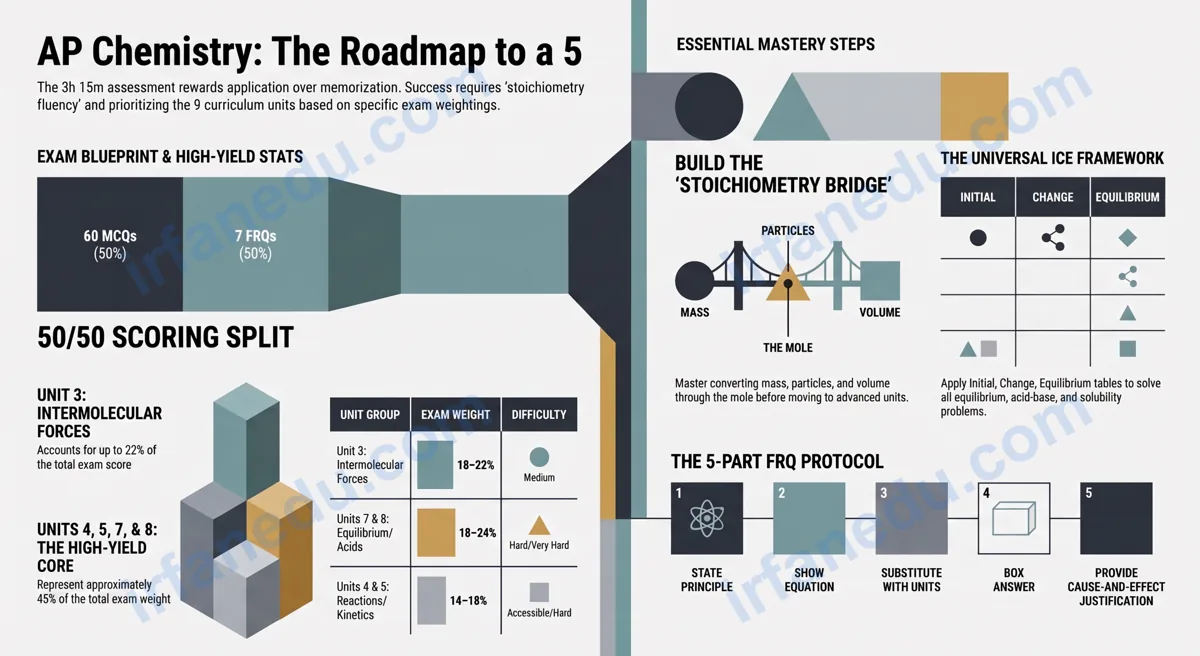
AP Chemistry is a college-level course divided into 9 units, examined in a 3-hour 15-minute test worth college credit. The exam rewards students who can apply concepts to novel situations — not just recall definitions. Scoring a 4 or 5 requires mastering the quantitative core (stoichiometry, equilibrium math, electrochemistry) and learning to write precise, evidence-based free-response answers.
By the end of this guide, you will be able to:
- Identify which of the 9 units carry the most exam weight and study them first
- Solve stoichiometry and equilibrium problems with a repeatable method
- Write FRQ answers that earn full marks using the College Board’s own rubric logic
- Avoid the five most common mistakes that drop students from a 4 to a 3
- Follow a realistic 6-week study plan that fits around school
⚡ Quick Answer: AP Chemistry covers 9 units from atomic structure to electrochemistry. The 3-hour 15-minute exam has 60 MCQs and 7 FRQs, each worth 50% of the score. To score a 4 or 5, prioritize Units 4, 5, 7, and 8 (roughly 45% of exam weight), master stoichiometry first, and practice full free-response questions weekly using released College Board materials.
⚡ TL;DR – Quick Summary
- 🧪 AP Chem has 9 units; Units 4, 5, 7, and 8 are the highest-yield for the exam.
- 📝 The exam is 3 hr 15 min: 60 MCQs + 7 FRQs, each section worth 50%.
- 🔢 Stoichiometry fluency is the single most important skill to build first.
- 📊 ICE tables are the universal tool for all equilibrium and acid-base problems.
- 🏆 Released College Board FRQs are the best study resource — use them weekly.
- 📅 A focused 6-week plan (2-3 hrs/week) is enough for most students to move up a full score point.
AP Chemistry at a Glance: Quick Facts
| Feature | Detail |
|---|---|
| Exam Duration | 3 hours 15 minutes |
| Section I (MCQ) | 60 questions, 90 minutes, 50% of score |
| Section II (FRQ) | 7 questions, 105 minutes, 50% of score |
| Number of Units | 9 |
| Calculator Policy | Scientific/graphing calculator allowed on both sections |
| Reference Sheet | Periodic table + formula/constant sheet provided |
| Score Range | 1–5 (colleges typically accept 4 or 5 for credit) |
| % Scoring 5 (approx.) | ~12% of test-takers |
| % Scoring 4 or 5 (approx.) | ~26% of test-takers |
What Are the 9 AP Chemistry Units and How Much Do They Matter?
The 9 AP Chemistry units are not equally weighted — and that matters enormously for how you spend your study time. Units 4 and 5 alone account for 21-35% of the exam.
| Unit | Topic | Exam Weight | Difficulty |
|---|---|---|---|
| 1 | Atomic Structure & Properties | 7–9% | 🟡 Medium |
| 2 | Molecular & Ionic Compound Structure | 7–9% | 🟡 Medium |
| 3 | Intermolecular Forces & Properties | 18–22% | 🟡 Medium |
| 4 | Chemical Reactions | 7–9% | 🟢 Accessible |
| 5 | Kinetics | 7–9% | 🔴 Hard |
| 6 | Thermodynamics | 7–9% | 🔴 Hard |
| 7 | Equilibrium | 7–9% | 🔴 Very Hard |
| 8 | Acids & Bases | 11–15% | 🔴 Hard |
| 9 | Electrochemistry | 7–9% | 🟡 Medium |
In my experience, students over-invest in Unit 1 (Atomic Structure) because it comes first and feels manageable. That is a trap. Unit 3 (Intermolecular Forces) carries up to 22% of the exam weight — nearly a quarter of your score — yet most review books treat it as a quick chapter. Spend at least 20% of your total study time on Unit 3 alone. It will pay off more than any other single reallocation.
The mnemonic I give my students for the unit order is: “All My Interesting Chemistry Keeps Teaching Every Anxious Exam-taker” (Atomic, Molecular, Intermolecular, Chemical reactions, Kinetics, Thermodynamics, Equilibrium, Acids, Electrochemistry).
How Do You Master Stoichiometry for AP Chem?
Stoichiometry is the mathematical backbone of AP Chemistry — master it first and every other quantitative unit becomes easier. The core skill is converting between mass, moles, particles, and volume using the mole as the universal bridge.
The 4-Step Stoichiometry Method
- Write a balanced equation. Check that atoms and charges balance on both sides.
- Convert given quantity to moles. Divide mass by molar mass (g/mol).
- Use the mole ratio from the balanced equation to find moles of the target substance.
- Convert moles to the requested unit (grams, liters at STP, or molecules).
🧪 Worked Example: Limiting Reagent Problem
Problem: 10.0 g of hydrogen (H₂) reacts with 80.0 g of oxygen (O₂) to form water. Which is the limiting reagent and how many grams of water form?
Balanced equation: 2H₂ + O₂ → 2H₂O
Step 1 — Moles of each reactant:
- H₂: 10.0 g ÷ 2.02 g/mol = 4.95 mol H₂
- O₂: 80.0 g ÷ 32.00 g/mol = 2.50 mol O₂
Step 2 — Find the limiting reagent: The ratio requires 2 mol H₂ per 1 mol O₂. For 2.50 mol O₂ you need 5.00 mol H₂, but you only have 4.95 mol H₂. H₂ is the limiting reagent.
Step 3 — Moles of water: 4.95 mol H₂ × (2 mol H₂O / 2 mol H₂) = 4.95 mol H₂O
Step 4 — Mass of water: 4.95 mol × 18.02 g/mol = 89.2 g H₂O
Always show the mole ratio step explicitly in your FRQ answer. College Board rubrics award a point specifically for demonstrating correct use of stoichiometric ratios — even if your final numerical answer is slightly off due to a rounding error.
Why Is Equilibrium the Hardest AP Chem Topic — and How Do You Conquer It?
Equilibrium is hard because it requires you to hold three ideas in your head simultaneously: the direction a reaction shifts, the quantitative change in concentrations, and the final state. The ICE table method organizes all three into one clean framework.
How to Build an ICE Table
ICE stands for Initial, Change, Equilibrium. Set up one column per species in the equilibrium expression.
🔬 Visual: ICE Table for N₂ + 3H₂ ⇌ 2NH₃
  Reaction:       N₂      +    3H₂    ⇌    2NH₃
  ─────────────────────────────────────────────────
  Initial (M):   0.500        1.500         0.000
  Change (M):     −x          −3x          +2x
  Equilibrium:  0.500−x    1.500−3x        2x
  ─────────────────────────────────────────────────
  Kc = [NH₃]² / ([N₂][H₂]³)
  Substitute equilibrium expressions → solve for x
Once you find x, substitute back to get equilibrium concentrations, then verify by plugging into the Kc expression. This same structure works for acid-base problems (Ka/Kb), solubility (Ksp), and gas-phase equilibria (Kp).
Students often forget to subtract x from the initial concentration of reactants AND add x to products. Double-check the sign of every Change row entry before solving. A sign error here cascades into a completely wrong answer.
How Do You Write a Perfect AP Chem FRQ Answer?
Free-response questions are worth 50% of your score, yet most students practice them far less than MCQs. A perfect FRQ answer is not an essay — it is a series of precise, numbered responses that match the rubric point for point.
The 5-Part FRQ Framework
- Restate the question in one sentence. This forces clarity and earns no points but prevents you from answering the wrong question.
- State the relevant principle or equation. Write the formula before plugging in numbers. Rubrics often award a point just for the correct equation.
- Show all substitutions with units. Never skip the step where you plug numbers into the formula.
- Calculate and box your answer with units. Circle or box the final answer so the grader finds it instantly.
- Justify or explain if asked. “Explain” prompts require a cause-and-effect sentence, not just a calculation.
The single biggest FRQ mistake I see is students writing “because of Le Chatelier’s Principle” without explaining what that means in the specific context. The rubric does not award points for naming a principle — it awards points for applying it. Write: “Adding more reactant increases the reaction quotient Q above Kc, so the reaction shifts right to re-establish equilibrium.” That earns the point. “Le Chatelier’s Principle” alone does not.
[IMAGE: AP Chemistry FRQ answer sheet with annotated scoring guide | ALT: AP Chemistry free response question example with rubric annotations for exam prep]
What Are the Most Common AP Chemistry Mistakes — and How Do You Avoid Them?
These five mistakes account for the majority of lost points I see in student practice exams. Fixing them is faster than learning new content.
| Mistake | What Students Do Wrong | The Fix |
|---|---|---|
| 1. Forgetting units | Writing “2.5” instead of “2.5 mol/L” | Write units at every step, not just the final answer |
| 2. Unbalanced equations | Using an unbalanced equation for stoichiometry | Always balance before any calculation; count atoms on both sides |
| 3. Mixing Kc and Kp | Using concentration in a Kp expression | Kp uses partial pressures (atm); Kc uses molarity (mol/L) |
| 4. Skipping the ICE table | Trying to solve equilibrium problems mentally | Always draw the full ICE table, even for simple problems |
| 5. Vague explanations | “The reaction shifts right” with no reasoning | State the cause, the direction, and the effect in one sentence |
What Is the Best 6-Week AP Chem Study Plan?
This plan assumes you have already taken the AP Chemistry course and need a structured review. Adjust the pace based on your diagnostic results.
- Week 1 — Diagnostic + Units 1-2: Take a timed 30-question diagnostic. Review atomic structure, electron configuration, and bonding. Identify your three weakest topics.
- Week 2 — Units 3-4 (High Weight): Deep dive into intermolecular forces (Unit 3 = up to 22% of exam). Practice predicting physical properties from IMF type. Review reaction types in Unit 4.
- Week 3 — Units 5-6 (Kinetics + Thermodynamics): Master rate laws, integrated rate laws, and Arrhenius equation. For thermodynamics, practice ΔG = ΔH − TΔS calculations and Hess’s Law.
- Week 4 — Units 7-8 (Equilibrium + Acids/Bases): ICE tables every day. Practice Ka, Kb, Kw relationships. Buffer problems and titration curves are high-yield FRQ topics.
- Week 5 — Unit 9 + FRQ Intensive: Electrochemistry: standard cell potential, Nernst equation, electrolysis. Write 2 full FRQs per day using released College Board questions.
- Week 6 — Full Practice Exam + Targeted Review: Take one full timed practice exam. Review every wrong answer. Focus the last 3 days on your weakest unit only.
Download the last 5 years of released AP Chemistry FRQs directly from the College Board website (free). Each comes with a scoring guideline. Reading the scoring guideline is as valuable as writing the answer — it shows you exactly how graders think.
Most AP Chemistry study guides tell you to “memorize all the polyatomic ions.” That is not wrong, but it misses a deeper point: the College Board provides a reference sheet on exam day. What the reference sheet does NOT provide is conceptual fluency — the ability to look at a reaction and instantly know whether it will be spontaneous, which direction equilibrium will shift, or why a particular acid is stronger than another.
In my experience, students who score 5s spend about 30% less time on memorization than students who score 3s — and about 50% more time on explaining their reasoning out loud (a technique called “teach-back”). If you cannot explain why ΔG must be negative for a spontaneous process without looking at your notes, you are not ready for the FRQ section. The exam tests reasoning, not recall.
🧠 Quick AP Chemistry Quiz — Test Yourself
Q1. In the reaction 2H₂ + O₂ → 2H₂O, if you start with 3.0 mol H₂ and 2.0 mol O₂, which is the limiting reagent?
Q2. A reaction has Kc = 1 × 10⁻⁸ at 25°C. What does this tell you about the equilibrium position?
Q3. Which of the following conditions guarantees a spontaneous reaction at ALL temperatures?
🔍 Reveal-on-Click Practice Problems
Problem 1: Calculate the pH of a 0.050 M solution of acetic acid (Ka = 1.8 × 10⁻⁵)
Set up the ICE table:
CH₃COOH ⇌ H⁺ + CH₃COO⁻
Initial: 0.050 M, 0, 0 | Change: −x, +x, +x | Equilibrium: 0.050−x, x, x
Ka expression: Ka = x² / (0.050 − x) ≈ x² / 0.050 (x is small)
x² = 1.8 × 10⁻⁵ × 0.050 = 9.0 × 10⁻⁷
x = √(9.0 × 10⁻⁷) = 9.49 × 10⁻⁴ mol/L = [H⁺]
pH = −log(9.49 × 10⁻⁴) = 3.02
Check assumption: x/0.050 = 1.9% < 5% ✓ (approximation valid)
Problem 2: A galvanic cell uses Zn/Zn²⁺ and Cu/Cu²⁺ half-cells. Calculate the standard cell potential. (E°Zn²⁺/Zn = −0.76 V; E°Cu²⁺/Cu = +0.34 V)
Identify anode and cathode: Zinc has the more negative reduction potential, so it is oxidized (anode). Copper is reduced (cathode).
Formula: E°cell = E°cathode − E°anode
E°cell = (+0.34 V) − (−0.76 V) = +1.10 V
A positive E°cell confirms the reaction is spontaneous under standard conditions.
Problem 3: A first-order reaction has a rate constant k = 0.0231 min⁻¹. What is the half-life?
Formula for first-order half-life: t₁/₂ = ln(2) / k = 0.693 / k
t₁/₂ = 0.693 / 0.0231 min⁻¹ = 30.0 minutes
Note: For first-order reactions, half-life is constant — it does not depend on initial concentration. This is a key distinguishing feature that often appears on MCQs.
❓ Frequently Asked Questions About AP Chemistry
How many units are in AP Chemistry?
How hard is it to get a 5 on AP Chemistry?
What is the AP Chemistry exam format?
What topics should I study first for AP Chemistry?
Is a calculator allowed on the AP Chemistry exam?
Sources & References
Reviewed by Dr. Irfan Mansuri. External links open in a new tab and are provided for further reading and verification.