
Simplify Calculator: Fractions, Expressions & Radicals
Most students reach for a simplify calculator because they want the answer fast. But the ones who actually improve are the ones who also read the steps. This tool gives you both: the instant result and the numbered reasoning behind it, so you understand what happened and can replicate it on a test.
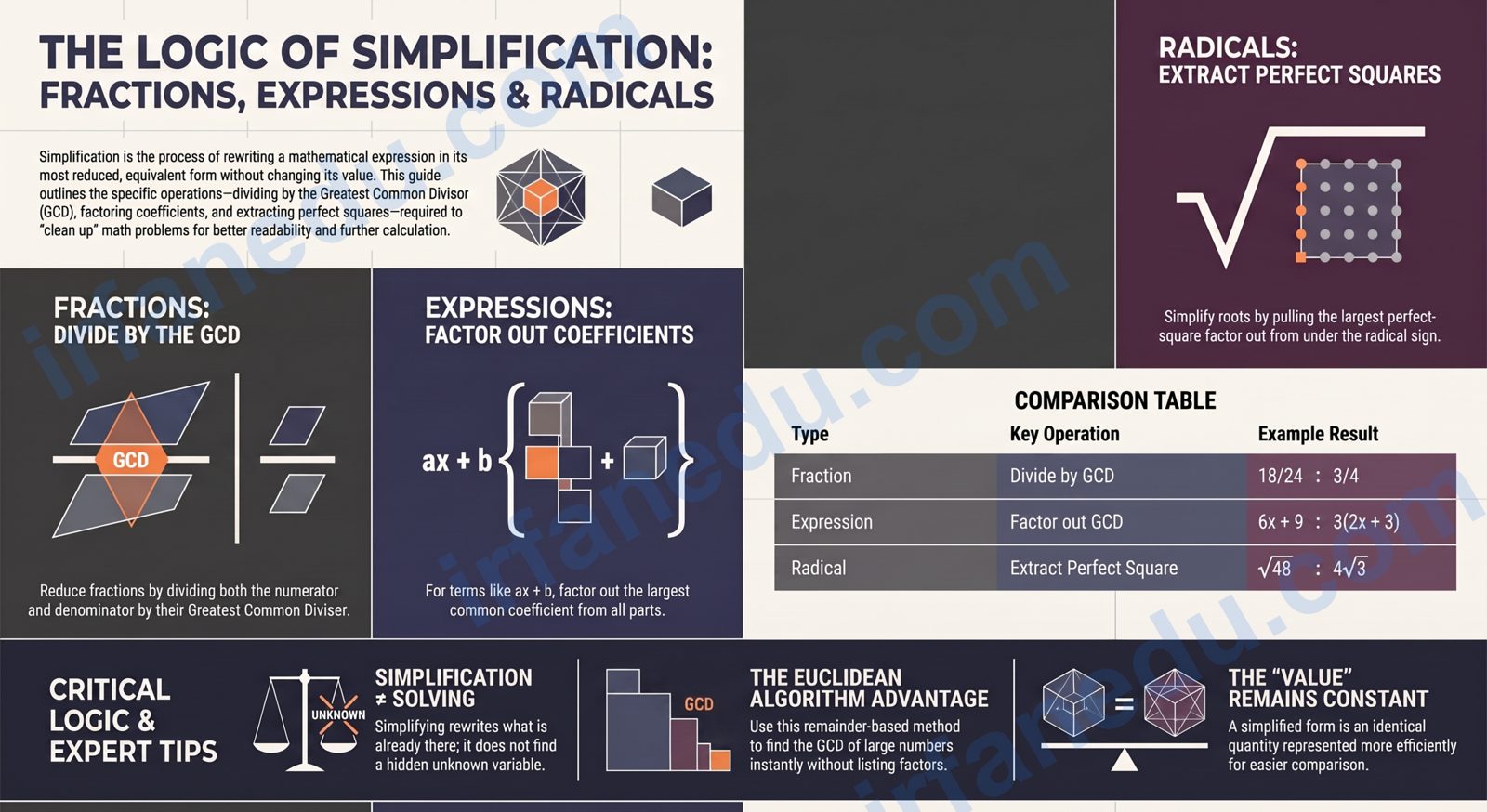
A simplify calculator reduces a mathematical expression to its most compact equivalent form. For fractions, it divides numerator and denominator by their Greatest Common Divisor. For algebraic expressions, it factors out the GCD of all coefficients. For radicals, it extracts the largest perfect-square factor from under the root sign. The result is always equal in value to the original.
A simplify calculator reduces a fraction, expression, or radical to its simplest form. For fractions, divide numerator and denominator by their Greatest Common Divisor (GCD). For expressions, factor out the GCD of coefficients. For radicals, extract the largest perfect-square factor. The result is mathematically equivalent but written in the most reduced form possible.
⚡ In Short
- 🔢 Simplify fractions by dividing both parts by their GCD.
- 🔢 Simplify expressions by factoring out the largest common coefficient.
- 🔢 Simplify radicals by pulling out the biggest perfect-square factor.
- 🔢 A simplified form has the same value — just a cleaner representation.
- 🔢 The calculator shows every step so you can learn, not just copy.
Simplify Calculator
Fractions • Expressions • Radicals — with step-by-step solutions
Enter a two-term expression of the form ax + b (e.g. 6x + 9 → 3(2x + 3)).
How to Use This Simplify Calculator
- Choose a mode using the three buttons at the top: Fraction, Expression, or Radical.
- Enter your values in the clearly labeled input fields. Each field shows an example placeholder.
- Click Simplify (or press Enter) to get the result instantly.
- Read the step-by-step solution that appears below the result to understand the method.
- Click Reset to clear the inputs and try another problem.
What Does “Simplify” Actually Mean in Math?
Simplifying means rewriting a number or expression in its most reduced, equivalent form. The value does not change. Only the representation gets cleaner. A fraction like 18/24 and its simplified form 3/4 are identical in value; 3/4 is just easier to read, compare, and use in further calculations.
In my experience teaching algebra, students often confuse “simplify” with “solve.” Simplifying does not find an unknown. It rewrites what is already there. That distinction matters because many exam questions ask you to simplify an expression that has no equals sign and no variable to find.
The Formulas This Calculator Uses
📝 Core Formulas
FRACTION:
  Simplified = (Numerator ÷ GCD) / (Denominator ÷ GCD)
  GCD = Greatest Common Divisor of |numerator| and |denominator|

EXPRESSION (ax + b):
  Simplified = GCD × ( (a/GCD)x + (b/GCD) )
  GCD = Greatest Common Divisor of |a| and |b|

RADICAL (√n):
  Find largest k² such that k² divides n evenly
  Simplified = k√(n ÷ k²)
  If no such k > 1 exists, √n is already in simplest form
| Symbol | Meaning | Notes |
|---|---|---|
| GCD | Greatest Common Divisor | Largest integer dividing both values evenly |
| a, b | Integer coefficients | Can be positive or negative |
| n | Radicand | Must be a non-negative integer for real results |
| k | Extracted root factor | Largest integer where k² divides n |
Three Worked Examples That Mirror the Calculator’s Output
🔍 Example 1 — Simplify the Fraction 36/48
- Original fraction: 36/48
- Find GCD(36, 48): factors of 36 are 1,2,3,4,6,9,12,18,36; factors of 48 include 12. GCD = 12.
- Divide numerator: 36 ÷ 12 = 3
- Divide denominator: 48 ÷ 12 = 4
- Simplified: 3/4
🔍 Example 2 — Simplify the Expression 15x + 25
- Expression: 15x + 25
- Find GCD(15, 25): GCD = 5
- Factor out 5: 5 × (3x + 5)
- Simplified: 5(3x + 5)
🔍 Example 3 — Simplify the Radical √72
- Original: √72
- Largest perfect-square factor of 72: 36 (since 6² = 36 and 72 ÷ 36 = 2)
- Rewrite: √(36 × 2) = √36 × √2 = 6√2
- Simplified: 6√2
  Simplify √72
  ─────────────────────────────
  72  =  36  ×  2
         ↓
       6²  ×  2
         ↓
  √72  =  √(6²)  ×  √2
         ↓
       =  6  ×  √2
         ↓
  ✔  Answer:  6√2
  ─────────────────────────────
Simplification Types Compared
| Type | Input Example | Key Operation | Simplified Result | Value Changes? |
|---|---|---|---|---|
| Fraction | 18/24 | Divide by GCD (6) | 3/4 | No |
| Expression | 6x + 9 | Factor out GCD (3) | 3(2x + 3) | No |
| Radical | √48 | Extract √16 = 4 | 4√3 | No |
| Already Simple | 7/13 | GCD = 1 (coprime) | 7/13 | No |
⚠️ Common Mistakes Students Make When Simplifying
These are the errors I see most often, both in classroom work and in online forum questions. Each one has a clean fix.
🧠 Worth Knowing
Most guides teach you to find the GCD by listing all factors and picking the largest. That works for small numbers, but it breaks down fast. The Euclidean Algorithm is dramatically faster: to find GCD(a, b), repeatedly replace the larger number with the remainder of dividing the two. For example, GCD(252, 105): 252 = 2×10⁵ + 42, then 105 = 2×42 + 21, then 42 = 2×21 + 0. GCD = 21. This is the exact algorithm the calculator above runs, and it handles numbers in the thousands instantly without listing a single factor. Knowing this method means you can simplify large fractions by hand on any timed test without a calculator.
📚 See the Complete Geometry Formula Sheet →
Frequently Asked Questions
How do you simplify a fraction step by step?
What Does It Mean to Simplify an Algebraic Expression?
How Do You Simplify a Radical Like √48?
Is a Simplified Fraction Always a Smaller Number?
Can Every Fraction Be Simplified?
📚 Sources & References
- Khan Academy — Greatest Common Factor Explained
- Wikipedia — Euclidean Algorithm
- Math Is Fun — Simplifying Fractions
✍️ Written & fact-checked by Dr. Irfan Mansuri. All formulas verified against standard curriculum references. Last reviewed August 2026.