
Log calculator: solve any logarithm instantly (any base)
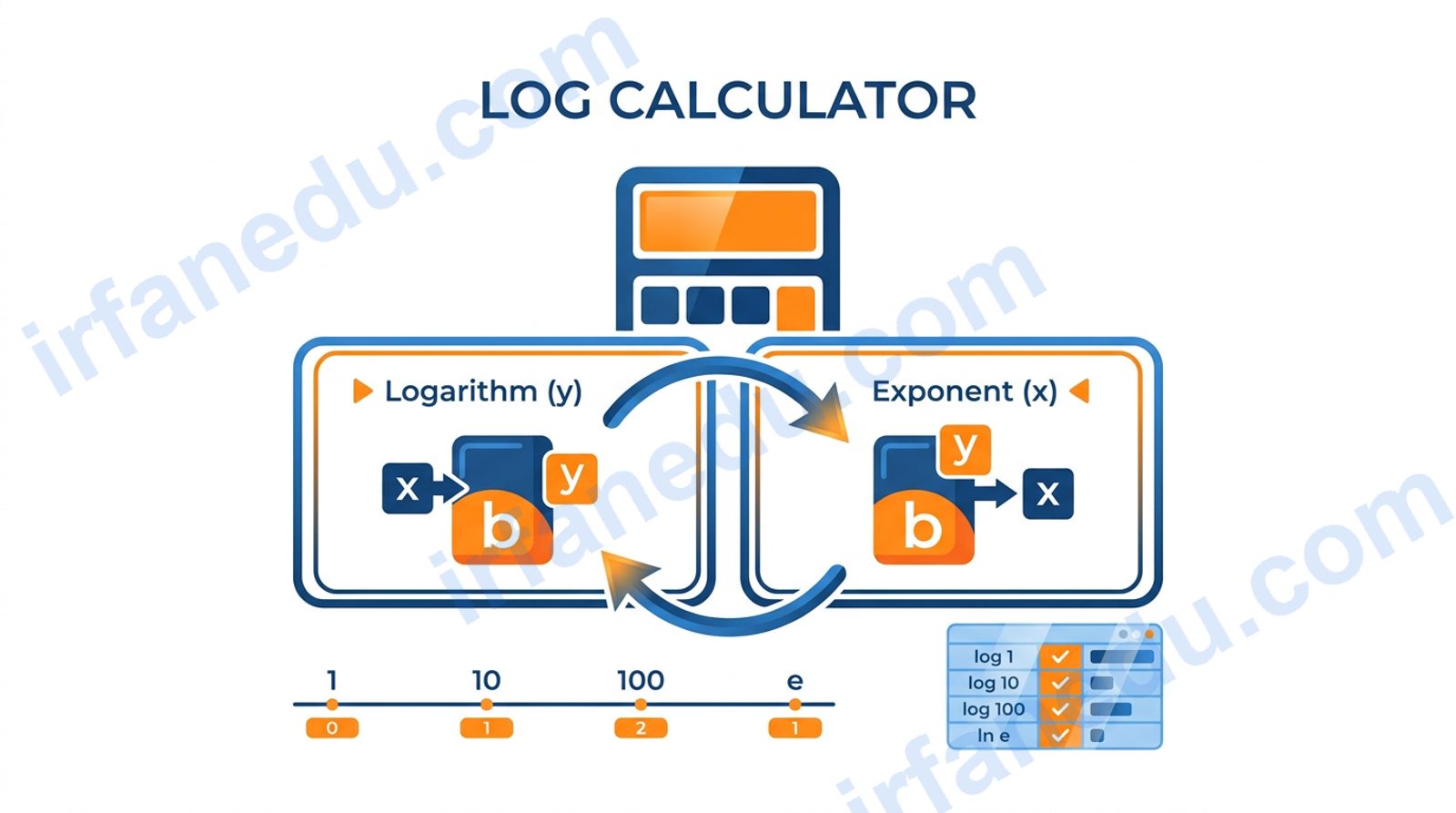
Picture this: a student stares at the problem log₅(125) = ? the night before an exam. She knows 5³ = 125, so the answer is 3 — but what if the numbers were messier, like log₇(500)? That is exactly the scenario this log calculator solves in one click, with every step shown so you understand the process, not just the answer.
⚡ Quick Answer
A logarithm answers: “To what power must the base be raised to get this number?” For log base 10 of 1000, the answer is 3, because 10³ = 1000. The formula is log_b(x) = y, meaning b^y = x. For natural log (ln), the base is e ≈ 2.71828. Use the change-of-base formula — log_b(x) = log(x) ÷ log(b) — to compute any base on any calculator.
- 🔢 log_b(x) = y means b^y = x — logarithm and exponent are inverses.
- 📐 Log base 10 is written log(x); natural log uses base e and is written ln(x).
- 🔄 Change-of-base formula: log_b(x) = log(x) / log(b) — works on any calculator.
- 🚫 log(0) and log of negatives are undefined in real numbers.
- ✅ log(1) = 0 for every valid base — because b⁰ = 1 always.
- 🌍 Used in earthquake scales, sound decibels, pH, and compound interest.
x > 0
x > 0
x > 0
b > 0, b ≠ 1
Step-by-step solution:
How to use this log calculator
- Choose a mode: click Log Base 10, Natural Log (ln), or Custom Base depending on your problem.
- Enter the number x — the value whose logarithm you want. It must be greater than 0.
- If using Custom Base: also enter the base b (b > 0, b ≠ 1).
- Click Calculate. The result appears instantly with a numbered step-by-step solution.
- Click Reset to clear all fields and start fresh.
What is a logarithm?
A logarithm is the inverse of exponentiation. If b^y = x, then log_b(x) = y. In plain language: a logarithm tells you the exponent needed to reach a target number from a given base.
Think of it as a question: "How many times do I multiply the base by itself to get x?" For log₁₀(1000): 10 × 10 × 10 = 1000, so the answer is 3.
  LOGARITHM ↔ EXPONENT (they are inverses)
  ─────────────────────────────────────────
  Exponent form:   b ^ y  =  x
  Log form:        log_b(x)  =  y

  Example 1:  10 ^ 3  = 1000   →   log₁₀(1000) = 3
  Example 2:   2 ^ 8  =  256   →   log₂(256)   = 8
  Example 3:   e ^ 1  ≈ 2.718  →   ln(2.718)   ≈ 1

  Key identities:
    log_b(1)  = 0   (because b⁰ = 1)
    log_b(b)  = 1   (because b¹ = b)
    log_b(b^n)= n
The logarithm formula explained
The core formula is simple: log_b(x) = y ⟺ b^y = x. The change-of-base formula extends this to any calculator: log_b(x) = log(x) / log(b).
| Symbol | Meaning | Constraint |
|---|---|---|
| b | Base of the logarithm | b > 0, b ≠ 1 |
| x | The argument (input number) | x > 0 |
| y | The logarithm result (exponent) | Any real number |
| log | Log base 10 (common log) | Base = 10 |
| ln | Natural log (base e) | Base ≈ 2.71828 |
| e | Euler's number | ≈ 2.71828182845 |
SI units & dimensions: Logarithms are dimensionless — the result has no physical unit. When you apply log to a physical quantity (e.g. decibels), the ratio inside the log must be unitless first.
Comparison: log vs ln vs log_b
| Type | Notation | Base | Use case |
|---|---|---|---|
| Common log | log(x) | 10 | pH, Richter scale, decibels, engineering |
| Natural log | ln(x) | e ≈ 2.718 | Calculus, growth/decay, finance, physics |
| Binary log | log₂(x) | 2 | Computer science, information theory |
| Custom base | log_b(x) | Any valid b | General math, specific applications |
Worked examples (matching the calculator's steps)
- Formula: log₁₀(x) = ln(x) / ln(10)
- Substitute: ln(500) / ln(10)
- = 6.21461 / 2.30259
- = 2.698970
- Verification: 10^2.698970 ≈ 500 ✓
- Change-of-base: log₇(500) = ln(500) / ln(7)
- = 6.21461 / 1.94591
- = 3.194814
- Verification: 7^3.194814 ≈ 500 ✓
So the student from our opening case study gets her answer: 7 must be raised to the power 3.1948 to reach 500.
Common mistakes students make with logarithms
This is false. The product rule says log(a × b) = log(a) + log(b). Addition inside the log has no simple split.
Example: log(2 × 50) = log(2) + log(50) = 0.301 + 1.699 = 2 = log(100). ✓
log(0) is undefined. No real power of any base equals 0. The function approaches −∞ as x → 0⁺.
Always check that the argument is strictly positive before computing.
The power rule says log(x^n) = n × log(x), not [log(x)]^n. The exponent moves in front as a multiplier.
Example: log(10³) = 3 × log(10) = 3 × 1 = 3. ✓
In my experience teaching algebra, the root cause of log mistakes is that students try to apply arithmetic rules (addition, multiplication) directly inside the log. Logarithms have their own rule set — product, quotient, power — and they only work on the argument as a whole. I always tell students: treat the log like a function, not a number. Once that clicks, the rules become intuitive.
Real-world applications of logarithms
Logarithms compress enormous ranges into manageable numbers. That is why they appear wherever quantities span many orders of magnitude.
- Richter scale: each whole number increase = 10× more ground motion amplitude.
- Decibels (dB): sound intensity uses log₁₀; 10 dB increase = 10× more power.
- pH scale: pH = −log₁₀[H⁺]; each unit = 10× change in acidity.
- Compound interest: time to double = ln(2) / r, where r is the continuous rate.
- Computer science: binary search runs in O(log₂ n) time — logarithms define algorithm efficiency.
- Signal processing: frequency response and gain are plotted on log scales (Bode plots).
Most log tutorials teach you the change-of-base formula as a trick to punch into a calculator — but they never explain why it works. Here is the real reason: all logarithm functions with positive bases are scalar multiples of each other. Specifically, log_b(x) = log_a(x) / log_a(b) for any valid base a. This means log₁₀ and ln are just stretched or compressed versions of the same curve. The "different bases" are not fundamentally different functions — they are the same function scaled by a constant factor (log_a(b)). That insight explains why log identities (product, quotient, power rules) hold for every base: they are properties of the underlying exponential structure, not of any particular base.
Practical payoff: if you ever need to graph log_b(x) by hand, just draw ln(x) and divide every y-value by ln(b). No separate derivation needed.
🧠 Quick quiz — test yourself
1. What is log₁₀(10,000)?
2. Which rule says log(a × b) = log(a) + log(b)?
3. What is ln(e²)?
Select an answer to see instant feedback (green = correct, red = wrong).
Frequently asked questions about logarithms
What is a logarithm in simple terms?
Sources & References
Written and fact-checked by Dr Irfan Mansuri. External links open in a new tab and are provided for further reading and verification.