
Implicit Differentiation Calculator: Solve dy/dx Step by Step
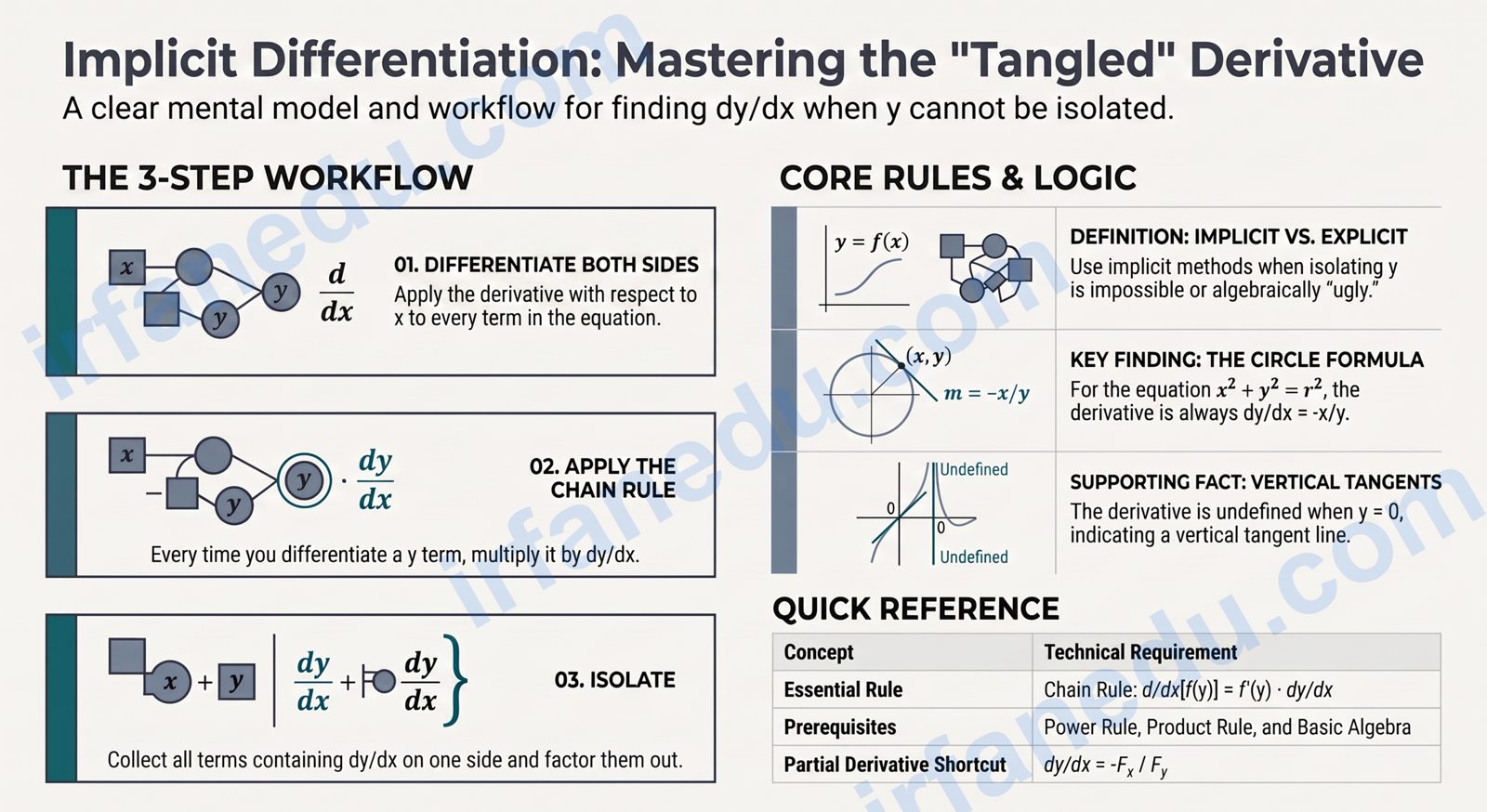
Implicit differentiation trips up more calculus students than almost any other topic — not because it is hard, but because most explanations skip the one mental model that makes it click. This calculator solves dy/dx for the most common implicit equation types and shows every algebraic step, so you can check your work or learn the method from scratch.
Implicit differentiation lets you find dy/dx when y is tangled up with x in an equation you cannot easily solve for y. You differentiate both sides with respect to x, attach a dy/dx whenever you differentiate a y term (chain rule), then collect and isolate dy/dx algebraically.
Implicit differentiation finds dy/dx when y cannot be isolated. Differentiate both sides with respect to x, apply the chain rule to every y term (multiply by dy/dx), collect all dy/dx terms on one side, then factor and divide. For x² + y² = 25: differentiate to get 2x + 2y(dy/dx) = 0, so dy/dx = −x/y.
Implicit Differentiation Calculator
Select an equation type, enter values, and get dy/dx with full steps.
units
Equation: x² + y² = r²
How to use this implicit differentiation calculator
The calculator handles four equation families. Here is how to get a result in under a minute:
- Pick an equation type using the mode buttons: Circle, Ellipse, Hyperbola, or ax³ + by³ = c.
- Enter the required values — radius for a circle, semi-axes for an ellipse or hyperbola, or coefficients for the polynomial form.
- Optionally enter an (x, y) point to get the numerical slope of the tangent line at that specific location.
- Click Calculate dy/dx. The result card shows the general formula and a numbered step-by-step solution using your exact values.
- Click Reset to clear all fields and start a new calculation.
You can also press Enter from any input field to trigger the calculation.
Quick facts about implicit differentiation
| Fact | Detail |
|---|---|
| What it finds | dy/dx (the derivative of y with respect to x) when y is not isolated |
| Key rule used | Chain rule: d/dx[f(y)] = f'(y) · dy/dx |
| General formula | dy/dx = −Fₓ / Fᵧ (partial derivatives of F(x,y) = 0) |
| Typical exam contexts | Tangent lines, normal lines, related rates, AP Calculus AB & BC |
| When y = 0 (circle) | dy/dx is undefined — the tangent line is vertical |
| Prerequisite skills | Power rule, product rule, chain rule, basic algebra |
What is implicit differentiation?
Implicit differentiation is a technique for finding dy/dx when y is defined implicitly — meaning y and x appear together in one equation rather than y being written alone on one side. The equation x² + y² = 25 is implicit because you cannot cleanly write y = (something involving only x) without introducing a ± sign that breaks the single-function requirement.
The method works because of one idea: y is still a function of x, even if you have not solved for it. So every time you differentiate a y term, the chain rule demands you multiply by dy/dx. That extra factor is what you then solve for.
Contrast this with explicit differentiation, where y = f(x) is already isolated and you simply apply the standard rules directly. Implicit differentiation is the tool you reach for when isolation is impossible or algebraically ugly.
The formula and rules explained
General implicit differentiation formula
Where F(x, y) = 0 is the implicit equation, Fₓ is the partial derivative of F with respect to x, and Fᵧ is the partial derivative with respect to y.
In practice, most students do not use the partial-derivative shortcut — they differentiate term by term and collect dy/dx. Both approaches give the same answer. The shortcut is faster once you are comfortable with partial derivatives.
Variables and symbols
| Symbol | Meaning | Notes |
|---|---|---|
| dy/dx | Derivative of y with respect to x | The slope of the curve at any point |
d/dx[ ]
Sources & ReferencesWritten and fact-checked by Dr Irfan Mansuri. External links open in a new tab and are provided for further reading and verification. |