
DMV Written Test Practice: Pass on Your First Try (2026 Guide)
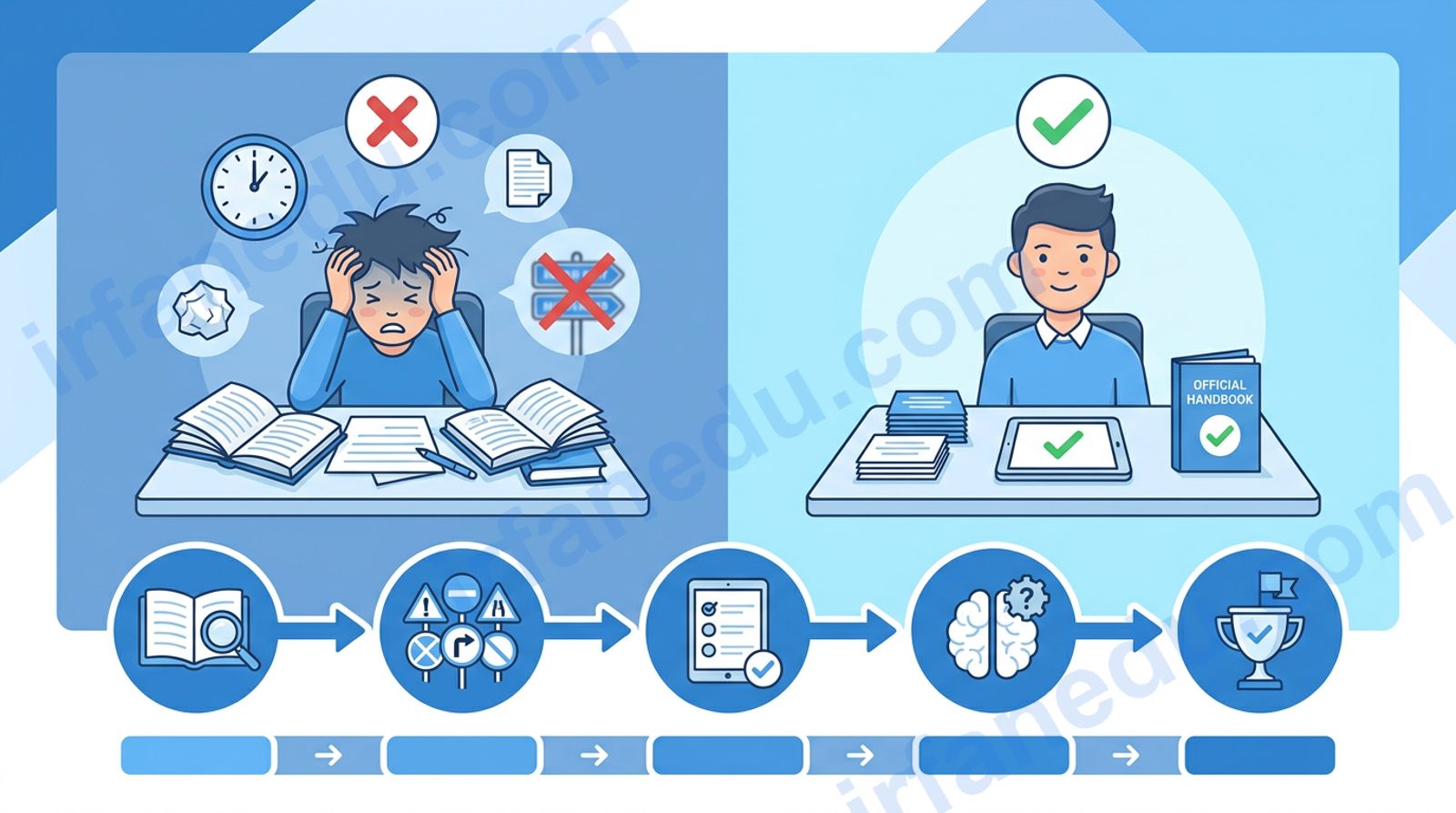
DMV written test practice means drilling official-handbook rules, road signs, and right-of-way scenarios using timed mock tests before your real knowledge exam. Study the official driver handbook first, then take at least 5 full-length practice tests, review every wrong answer, and focus extra time on signs and speed limits — the two most-failed topic areas. Most students pass after 7–14 days of focused daily study.
The DMV written test — also called the knowledge test or permit test — is a closed-book multiple-choice exam that checks whether you understand traffic laws, road signs, and safe driving rules well enough to get behind the wheel. Passing it is the first legal step toward a driver’s license in the United States and in many countries worldwide.
I have helped hundreds of students prepare for high-stakes exams, and the DMV knowledge test follows a pattern I see repeatedly: the people who fail are not unintelligent — they just practiced the wrong way. They downloaded a random quiz app, tapped through questions without reading explanations, and walked into the exam room without ever touching the official handbook. That approach fails more often than most guides admit.
This guide gives you a clear, honest picture of what the test actually covers, a realistic study plan, and the non-obvious strategies that separate first-time passers from repeat test-takers.
After reading this guide, you will be able to:
- Identify the exact topics the DMV written test covers
- Build a structured 2-week study plan from scratch
- Choose practice resources that actually match the real exam
- Spot and fix the three mistakes that cause most failures
- Walk into the test room confident you will pass on your first attempt
Quick Facts: DMV Knowledge Exam at a Glance
| Feature | Typical Details |
|---|---|
| Official name | DMV Knowledge Test / Written Test / Permit Test |
| Format | Multiple-choice (closed book) |
| Number of questions | 20–46 depending on state/country |
| Passing score | 70–80% correct (varies by location) |
| Time limit | Usually 20–60 minutes |
| Primary source | Official state/country driver handbook |
| Most-tested topics | Road signs, right-of-way, speed limits, DUI laws |
| Recommended study time | 7–14 days, 30–45 min/day |
| Retake policy | Typically 3 attempts before waiting period (varies) |
What Is the DMV Written Test?
The DMV written test is a multiple-choice knowledge exam administered by your state’s Department of Motor Vehicles (or equivalent licensing authority) before you can receive a learner’s permit or driver’s license. It is closed-book: you cannot bring notes, a handbook, or a phone.
Every question on the test comes directly from the official driver handbook published by your state or country’s motor vehicle authority. That single fact is the most important thing to understand about this exam — the handbook is not supplementary reading, it is the test itself in paragraph form.
The test is typically taken on a computer terminal at the DMV office, though some jurisdictions now offer online testing for certain permit categories. You receive your result immediately. If you pass, you move on to the vision test and, eventually, the behind-the-wheel driving test. If you fail, you wait a set period (often 1–7 days) before retaking it.
What Topics Are Covered on the DMV Written Test?
The DMV written test draws questions from five core topic areas that appear on virtually every state and country’s knowledge exam. Knowing these areas lets you study with precision rather than guessing what might show up.
1. Road Signs and Their Meanings
Signs are the single most-tested category. You must recognize shapes, colors, and symbols — not just the text. A red octagon means stop even if the word is obscured. A yellow diamond signals a warning. Regulatory signs are typically white rectangles. Expect 25–35% of your exam questions to involve signs.
2. Right-of-Way Rules
Intersections, roundabouts, pedestrian crossings, emergency vehicles, and school buses all have specific right-of-way rules. These questions are scenario-based: “You arrive at a four-way stop at the same time as a driver on your right — who goes first?” (Answer: the driver on the right.)
3. Speed Limits and Safe Following Distance
Default speed limits in school zones, residential areas, highways, and work zones are heavily tested. The 3-second following-distance rule and how to adjust it in bad weather also appear frequently.
4. Alcohol, Drugs, and Impaired Driving Laws
BAC (blood alcohol concentration) legal limits, implied consent laws, and the consequences of DUI convictions are standard exam content. In most U.S. states, the legal BAC limit for non-commercial adult drivers is 0.08%.
5. Vehicle Safety and Special Situations
Seat belt laws, child safety seat rules, headlight requirements, and what to do when emergency vehicles approach round out the exam.
When I work through practice tests with students, I find road signs and right-of-way scenarios account for roughly half of all wrong answers. If you only have limited study time, put it there first.
How to Build a 2-Week DMV Written Test Study Plan
A structured plan beats random cramming every time. This 2-week schedule is built around spaced repetition — the evidence-backed method of reviewing material at increasing intervals so it sticks in long-term memory.
-
Day 1–2: Get and Read the Official Handbook
Download your state/country’s official driver handbook from the DMV website. Read it cover to cover — do not skip chapters. Highlight road signs, speed limits, and any rule you find surprising.
-
Day 3: Take a Diagnostic Practice Test
Sit a full-length practice test with no notes. Score yourself honestly. Your weakest topic areas are now your study priorities — not the topics you already know.
-
Day 4–8: Drill Weak Topics Daily
Spend 20–30 minutes per day on your two lowest-scoring categories. Use targeted practice questions, not random mixed quizzes. After each wrong answer, find the relevant handbook page and re-read it.
-
Day 9–12: Take Full-Length Timed Mock Tests
Simulate real exam conditions — set a timer, no notes, no interruptions. Take at least 3 full-length tests. Aim for 90% or higher before you book the real exam.
-
Day 13: Review All Flagged Questions
Go back through every question you got wrong across all your practice tests. Write a one-sentence rule in your own words for each mistake. Writing it out forces active recall.
-
Day 14: Final Light Review + Rest
Do one short 20-question quiz to stay sharp, then stop. Sleep well. Fatigue hurts test performance more than one extra hour of studying helps it.
Practice Methods Compared: What Actually Works
Not all DMV written test practice methods are equal. The table below compares the four most common approaches by effectiveness, time cost, and what the research on memory retention actually says.
| Method | Effectiveness | Time Cost | Best For | Verdict |
|---|---|---|---|---|
| Official handbook + targeted practice tests | Very High | 7–14 days | First-time test-takers | Best overall |
| Random quiz apps (no handbook) | Low–Medium | Variable | Quick refresher only | Risky alone |
| Watching YouTube DMV videos | Medium | 2–4 hours | Visual learners, sign review | Good supplement |
| Cramming the night before | Very Low | 4–6 hours | Nobody | Avoid |
The key finding here: quiz apps that do not tie wrong answers back to the official handbook teach you to recognize question patterns, not to understand rules. That distinction matters because the real exam uses different wording than most third-party apps.
Common Mistakes That Cause People to Fail the DMV Written Test
Failing the DMV written test is more common than most people expect. In my experience reviewing student results, three mistakes account for the majority of failures.
Mistake 1 — Skipping the Official Handbook. The handbook is the test’s source document. Third-party practice sites are useful, but they sometimes contain outdated or state-incorrect information. Always cross-check against your official handbook.
Mistake 2 — Memorizing Answers Without Understanding Rules. Some students memorize which answer to click for a specific question. When the real exam rephrases the same rule, they fail. Study the rule, not the answer choice.
Mistake 3 — Ignoring Road Signs. Signs feel obvious until you sit the test. The exam tests shapes, colors, and symbols — not just words. Spend dedicated time on sign recognition, especially warning signs and regulatory signs.
Every DMV practice guide tells you to “read the handbook and take practice tests.” What they do not tell you is this: the most reliable predictor of passing is not how many practice questions you answered — it is whether you reviewed your wrong answers by going back to the exact handbook page.
Here is why that matters: the DMV written test is not a memory test of isolated facts. It is a comprehension test of rules in context. A student who answers 200 practice questions and skips the explanations will score lower than a student who answers 80 questions and reads the handbook rule behind every single mistake. The second student understands the logic; the first student only recognizes patterns.
In practice: after every wrong answer, open the handbook, find the relevant section, and write one sentence summarizing the rule in your own words. This active-recall loop takes 2 extra minutes per question and dramatically improves retention — far more than simply retaking the same quiz.
Visual: The 6-Step DMV Study Roadmap
Here is a visual overview of the complete study process from Day 1 to test day. Each step builds on the last.
  DMV WRITTEN TEST — 6-STEP STUDY ROADMAP
  ─────────────────────────────────────────────────────────────────

  STEP 1           STEP 2           STEP 3
  ┌───────────┐    ┌───────────┐    ┌───────────┐
  │  Get the  │───▶│  Read     │───▶│ Diagnostic│
  │ Official  │    │ Handbook  │    │ Practice  │
  │ Handbook  │    │ Cover-to- │    │   Test    │
  │ (DMV.gov) │    │  Cover    │    │ (No Notes)│
  └───────────┘    └───────────┘    └─────┬─────┘
                                          │
                                   Identify Weak Topics
                                          │
  STEP 6           STEP 5           STEP 4▼
  ┌───────────┐    ┌───────────┐    ┌───────────┐
  │  Rest +   │◀───│  Review   │◀───│   Drill   │
  │ Light     │    │  All Wrong│    │   Weak    │
  │ 20-Q Quiz │    │  Answers  │    │  Topics   │
  │ (Day 14)  │    │ (Handbook)│    │ (Daily)   │
  └─────┬─────┘    └───────────┘    └───────────┘
        │
        ▼
  ┌─────────────────────────────────────────────┐
  │   TAKE 3+ FULL-LENGTH TIMED MOCK TESTS      │
  │   Target: 90%+ before booking real exam     │
  └─────────────────────────────────────────────┘
        │
        ▼
  ✅  PASS THE DMV WRITTEN TEST — FIRST TRY

  ─────────────────────────────────────────────────────────────────
  Key Rule: Wrong Answer → Find Handbook Page → Write Rule in
            Your Own Words → Move On
Free vs. Paid DMV Practice Resources Compared
You do not need to spend money to pass the DMV written test. But understanding what each resource type offers helps you use your time wisely.
| Resource | Cost | Handbook-Aligned? | Explanations? | Recommended? |
|---|---|---|---|---|
| Official DMV handbook (state website) | Free | Yes — it IS the source | Full context | Essential |
| DMV.org practice tests | Free | Usually yes | Basic | Good supplement |
| Zutobi / Aceable (paid apps) | $10–$30 | Yes | Detailed | Good if budget allows |
| Generic quiz apps (no source cited) | Free | Often no | Minimal or none | Use with caution |
| YouTube sign-recognition videos | Free | Partial | Visual explanation | Good for signs only |
The official handbook from your state’s DMV website is always free and always the most accurate source. I recommend downloading the PDF version so you can search it by keyword when reviewing wrong answers.
Practice Problems: Test Yourself
Click each question to reveal the correct answer and the rule behind it. These are written to mirror the style of real DMV exam questions — scenario-based, with plausible wrong answers.
Question 1: You are driving at 30 mph in a school zone with flashing yellow lights. What should you do?
Flashing yellow lights on a school zone sign mean children are present or the school day is active. You must reduce speed to the posted school zone limit — not just “slow down” generally. The exact limit varies by state but is almost always lower than the surrounding road’s normal limit.
Question 2: At a four-way stop, you and a driver on your right arrive at exactly the same time. Who has the right of way?
The universal right-of-way rule at a four-way stop when two vehicles arrive simultaneously is: yield to the vehicle on your right. This rule applies in virtually every U.S. state and most countries. If three or four vehicles arrive at once, the same logic cascades — each driver yields to the one on their right.
Question 3: A solid yellow line on your side of the center line means what?
A solid yellow line on your side of the road means passing is prohibited for you. A broken yellow line on your side means passing is permitted when safe. A double solid yellow line means neither direction may pass. This is one of the most-tested road marking questions on the DMV written test.
Question 4: How many seconds of following distance should you maintain under normal conditions?
The 3-second rule is the standard taught in most handbooks: pick a fixed object ahead, and when the vehicle in front passes it, count “one-thousand-one, one-thousand-two, one-thousand-three.” If you pass the same object before finishing the count, you are too close. In rain, fog, or heavy traffic, increase to 4–6 seconds.
Question 5: What does a flashing red traffic light mean?
A flashing red light has the same legal meaning as a stop sign. You must make a complete stop, check for cross traffic and pedestrians, and then proceed only when it is safe. A flashing yellow light, by contrast, means slow down and proceed with caution — no full stop required.
Key Takeaways
- The official driver handbook is the only source the DMV written test is written from — read it first, not last.
- Road signs and right-of-way rules account for the majority of exam questions and the majority of wrong answers.
- A 7–14 day study plan with 30–45 minutes per day beats overnight cramming by a wide margin.
- After every wrong practice answer, find the handbook page and write the rule in your own words — this is the single highest-ROI study habit.
- Aim for 90% or higher on full-length timed mock tests before booking your real exam appointment.
- Free resources (official handbook + DMV.org) are sufficient to pass — you do not need to pay for a prep course.
Frequently Asked Questions About DMV Written Test Practice
How many questions are on the DMV written test?
The number of questions varies by state or country — most U.S. states use between 20 and 46 questions. The passing score is typically 70–80%. Always check your specific DMV’s official website for the exact count before you sit the exam.
How long should I study for the DMV written test?
Most first-time test-takers pass after 7–14 days of focused study — roughly 30–45 minutes per day. Spread your study over multiple short sessions rather than cramming the night before, which research consistently shows is less effective for retention.
What topics appear most on the DMV written test?
Road signs and their meanings, right-of-way rules, speed limits in school and work zones, DUI/BAC laws, and safe following distances are the most heavily tested topics on virtually every DMV knowledge exam.
Can I use the driver handbook during the DMV test?
No. The DMV written test is a closed-book exam. You must memorize the rules, signs, and laws from the official driver handbook before you arrive. Some DMVs allow a translator but never the handbook itself.
How many times can I retake the DMV written test if I fail?
Retake policies differ by location. Many U.S. states allow 3 attempts before requiring a waiting period or a new application fee. Check your local DMV’s policy, but the best strategy is to over-prepare so you never need a retake.
Dr. Irfan Mansuri
Dr. Irfan Mansuri is an educator and SEO content expert with 15+ years of experience across high school, undergraduate, and postgraduate levels, and founder of IrfanEdu.com. I combine deep subject knowledge with proven test-taking strategies to make complex ideas simple.
Sources & References
- DMV.org — DMV Written Test Overview — General guidance on knowledge test formats across U.S. states.
- NHTSA — Teen Driving Road Safety (nhtsa.gov) — U.S. federal data on new driver licensing requirements and road safety education.
- Wikipedia — Driving Test — Overview of driving test formats and requirements internationally.
Editorial note: This article was written and fact-checked by Dr. Irfan Mansuri. All claims about test formats and rules are based on publicly available official DMV materials. Specific question counts and passing scores vary by state and country — always verify with your local DMV before your exam date. Last verified: August 2026.