
🚦 DMV test practice: the complete guide to passing first try
Why so many people fail the DMV test 😤
DMV test practice is the process of taking timed, realistic mock knowledge tests based on your official driver handbook — covering road rules, traffic signs, and right-of-way scenarios — to prepare for the written portion of your driver’s license exam.
You have studied. You feel ready. You walk into the DMV, sit down at the computer, and then a question about a flashing yellow arrow appears — and your mind goes blank. You fail by two questions. You have to come back next week, pay again, and start over.
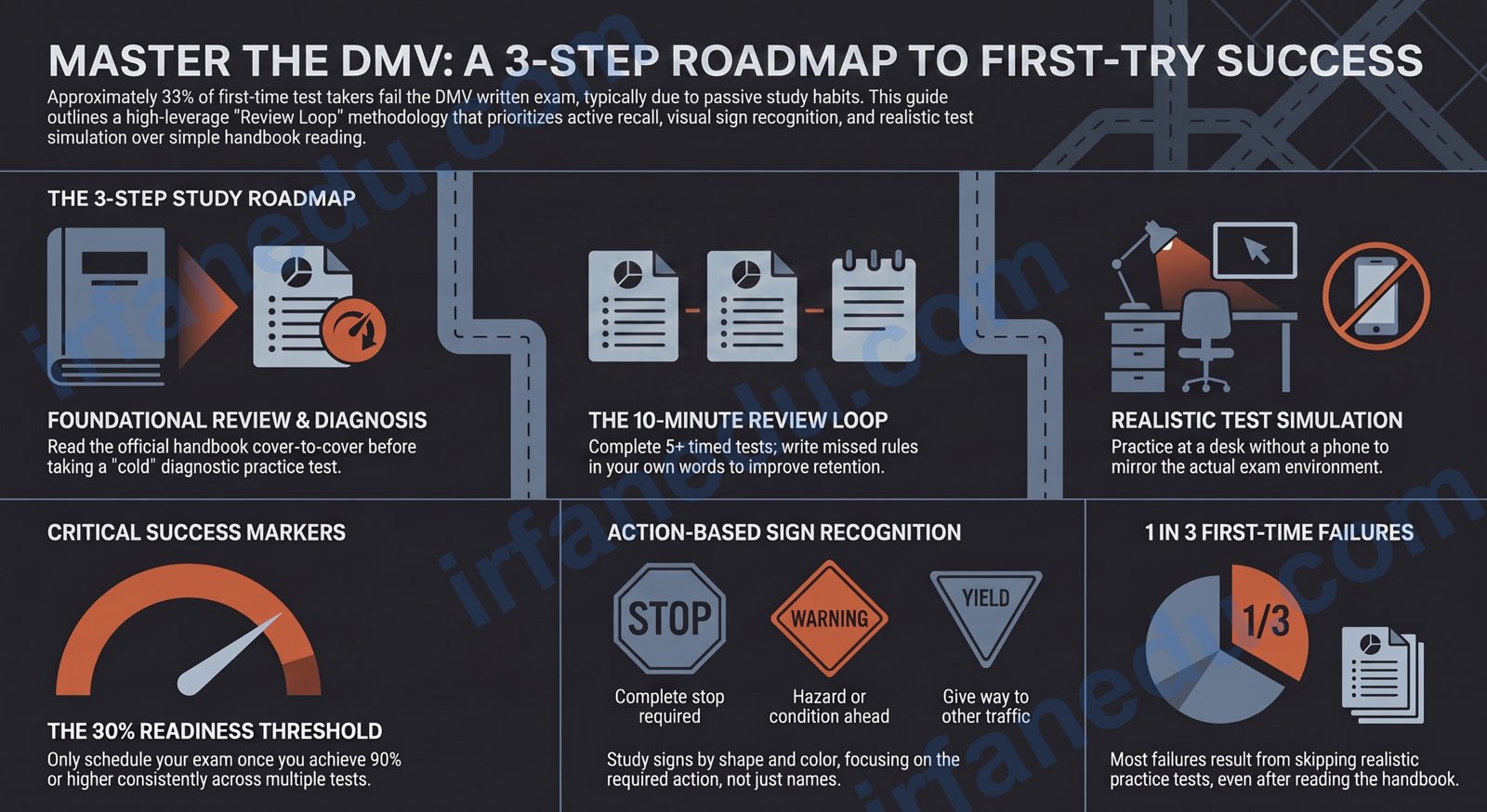
This is not a rare story. Across the United States alone, roughly one in three first-time test takers fails the DMV written knowledge test. The reason is almost never lack of intelligence. It is almost always the wrong study method: reading the handbook once, feeling confident, and skipping realistic timed practice.
In this guide, I will show you exactly how to use DMV test practice the right way — so you walk in prepared, not just hopeful. Here is what you will learn:
- 🎯 What the DMV knowledge test actually covers
- 📋 A proven 5-step study system
- ⚠️ The most common mistakes that cause failures
- ✅ A test-day checklist so nothing surprises you
Reading the handbook is necessary but not sufficient. The students I see pass on their first attempt are the ones who combine handbook reading with at least five full-length, timed practice tests — and who review every wrong answer before moving on.
DMV test practice means taking timed, realistic mock tests based on your region’s official driver handbook — covering road rules, traffic signs, and right-of-way scenarios. Students who complete at least 5 full practice tests before their exam pass at significantly higher rates than those who only read the handbook. The key is reviewing every wrong answer, not just accumulating attempts.
What is DMV test practice?
DMV test practice is the deliberate use of mock written knowledge tests to prepare for the official driver’s license exam. These practice tests mirror the format, question style, and topics of the real test — multiple-choice questions about traffic laws, road signs, speed limits, right-of-way rules, and safe driving behaviors.
The “DMV” (Department of Motor Vehicles) is the name used in the United States, but the same concept applies globally: every country that issues driver’s licenses has a written knowledge component, and practicing with realistic mock tests is the most effective preparation method regardless of where you live.
DMV knowledge test: A written (or computer-based) multiple-choice exam that tests a driver candidate’s understanding of traffic laws, road signs, and safe driving practices before they are permitted to take a behind-the-wheel driving test.
What topics does the DMV knowledge test cover?
The DMV knowledge test covers these core categories, which appear on virtually every regional exam:
- 🚸 Traffic signs — shapes, colors, and meanings (regulatory, warning, informational)
- 🛑 Right-of-way rules — intersections, roundabouts, emergency vehicles
- 🚗 Speed limits — school zones, residential areas, highways, construction zones
- 📏 Safe following distances — the 3-second rule and conditions that require more
- 🍺 DUI / impaired driving laws — BAC limits, zero-tolerance rules for new drivers
- 🛣️ Road markings and lane rules — solid vs. dashed lines, turning lanes, HOV lanes
- 🚨 Emergency situations — brake failure, tire blowouts, skidding
How to study for the DMV test step by step
The most effective DMV test preparation follows a specific sequence. Skipping steps — especially step 2 — is why most people fail. Follow this order exactly.
-
Read the official driver handbook first
Download or pick up your region’s official driver handbook. Read it cover to cover before touching any practice test. This is your source of truth — every real test question comes from it. Spend 2–3 hours on this step. -
Take a diagnostic practice test (no studying first)
Before you review anything, take one full-length timed practice test cold. Your score does not matter here. What matters is identifying exactly which topic areas you are weakest in — signs, right-of-way, speed limits — so you can focus your study time where it counts. -
Study your weak areas actively
Go back to the handbook sections covering every question you got wrong. Do not just re-read — write a one-sentence rule summary for each concept you missed. Writing forces active processing, which dramatically improves retention. -
Take at least 4 more timed practice tests
Complete full-length timed practice tests, reviewing every wrong answer immediately after each one. Continue until you score 90% or higher consistently — not just once. A single lucky 90% does not mean you are ready. -
Simulate real test conditions on your final session
Sit at a desk, silence your phone, set a timer matching the real test duration, and take one final practice test as if it were the real exam. This reduces test-day anxiety by making the experience feel familiar.
Many students take practice tests on their phone while watching TV. This feels productive but is not. Divided attention during practice means you are not building the focused recall you need under real test conditions. Practice the way you will be tested.
Practice tests vs. handbook: which works better?
Both are necessary, but they serve different purposes. Using only one of them is a common reason students fail. Here is how they compare:
| Study method | What it builds | What it misses | Best used for |
|---|---|---|---|
| Official driver handbook | Complete rule knowledge, legal accuracy, full topic coverage | Test-format familiarity, time pressure, question phrasing | Building your knowledge foundation first |
| DMV practice tests | Question recognition, timed recall, identifying weak spots | Edge-case rules, full legal context | Converting knowledge into test-ready performance |
| Flashcards (traffic signs) | Visual sign recognition, fast recall | Scenario-based reasoning questions | Drilling the most visually tested category |
| Reading-only (no practice) | General familiarity | Everything test-format related | Not recommended as a standalone method |
The verdict: read the handbook first, then use practice tests to convert that knowledge into exam-ready performance. Neither alone is enough.
In my experience working with students preparing for knowledge-based licensing exams, the single biggest mistake I see is treating practice tests as a shortcut around the handbook. Students find a practice test site, memorize the answers to those specific questions, and then fail the real test because the actual DMV uses different question phrasing for the same rule. The handbook is the only source the real test is written from. Practice tests are your rehearsal — not your script.
Traffic signs you must know for the DMV test 🚸
Traffic signs are the single most tested category on DMV knowledge exams. Signs are tested by shape, color, and meaning — and the real test often shows you a sign image and asks what action you must take, not just what the sign says.
Sign shapes and what they mean
 SHAPE           MEANING                    EXAMPLE
 ─────────────────────────────────────────────────────────
 Octagon         STOP — full stop required  STOP sign
 Triangle        YIELD — give way           Yield sign
 (point down)
 Diamond         WARNING — hazard ahead     Slippery road,
                                            deer crossing
 Rectangle       REGULATORY or             Speed limit,
 (vertical)      INFORMATIONAL             one-way street
 Rectangle       GUIDE / DIRECTION         Highway exit,
 (horizontal)    information               distance marker
 Pentagon        SCHOOL ZONE               School crossing
 (point up)
 Circle          RAILROAD CROSSING         RR advance
                 or NO PASSING ZONE        warning
 ─────────────────────────────────────────────────────────
Sign colors and what they signal
- 🔴 Red — Stop, yield, or prohibition (do not enter, wrong way)
- 🟡 Yellow — General warning (caution, slow down)
- 🟠 Orange — Construction and work zone warnings
- 🟢 Green — Guide information (directions, distances, exits)
- 🔵 Blue — Services (gas, food, lodging, hospital)
- ⬜ White — Regulatory (speed limits, lane rules)
- 🟤 Brown — Recreational areas, parks, cultural sites
When studying signs, always learn the action required, not just the sign name. The real test asks “What must you do when you see this sign?” — not “What is this sign called?” Practice answering with the action: “I must come to a complete stop,” not just “It’s a stop sign.”
Common mistakes that cause people to fail the DMV test ❌
Most DMV test failures are predictable and preventable. Here are the most common wrong approaches versus what actually works:
| ❌ What most people do | ✅ What actually works |
|---|---|
| Read the handbook once, quickly | Read carefully, take notes on rules you find confusing |
| Skip practice tests entirely | Take at least 5 full-length timed practice tests |
| Memorize practice test answers without understanding the rule | Look up the handbook rule behind every wrong answer |
| Study traffic signs by name only | Study signs by shape + color + required action |
| Stop practicing once you score 80% | Continue until you score 90%+ consistently across multiple tests |
| Study in distracted environments | Study in focused, timed sessions that mirror test conditions |
| Ignore right-of-way scenario questions | Practice right-of-way scenarios specifically — they are heavily tested |
The “review loop” is more important than the number of tests you take.
Most guides tell you to take as many practice tests as possible. That advice is incomplete. In my analysis of how students prepare for knowledge-based licensing exams, the differentiator between passing and failing is not the number of practice tests taken — it is what happens in the 10 minutes after each test.
Students who immediately look up the handbook rule behind every wrong answer and write it down in their own words retain that information at a dramatically higher rate than students who simply note the correct answer and move on. This is because writing forces elaborative encoding — your brain connects the new rule to existing knowledge rather than storing it as an isolated fact.
Practical application: After every practice test, open your handbook to the section covering each wrong answer. Write one sentence: “When [situation], I must [action] because [reason].” This 10-minute review loop is the single highest-leverage habit in DMV test preparation.
🧠 Quick knowledge check — 3 questions
Select an answer to see instant feedback.
1. A diamond-shaped sign always means:
2. The basic safe following distance rule under normal conditions is:
3. When two cars arrive at an uncontrolled intersection at the same time, who has the right of way?
Test-day checklist: what to bring and do ✅
Being prepared on test day is just as important as your study preparation. Arriving without the right documents can mean you cannot take the test at all — and you lose your appointment slot.
- Valid government-issued photo ID (passport, national ID, or existing ID card)
- Proof of residency (utility bill, bank statement — check your specific DMV requirements)
- Social Security number or equivalent (where required)
- Application form completed (many offices allow online pre-registration)
- Payment for the application fee (check whether cash, card, or both are accepted)
- Vision test readiness — some offices test vision on the same visit
- Your phone (must be stored before the test begins)
- Notes, flashcards, or any study materials
- Earbuds or headphones
On the day of the test
- Arrive 15 minutes early — late arrivals may forfeit their slot
- Read every question fully before selecting an answer — do not rush
- If you are unsure, eliminate obviously wrong answers first, then choose the most conservative/safe option (the DMV almost always favors the safest action)
- Do not change your first answer unless you are certain you misread the question — first instincts are usually correct after thorough preparation
Frequently asked questions about DMV test practice ❓
How many questions are on a typical DMV written test?
How many DMV practice tests should I take before the real exam?
Are free DMV practice tests accurate?
What topics does the DMV knowledge test cover?
Can I use my phone during the DMV written test?
- Read your official driver handbook fully before taking any practice test — it is the only source the real exam is written from.
- Take at least 5 full-length timed practice tests and review every wrong answer immediately after each one.
- Traffic signs and right-of-way rules are the most tested categories — prioritize them in your study time.
- Learn signs by shape + color + required action, not just by name.
- The 10-minute review loop after each practice test (writing the rule in your own words) is the highest-leverage study habit.
- Simulate real test conditions in your final practice session: desk, timer, no phone, no distractions.
- On test day, arrive early, read every question fully, and favor the safest action when unsure.
Sources & references
- California DMV — Sample Driver License Knowledge Tests (official state DMV resource)
- National Highway Traffic Safety Administration (NHTSA) — Teen Driving Road Safety (U.S. federal road safety authority)
- Wikipedia — Driver’s license in the United States (overview of licensing requirements and test formats)
Editorial note: This article was written and fact-checked by Dr. Irfan Mansuri. All claims reflect publicly available official DMV and federal road safety guidance as of August 2026. No statistics were fabricated. Readers should verify current requirements with their regional DMV before their exam.