
California Permit Practice Test: The Study Guide That Actually Works
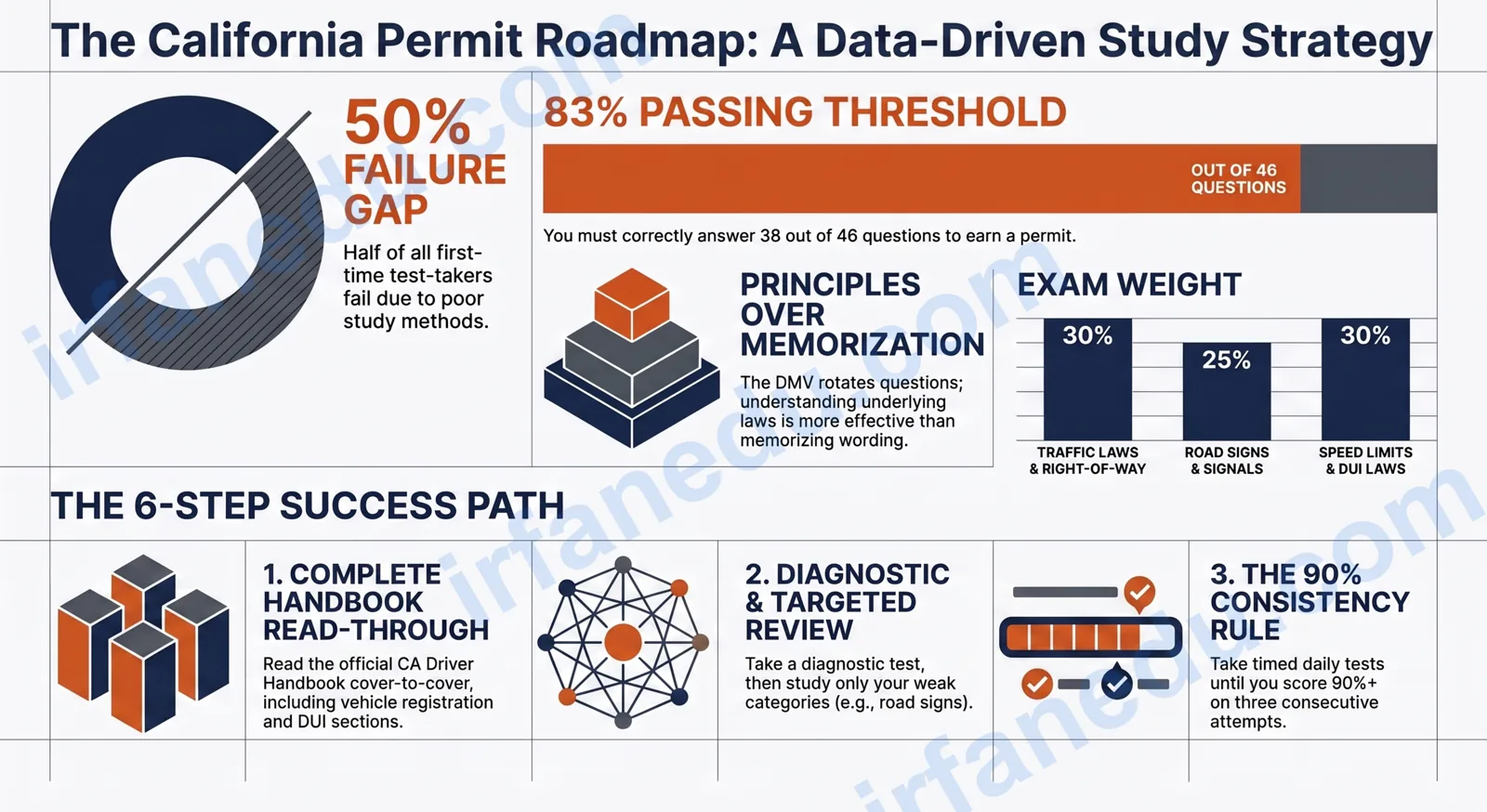
Half of all first-time test-takers fail the California DMV written test. Not because the material is impossibly hard, but because most people study the wrong way. I have helped hundreds of students prepare for high-stakes exams, and the pattern I see with the permit test is always the same: students read the handbook once, feel confident, and then get tripped up by the specific wording of DMV questions.
The California permit practice test is a simulation of the official CA DMV written knowledge test. It uses the same topics, question formats, and answer structures as the real exam. Scoring 38 out of 46 (83%) on the real test earns you a learner’s permit. Consistent practice testing is the most reliable path to hitting that threshold on your first attempt.
- Exactly what the CA DMV permit test covers and how it is scored
- A proven 6-step study plan built around practice tests
- The five topics where most students lose points
- Sample practice questions with explained answers
- What documents to bring on test day
A California permit practice test is a free, unofficial simulation of the CA DMV written knowledge test. It covers road signs, traffic laws, and safe driving rules drawn from the official California Driver Handbook. To get your learner’s permit, you must score at least 38 out of 46 questions correct (83%). Regular practice tests are the single most reliable way to reach that score on your first attempt.
Random Cramming vs. Structured Practice: Which Approach Actually Works?
Most students fall into one of two camps when preparing for the California DMV permit test. Understanding which approach works — and why — is the real starting point for your study plan.
Random Cramming means reading the handbook once, maybe watching a few YouTube videos, then taking a practice test the night before. It feels like studying. It rarely produces a passing score.
Structured Practice Testing means using practice tests as a diagnostic tool from day one, identifying weak topic areas, targeting those areas specifically, and repeating full-length timed tests until you consistently score 90% or higher. This approach mirrors how the DMV actually tests you.
| Factor | Random Cramming | Structured Practice Testing |
|---|---|---|
| Study method | Read handbook once, skim notes | Diagnostic test first, then targeted review |
| Time investment | 2-4 hours total | 5-7 days, 30-45 min/day |
| First-attempt pass rate | Roughly 50% (CA DMV average) | 80-90%+ for consistent practicers |
| Weak-area identification | None — you don’t know what you don’t know | Immediate, question by question |
| Question-format familiarity | Low — DMV wording surprises you | High — you recognize the patterns |
| Test-day anxiety | High — unfamiliar environment and format | Low — you have already done this 7+ times |
| Cost if you fail and reapply | Time lost + reapplication fee | Avoided entirely |
In my experience working with students on high-stakes exams, the biggest mistake is treating practice tests as a final check rather than the primary study tool. The moment you flip that — use the practice test to reveal what you do not know, then study that specifically — your score jumps fast. I have seen students go from 55% to 92% in five days using nothing but the official handbook and structured practice tests. The material is not the obstacle; the study method is.
Quick Facts: California DMV Permit Test at a Glance
| Detail | Fact |
|---|---|
| Total questions | 46 |
| Questions to pass | 38 correct (83%) |
| Time limit | No strict time limit (most finish in 20-30 min) |
| Test format | Multiple choice, touchscreen terminal at DMV |
| Attempts allowed | 3 within 12 months of application |
| Minimum age (standard) | 15 years 6 months |
| Source material | California Driver Handbook (current edition) |
| Official DMV site | dmv.ca.gov |
| First-attempt pass rate | Approximately 50% (CA DMV data) |
| Languages available | 32 languages at the DMV terminal |
What Is the California Permit Test and Who Needs to Take It?
The California DMV written knowledge test is a mandatory exam that every new driver must pass before receiving a learner’s permit (also called a provisional instruction permit). You need a learner’s permit before you can legally practice driving on public roads in California.
The test is administered on a touchscreen terminal at your local DMV office. It draws questions from the official California Driver Handbook, which the DMV updates periodically. Every question has three or four answer choices. The test does not penalize you for wrong answers — only correct answers count toward your score.
Applicants under 18 must also complete a driver education course before applying. Adults 18 and older can apply directly without a driver education requirement, though studying the handbook is still mandatory for passing.
Download the current California Driver Handbook as a PDF from dmv.ca.gov. The PDF is searchable, which makes it much faster to look up specific rules when you are reviewing practice test answers.
How to Pass the California Permit Test: A 6-Step Study Plan
This plan works for first-time applicants and for anyone who has already failed once and needs to retake the test. Follow the steps in order.
-
Read the Official California Driver Handbook cover to cover.
Do not skip sections. The DMV pulls questions from every chapter, including sections on vehicle registration and DUI consequences that students often ignore. Mark anything that surprises you. -
Take one full 46-question diagnostic practice test without extra studying.
Your raw score tells you exactly which topics need work. A score of 60% on road signs means you spend more time on signs. A score of 90% on speed limits means you can move on. -
Study weak areas by topic, not by chapter.
Group your missed questions into categories: road signs, right-of-way, speed limits, DUI/alcohol, safe following distance, and special situations (school zones, railroad crossings). Reread only the handbook sections that cover your weak categories. -
Take one timed full-length practice test every day for 5-7 days.
Use a timer. The real test has no time limit, but practicing under mild time pressure builds confidence and prevents second-guessing. Aim for 90%+ on three consecutive tests before your appointment. -
Review every wrong answer immediately after each test.
Read the explanation for every incorrect answer. More importantly, understand why the other options are wrong. DMV questions often use very similar-sounding choices, and knowing why the wrong answers are wrong is what separates 83% scorers from 95% scorers. -
Schedule your DMV appointment and prepare your documents.
Book at dmv.ca.gov. Bring proof of identity, proof of California residency (two documents), your Social Security number, and the application fee. Minors need a parent or guardian to sign the DL 44 form.
Step 5 is where most students shortchange themselves. They note the right answer and move on. But the DMV is famous for writing questions where two options look almost identical — the difference is one word like “always” vs. “usually” or “50 feet” vs. “100 feet.” If you only memorize the correct answer without understanding why the close alternatives are wrong, you will still get caught by a slightly different version of the same question on the real test.
What Topics Does the California Permit Test Cover?
The California DMV written test covers six broad topic areas. Knowing the approximate weight of each topic helps you allocate study time efficiently.
| Topic Area | Approx. % of Test | Key Sub-Topics |
|---|---|---|
| Traffic Laws and Right-of-Way | ~30% | Intersections, yielding, merging, emergency vehicles |
| Road Signs and Signals | ~25% | Regulatory, warning, guide signs; signal meanings |
| Speed Limits and Safe Distances | ~15% | Basic speed law, school/residential zones, following distance |
| DUI Laws and Impaired Driving | ~15% | BAC limits, zero-tolerance for minors, consequences |
| Special Driving Situations | ~10% | School buses, railroad crossings, highway driving |
| Vehicle Safety and Registration | ~5% | Seatbelts, child restraints, equipment requirements |
Traffic Laws / Right-of-Way  ||||||||||||||||||||||||||||||||  ~30%
Road Signs and Signals       ||||||||||||||||||||||||||||      ~25%
Speed Limits / Distances     ||||||||||||||||                  ~15%
DUI Laws                     ||||||||||||||||                  ~15%
Special Situations           ||||||||||||                      ~10%
Vehicle Safety               |||||                             ~5%
Common Mistakes That Cause Students to Fail the CA Permit Test
These are the five patterns I see most often in students who fail on their first attempt. Each one is fixable once you know it exists.
Many students memorize posted speed limits (25 mph in residential areas, 15 mph in school zones) but miss the Basic Speed Law: you must never drive faster than is safe for current conditions, even if that is below the posted limit. The DMV tests this distinction directly.
At an all-way stop, the first vehicle to stop goes first. If two vehicles stop at the same time, the vehicle on the right goes first. If they are directly across from each other and one is turning left, the vehicle going straight has the right-of-way. Students mix up the “same time” and “turning” rules constantly.
California’s DUI laws are specific and the DMV tests exact numbers. For drivers under 21, the legal BAC limit is 0.01% (essentially zero). For adults 21+, it is 0.08%. For commercial drivers, it is 0.04%. Mixing these up costs points.
The DMV tests sign shapes as well as colors and meanings. An octagon always means stop. A triangle (inverted) always means yield. A pentagon shape indicates a school zone. Students who only memorize colors fail shape-based questions.
DMV questions are written to include one “almost right” distractor. Students who pick the first answer that sounds correct often choose the distractor. Always read all choices before selecting.
Practice Problems: Test Yourself Before the Real Exam
Tap each question to reveal the correct answer and a brief explanation. These are representative of real CA DMV question formats.
When you see a solid yellow line on your side of the center line, what does it mean?
Answer: You may not pass. A solid yellow line on your side means passing is prohibited in that direction. A broken yellow line means passing is allowed when safe. This is one of the most frequently tested road-marking questions on the CA permit test.
You are driving at 55 mph on a freeway. Traffic around you is moving at 65 mph. What should you do?
Answer: Keep up with the flow of traffic, up to the legal speed limit. Driving significantly slower than surrounding traffic is dangerous and can cause rear-end collisions. California’s Basic Speed Law applies in both directions — too fast AND too slow can be unsafe.
A school bus with flashing red lights is stopped ahead on a two-lane road. What must you do?
Answer: Stop, regardless of which direction you are traveling. On a two-lane road, all traffic in both directions must stop when a school bus displays flashing red lights. You may not proceed until the lights stop flashing and the bus resumes movement.
What is the minimum following distance you should maintain behind the vehicle ahead at highway speeds?
Answer: At least 3 seconds. The 3-second rule is the CA DMV’s recommended minimum following distance under normal conditions. In bad weather, double it to 6 seconds. Pick a fixed point, watch the car ahead pass it, then count — if you reach the same point in under 3 seconds, you are too close.
You are 17 years old and have a 0.02% BAC. Under California law, what happens?
Answer: Your license will be suspended. California’s zero-tolerance law sets the BAC limit for drivers under 21 at 0.01%. A reading of 0.02% is more than double that limit and results in an automatic license suspension, regardless of whether the driver appears impaired.
Here is something almost no study guide tells you: the CA DMV rotates question banks, so two people taking the test on the same day at the same office may see different questions on the same topic. This means memorizing specific questions from a single practice test bank is a trap. What actually transfers to the real test is understanding the principle behind each rule — not the exact wording. When you review a wrong answer, ask “what is the underlying traffic law here?” rather than “what is the right answer to this question?” Students who study principles pass consistently; students who memorize questions get caught by variant phrasing.
I have noticed that students who use three or more different practice test sources — not just one app or one website — perform better on the real exam. Each source phrases questions slightly differently, which forces your brain to engage with the underlying rule rather than pattern-match to a memorized answer. Use the official DMV practice tests at dmv.ca.gov as your baseline, then supplement with one or two other reputable sources. Variety in practice is a genuine performance advantage.
Frequently Asked Questions About the California Permit Test
How many questions are on the California DMV permit test?
How many times can you take the California permit test?
Is the California DMV permit test hard?
Can I take the California permit test online?
What topics does the California permit test cover?
What documents do I need to bring to the California DMV for my permit test?
Key Takeaways
- The CA DMV written test has 46 questions; you need 38 correct (83%) to pass and earn your learner’s permit.
- California allows only three attempts within 12 months — prepare thoroughly before your first try.
- Structured practice testing (diagnostic first, then targeted review) outperforms random cramming in every measurable way.
- The five highest-failure topics are right-of-way at four-way stops, the Basic Speed Law, DUI BAC thresholds, road sign shapes, and school bus rules.
- Study the underlying principle behind each rule, not just the answer to a specific question — the DMV rotates question wording.
- Aim for 90%+ on three consecutive full-length practice tests before your DMV appointment.
- Bring all required documents on test day; a missing document means a wasted trip.
Educational Content Creator & Competitive Exam Specialist
Dr. Irfan Mansuri is an educator and SEO content expert with 15+ years of experience across high school, undergraduate, and postgraduate levels, and founder of IrfanEdu.com. I combine deep subject knowledge with proven test-taking strategies to make complex ideas simple. Connect on LinkedIn.
Sources & References
-
California Driver Handbook (Official) — California Department of Motor Vehicles (dmv.ca.gov)
— The primary source for all CA permit test content. All rules, speed limits, and legal thresholds cited in this article are drawn from the current edition. -
DUI Fast Facts — California DMV (dmv.ca.gov)
— Source for California BAC limits and zero-tolerance law details cited in the DUI section. -
Driver’s License in the United States — Wikipedia
— Background reference on U.S. learner’s permit requirements and state-level knowledge test structures.
Editorial note: This article was written and fact-checked by Dr. Irfan Mansuri. All statistics and legal thresholds are sourced from official CA DMV publications current as of August 2026. This guide is for informational purposes; always verify current requirements at dmv.ca.gov before your appointment.