
HESI A2 Practice Test: The Complete 2026 Study Guide
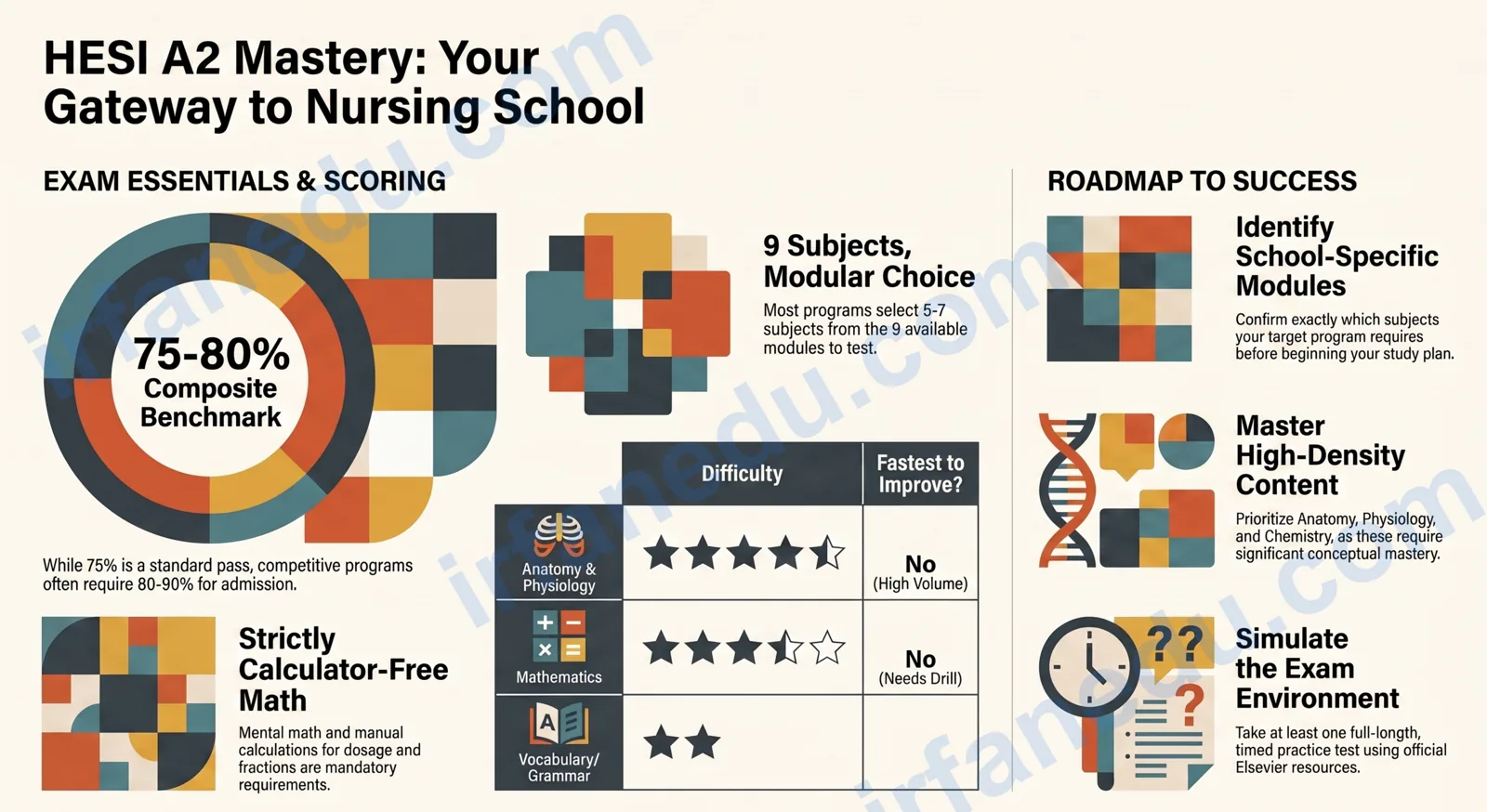
- The HESI A2 tests up to 9 subjects; most programs require 5-7 of them.
- A composite score of 75-80% is the standard minimum; competitive programs want 80-90%.
- Math is calculator-free — drill fractions, dosage, and percentages by hand.
- Vocabulary and Grammar are the fastest sections to improve with daily flashcard practice.
- Take at least one full-length timed practice test before your real exam date.
- Retake policies vary by school; confirm wait periods before you sit the exam.
The HESI A2 exam is the gateway to nursing and allied health programs at hundreds of institutions worldwide. It measures academic readiness across science, math, and English skills — and your score directly determines whether you get a seat in your chosen program. Knowing exactly what the exam covers, how it is scored, and how to practice efficiently can be the difference between a first-attempt pass and a costly retake.
In my experience working with pre-nursing students, the biggest mistake I see is treating HESI A2 preparation as a passive activity — reading notes without ever sitting a timed practice test. This guide fixes that. I will walk you through every subject, show you how scoring works, give you a worked math example, and leave you with a concrete checklist you can act on today.
- The structure and content of all 9 HESI A2 subjects
- How scores are calculated and what “good” looks like
- A 6-step study plan you can start immediately
- A worked dosage-calculation example (the type most students miss)
- A subject-by-subject preparation checklist
What Is the HESI A2 Exam?
The HESI A2 is a pre-admission assessment developed by Elsevier and used by nursing and allied health programs to evaluate academic readiness before enrollment. It is not a licensure exam — it is an entrance filter designed to predict student success in rigorous healthcare programs.
Each institution chooses which of the 9 available subject modules to require. A school might ask for only Math, Reading, Vocabulary, Grammar, and Biology — or it might require all 9 sections including Physics. Always check your target school’s specific requirements before you begin studying, because preparing for sections you will not be tested on wastes valuable time.
The exam is delivered at approved testing centers on a computer. Each section is timed independently, typically at 50 minutes per section. There is no overall time limit for the full exam — you take breaks between sections.
Quick Facts About the HESI A2
| Feature | Detail |
|---|---|
| Full Name | Health Education Systems, Inc. Admission Assessment (HESI A2) |
| Developer | Elsevier |
| Purpose | Nursing and allied health program admission |
| Number of Subjects | Up to 9 (schools choose which to require) |
| Questions per Section | 25-50 multiple-choice questions |
| Time per Section | ~50 minutes |
| Calculator Allowed? | No (Math section is calculator-free) |
| Passing Score (typical) | 75-80% composite |
| Scoring Scale | 0-100% per section + composite |
| Retake Policy | Varies by school; usually 60-90 day wait |
| Delivery Format | Computer-based at approved testing centers |
All 9 HESI A2 Subjects Explained
Each HESI A2 subject module tests a distinct skill set. Here is what you need to know about each one before you start your practice test routine.
1. Mathematics
The Math section covers arithmetic, fractions, decimals, percentages, ratios, proportions, basic algebra, and — critically — dosage and medication calculations. No calculator is permitted. Students who rely on calculators in daily life consistently underperform here. Mental math fluency is not optional.
2. Reading Comprehension
You will read short passages and answer questions about the main idea, supporting details, author’s purpose, and implied meaning. The passages often use medical or scientific language, so familiarity with healthcare terminology helps.
3. Vocabulary and General Knowledge
This section tests academic and medical vocabulary in context. Words like “contraindication,” “prognosis,” and “etiology” appear regularly. Daily flashcard practice with medical terminology is the most efficient preparation method.
4. Grammar
Grammar questions test subject-verb agreement, pronoun usage, punctuation, sentence structure, and word choice. This section is unique to the HESI A2 — the competing TEAS exam does not include a standalone Grammar section.
5. Biology
Biology covers cell structure, genetics, metabolism, and basic biological processes. Questions are conceptual rather than memorization-heavy, so understanding how systems work matters more than reciting definitions.
6. Chemistry
Chemistry questions focus on atomic structure, the periodic table, chemical bonding, reactions, and basic stoichiometry. High school chemistry knowledge is sufficient — no university-level organic chemistry is tested.
7. Anatomy and Physiology
This is the most content-dense section. It covers all major body systems: skeletal, muscular, cardiovascular, respiratory, digestive, nervous, endocrine, and reproductive. Students who have not taken an A&P course recently should budget extra study time here.
8. Physics
Not all programs require Physics. Topics include mechanics, energy, waves, and basic electricity. If your target school requires it, treat it seriously — students who skip Physics practice are often caught off guard by its conceptual depth.
9. Critical Thinking
This section evaluates logical reasoning and problem-solving ability using scenario-based questions. It is less about content knowledge and more about structured thinking. Practice with logic puzzles and clinical scenario questions in the weeks before your exam.
Subject                  Difficulty   Fastest to Improve?
─────────────────────────────────────────────────────────
Mathematics              ★★★★☆        No  (needs daily drill)
Reading Comprehension    ★★☆☆☆        Yes (strategy-based)
Vocabulary               ★★★☆☆        Yes (flashcards work fast)
Grammar                  ★★☆☆☆        Yes (rule review + practice)
Biology                  ★★★☆☆        Moderate
Chemistry                ★★★★☆        No  (concept-heavy)
Anatomy & Physiology     ★★★★★        No  (most content volume)
Physics                  ★★★★☆        No  (requires concept mastery)
Critical Thinking        ★★★☆☆        Moderate
─────────────────────────────────────────────────────────
How HESI A2 Scoring Works
Each HESI A2 section is scored on a scale of 0-100%. Your composite score is the average of all sections your school requires. There is no penalty for wrong answers, so you should always attempt every question.
Elsevier reports scores immediately after you finish the exam. Your testing center prints a score report, and Elsevier also sends results directly to your school. Most programs set a minimum composite score of 75%, though competitive programs at major universities often require 80-90%.
- Below 70%: Below the minimum at most programs — retake recommended.
- 70-74%: Borderline — some programs accept this; check your school’s cutoff.
- 75-79%: Meets the standard minimum at most institutions.
- 80-89%: Competitive — qualifies for most programs including selective ones.
- 90%+: Excellent — places you in the top tier of applicants.
One thing I want to flag from working with students: a high score in one section does not compensate for a failing score in another if your school has per-section minimums. Always check whether your target program sets individual section floors in addition to a composite minimum.
HESI A2 vs. TEAS: Which Is Harder?
The HESI A2 and ATI TEAS are the two most common nursing entrance exams. They test similar academic domains but differ in structure and emphasis. Here is a direct comparison to help you understand which exam your program uses and what to expect.
| Feature | HESI A2 | ATI TEAS 7 |
|---|---|---|
| Developer | Elsevier | ATI Testing |
| Total Sections | Up to 9 (school chooses) | 4 fixed sections |
| Grammar Section | Yes | No (included in English) |
| Physics Section | Yes (if required) | No |
| Science Depth | Higher (4 science sections) | Moderate (1 science section) |
| Calculator | Not permitted | 4-function calculator provided |
| Typical Duration | 3-5 hours (varies by sections) | ~3.5 hours |
| Score Scale | 0-100% per section | 0-100% composite |
| Retake Wait | 60-90 days (school policy) | 30 days minimum |
| Best For | Strong science background | Strong reading/English background |
The HESI A2 is generally considered more demanding for students with weaker science backgrounds because it can require four separate science sections. The TEAS, by contrast, consolidates all science into one section and provides a calculator for math. Neither exam is objectively “harder” — it depends on your strengths.
6-Step HESI A2 Study Plan
This plan works whether you have 4 weeks or 8 weeks before your exam. The key is to start with a diagnostic test so you know exactly where to focus your energy.
- Confirm Your School’s Requirements. Find out which subjects your target program tests and the minimum score required for each section and the composite. This single step prevents wasted study time.
- Take a Diagnostic Practice Test. Complete a full-length HESI A2 practice test under timed conditions before you study anything. Your scores reveal your actual weak spots — not the ones you assume you have.
- Build a Subject-by-Subject Study Schedule. Allocate study time in inverse proportion to your diagnostic scores. If you scored 90% on Reading but 60% on Chemistry, Chemistry gets four times the study time.
- Drill Math Without a Calculator Daily. Spend 20-30 minutes every day on arithmetic, fractions, percentages, and dosage calculations by hand. Consistency over 4-6 weeks produces reliable improvement.
- Learn 10-15 Vocabulary Words Per Day. Use spaced repetition flashcard apps (Anki is free and effective). Focus on medical and academic vocabulary. In 4 weeks, you can cover 300+ high-frequency words.
- Simulate Full Exam Conditions in the Final Week. Take at least two complete timed practice tests. Sit at a desk, time each section strictly, and review every wrong answer immediately after. This builds both stamina and test-day confidence.
Worked Example: HESI A2 Math (Dosage Calculation)
Dosage calculation questions are among the most commonly missed on the HESI A2 Math section. Here is a step-by-step worked example of the type you will encounter — without a calculator.
Step 1: Identify what you have and what you need.
You need: 750 mg. Available: 250 mg per tablet.
Step 2: Set up the ratio.
Tablets needed = Dose ordered ÷ Dose available per unit
Tablets needed = 750 mg ÷ 250 mg/tablet
Step 3: Calculate.
750 ÷ 250 = 3 tablets.
Answer: 3 tablets.
Step 1: Total drops = 1,000 mL × 15 drops/mL = 15,000 drops.
Step 2: Total minutes = 8 hours × 60 min/hr = 480 minutes.
Step 3: Drip rate = 15,000 ÷ 480 = 31.25, rounded to 31 drops/minute.
In my experience, students who practice 5-10 dosage problems per day for three weeks consistently move their Math section score up by 10-15 percentage points. The formula is always the same — what changes is the unit and the numbers. Recognizing the pattern is the skill.
Most HESI A2 guides tell you to “study all 9 subjects.” That advice is actively harmful for most students. Here is what the data actually shows: the HESI A2 is scored per section, and most programs set a composite minimum — not a per-section minimum. This means a student who scores 95% on five sections and 65% on two sections will often still meet the composite cutoff. The smarter strategy is to identify your school’s per-section floors (if any exist), protect your strong sections, and only deep-dive the subjects where you are genuinely below the threshold. I have seen students spend 40 hours studying Physics — a section their school did not even require — while their Anatomy score sat at 68%. Always audit the requirements first, then allocate study time surgically. Blanket “study everything equally” advice wastes weeks.
Subject-by-Subject HESI A2 Preparation Checklist
Use this checklist to track your readiness before your exam date. Check each item off only when you can consistently score 80%+ on practice questions in that area.
Mathematics
- Can solve fraction addition, subtraction, multiplication, and division without a calculator
- Can convert between fractions, decimals, and percentages fluently
- Can solve ratio and proportion problems in under 60 seconds
- Can complete dosage calculation problems (tablets, IV drip rates, weight-based dosing)
- Can solve one-variable algebra equations
Reading Comprehension
- Can identify the main idea of a passage in one reading
- Can distinguish stated facts from implied meaning
- Can identify the author’s purpose and tone
- Can answer detail questions without re-reading the full passage
Vocabulary and Grammar
- Have reviewed 200+ medical and academic vocabulary words
- Can define common prefixes and suffixes (brady-, tachy-, -itis, -ectomy)
- Can identify subject-verb agreement errors
- Can correct pronoun-antecedent agreement errors
- Can identify sentence fragments and run-on sentences
Science (Biology, Chemistry, A&P)
- Can describe cell structure and function (organelles, cell membrane, mitosis)
- Can explain basic genetics (dominant/recessive, Punnett squares)
- Can name and describe all major body systems and their primary functions
- Can balance a simple chemical equation
- Can identify elements by atomic number and explain basic bonding
Where to Find Quality HESI A2 Practice Tests
Not all practice resources are equal. Here is a comparison of the most commonly used options so you can choose the right one for your study plan.
| Resource | Cost | Closest to Real Exam? | Best For |
|---|---|---|---|
| Elsevier Official HESI A2 Practice Exam | Paid (~$40-60) | Highest (same developer) | Final-week simulation |
| Evolve Elsevier Study Guide | Paid (~$30-50) | High | Content review + practice |
| Mometrix HESI A2 Study Guide | Paid (~$25-40) | Moderate-High | Comprehensive content review |
| Union Test Prep (online) | Free | Moderate | Quick subject-by-subject drills |
| Quizlet HESI A2 Flashcard Sets | Free | Low (community-created) | Vocabulary and terminology |
| Khan Academy (Math & Science) | Free | Low (not HESI-specific) | Rebuilding foundational skills |
My recommendation: use Khan Academy to rebuild any foundational gaps in Math or Chemistry, then switch to the official Elsevier practice exam in the final 7-10 days before your test. The Elsevier product mirrors the actual exam’s interface, question style, and difficulty level more accurately than any third-party resource.
Frequently Asked Questions About the HESI A2
How many questions are on the HESI A2 exam?
What is a good score on the HESI A2?
How many times can you retake the HESI A2?
Is the HESI A2 harder than the TEAS?
What math topics appear on the HESI A2?
Sources & References
1. Elsevier — Official HESI A2 Exam Information
evolve.elsevier.com — HESI Admission Assessment Exam — The official source for HESI A2 exam structure, subject modules, and scoring information.
2. Khan Academy — Free Math and Science Foundational Review
khanacademy.org — Arithmetic — Free arithmetic, fractions, percentages, and algebra practice directly relevant to the HESI A2 Math section.
3. National Council of State Boards of Nursing (NCSBN)
ncsbn.org — Authoritative resource on nursing education standards and pre-admission requirements in the United States.
Editorial note: All facts, score benchmarks, and exam structure details in this article are based on publicly available information from Elsevier and institutional nursing program admissions pages as of August 2026. Retake policies and score requirements vary by institution — always verify with your target school directly.