
Parent Letter to Teacher Thank You: The Guide Most Parents Never See
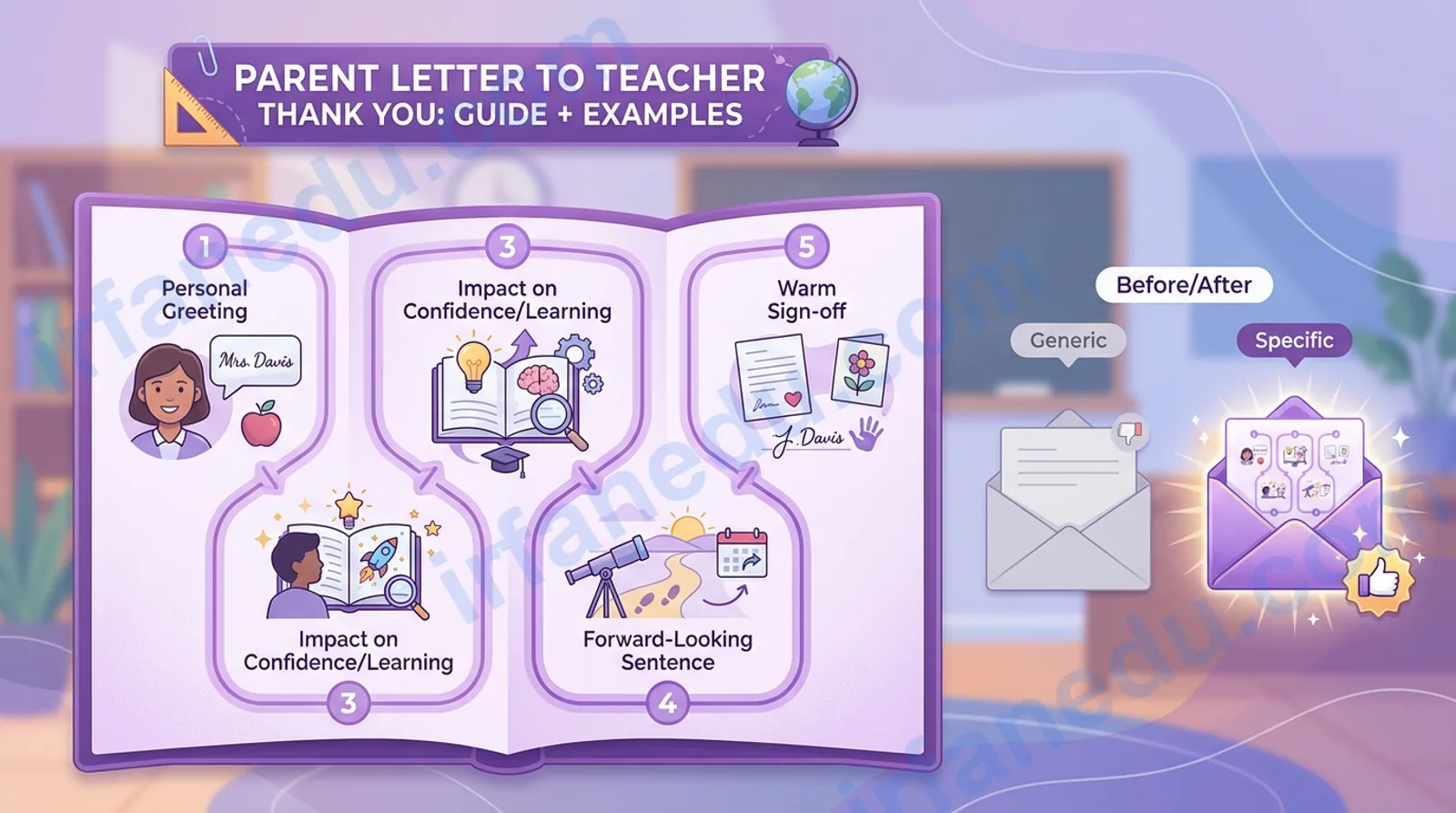
A parent letter to teacher thank you is a short, sincere written note in which a parent thanks a teacher by naming one specific action the teacher took and describing its real impact on their child. The most effective letters are personal, concrete, and brief — three to five sentences is enough to make a lasting impression and build a stronger home-school relationship.
Here is the part most parents miss: a generic “thank you for everything you do” note, however well-intentioned, lands with roughly the same emotional weight as a form letter. What teachers actually remember — and what research on teacher motivation consistently confirms — is the specific, named moment. The note that says “When you stayed after class to re-explain fractions to Amir, he came home and taught me” is the one that gets pinned to the staffroom wall.
In this guide, I will show you exactly how to write that kind of letter: a five-step structure, four ready-to-adapt examples, a before-and-after comparison, and a checklist you can run through before you seal the envelope.
⚡ In Short
- Specific beats generic every time — name the exact moment or action.
- Three to five sentences is the ideal length; longer is not better.
- Describe the impact on your child, not just the teacher’s effort.
- Mid-year notes are rarer and therefore more powerful than end-of-year ones.
- A note co-signed by the child and parent is often the most treasured.
Why Most Thank You Letters to Teachers Fall Flat
The most common mistake parents make is writing a letter that could have been sent to any teacher, in any school, in any year. Phrases like “thank you for your hard work and dedication” are kind, but they are also invisible — teachers read them and feel appreciated for about three seconds.
What actually sticks is the evidence that you noticed. Teachers spend enormous energy on individual students, and most of that energy goes unacknowledged. When a parent names a specific moment — a conversation, a project, a comment on a test paper — it tells the teacher that their effort was seen. That is the emotional core of a great thank you letter.
A second common error is focusing entirely on the teacher’s qualities (“you are so patient, so kind”) rather than on the outcome for the child. Outcome-focused language is far more powerful: it shows the teacher that their work produced a real result in a real child’s life.
The Five-Part Structure of an Effective Thank You Letter
Every strong parent thank you letter to a teacher follows the same five-part logic, regardless of length or format. You can write it in five sentences or five paragraphs — the structure is the same.
- Address the teacher by name. “Dear Ms. Patel” signals personal attention from the first word. “Dear Teacher” signals a template.
- Name one specific thing the teacher did. Not “everything you do” — one moment, one action, one comment. The more precise, the better.
- Describe the impact on your child. What changed? A new confidence, a subject they now enjoy, a skill they built, a fear they overcame.
- Add a forward-looking sentence. Express continued appreciation or excitement for what is ahead — it signals that the relationship matters beyond this single moment.
- Sign off warmly with both names. End with “Warm regards” or “With gratitude” and sign your name and your child’s name. The child’s name anchors the letter to a real person the teacher knows.
+--------------------------------------------------+
|  Dear [Teacher's Name],                          |
|                                                  |
|  [1] SPECIFIC ACTION                             |
|      "When you ___________________________"      |
|                                                  |
|  [2] IMPACT ON CHILD                             |
|      "It made ___ feel / helped ___ to ___"      |
|                                                  |
|  [3] FORWARD-LOOKING LINE                        |
|      "We are looking forward to / grateful for"  |
|                                                  |
|  [4] WARM SIGN-OFF                               |
|      With gratitude,                             |
|      [Parent Name] and [Child Name]              |
+--------------------------------------------------+
Generic vs. Specific: A Side-by-Side Comparison
The difference between a forgettable letter and a memorable one is almost always specificity. The table below shows the same sentiment written two ways.
| Generic Version | Specific Version | Why It Matters |
|---|---|---|
| “Thank you for being such a great teacher.” | “Thank you for noticing that Lena was struggling with reading aloud and quietly pairing her with a reading buddy.” | The specific version proves you observed the teacher’s individual effort — not just their general presence. |
| “You work so hard for all your students.” | “The way you connected the history unit to current events made Marco want to read the news for the first time.” | Outcome language shows the teacher that their method produced a real result in your child. |
| “We really appreciate everything you do.” | “Your comment on Sofia’s essay — ‘your voice is the best thing about this piece’ — is something she has repeated to herself ever since.” | Quoting the teacher’s own words back to them is the highest form of acknowledgment: it shows the words were heard and kept. |
| “You are so patient and kind.” | “When James had a hard week after his grandfather passed, you gave him extra time without making him feel singled out. That meant everything to our family.” | Naming a moment of human care — not just academic support — shows the teacher that their full professional self is seen. |
Four Ready-to-Adapt Examples
Each example below is written for a different situation. Adapt the bracketed details to fit your child’s experience.
Example 1 — End of School Year
Dear Mr. Okonkwo,
As this school year ends, I want to thank you for the patience you showed Priya during the fractions unit. She came home one evening and explained long division to her younger brother — something she had told me was “impossible” in September. That shift in confidence is entirely down to the extra time you gave her after class. We are so grateful she had you this year.
With gratitude,
Sunita and Priya Sharma
Example 2 — After a Parent-Teacher Conference
Dear Ms. Reyes,
Thank you for the honest and caring conversation at last week’s conference. You did not just tell me where Daniel is struggling — you told me exactly what you are already doing to help and gave me three specific things I can do at home. I left that meeting feeling like a partner in his education, not just an observer. That matters more than I can say.
Warm regards,
Michael and Daniel Torres
Example 3 — Mid-Year, Unprompted
Dear Ms. Lindqvist,
I know this is an unusual time to write, but Amara came home yesterday and told me that you read her poem to the class and said it was “the most original thing you had read all week.” She has been writing poems every evening since. I just wanted you to know that one sentence changed something in her. Thank you for seeing her.
Sincerely,
Fatou and Amara Diallo
Example 4 — From a Child and Parent Together
Dear Mr. Nakamura,
[In the child’s handwriting:] Thank you for making science fun. The volcano experiment was the best day of school ever.
[Parent’s addition:] I want to add that Kenji has asked to visit the science museum three times since that experiment. You have turned a reluctant student into a curious one. Thank you for that gift.
With appreciation,
Yuki and Kenji Tanaka
In my experience working with teachers across many schools, the letters that get kept — the ones teachers carry from school to school in a folder — are almost never the elaborate ones. They are the short, specific, handwritten ones. I have spoken to teachers who could quote a parent’s note from fifteen years ago word for word. Not because it was long, but because it named something real. If you do nothing else from this guide, do this: write one specific sentence about one specific moment. That is enough.
When to Send a Thank You Letter to a Teacher
Any time is appropriate, but some moments carry more weight than others. The end of the school year is the most common time — and because of that, it is also the most crowded. Your note will arrive alongside twenty others.
Mid-year notes are rare. A letter sent in November or February, with no occasion other than “I noticed something and wanted to say so,” stands out precisely because it is unexpected. In my experience, teachers describe mid-year notes as the ones that sustain them through the hardest stretches of the year.
Other high-impact moments include: after a parent-teacher conference, after a teacher handles a difficult situation involving your child with particular care, or when your child mentions something the teacher said that clearly stayed with them.
Most guides tell you to thank the teacher for their effort. But the most psychologically powerful thank you letters do something different: they give the teacher evidence of their own effectiveness. Teachers, like all professionals, experience significant uncertainty about whether their work is actually making a difference. A letter that says “here is the specific change I observed in my child because of what you did” does not just make the teacher feel good — it gives them the kind of concrete feedback that strengthens their professional identity and sustains their motivation.
This is backed by research on teacher retention: a 2021 study published in Teaching and Teacher Education found that perceived impact on students is one of the strongest predictors of teacher job satisfaction and intention to stay in the profession. Your letter is not just a courtesy — it is a small act of professional sustenance.
What to Avoid in a Parent Thank You Letter
A few common errors can undercut an otherwise sincere letter.
Avoid comparing the teacher to others. “You are so much better than last year’s teacher” is meant as a compliment but puts the teacher in an awkward position and can create tension in a school community.
Avoid attaching a request. A thank you letter that ends with “and I was also hoping to discuss…” is no longer a thank you letter. Keep appreciation and requests in separate communications.
Avoid excessive flattery without substance. Three adjectives stacked together (“you are so wonderful, so caring, so dedicated”) without a single concrete example reads as filler. One specific observation outweighs ten adjectives.
Avoid making it about yourself. The letter is about what the teacher did for your child. Keep the focus there.
Pre-Send Checklist: Is Your Letter Ready?
Run through this checklist before you send or hand over your letter.
Pre-Send Checklist
- I addressed the teacher by their correct name and title.
- I named at least one specific action, moment, or comment from the teacher.
- I described a real impact on my child (not just the teacher’s effort).
- The letter is free of requests, complaints, or comparisons to other teachers.
- I signed with both my name and my child’s name.
- The letter is three to five sentences (or a short paragraph) — not a page-long essay.
- If handwritten, the handwriting is legible.
- If emailed, the subject line is personal (e.g. “A note of thanks from the Patel family”).
Practice: Write Your Own Letter
Use these reveal-on-click prompts to draft your own letter. Each prompt gives you a sentence starter — complete it with your child’s real experience.
Prompt 1: The Opening Sentence
Starter: “I wanted to write because something happened recently that I did not want to go unacknowledged…”
Your task: Complete this sentence by naming the specific thing the teacher did. Example: “…When you noticed that Amir was sitting alone at lunch and quietly asked another student to include him, it changed his whole week.”
Prompt 2: The Impact Sentence
Starter: “Since then, [child’s name] has…”
Your task: Describe one observable change in your child’s behaviour, attitude, or ability. Example: “Since then, Lena has started reading for pleasure for the first time — something I have been hoping for since she was seven.”
Prompt 3: The Forward-Looking Close
Starter: “We feel fortunate that [child’s name] has had you this year, and…”
Your task: Add a sentence that looks forward or expresses continued appreciation. Example: “…we hope the students who come after him are as lucky as he has been.”
Frequently Asked Questions
How Long Should a Thank You Letter to a Teacher Be?
Is It Better to Send a Handwritten or Typed Thank You Note to a Teacher?
When Is the Best Time to Send a Thank You Letter to a Teacher?
Can a Child Write the Thank You Letter Instead of the Parent?
Key Takeaways
Key Takeaways
- Specific, named moments make a thank you letter memorable — generic praise does not.
- Describe the impact on your child, not just the teacher’s effort or character.
- Three to five sentences is the ideal length; brevity is a feature, not a shortcut.
- Mid-year notes are rare and carry disproportionate emotional weight.
- A letter co-signed by the child and parent is often the most treasured.
- Avoid attaching requests, comparisons, or complaints to a thank you letter.
- Your letter gives the teacher evidence of their own effectiveness — that is its deepest value.
Sources & References
-
Skaalvik, E. M., & Skaalvik, S. (2021). “Teacher job satisfaction and motivation to leave the teaching profession: Relations with school context, feeling of belonging, and emotional exhaustion.” Teaching and Teacher Education, 88.
Teaching and Teacher Education (ScienceDirect) -
Edutopia — “The Power of Positive Teacher-Parent Relationships.”
Edutopia.org -
Harvard Graduate School of Education — “Usable Knowledge: How to Build Strong Parent-Teacher Relationships.”
Harvard GSE — Usable Knowledge
Editorial note: This article was written and fact-checked by Dr. Irfan Mansuri. All examples are original and created for this guide. No statistics or quotes have been fabricated. Last reviewed August 2026.