
2.0 GPA: what it means, is it good enough, and how to raise it
Jordan just got their semester grades back. Three C’s, one D, and one B. The cumulative GPA now reads 2.0 on the transcript. Jordan’s parents are worried. Jordan is worried. The college application deadline is eight months away.
Is this the end of the road — or a recoverable situation? I’ll use Jordan’s exact scenario to show you every number, every option, and every step that actually works.
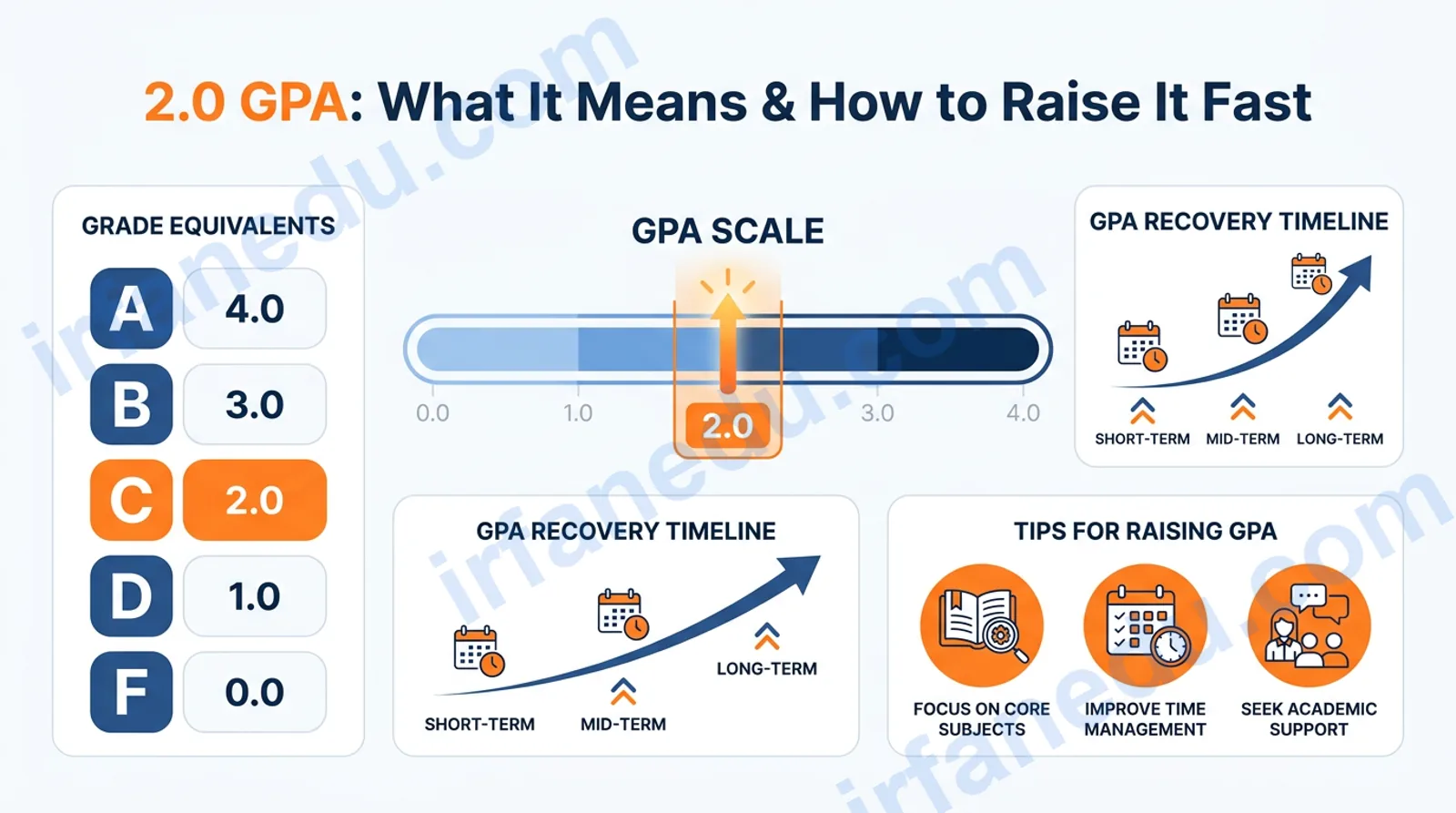
A 2.0 GPA on a 4.0 scale is a C average. It is the minimum passing threshold at most institutions — enough to graduate from many high schools, but below the floor for competitive college admission and most scholarship programs. The good news: it is one of the most fixable GPA situations in education.
In this guide, I’ll walk you through exactly what a 2.0 GPA means numerically, how colleges and employers interpret it, and — most importantly — a realistic, semester-by-semester plan to move it upward. Every claim here is backed by how GPA math actually works, not vague encouragement.
- Understand what a 2.0 GPA means on a 4.0 scale
- See how colleges and scholarship programs evaluate it
- Follow a worked, numerical plan to raise it
- Avoid the three mistakes that keep students stuck at 2.0
Quick answer: A 2.0 GPA on a 4.0 scale equals a C average — roughly 73–76% across your courses. It meets the minimum graduation requirement at most high schools and some colleges, but falls below the 2.5–3.0 threshold many four-year universities and scholarship programs require. It is fixable: targeted effort over one or two semesters can realistically push it to 2.5 or higher.
What is a 2.0 GPA, exactly?
A GPA (Grade Point Average) is a single number that summarizes your academic performance across all courses. On the standard 4.0 scale used by most schools worldwide, each letter grade maps to a grade point value, and those values are averaged — weighted by credit hours — to produce your cumulative GPA.
A 2.0 GPA means your credit-weighted average grade point is exactly 2.0, which corresponds to a C. It is the mathematical midpoint between a D (1.0) and a B (3.0). Most institutions set 2.0 as the minimum cumulative GPA required to remain in good academic standing and to graduate.
The full GPA scale at a glance
The table below shows how letter grades, percentage ranges, and GPA points relate on the standard 4.0 scale. A 2.0 sits squarely in the C band.
| Letter grade | Percentage range | GPA points (4.0 scale) | Academic standing |
|---|---|---|---|
| A / A+ | 93–100% | 4.0 | Excellent |
| A- | 90–92% | 3.7 | Excellent |
| B+ | 87–89% | 3.3 | Good |
| B | 83–86% | 3.0 | Good |
| B- | 80–82% | 2.7 | Good |
| C+ | 77–79% | 2.3 | Satisfactory |
| C | 73–76% | 2.0 ← you are here | Minimum standing |
| C- | 70–72% | 1.7 | Below average |
| D | 60–69% | 1.0 | Poor / at risk |
| F | 0–59% | 0.0 | Failing |
Jordan’s situation — three C’s, one D, one B — averages out to exactly 2.0 if each course carries equal credit hours. Let me show the math in a later section.
Is a 2.0 GPA good enough?
A 2.0 GPA is the academic equivalent of “passing, but just.” Whether it is “good enough” depends entirely on your goal.
| Goal | Is 2.0 GPA enough? | Typical minimum needed |
|---|---|---|
| High school graduation | ✅ Usually yes | 2.0 at most schools |
| Community college admission | ✅ Usually yes | 2.0 (open enrollment) |
| Four-year university admission | ⚠️ Borderline / often no | 2.5–3.0+ |
| Competitive university admission | ❌ No | 3.5–4.0 |
| Merit scholarships | ❌ No | 3.0–3.5 minimum |
| NCAA Division I athletics eligibility | ⚠️ Borderline | 2.3 core GPA minimum |
| Staying off academic probation | ✅ Barely (2.0 is the floor) | 2.0 cumulative |
| Graduate school admission | ❌ No | 3.0 minimum (most programs) |
The honest answer: a 2.0 GPA keeps doors open but closes many of them. It is not a failure — but it is a signal that something needs to change.
How colleges view a 2.0 GPA
Most four-year colleges list a minimum GPA of 2.5 in their admissions requirements, and the average admitted student at a mid-tier university sits around 3.0–3.3. A 2.0 GPA does not automatically disqualify you, but it does shift the burden of proof onto other parts of your application.
Here is what actually matters in that context:
- Grade trend: A student who earned a 1.6 GPA in year one and a 2.8 GPA in year two shows upward momentum. Admissions officers notice this — a rising trend with a 2.0 cumulative is more compelling than a flat 2.5.
- Course rigor: A 2.0 in AP and honors courses signals more academic potential than a 2.0 in standard-track courses.
- Community college pathway: This is the most underused and most effective route. Earning a 3.0+ GPA over 30–60 community college credits opens transfer admission to universities that would have rejected the same student straight out of high school.
- Standardized test scores: A strong SAT/ACT score can partially offset a low GPA at schools that still consider test scores.
How to raise a 2.0 GPA: a step-by-step plan
Raising a GPA is a math problem before it is a motivation problem. You need to know the numbers before you can change them. Here is the exact process I walk students through.
-
Audit every course grade. List all completed courses, their credit hours, and the grade you earned. Calculate how many total grade points you have (grade points × credit hours for each course, summed). This is your baseline.
-
Check your school’s retake and grade-forgiveness policy. Many high schools and colleges allow you to retake a course and replace the original grade in your GPA calculation. Retaking a D (1.0) in a 3-credit course and earning a B (3.0) adds 6 grade points to your total — a significant jump.
-
Choose next semester’s courses strategically. Balance required courses you find difficult with electives where you are genuinely strong. Do not overload — four courses done well beats six courses done poorly every time.
-
Start office hours and tutoring in week one. Not week eight. Instructors notice consistent effort and it directly improves your grade. In my experience teaching, students who show up early almost never end up in academic trouble.
-
Track your projected cumulative GPA weekly. Use a GPA calculator to see where your cumulative GPA will land based on your current grades. Adjust your effort before finals — not after you see the damage.
-
Repeat for two consecutive semesters. Consistency compounds. Two semesters of 3.5+ GPA can move a 2.0 to 2.6–2.8 depending on how many total credits you have completed.
📚 Explore more academic guides on IrfanEdu
The GPA math: worked examples
GPA math is simpler than most students think. Here is the formula, then Jordan’s exact numbers, then two projection scenarios.
GPA FORMULA
───────────────────────────────────────────────────────
Cumulative GPA = Total Grade Points ÷ Total Credit Hours

Grade Points for a course = Grade Point Value × Credit Hours

JORDAN'S CURRENT SEMESTER (5 courses, 3 credits each = 15 credits)
───────────────────────────────────────────────────────
Course          Grade   Points   Credits   Grade Points
English         C       2.0    ×   3    =    6.0
Math            C       2.0    ×   3    =    6.0
History         C       2.0    ×   3    =    6.0
Biology         D       1.0    ×   3    =    3.0
Art             B       3.0    ×   3    =    9.0
                                  ────     ─────
TOTALS                            15       30.0

Semester GPA = 30.0 ÷ 15 = 2.0  ✓

SCENARIO A: Jordan retakes Biology (D→B) next semester
AND earns B's in 4 new courses (3 credits each)
───────────────────────────────────────────────────────
New grade points added = (3.0×3) + (3.0×3×4) = 9 + 36 = 45
New credits added = 15
Cumulative: (30 + 45) ÷ (15 + 15) = 75 ÷ 30 = 2.5 GPA ✓

SCENARIO B: Jordan earns straight A's next semester
───────────────────────────────────────────────────────
New grade points = 4.0 × 15 = 60
Cumulative: (30 + 60) ÷ (15 + 15) = 90 ÷ 30 = 3.0 GPA ✓
The takeaway from Jordan’s numbers: one semester of B’s moves the needle to 2.5. One semester of A’s reaches 3.0. Neither requires perfection — just consistent, focused effort.
🔑 The part most guides miss
Credit hours are not equal — and that asymmetry is your biggest lever. Most GPA guides tell you to “get better grades.” They skip the fact that a 1-credit elective and a 4-credit core course affect your GPA very differently. A grade change in a 4-credit course moves your GPA roughly four times as much as the same grade change in a 1-credit course.
This means: if you have a D in a 4-credit required course, retaking that single course is worth more to your GPA than earning A’s in four 1-credit electives. Identify your highest-credit, lowest-grade courses first — those are your highest-ROI retakes. Most students do the opposite: they retake easy 1-credit courses because they feel safer, and wonder why their GPA barely moves.
Jordan’s biology retake (3 credits, D to B) adds 6 grade points in one move. Four 1-credit elective A’s add only 4 grade points total. Target the heavy courses. That is the real GPA recovery strategy.
Common mistakes students make with a low GPA
After working with students at the 2.0 threshold for years, I see the same three errors repeated constantly. Avoiding them is half the battle.
Mistake 1: Waiting until midterms to seek help
By midterms, you have already locked in roughly 40–50% of your final grade. Seeking help in week two or three — when you first feel lost — is the difference between a C and a B in most courses. The students who recover fastest are the ones who treat week one as the crisis point, not week eight.
Mistake 2: Retaking easy low-credit courses instead of hard high-credit ones
As the Unique Insight box above shows, this is the single most common and most costly GPA mistake. Always target your highest-credit, lowest-grade courses for retakes first. The math is unambiguous.
Mistake 3: Overloading the recovery semester
Students often try to compensate for a bad semester by taking extra courses the next semester. This usually backfires. A lighter load done excellently — say, four courses with a 3.5 GPA — does more for your cumulative GPA and your confidence than six courses with a 2.5 GPA. Slow and steady genuinely wins this race.
📐 Sharpen your math skills — Distance & Midpoint Formulas Guide
🧠 Quick knowledge check
1. What letter grade does a 2.0 GPA represent?
2. Jordan has 30 earned credits at 2.0 GPA. She earns straight A’s (4.0) in the next 30 credits. What is her new cumulative GPA?
3. Which retake gives the biggest GPA boost?
Frequently asked questions about a 2.0 GPA
Is a 2.0 GPA good enough for college?
What letter grade is a 2.0 GPA?
Can I raise my GPA from 2.0 to 3.0?
What is the minimum GPA to avoid academic probation?
Do employers care about a 2.0 GPA?
✅ Key takeaways
- A 2.0 GPA = C average = 73–76% on a 4.0 scale.
- It meets minimum graduation requirements at most high schools but falls short for competitive college admission.
- One semester of B’s (3.0) can raise a 2.0 to 2.5 if you have 15 credits completed.
- Target your highest-credit, lowest-grade courses for retakes first — that is the highest-ROI GPA move.
- A rising grade trend matters to admissions officers, even if the cumulative GPA is still low.
- Community college is a legitimate and effective path for students starting at 2.0 who want to transfer to a four-year university.
- Start office hours and tutoring in week one, not week eight — early intervention is the single biggest differentiator.
Dr. Irfan Mansuri
Educational Content Creator & Competitive Exam Specialist. Dr. Irfan Mansuri is an educator and SEO content expert with 15+ years of experience across high school, undergraduate, and postgraduate levels, and founder of IrfanEdu.com. I combine deep subject knowledge with proven academic strategies to make complex ideas simple and actionable.
Sources & references
- Khan Academy — GPA Explained (College Admissions)
- Wikipedia — Grading in the United States (4.0 GPA scale reference)
- NCAA — Academic Eligibility Requirements (core GPA standards)
Editorial note: This article was written and fact-checked by Dr. Irfan Mansuri. GPA calculations are based on the standard 4.0 scale. Individual school policies on grade forgiveness and retakes vary — always confirm with your institution’s academic registrar.