
2.5 GPA: What it means, how it compares, and how to raise it
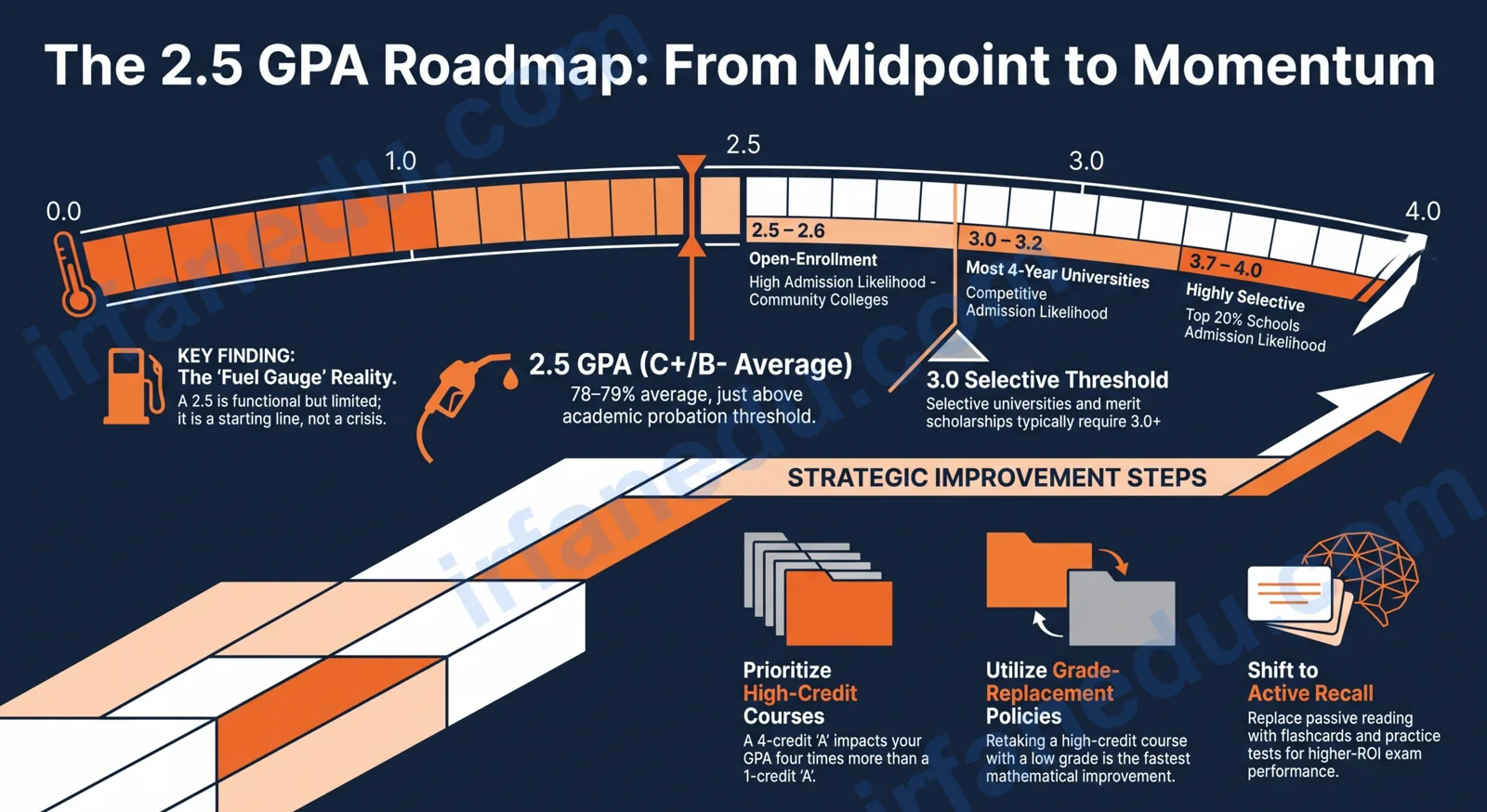
Imagine your car’s fuel gauge. A full tank is 4.0. Empty is 0.0. A 2.5 GPA puts the needle just past the halfway mark — you have enough fuel to keep moving, but you will not make it far on a long road trip without a refill. That single image captures everything you need to know about a 2.5 GPA: it is functional, it is not a crisis, and it is absolutely fixable.
A 2.5 GPA on the standard 4.0 scale equals roughly a C+ to B- average. It sits above the minimum passing threshold at most institutions but below the 3.0 benchmark that selective colleges and many employers use as a filter. Students with a 2.5 GPA have real options — and a clear, achievable path to improvement.
In this guide, I break down exactly what a 2.5 GPA means numerically, how it compares across college tiers, and the five highest-leverage steps to raise it — backed by 15 years of working with students at every GPA level. You will leave with a concrete action plan, not just a definition.
- 🎯 Understand what a 2.5 GPA means on the 4.0 scale
- 📊 See how it compares to college admission benchmarks
- 🔢 Learn the exact math behind raising your GPA
- 🛠️ Get a step-by-step improvement plan
A 2.5 GPA on the 4.0 scale equals roughly a C+ to B- average. It is above the minimum passing threshold but below the 3.0 benchmark most colleges and employers prefer. Students with a 2.5 GPA can gain admission to many two-year colleges and less-selective four-year universities, and the GPA is absolutely raisable with a focused, credit-aware strategy.
- 📌 2.5 GPA = roughly C+ to B- on the 4.0 scale.
- 📌 Above passing, but below the 3.0 threshold most selective schools require.
- 📌 Community colleges and open-enrollment universities will accept you.
- 📌 Raising it requires targeting high-credit courses, not just studying harder.
- 📌 Need-based financial aid is unaffected; most merit scholarships require 3.0+.
- 📌 An upward grade trend matters as much as the raw number to admissions officers.
The fuel-gauge analogy: why 2.5 is not where you want to stay
Think of the 4.0 GPA scale as a fuel gauge in a car. A 4.0 is a full tank — you can go anywhere. A 2.5 is just past the halfway mark. You can still drive, but you will not make it to every destination, and some roads (selective universities, competitive graduate programs, certain employers) require a fuller tank before they let you on.
The analogy matters because it reframes the question. A 2.5 GPA is not a broken engine — it is a tank that needs refilling. And unlike a real fuel gauge, you can refill a GPA incrementally, one course at a time, by understanding the math behind it.
The fuel-gauge framing helps because it removes shame. You are not broken — you are just not full yet. Every high grade you earn from this point forward adds fuel. The earlier you start, the more total distance you can cover.
What does a 2.5 GPA actually mean?
A GPA (Grade Point Average) is the numerical average of all your course grades, weighted by credit hours, on a scale from 0.0 to 4.0. A 2.5 GPA means that, on average, your grades have earned 2.5 grade points per credit hour.
On most grading systems, grade points map to letter grades like this:
  GPA SCALE — WHERE DOES 2.5 LAND?
  ─────────────────────────────────────────────────────
  4.0  ████████████████████  A   (Excellent)
  3.7  ██████████████████░░  A-
  3.3  █████████████████░░░  B+
  3.0  ████████████████░░░░  B   (Good — common benchmark)
  2.7  ██████████████░░░░░░  B-
  2.5  █████████████░░░░░░░  C+  ◄── YOU ARE HERE
  2.3  ████████████░░░░░░░░  C+/C
  2.0  ███████████░░░░░░░░░  C   (Minimum for many programs)
  1.0  █████░░░░░░░░░░░░░░░  D
  0.0  ░░░░░░░░░░░░░░░░░░░░  F
  ─────────────────────────────────────────────────────
A 2.5 GPA corresponds to roughly a C+ (78–79%) on most percentage-based grading systems. Some institutions place it at the lower boundary of B-, depending on whether they use plus/minus grading.
How is a GPA calculated?
GPA is calculated by multiplying each course’s grade points by its credit hours, summing those products, then dividing by total credit hours. Here is a worked example:
Student A’s semester:
English (3 credits) → B = 3.0 × 3 = 9.0
Math (4 credits) → C = 2.0 × 4 = 8.0
History (3 credits) → B+ = 3.3 × 3 = 9.9
Art (2 credits) → C+ = 2.3 × 2 = 4.6
Total: (9.0 + 8.0 + 9.9 + 4.6) ÷ (3+4+3+2) = 31.5 ÷ 12 = 2.625 ≈ 2.6 GPA
Notice that the 4-credit Math course drags the GPA down more than the 2-credit Art course. This is the most important mechanical fact about GPA that most students overlook — and I will return to it in the improvement section.
How a 2.5 GPA compares across the full scale
Context makes a number meaningful. Here is how a 2.5 GPA sits relative to every major benchmark a student encounters.
| GPA Range | Letter Grade | % Equivalent | Typical Label | College Tier Access |
|---|---|---|---|---|
| 3.7 – 4.0 | A / A+ | 93–100% | Excellent | Highly selective (top 20%) |
| 3.3 – 3.6 | B+ / A- | 87–92% | Above average | Selective colleges |
| 3.0 – 3.2 | B | 83–86% | Good | Most 4-year universities |
| 2.7 – 2.9 | B- | 80–82% | Satisfactory | Many 4-year universities |
| 2.5 – 2.6 | C+ | 78–79% | Average ← YOU | Open-enrollment & community colleges |
| 2.0 – 2.4 | C | 73–77% | Below average | Community college / remedial |
| Below 2.0 | D / F | Below 73% | Failing / probation | Academic probation risk |
In my experience advising students, a 2.5 GPA is the most psychologically tricky spot on the scale. It is high enough that students do not feel urgent pressure to change, but low enough to close real doors. The students who improve fastest are the ones who treat 2.5 as a starting line, not a finish line — and who understand the credit math before they start.
What are your college admission chances with a 2.5 GPA?
Your admission chances depend heavily on the selectivity tier of the school you are targeting. A 2.5 GPA closes some doors and keeps others wide open.
Schools where a 2.5 GPA is competitive
- Community colleges: Most have open enrollment — GPA is not a barrier at all.
- Open-enrollment four-year universities: Many regional and state universities accept students with a 2.5 GPA, especially if test scores are solid.
- Online universities: Many accredited online programs have a 2.0 or 2.5 minimum GPA requirement.
Schools where a 2.5 GPA is a significant disadvantage
- Selective four-year universities (acceptance rate 30–60%): Average admitted GPA is typically 3.2–3.6. A 2.5 requires exceptional compensating factors.
- Highly selective schools (acceptance rate below 30%): Average admitted GPA is 3.7+. A 2.5 is effectively disqualifying without extraordinary circumstances.
- Graduate programs: Most require a 3.0 undergraduate GPA minimum; some require 3.3+.
Many students with a 2.5 GPA assume they cannot go to a four-year college at all. That is false. Hundreds of accredited four-year universities accept students at this GPA level. The strategy is to target the right tier, demonstrate an upward trend, and write a strong personal statement that explains your trajectory.
The upward trend factor
Admissions officers at mid-range schools pay close attention to grade trends. A student who earned a 1.9 GPA freshman year and a 3.1 GPA senior year — cumulative 2.5 — is a very different applicant from one who earned a flat 2.5 throughout. If your recent grades are stronger, highlight that trend explicitly in your application.
How to raise your GPA from 2.5 to 3.0 (step-by-step)
Raising a GPA from 2.5 to 3.0 is achievable for most students — but it requires a credit-aware strategy, not just “studying harder.” Here is the exact process I walk students through.
Step 1: Calculate your GPA gap with real numbers
Before doing anything else, find out exactly how many grade points you need. The formula is:
Grade points needed = (Target GPA × Total future credits) − (Current GPA × Credits completed)
Example: You have completed 60 credits at a 2.5 GPA (150 grade points). You want a 3.0 at 120 total credits.
Grade points needed from remaining 60 credits = (3.0 × 120) − 150 = 360 − 150 = 210 grade points.
210 ÷ 60 credits = 3.5 GPA needed going forward — meaning mostly A- and B+ grades from here on.
This calculation often surprises students. The earlier you start improving, the less extreme your future grades need to be.
- Calculate your exact GPA gap using the formula above so you know the target, not just the direction.
- Prioritise high-credit courses. A 4-credit course A moves your GPA four times more than a 1-credit A. List your upcoming courses by credit weight and focus your effort there first.
- Use grade-replacement policies. Many schools let you retake a course and replace the original grade in your GPA calculation. Identify your lowest-grade, highest-credit courses and retake them where eligible.
- Switch to active recall study methods. Re-reading notes is the lowest-ROI study habit. Replace it with flashcards, practice tests, and the Feynman technique (explain the concept aloud as if teaching it). Research consistently shows active recall outperforms passive review for exam performance.
- Attend office hours every single week. In 15 years of education, this is the single most underused lever. Instructors who know you grade borderline work more generously, give you targeted feedback, and sometimes curve final grades for engaged students.
The students I have seen make the fastest GPA jumps are not the ones who studied the most hours — they are the ones who studied the right things in the right courses. One student I worked with raised her GPA from 2.4 to 3.1 in a single semester by retaking two high-credit courses she had previously failed, while using active recall for her new courses. The math did the heavy lifting; the strategy made it possible.
How long does it take to raise a 2.5 GPA?
The timeline depends on how many credits you have completed. With 30 credits completed, earning straight A’s for one semester can move you to roughly 3.0. With 90 credits completed, the same semester of A’s moves you only about 0.15 points. The more credits you have banked, the longer the runway — which is why starting early matters enormously.
Every GPA guide tells you to “get better grades.” Almost none of them explain the credit-weight asymmetry — and it is the most important mechanical fact about GPA improvement.
Here is the non-obvious truth: your GPA is not a simple average of your grades. It is a weighted average of your grade points per credit hour. This means a student who earns an A in a 4-credit course gains exactly the same grade-point boost as earning A’s in four separate 1-credit courses — but with far less total work.
The practical implication most students miss:
- Dropping a 1-credit elective to retake a 4-credit core course is almost always the better GPA move.
- If your school offers grade replacement, retaking a 4-credit course where you earned a D is worth more than acing four new 1-credit courses.
- When choosing between two courses of equal difficulty, always take the higher-credit version if GPA improvement is your goal.
I have never seen this explained clearly in a generic GPA guide. It is the single biggest lever most students leave unused.
Test your GPA knowledge
Q1. What letter grade does a 2.5 GPA most closely equal?
Q2. Which course move raises your GPA the most?
Q3. A 2.5 GPA means you are on academic probation.
Frequently asked questions about a 2.5 GPA
Is a 2.5 GPA good?
What letter grade is a 2.5 GPA?
Can I get into college with a 2.5 GPA?
How do I raise my GPA from 2.5 to 3.0?
Does a 2.5 GPA affect scholarship eligibility?
- A 2.5 GPA equals roughly C+ on the 4.0 scale — above passing, below the 3.0 benchmark.
- Community colleges and open-enrollment universities are accessible; selective schools are a stretch.
- GPA is a weighted average — high-credit courses have the biggest impact on your number.
- Calculate your exact grade-point gap before choosing which courses to prioritise.
- Grade-replacement policies and active recall study methods are the two highest-leverage tools.
- An upward grade trend matters to admissions officers — demonstrate momentum, not just a number.
- Need-based financial aid is unaffected by GPA; most merit scholarships require 3.0+.
- Khan Academy — GPA and Class Rank in College Admissions
- Wikipedia — Grading in the United States (GPA scale reference)
- IrfanEdu — Complete Geometry Formula Sheet
- IrfanEdu — Distance & Midpoint Formulas Guide
✍ This article was written and fact-checked by Dr. Irfan Mansuri. All GPA calculations and grade equivalencies reflect standard 4.0-scale conventions. Last reviewed August 2026.