
NC Permit Practice Test: Pass First Try (2026 Guide)
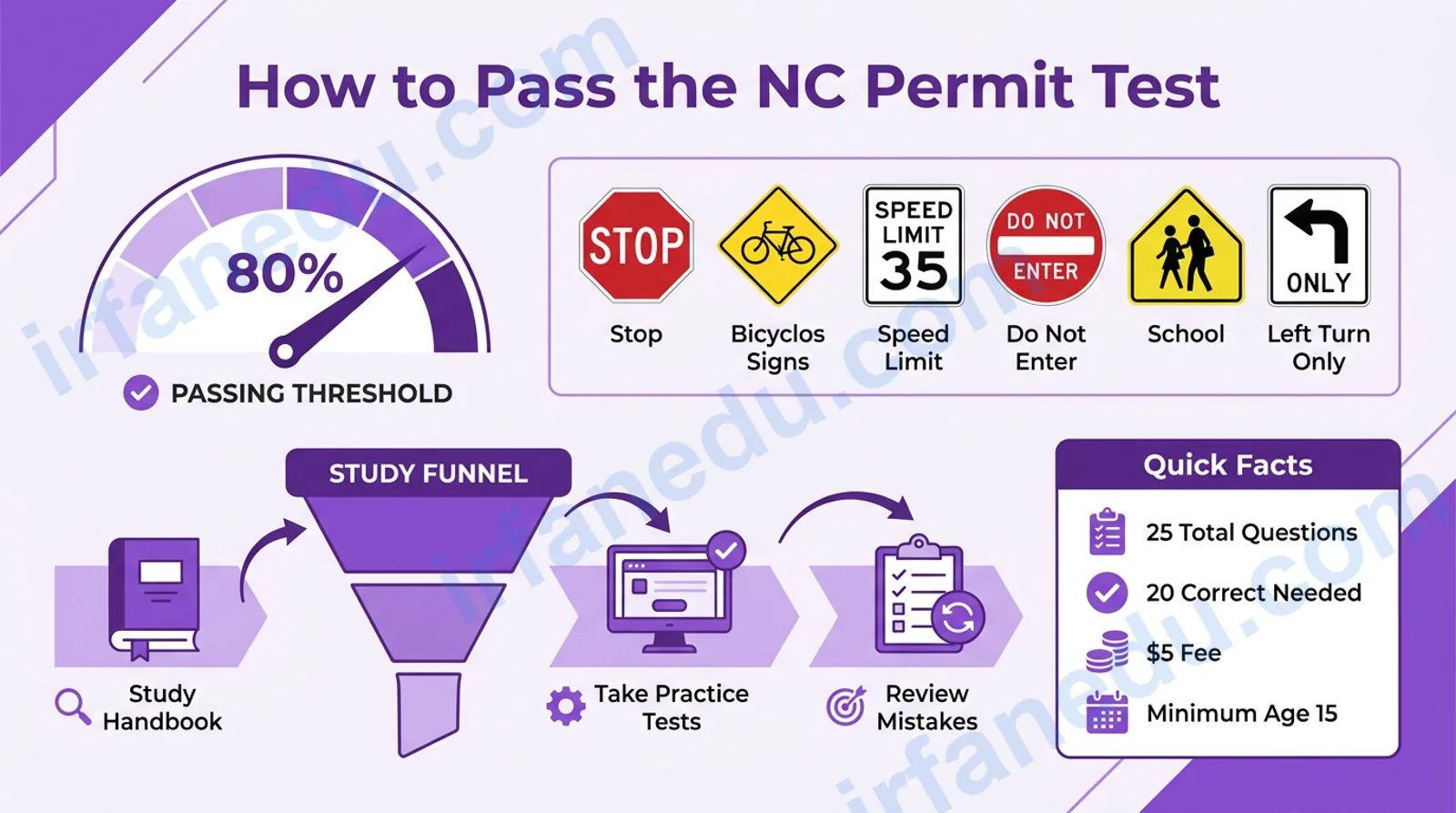
The NC permit practice test mirrors the real North Carolina DMV knowledge test: 25 questions drawn from road signs, traffic laws, and safe driving rules. You need 20 correct answers (80%) to pass. Study the NC Driver’s Handbook, take multiple timed practice tests, and focus on road sign recognition — the area where most first-time test-takers lose points.
⚡ In Short
- The real NC DMV test is 25 questions; you need 20 correct (80%) to pass.
- Topics: road signs, traffic laws, speed limits, right-of-way, and safe driving habits.
- Minimum age to test: 15 years old.
- The test is taken in person at an NCDMV office — not online.
- Scoring 90%+ on practice tests before your appointment is the best predictor of passing.
- Road signs are the highest-yield study area; most failures trace back to sign questions.
Quick Facts: NC Permit Test at a Glance
| Detail | Information |
|---|---|
| Number of Questions | 25 |
| Passing Score | 20 correct (80%) |
| Minimum Age | 15 years old |
| Test Format | Multiple choice, in person at NCDMV |
| Test Fee | $5 (knowledge test portion) |
| Time Limit | No strict time limit; most finish in 20-30 minutes |
| Retake Policy | Allowed; fee applies per attempt |
| Study Source | NC Driver’s Handbook (NCDMV official) |
| Permit Validity | 18 months from issue date |
What Is the NC Permit Test?
The NC permit test — formally called the North Carolina DMV knowledge test — is a 25-question multiple-choice exam that every new driver must pass before receiving a learner’s permit. It tests your understanding of road signs, traffic laws, and safe driving behavior as defined in the official NC Driver’s Handbook.
The test is administered in person at any North Carolina Division of Motor Vehicles (NCDMV) office. You sit at a computer terminal and answer questions one at a time. There is no strict clock, but most applicants finish in under 30 minutes.
Passing the knowledge test is the first formal step toward a full NC driver’s license. After you pass, you receive a learner’s permit that lets you practice driving with a licensed adult supervisor. You must hold the permit for at least 12 months before applying for a full license.
What to Expect on Test Day
On test day, you check in at the DMV counter, present your documents, pay the fee, and are directed to a computer terminal. The interface shows one question at a time with three or four answer choices. You click your answer and move to the next question.
The system scores your test immediately. If you pass (20 or more correct), you proceed to the vision screening and photo. If you fail, you receive a score sheet showing which topic areas you missed — that sheet is genuinely useful for targeted review before your next attempt.
What Topics Does the NC Permit Test Cover?
The NC DMV knowledge test draws questions from three broad topic areas. Understanding the weight of each area helps you allocate study time wisely.
| Topic Area | Approx. % of Test | Key Subtopics |
|---|---|---|
| Road Signs | ~40% | Warning signs, regulatory signs, guide signs, sign shapes and colors |
| Traffic Laws & Rules of the Road | ~40% | Right-of-way, speed limits, lane changes, passing, intersections, school zones |
| Safe Driving Practices | ~20% | Following distance, DUI laws, seat belt rules, distracted driving, weather driving |
Road signs and traffic laws together make up roughly 80% of the test. That is where your study time should go first. Safe driving practices questions are important but fewer in number.
How to Study: A 6-Step Plan That Works
This is the exact study sequence I recommend to any student preparing for the NC permit test. It is designed to take 5-7 days of 30-minute sessions, which is realistic for most high school students.
-
Read the NC Driver’s Handbook Once Through
Download the official handbook from the NCDMV website (ncdot.gov). Read it cover to cover without highlighting or notes. The goal is familiarity, not memorization. This takes about 90 minutes. -
Take a Diagnostic Practice Test
Take a full 25-question practice test cold — no notes, no looking things up. Your score does not matter. What matters is the list of topics you got wrong. Write them down. -
Drill Road Signs with Flashcards
Road signs are the highest-yield area. Create or use a pre-made set of flashcards for every sign in the handbook. Test yourself until you can identify each sign by shape and color alone, without reading the label. -
Re-Read Weak Sections in the Handbook
For every topic you missed on the diagnostic test, return to that section in the handbook. Read it slowly. Note the specific numbers: speed limits in school zones (25 mph), following distance rules, blood alcohol limits. -
Take Timed Practice Tests Daily
From Day 3 onward, take at least one full 25-question practice test per day under timed, no-notes conditions. Track your score each day. When you consistently score 23 or 24 out of 25 (92-96%), you are ready. -
Book Your DMV Appointment and Arrive Prepared
Schedule your in-person test at an NCDMV office. Gather all required documents the night before. Arrive 15 minutes early. Eat beforehand — low blood sugar is a real performance factor on short tests.
Practice Tests vs. the Real Exam: Key Differences
Practice tests are excellent preparation tools, but they are not identical to the official exam. Knowing the differences prevents surprises on test day.
| Feature | Practice Tests (Online) | Real NC DMV Test |
|---|---|---|
| Question source | Third-party, handbook-based | Official NCDMV question bank |
| Number of questions | Varies (10-50) | Always 25 |
| Immediate feedback | Yes — shows correct answer | No — score shown at end only |
| Retakes | Unlimited, free | Fee required each time |
| Location | Any device, anywhere | In person at NCDMV only |
| Question wording | May differ from official phrasing | Official NCDMV phrasing |
| Best use | Daily study and self-assessment | The real licensing step |
The most important difference: practice sites show you the correct answer immediately after each question. The real test does not. This means you need to be genuinely confident in your answers, not just good at learning from instant feedback.
Common Mistakes That Cause Failures
Most NC permit test failures are preventable. These are the patterns I see most often when students come back after a failed attempt.
Practice tests sample from the handbook but do not cover every topic. Students who skip the handbook miss questions on topics that practice sites happen not to include in their question pools.
Many students know what a stop sign looks like but cannot identify a pennant-shaped “No Passing Zone” sign or a pentagon-shaped school zone sign. Shape and color are tested directly.
The real test rephrases questions. A student who memorized “the answer to question 7 is B” will fail when the same concept appears with different wording. Understand the rule, not the answer letter.
The test frequently asks about exact figures: speed limits in school zones, the legal blood alcohol content limit (0.08% for adults, 0.00% for drivers under 21 in NC), and minimum following distances. These numbers are in the handbook. Learn them.
Sample Questions (With Answers)
These questions are representative of the style and difficulty of the real NC permit test. They are drawn from topics covered in the NC Driver’s Handbook.
Sample NC Permit Test Questions
Q1. A red octagonal sign means:
    A) Slow down
    B) Stop completely
    C) Yield to oncoming traffic
    D) No entry
    ANSWER: B — A red octagon is always a STOP sign.

Q2. In North Carolina, the speed limit in a school zone
    (when children are present) is:
    A) 15 mph
    B) 20 mph
    C) 25 mph
    D) 35 mph
    ANSWER: C — 25 mph unless otherwise posted.

Q3. When two vehicles reach an uncontrolled intersection
    at the same time, who has the right of way?
    A) The vehicle on the left
    B) The vehicle on the right
    C) The larger vehicle
    D) The vehicle traveling faster
    ANSWER: B — Yield to the vehicle on your right.

Q4. A solid yellow line on YOUR side of the center line means:
    A) Passing is permitted with caution
    B) Passing is not permitted
    C) The road is one-way
    D) Slow down ahead
    ANSWER: B — A solid yellow line on your side = no passing.

Q5. The legal blood alcohol content (BAC) limit for drivers
    under 21 in North Carolina is:
    A) 0.08%
    B) 0.04%
    C) 0.02%
    D) 0.00%
    ANSWER: D — NC has a zero-tolerance policy for drivers under 21.
Notice that questions 1, 3, and 4 test rules you can derive from logic if you understand the underlying principle. Questions 2 and 5 test specific numbers you must memorize. Both types appear on the real exam.
⭐ My Key Takeaway: The “Sign Shape First” Strategy Most Guides Miss
Every NC permit test guide tells you to study road signs. What they do not tell you is how to study them efficiently. The NCDMV test frequently shows a sign without its text label and asks what it means. The fastest path to full marks on sign questions is to learn the shape-and-color system before you learn individual sign names. Octagons always stop. Triangles (inverted) always yield. Pentagons are always school-related. Diamonds are always warnings. Rectangles are regulatory or informational. Once that framework is locked in, you can reason through an unfamiliar sign you have never seen before — instead of being stuck because you did not memorize that exact sign. This “shape-first” approach is something I have found dramatically improves scores on the sign section, and it is not taught explicitly in the handbook itself.
Documents You Need to Bring to the DMV
Arriving without the correct documents means you cannot test that day. North Carolina uses a point-based document verification system. You need to accumulate enough points across the categories below.
- Proof of identity (e.g., original birth certificate, valid US passport, or permanent resident card)
- Proof of Social Security number (Social Security card, W-2, or pay stub showing full SSN)
- Two proofs of NC residency (utility bill, bank statement, or school enrollment record showing your NC address)
- For applicants under 18: a parent or legal guardian must sign the application in person at the DMV
- Payment: the $5 knowledge test fee (check current NCDMV fee schedule, as fees can change)
Verify the current document requirements directly on the NCDMV website before your visit. Requirements can be updated, and the official source is always authoritative.
Frequently Asked Questions
How many questions are on the NC permit test?
What is the minimum age to take the NC permit test?
How many times can you retake the NC permit test if you fail?
What documents do I need for the NC permit test?
Is the NC permit test available online?
Key Takeaways
- The NC permit test is 25 questions; you need 20 correct (80%) to pass.
- Road signs and traffic laws make up roughly 80% of the test — prioritize these areas.
- Every question comes from the official NC Driver’s Handbook; read it before anything else.
- Learn road signs by shape and color first, then by name — this lets you reason through unfamiliar signs.
- Aim for 90%+ on practice tests before your real appointment to build a passing buffer.
- Memorize specific numbers: 25 mph school zone speed, 0.08% adult BAC limit, 0.00% under-21 BAC limit.
- Bring all required documents to the DMV; missing paperwork means no test that day.
- If you fail, use the score sheet to guide targeted review before your next attempt.
Sources & References
-
North Carolina Division of Motor Vehicles (NCDMV) — Official Driver’s Handbook:
ncdot.gov — New Driver Information. The primary source for all NC permit test content and requirements. -
NCDMV — Learner’s Permit Requirements:
NCDMV New Drivers Page. Official documentation requirements, fees, and eligibility rules. -
Federal Highway Administration — Road Sign Standards (MUTCD):
mutcd.fhwa.dot.gov. The Manual on Uniform Traffic Control Devices defines the shape, color, and meaning standards for all US road signs tested on state permit exams.
Editorial note: This guide was written and fact-checked by Dr. Irfan Mansuri in August 2026. All test details (question count, passing score, fees, age requirements) are accurate as of the publication date. Verify current requirements at the official NCDMV website before your appointment, as policies can change.