
AP Macro Unit 1: Basic Economic Concepts — Complete Study Guide & Free Worksheet
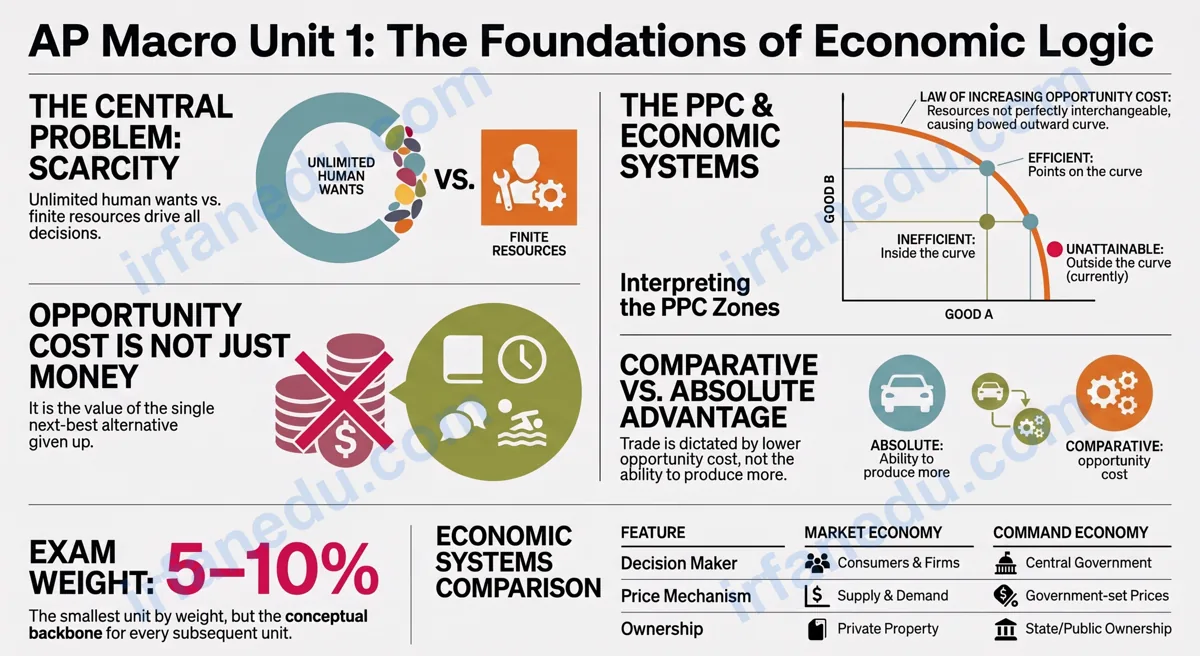
AP Macro Unit 1 — officially titled Basic Economic Concepts — introduces the foundational trade-off logic of economics: scarcity forces every society to choose, and every choice has an opportunity cost. The Production Possibilities Curve visualizes those trade-offs, while comparative advantage explains why specialization and trade benefit everyone. Mastering Unit 1 is non-negotiable because its vocabulary and models reappear in every later AP Macro unit.
- 🎯 Understand what scarcity is and why it drives all economic decisions
- 📐 Read, draw, and interpret a Production Possibilities Curve (PPC)
- 💰 Calculate opportunity cost from a table or graph
- 🌍 Compare market, command, and mixed economic systems
- 🤝 Identify comparative advantage and explain the gains from trade
- 📝 Practice with a free printable worksheet and answer key
AP Macro Unit 1 covers Basic Economic Concepts: scarcity, opportunity cost, the Production Possibilities Curve (PPC), economic systems (market, command, mixed), and comparative advantage. It is the foundation of the AP Macroeconomics course, typically worth about 5–10% of the AP exam, and introduces the core trade-off logic that every later unit builds on.
Download Free PDF Worksheet
⚡ TL;DR – Quick Summary
- 📌 Unit 1 = Basic Economic Concepts; worth ~5–10% of the AP Macro exam.
- 📌 Scarcity means unlimited wants vs. limited resources — the root of all economics.
- 📌 Opportunity cost = the value of the best alternative you give up.
- 📌 The PPC shows efficient, inefficient, and unattainable output combinations.
- 📌 Comparative advantage (lower opportunity cost) — not absolute advantage — drives trade.
- 📌 Positive statements are factual; normative statements involve value judgments.
| 📊 Quick Facts | Detail |
|---|---|
| Unit Name | Basic Economic Concepts |
| AP Exam Weight | ~5–10% of total score |
| Key Models | Production Possibilities Curve (PPC / PPF) |
| Core Vocabulary | Scarcity, opportunity cost, comparative advantage, economic systems |
| Typical AP FRQ appearance | PPC shifts, opportunity cost calculations, trade gains |
| Prerequisite | None — this is the starting unit |
| Connects to | Every subsequent AP Macro unit (esp. Unit 2: Measurement) |
🙋 The Most-Asked AP Macro Unit 1 Questions — Answered First
Before diving into the full lesson, I want to answer the questions students search for most. These are the exact questions I see on student forums and in my own teaching practice every year.
What is covered in AP Macro Unit 1?
AP Macro Unit 1 covers Basic Economic Concepts: scarcity, the three fundamental economic questions (what/how/for whom to produce), opportunity cost, the Production Possibilities Curve (PPC), economic systems (market, command, mixed), comparative vs. absolute advantage, and the positive/normative economics distinction. These concepts form the vocabulary and logic framework for the entire course.
How much of the AP Macro exam is Unit 1?
Unit 1 accounts for roughly 5–10% of the AP Macroeconomics exam — the smallest unit by weight. The College Board allocates more exam weight to Units 3 (National Income and Price Determination) and 4 (Financial Sector). That said, Unit 1 vocabulary and models (especially the PPC and opportunity cost) appear embedded in questions from every other unit.
What is the difference between absolute and comparative advantage?
Absolute advantage means producing more output with the same inputs (or the same output with fewer inputs). Comparative advantage means producing a good at a lower opportunity cost than another producer. The AP exam almost always tests comparative advantage — trade is based on comparative, not absolute, advantage. A country can have an absolute advantage in everything and still benefit from specializing in its comparative advantage.
Why is the PPC bowed outward (concave)?
The PPC is bowed outward because of the Law of Increasing Opportunity Cost: as you shift more and more resources toward producing one good, you must use resources that are progressively less suited to making that good. The opportunity cost of each additional unit rises. If resources were perfectly interchangeable, the PPC would be a straight line — but they rarely are.
📚 What Is AP Macro Unit 1?
AP Macro Unit 1 is the entry point to the AP Macroeconomics course. It establishes the economic way of thinking — the idea that every decision involves a trade-off — before the course moves into national income accounting, monetary policy, and international trade.
The College Board’s official course description groups Unit 1 under “Basic Economic Concepts” and expects students to understand scarcity, resource allocation, the PPC model, economic systems, and the logic of specialization and trade. In my experience teaching AP Economics, students who rush through Unit 1 to get to the “real macro” content consistently struggle with free-response questions in later units, because those questions embed Unit 1 vocabulary without warning.
🌐 Scarcity, Choice & the Three Economic Questions
Scarcity is the central problem of economics: human wants are unlimited, but the resources available to satisfy them — land, labor, capital, and entrepreneurship — are finite. Because of scarcity, every individual, firm, and government must make choices.
Those choices reduce to three fundamental questions every economic system must answer:
-
What to produce?
Which goods and services should be made, and in what quantities? A society that produces more military goods produces fewer consumer goods — the PPC makes this trade-off visible. -
How to produce it?
Which combination of resources and technology should be used? A factory can be labor-intensive or capital-intensive; the choice depends on relative costs. -
For whom to produce?
Who gets the output? Different economic systems answer this differently — markets use price signals, command economies use government directives, and mixed economies blend both.
💰 What Is Opportunity Cost in AP Macro?
Opportunity cost is the value of the next-best alternative forgone when a choice is made. It is not the total cost of all alternatives — only the single best one you gave up.
On the AP exam, opportunity cost appears in two main forms:
- Verbal/scenario form: “A student spends Saturday studying instead of working a 4-hour shift at $12/hour. What is the opportunity cost?” Answer: $48 (the forgone wages).
- PPC/table form: Calculate the trade-off ratio from a production table or the slope of the PPC.
In my experience, the single most common Unit 1 mistake I see on practice exams is students confusing opportunity cost with monetary cost. A student who quits a $60,000/year job to attend graduate school does not just pay tuition — the opportunity cost includes the forgone salary. The AP exam tests this distinction directly, and students who only think in dollar terms lose easy points.
📐 The Production Possibilities Curve (PPC) Explained
The PPC (also called the Production Possibilities Frontier, or PPF) is a graph showing all maximum output combinations of two goods an economy can produce given its current resources and technology. It is the most-tested model in AP Macro Unit 1.
📊 Visual: Standard PPC Diagram (ASCII)
  Butter (units)
  |
80 |*
   | \
60 |   \
   |    \
40 |      \
   |        \
20 |          \
   |            *
 0 +---+---+---+---+--- Guns (units)
   0  20  40  60  80

  * = endpoints (max production of one good only)
  \ = the PPC curve (bowed outward in reality)

  ZONE KEY:
  ● ON the curve   → Productively EFFICIENT
  ● INSIDE curve   → Inefficient (unemployed resources)
  ● OUTSIDE curve  → Currently UNATTAINABLE
Key PPC concepts the AP exam tests:
| Point Location | What It Means | AP Exam Implication |
|---|---|---|
| On the curve | Productively efficient — no waste | Economy is using all resources fully |
| Inside the curve | Inefficient — resources unemployed or misallocated | Recession, unemployment, or poor resource use |
| Outside the curve | Currently unattainable | Possible after economic growth (PPC shifts out) |
| PPC shifts outward | Economic growth — more of both goods possible | Caused by: better tech, more resources, improved education |
| PPC shifts inward | Economic decline — productive capacity falls | Caused by: natural disaster, war, disease reducing workforce |
| One-sided outward shift | Tech/resource improvement in only one good | PPC pivots on one axis — asymmetric shift |
🔢 How to Solve PPC Opportunity Cost Problems Step-by-Step
PPC opportunity cost questions follow a predictable pattern on the AP exam. Here is the exact method I teach my students.
-
Identify the two goods and their maximum quantities.
Read the graph or table. Example: Country A can produce max 100 units of food OR max 50 units of clothing. -
Calculate the trade-off ratio.
Opportunity cost of 1 unit of clothing = 100 food ÷ 50 clothing = 2 units of food. Opportunity cost of 1 unit of food = 50 clothing ÷ 100 food = 0.5 units of clothing. -
State the answer in the correct form.
“The opportunity cost of producing 1 unit of clothing is 2 units of food.” Always name both goods. -
For comparative advantage: compare opportunity costs across producers.
The producer with the lower opportunity cost for a good has the comparative advantage in that good.
Country A: max 120 cars OR max 60 tons of wheat.
Country B: max 80 cars OR max 80 tons of wheat.
Opportunity cost of 1 car:
Country A: 60/120 = 0.5 tons of wheat
Country B: 80/80 = 1 ton of wheat
Opportunity cost of 1 ton of wheat:
Country A: 120/60 = 2 cars
Country B: 80/80 = 1 car
Comparative advantage: Country A has lower opportunity cost for cars (0.5 < 1) → A specializes in cars. Country B has lower opportunity cost for wheat (1 < 2) → B specializes in wheat.
Trade benefit: Both countries consume beyond their individual PPCs by specializing and trading.
🏛️ How Do Economic Systems Differ?
Every economy answers the three fundamental questions differently. The AP exam expects you to compare market, command, and mixed systems — and to recognize that no real-world economy is purely one type.
| Feature | Market Economy | Command Economy | Mixed Economy |
|---|---|---|---|
| Who decides what to produce? | Consumers & firms (price signals) | Central government | Both markets and government |
| Price mechanism | Supply & demand | Government-set prices | Mostly market, some regulation |
| Property ownership | Private | State/public | Both private and public |
| Incentive structure | Profit motive | Government directives | Mixed incentives |
| Real-world example | Hong Kong (historically) | North Korea, Soviet-era USSR | Most modern economies (US, Germany, Japan) |
| Main strength | Efficiency, innovation | Centralized coordination | Balance of efficiency and equity |
| Main weakness | Inequality, market failures | Inefficiency, lack of innovation | Complexity, potential for policy conflict |
I always tell my students: the AP exam never asks you to judge which system is “best” — that is a normative question. It asks you to describe how each system works and compare their trade-offs. Keep your answers descriptive and analytical, not political. Students who editorialize in free-response answers lose points even when their economics is correct.
🤝 Comparative Advantage & the Gains from Trade
Comparative advantage is the ability to produce a good at a lower opportunity cost than another producer. It is the economic rationale for specialization and trade — and one of the most powerful ideas in all of economics.
The key insight: even if one country (or person) has an absolute advantage in producing everything, both parties still gain by specializing in their comparative advantage and trading. This is counterintuitive, and the AP exam exploits that.
Suppose a doctor can type faster than her assistant AND perform surgery better. She has an absolute advantage in both. But her opportunity cost of typing is extremely high — every hour she types is an hour she could be performing surgery. Her assistant’s opportunity cost of typing is low. So the doctor specializes in surgery (her comparative advantage) and the assistant handles typing. Both are better off. This is comparative advantage in action.
⚠️ Common AP Macro Unit 1 Mistakes (Wrong vs. Right)
These are the exact errors I see most often on Unit 1 free-response and multiple-choice questions. Knowing them in advance is worth several exam points.
| ❌ Wrong Thinking | ✅ Correct Thinking |
|---|---|
| “Trade is based on absolute advantage.” | Trade is based on comparative advantage (lower opportunity cost), not absolute advantage. |
| “A point outside the PPC is inefficient.” | A point outside the PPC is unattainable with current resources. Inefficient = inside the PPC. |
| “Opportunity cost = total money spent.” | Opportunity cost = value of the single best alternative forgone, not all alternatives. |
| “A straight-line PPC means increasing opportunity cost.” | A straight-line PPC means constant opportunity cost. Bowed-out = increasing opportunity cost. |
| “Economic growth always shifts the entire PPC outward equally.” | If only one sector improves (e.g., better tech for computers only), the PPC pivots outward on that axis only. |
| “‘The minimum wage should be raised’ is a positive statement.” | That is a normative statement (value judgment). Positive: “Raising the minimum wage reduces teen employment by X%.” |
💡 Unique Insight — What Most AP Macro Guides Get Wrong About the PPC
Most study guides teach the PPC as a static snapshot — draw it, label the zones, move on. What they miss is that the PPC is also a dynamic policy tool. On the AP exam’s free-response section, you are often asked to show the effect of a specific policy (e.g., a new education investment, a war, a pandemic) on the PPC. The key skill is not just knowing that the PPC shifts — it is knowing which axis it pivots on and why. A technology improvement in solar panels shifts the PPC outward along the energy axis only. A general increase in the labor force shifts the entire curve outward. Students who learn the PPC as a static diagram fail these questions; students who understand it as a model of productive capacity answer them fluently. In my experience, this single distinction separates 4s from 5s on the AP exam.
📝 AP Macro Unit 1 Practice Worksheet
Use this on-page worksheet to test your understanding before downloading the full PDF. Complete all problems first, then reveal the answer key. Print the PDF for offline practice or classroom use.
How to use this worksheet: Work through each problem independently. Do not peek at the answers until you have attempted every question. Then use the answer key to identify gaps — any question you got wrong points to a concept worth reviewing in the sections above.
- Define scarcity in one sentence and give one real-world example.
- A country can produce 100 units of food OR 50 units of clothing (or any linear combination). What is the opportunity cost of producing 1 unit of clothing?
- On a standard PPC with guns on the x-axis and butter on the y-axis, what does a point INSIDE the curve represent?
- What does a point OUTSIDE the PPC represent?
- Country A can produce 10 cars OR 20 tons of wheat. Country B can produce 6 cars OR 18 tons of wheat. Which country has the comparative advantage in wheat?
- Name the three fundamental economic questions every society must answer.
- A technological improvement that only affects the production of computers shifts the PPC how?
- True or False: In a pure command economy, prices are set by supply and demand. Explain.
- If a student spends 3 hours gaming instead of studying, and studying would have earned them an extra 10 points on a test, what is the opportunity cost of gaming?
- Explain why the PPC is typically bowed outward (concave to the origin) rather than a straight line.
- A country discovers a large new oil reserve. How does this affect its PPC?
- What distinguishes a positive economic statement from a normative one? Give one example of each.
📋 Show Answer Key
- Scarcity means unlimited wants exceed limited resources; e.g., a student has only 2 hours to study but three subjects to cover.
- 2 units of food (100 ÷ 50 = 2).
- Productive inefficiency — resources are unemployed or misallocated.
- Currently unattainable given existing resources and technology.
- Country B. Opportunity cost of 1 ton of wheat: Country A = 10/20 = 0.5 cars; Country B = 6/18 = 0.33 cars. Country B’s cost is lower.
- What to produce? How to produce it? For whom to produce it?
- The PPC shifts outward (pivots) along the computers axis only — an asymmetric outward shift.
- False. In a command economy, the government sets prices; market forces do not operate freely.
- 10 test points (the highest-valued forgone alternative).
- Because of the Law of Increasing Opportunity Cost: resources are not perfectly substitutable, so shifting more resources to one good raises the opportunity cost of each additional unit.
- The entire PPC shifts outward, representing economic growth — the economy can produce more of both goods.
- Positive: factual/testable (“Unemployment is 4%”). Normative: value judgment (“Unemployment benefits should be increased”).
Download Free PDF Worksheet
🧠 Quick Quiz — Test Yourself
AP Macro Unit 1 — 3-Question Quiz
Q1. Country X can produce 200 units of steel OR 100 units of wheat. What is the opportunity cost of 1 unit of wheat?
Q2. A point inside the Production Possibilities Curve represents
Sources & References
Written and fact-checked by Dr Irfan Mansuri. External links open in a new tab and are provided for further reading and verification.