
Distance & Midpoint Formulas:
The Complete Student Guide
Two formulas. Infinite applications. Master exactly how to find the distance between any two points and the midpoint of any line segment — with visual proofs, worked examples, and ACT/SAT strategies.
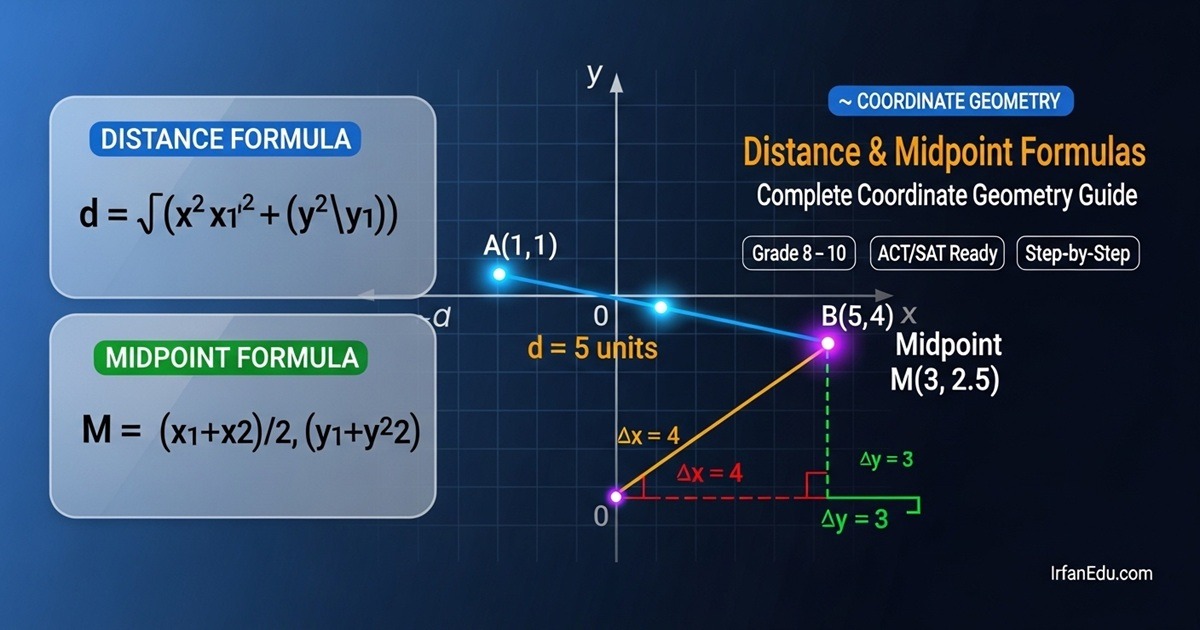
Here is something that surprises most students: two of the most powerful formulas in all of coordinate geometry are just the Pythagorean theorem and basic averaging in disguise. Once you see that connection, both the distance formula and the midpoint formula become impossible to forget.
The distance formula d = √((x₂−x₁)² + (y₂−y₁)²) finds the straight-line length between any two points on a coordinate plane. The midpoint formula M = ((x₁+x₂)/2, (y₁+y₂)/2) finds the exact center point of the line segment connecting those two points. Together, these two formulas are the foundation of coordinate geometry and appear on every major standardized math test. [[1]](#__1) [[3]](#__3)
According to Khan Academy’s analytic geometry curriculum, the midpoint formula is essentially an averaging operation — you add the two x-values and divide by 2, then do the same for the y-values. This simple insight makes the formula intuitive rather than something to memorize blindly. [[3]](#__3)
In this guide you will learn:
- Where both formulas come from and why they work
- Step-by-step worked examples from easy to challenging
- The most common mistakes students make — and exactly how to avoid them
- Real-world applications of both formulas
- Targeted ACT and SAT strategy for distance and midpoint questions
- 10 practice problems with full solutions
- Distance formula = Pythagorean theorem applied to coordinate points. Result is a number.
- Midpoint formula = average of x-coordinates, average of y-coordinates. Result is a point.
- Order of points does NOT affect the distance result — squaring removes negatives.
- The ACT provides NO formula sheet — both formulas must be memorized completely.
- Both formulas extend naturally to 3D space by adding a z-component.
1 What is Coordinate Geometry?
Coordinate geometry — also called analytic geometry or Cartesian geometry — is the branch of mathematics that uses a numbered grid (the coordinate plane) to describe and analyze geometric shapes using algebra. Every point in the plane is described by an ordered pair (x, y), where x is the horizontal position and y is the vertical position. [[1]](#__1)
The coordinate plane was formalized by the French mathematician René Descartes in the 17th century — which is why it is also called the Cartesian plane. His key insight was that every geometric problem could be translated into an algebraic equation, and vice versa. The distance formula and midpoint formula are two of the most direct expressions of that idea.
Distance and midpoint formulas are part of the Common Core State Standards for Mathematics — High School Geometry (CCSS.MATH.CONTENT.HSG.GPE.B.7), which requires students to use coordinates to compute perimeters and areas, and to find distances and midpoints. These concepts also align with CCSS.MATH.CONTENT.8.G.B.8 for Grade 8 applications of the Pythagorean theorem in coordinate settings.
2 The Distance Formula — Definition and Formula Card
The distance formula gives you the straight-line distance — also called the Euclidean distance — between any two points on a coordinate plane. It does not matter where the points are, how far apart they are, or which quadrant they sit in. The formula always works.
What Each Part of the Formula Means
The formula has three operations happening in a specific order:
- Subtract the x-coordinates: (x₂ − x₁) gives the horizontal gap between the two points.
- Subtract the y-coordinates: (y₂ − y₁) gives the vertical gap between the two points.
- Square both, add them, take the square root: This is exactly the Pythagorean theorem — the horizontal and vertical gaps are the two legs of a right triangle, and the distance is the hypotenuse.
You can calculate (x₁ − x₂) instead of (x₂ − x₁) and get the exact same answer. Because both differences get squared, any negative sign disappears. So (-4)² = 16 and (4)² = 16 — identical result. This means you never need to worry about which point you label as “Point 1” and which as “Point 2.”
3 Where Does the Distance Formula Come From? (Visual Proof)
The distance formula is not a random rule someone invented. It is a direct consequence of the Pythagorean theorem — one of the most proven theorems in all of mathematics, with over 370 known proofs. Understanding this derivation means you can reconstruct the distance formula from scratch even if you forget it under test pressure.
Start: Take two points A(x₁, y₁) and B(x₂, y₂) on a coordinate plane.
They meet at a right-angle corner: C(x₂, y₁)
By the Pythagorean theorem: AB² = AC² + BC²
AB = d = √( (x₂ − x₁)² + (y₂ − y₁)² ) ✓
That is the complete proof. The distance formula IS the Pythagorean theorem — just written in coordinate notation. Every time you use the distance formula, you are secretly drawing a right triangle and finding its hypotenuse.
4 Distance Formula — Worked Examples
The best way to master the distance formula is to watch it applied across a range of problems — from straightforward integer coordinates to negative values and irrational results. Study each solution step carefully before moving to practice problems.
Problem: Find the distance between points A(1, 2) and B(4, 6).
Note: 3-4-5 is a Pythagorean triple. Recognizing these triples lets you skip the square root calculation entirely on the ACT.
Problem: Find the distance between P(−3, 1) and Q(5, −5).
Key lesson: (−6)² = 36, NOT −36. Squaring always gives a positive result — this is why order of subtraction never affects the final distance.
Problem: Find the distance between A(2, 5) and B(7, 3). Leave answer in simplest radical form.
√29 cannot be simplified further because 29 is a prime number. Leave as √29 unless a decimal approximation is specifically requested.
5 The Midpoint Formula — Definition and Formula Card
The midpoint of a line segment is the point that lies exactly halfway between the two endpoints. It divides the segment into two equal halves. The midpoint formula finds the coordinates of this center point by averaging the x-values and averaging the y-values of the two endpoints separately.
Why the Midpoint Formula is Just an Average
Think of it this way: if you want to find the number exactly halfway between 2 and 8 on a number line, you add them and divide by 2: (2 + 8) / 2 = 5. The midpoint formula does exactly this — but in two dimensions simultaneously. It finds the average x-position and the average y-position. The result is always a coordinate pair (x, y), never just a number.
“Add and halve — do it twice.” Add the two x-values and halve the result. Add the two y-values and halve the result. That is the entire midpoint formula in one sentence. Unlike the distance formula, there is no squaring, no square root, and no subtraction — just addition and division by 2.
Finding an Endpoint When the Midpoint is Known
A common exam variation gives you one endpoint and the midpoint, then asks you to find the other endpoint. You reverse the formula using algebra:
x₂ = 2mₓ − x₁ y₂ = 2m_y − y₁
Start from mₓ = (x₁ + x₂) / 2. Multiply both sides by 2: 2mₓ = x₁ + x₂. Subtract x₁ from both sides: x₂ = 2mₓ − x₁. You do not need to memorize this as a separate formula — just rearrange the midpoint formula algebraically whenever you need it.
6 Midpoint Formula — Worked Examples
Problem: Find the midpoint of the segment connecting A(2, 4) and B(8, 10).
Verify: The distance from A(2,4) to M(5,7) = √(9+9) = √18. The distance from M(5,7) to B(8,10) = √(9+9) = √18. Equal — confirming M is the midpoint. ✓
Problem: Find the midpoint of P(−6, 3) and Q(4, −9).
Problem: The midpoint of segment AB is M(3, −1). One endpoint is A(−1, 4). Find endpoint B.
Check: Midpoint of A(−1, 4) and B(7, −6) = ((−1+7)/2, (4+(−6))/2) = (6/2, −2/2) = (3, −1) ✓
7 Distance vs Midpoint — Complete Comparison
Students frequently confuse when to use each formula. The key distinction is simple: the distance formula gives you a number (how far), while the midpoint formula gives you a point (where the center is). Here is a complete side-by-side comparison:
| Property | 📏 Distance Formula | 📍 Midpoint Formula |
|---|---|---|
| Formula | d = √((x₂−x₁)² + (y₂−y₁)²) | M = ((x₁+x₂)/2, (y₁+y₂)/2) |
| Result type | A single number (scalar) | An ordered pair — a point (x, y) |
| What it finds | How far apart two points are | The center point between two points |
| Operations used | Subtraction, squaring, addition, square root | Addition, division by 2 (averaging) |
| Derived from | Pythagorean theorem (a²+b²=c²) | Arithmetic mean (average) |
| Order of points matters? | No — squaring removes negatives | No — addition is commutative |
| Can result be negative? | Never — distance is always ≥ 0 | Yes — coordinates can be negative |
| Extends to 3D? | Yes: d = √(Δx²+Δy²+Δz²) | Yes: M = ((x₁+x₂)/2, (y₁+y₂)/2, (z₁+z₂)/2) |
| On SAT reference sheet? | Sometimes included | Not provided — must memorize |
| On ACT? | Must memorize — no sheet provided | Must memorize — no sheet provided |
8 Common Mistakes Students Make — And How to Fix Them
After reviewing thousands of student solutions, the same errors appear repeatedly. Here are the five most common mistakes with the distance and midpoint formulas — and the exact corrections for each one.
Mistake 1 — Forgetting to Square Root at the End
Student stops after adding the squares.
Always take the square root of the entire sum.
Mistake 2 — Using Diameter Instead of Radius (Midpoint Confusion)
Student adds but forgets to divide by 2.
Always divide the sum by 2 — it is an average.
Mistake 3 — Subtracting Inside the Square Root Instead of Squaring First
Student takes square root of each difference separately.
Square each difference FIRST, then add, then take ONE square root.
Mistake 4 — Sign Errors with Negative Coordinates
Student drops the negative sign when subtracting.
Subtracting a negative = adding a positive. Always expand brackets first.
Mistake 5 — Giving Distance as a Coordinate Pair or Midpoint as a Number
Student confuses result types between the two formulas.
Distance is always a single number. Midpoint is always an ordered pair.
The ACT frequently gives you a problem where the answer choices include both the correct distance AND the value of d² (before taking the square root). For example, if the correct answer is √50, one wrong answer choice will be 50. Always check that you have taken the final square root before selecting your answer.
9 Real-World Applications of Distance and Midpoint Formulas
These formulas are not just abstract math exercises. They are used every day in navigation systems, computer graphics, architecture, sports analytics, and data science. Understanding real-world applications deepens your conceptual understanding and helps you recognize formula applications in unfamiliar problem contexts.
GPS Navigation
GPS systems calculate the straight-line distance between two geographic coordinates using a spherical extension of the distance formula. Every time your phone calculates “distance to destination,” it is applying this formula in 3D space.
Video Game Development
Game engines use the distance formula thousands of times per second to detect collisions, calculate line-of-sight between characters, determine explosion radii, and trigger proximity-based events.
Architecture and Construction
Architects use the midpoint formula to find the center of walls, beams, and structural elements. The distance formula calculates diagonal measurements across floor plans and determines whether structural components are correctly positioned.
Cell Tower Placement
Telecommunications engineers use the midpoint formula to position cell towers equidistant between population centers. The distance formula determines coverage radius and signal strength calculations.
Sports Analytics
Sports data analysts use the distance formula to calculate how far players run during a game, measure the distance of passes and shots, and analyze player positioning using coordinate tracking systems.
Machine Learning
The distance formula is the foundation of k-nearest neighbor algorithms and clustering methods in machine learning. Data points are treated as coordinates, and the algorithm groups points that are “close” to each other using the Euclidean distance formula.
10 ACT & SAT Strategy — Distance and Midpoint Questions
Distance and midpoint questions appear on every ACT and SAT administration. Knowing the formulas is necessary but not sufficient — you also need to recognize disguised applications and execute efficiently under time pressure.
The ACT provides zero formula sheets. Both the distance formula and midpoint formula must be memorized completely before test day. According to ACT.org mathematics content specifications, coordinate geometry questions — including distance, midpoint, and slope — represent approximately 15–20% of the ACT Mathematics test. These questions appear across difficulty levels from straightforward substitution to multi-step problems combining distance, midpoint, and slope.
5 ACT/SAT Strategy Tips
- Recognize Pythagorean triples instantly. If the coordinate differences are 3 and 4, the distance is 5 — no calculation needed. Common triples: (3,4,5), (5,12,13), (8,15,17), (6,8,10). Recognizing these saves 30–60 seconds per question.
- For midpoint problems, always write out the formula first. Do not try to do it mentally. Write M = ((x₁+x₂)/2, (y₁+y₂)/2), substitute, then simplify. One extra line of work prevents careless errors.
- When asked for distance, check if the answer choices include d². The ACT frequently traps students who forget the final square root. If you get a value that matches an answer choice exactly, verify you have taken the square root.
- For “find the missing endpoint” problems, use the reverse midpoint formula. x₂ = 2mₓ − x₁. This is faster than setting up and solving an equation from scratch.
- Draw a quick sketch for every coordinate problem. A 5-second rough sketch of the coordinate plane with the points plotted prevents sign errors and helps you verify that your answer is geometrically reasonable.
11 Practice Problems — Test Your Skills
Work through each problem independently before revealing the solution. Start with the easy problems to build confidence, then challenge yourself with the medium and hard problems. Full step-by-step solutions are provided for every problem.
Problem 1 — Find the distance between A(0, 0) and B(6, 8). Easy
Formula: d = √((x₂−x₁)² + (y₂−y₁)²)
Step 1: Differences: (6 − 0) = 6 and (8 − 0) = 8
Step 2: Square both: 6² = 36 and 8² = 64
Answer: d = 10 units. This is a 6-8-10 triple (3-4-5 scaled by 2). Recognizing this pattern means you can skip the calculation entirely on the ACT.
Problem 2 — Find the midpoint of C(−4, 6) and D(10, −2). Easy
Formula: M = ((x₁+x₂)/2, (y₁+y₂)/2)
Step 1: Average the x-values: (−4 + 10) / 2 = 6 / 2 = 3
Step 2: Average the y-values: (6 + (−2)) / 2 = 4 / 2 = 2
Answer: Midpoint M = (3, 2).
Problem 3 — Find the distance between P(−2, −3) and Q(4, 5). Leave in simplest radical form. Easy
Step 1: Differences: (4 − (−2)) = 6 and (5 − (−3)) = 8
Step 2: Square both: 6² = 36 and 8² = 64
Answer: d = 10 units. Note: subtracting a negative gives a positive — (4 − (−2)) = 4 + 2 = 6, not 2.
Problem 4 — The midpoint of AB is M(5, 1). If A = (2, −3), find B. Medium
Use the reverse midpoint formula: x₂ = 2mₓ − x₁ and y₂ = 2m_y − y₁
Step 1 — Find x₂: x₂ = 2(5) − 2 = 10 − 2 = 8
Step 2 — Find y₂: y₂ = 2(1) − (−3) = 2 + 3 = 5
Answer: B = (8, 5). Check: Midpoint of A(2,−3) and B(8,5) = ((2+8)/2, (−3+5)/2) = (5, 1) ✓
Problem 5 — Find the distance between A(3, −1) and B(−5, 4). Express as a decimal to 2 decimal places. Medium
Step 1: Differences: (−5 − 3) = −8 and (4 − (−1)) = 5
Step 2: Square both: (−8)² = 64 and 5² = 25
Answer: d = √89 ≈ 9.43 units. Since 89 is prime, √89 cannot be simplified further.
Problem 6 — Show that the triangle with vertices A(0,0), B(4,0), and C(2,2√3) is equilateral. Medium
An equilateral triangle has all three sides equal. Calculate all three side lengths using the distance formula.
Side AB: d = √((4−0)² + (0−0)²) = √16 = 4
Side BC: d = √((2−4)² + (2√3−0)²) = √(4 + 12) = √16 = 4
Side AC: d = √((2−0)² + (2√3−0)²) = √(4 + 12) = √16 = 4
Answer: All three sides equal 4 units, therefore triangle ABC is equilateral.
Problem 7 — Point M(2, 5) is the midpoint of segment PQ. P = (−2, 3). Find Q and then find the length of PQ. Medium
Part 1 — Find Q:
x_Q = 2(2) − (−2) = 4 + 2 = 6
y_Q = 2(5) − 3 = 10 − 3 = 7
Part 2 — Find length PQ:
Answer: Q = (6, 7). Length PQ = 4√5 ≈ 8.94 units.
Problem 8 — A circle has a diameter with endpoints A(−3, 2) and B(5, −6). Find the center and radius of the circle. Hard
Key insight: The center of a circle is the midpoint of any diameter. The radius is half the diameter length.
Step 1 — Find center (midpoint of AB):
Step 2 — Find diameter length:
Step 3 — Find radius:
Answer: Center = (1, −2). Radius = 4√2 ≈ 5.66 units.
This type of problem combines midpoint and distance formulas in one question — a common ACT/SAT multi-step format.
12 Frequently Asked Questions
What is the distance formula in coordinate geometry?
The distance formula in coordinate geometry is d = √((x₂−x₁)² + (y₂−y₁)²). It calculates the straight-line distance between two points (x₁, y₁) and (x₂, y₂) on a coordinate plane. The formula is derived directly from the Pythagorean theorem — the horizontal and vertical differences between the two points form the legs of a right triangle, and the distance is the hypotenuse.
What is the midpoint formula in coordinate geometry?
The midpoint formula is M = ((x₁+x₂)/2, (y₁+y₂)/2). It finds the exact center point of a line segment connecting two points. The midpoint is calculated by averaging the x-coordinates and averaging the y-coordinates separately. The result is always an ordered pair (x, y) representing the coordinates of the midpoint — never a single number.
How is the distance formula derived from the Pythagorean theorem?
Given two points on a coordinate plane, the horizontal distance between them is |x₂ − x₁| and the vertical distance is |y₂ − y₁|. These form the two legs of a right triangle. The straight-line distance between the points is the hypotenuse. Substituting into the Pythagorean theorem: c² = (x₂−x₁)² + (y₂−y₁)², so c = √((x₂−x₁)² + (y₂−y₁)²).
Does the order of points matter in the distance formula?
No — the order of points does not affect the result. Whether you calculate (x₂−x₁) or (x₁−x₂), the difference gets squared, which always produces a positive value. So d(A,B) = d(B,A) always. Similarly for the midpoint formula — addition is commutative, so (x₁+x₂)/2 = (x₂+x₁)/2.
Are the distance and midpoint formulas on the ACT and SAT?
The ACT provides no formula sheet — both formulas must be fully memorized. The SAT may include the distance formula on its reference sheet, but the midpoint formula is typically not provided. According to ACT.org mathematics content specifications, coordinate geometry including distance and midpoint calculations represents a significant portion of the ACT Mathematics test. Memorizing both formulas completely before test day is essential.
What is the difference between distance and midpoint in coordinate geometry?
Distance gives you a single number — how far apart two points are. Midpoint gives you a coordinate pair — the exact center point between two points. Distance uses subtraction and square roots. Midpoint uses addition and division. Distance is always non-negative. Midpoint coordinates can be negative.
How do you find a missing endpoint using the midpoint formula?
If you know the midpoint M(mₓ, m_y) and one endpoint A(x₁, y₁), find the other endpoint B using: x₂ = 2mₓ − x₁ and y₂ = 2m_y − y₁. This is derived by rearranging the midpoint formula algebraically. Multiply both sides of mₓ = (x₁+x₂)/2 by 2, then subtract x₁.

- Distance formula: d = √((x₂−x₁)² + (y₂−y₁)²) — gives a number. Derived from the Pythagorean theorem.
- Midpoint formula: M = ((x₁+x₂)/2, (y₁+y₂)/2) — gives a coordinate pair. Works by averaging x and y separately.
- Order of points never matters — squaring removes negatives in the distance formula; addition is commutative in the midpoint formula.
- Missing endpoint: Use x₂ = 2mₓ − x₁ and y₂ = 2m_y − y₁ — derived by rearranging the midpoint formula.
- Distance result: Always a non-negative number. Midpoint result: Always an ordered pair — never a single number.
- ACT/SAT: The ACT provides no formula sheet — memorize both formulas completely. Recognize Pythagorean triples to save time.
- Real-world uses: GPS navigation, game development, architecture, machine learning, sports analytics, and telecommunications.
- Study.com. “Midpoint, Distance & Slope on the Coordinate Plane.” Retrieved from study.com.
- ACT.org. ACT Mathematics Test — Content Specifications and Coordinate Geometry Standards. Retrieved from act.org.
- Khan Academy. “Midpoint Formula — Analytic Geometry.” Retrieved from khanacademy.org.
- Mathnasium. “Midpoint in Math Explained: What It Means and How to Find It.” Retrieved from mathnasium.com.
📋 Editorial Standards: This article was written and reviewed by Dr. Irfan Mansuri (Ph.D. Education, Mathematics Instructor). Last verified: March 7, 2026. IrfanEdu is committed to mathematical accuracy and curriculum alignment in all educational content. Content aligns with CCSS.MATH.CONTENT.HSG.GPE.B.7 (High School Geometry — Coordinate Geometry) and CCSS.MATH.CONTENT.8.G.B.8 (Grade 8 — Pythagorean Theorem in Coordinate Settings).