
Consumer Math: The Complete Student Guide That Actually Prepares You for Real Life
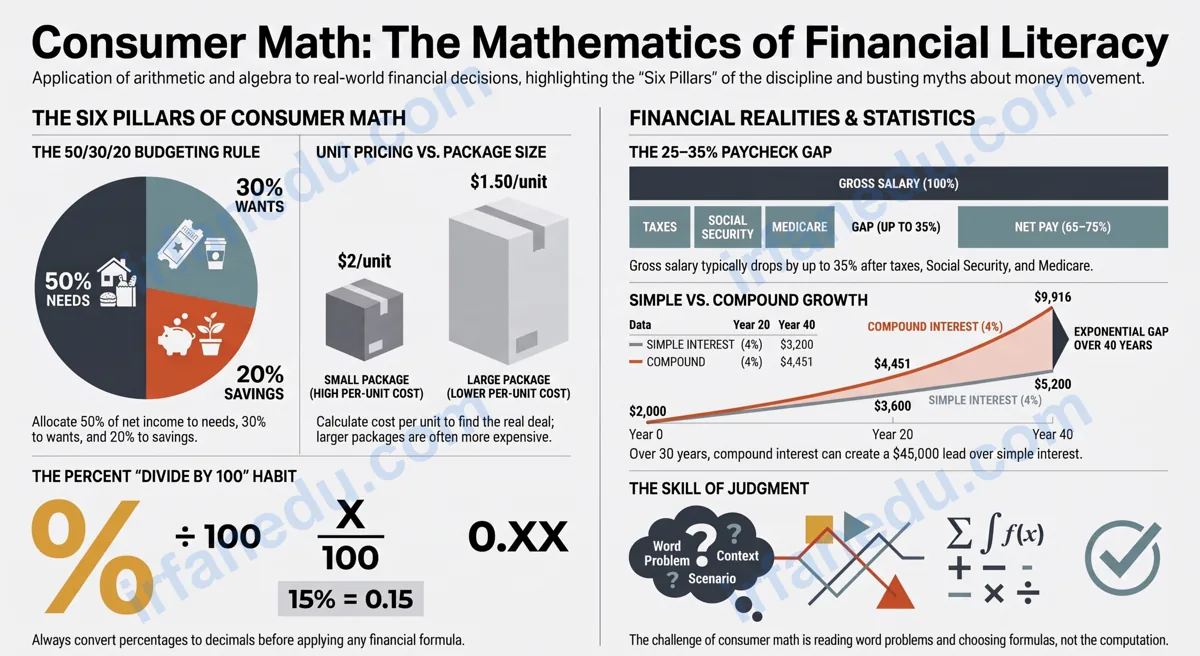
Consumer Math: Fact vs. Fiction — Clear the Myths Before You Start
Before any explanation, here is the myth-busting table. In my experience teaching this subject, these five misconceptions cause more confusion than any formula ever does. Read this first.
| Common Belief (Myth) | What Is Actually True (Fact) |
|---|---|
| “Consumer math is just basic arithmetic — it’s easy.” | The arithmetic is simple, but choosing the right formula and reading word problems accurately is where most students lose marks. The skill is judgment, not calculation. |
| “Gross pay and net pay are basically the same thing.” | They can differ by 25-35%. A $50,000 gross salary can become roughly $37,000-$40,000 net after federal tax, state tax, Social Security, and Medicare deductions. |
| “Simple interest and compound interest give similar results over time.” | Over 30 years at 7%, $10,000 grows to $31,000 with simple interest but over $76,000 with compound interest. The gap is enormous at long time horizons. |
| “The bigger package is always the better deal.” | Unit pricing often reveals the opposite. A 32 oz bottle at $4.80 ($0.15/oz) beats a 64 oz bottle at $11.52 ($0.18/oz). Always calculate cost per unit. |
| “Consumer math is only useful if you don’t go to college.” | College students take out loans, rent apartments, file taxes, and manage credit cards. Consumer math skills are needed by every adult, regardless of education level. |
What Is Consumer Math?
Consumer math is the branch of mathematics that applies arithmetic, percent, and algebra skills to real-world financial decisions — including budgeting, calculating taxes and interest, reading paychecks, comparing prices, and managing loans. It is the math of money in everyday life.
Most high schools offer consumer math as a standalone course, typically in grades 9-12. It sits at the intersection of mathematics and personal finance. Unlike algebra or calculus, every skill you learn in consumer math has a direct, immediate use outside the classroom.
The subject draws on skills you already know — multiplication, division, fractions, and percentages — and channels them toward decisions you will make for the rest of your life. That is what makes it uniquely valuable.
Consumer math is the practical branch of mathematics covering money skills used in daily life: budgeting, calculating sales tax, understanding simple and compound interest, reading paychecks, comparing unit prices, and managing debt. It is typically taught in high school and gives students the financial literacy tools they need before entering the adult world.
⚡ TL;DR – Quick Summary
- Consumer math = applied math for real-life money decisions.
- Core topics: budgeting, percent, interest, paychecks, unit pricing, loans.
- Simple interest: I = P x R x T. Compound interest grows exponentially faster.
- Net pay is always less than gross pay — the gap can exceed 30%.
- Unit pricing, not package size, tells you the real deal.
- The biggest student mistake is skipping the word problem setup — not the math itself.
| Quick Facts: Consumer Math at a Glance | |
|---|---|
| Subject area | Applied Mathematics / Personal Finance |
| Typical grade level | High School (Grades 9-12) |
| Core math skills used | Arithmetic, percentages, basic algebra |
| Key formulas | I = PRT (simple interest); A = P(1+r/n)^nt (compound); Tax = Price x Rate |
| Real-world applications | Budgeting, taxes, loans, paychecks, shopping, investing |
| Difficulty level | Accessible — the challenge is application, not computation |
| Why it matters | Every adult uses these skills regardless of career path |
What Topics Does Consumer Math Cover?
Consumer math covers six major topic clusters, each building on the last. Here is a structured overview of what you will encounter in a standard course.
| Topic Cluster | Key Skills | Real-World Use |
|---|---|---|
| Percents & Discounts | Percent of a number, percent change, markup/markdown | Sale prices, tips, commission |
| Taxes | Sales tax, income tax brackets, property tax | Shopping totals, filing taxes |
| Interest | Simple interest (I=PRT), compound interest (A=P(1+r/n)^nt) | Savings accounts, loans, credit cards |
| Paychecks & Income | Gross vs. net pay, deductions, hourly vs. salary | Reading your paycheck stub |
| Budgeting | Income vs. expenses, fixed vs. variable costs, savings rate | Monthly spending plans |
| Comparison Shopping | Unit pricing, best-buy calculations | Grocery shopping, online purchases |
Most consumer math courses also touch on insurance basics, checking and savings accounts, and introductory investing concepts. The exact scope varies by school, but the six clusters above are universal.
How Do You Solve Percent Problems in Consumer Math?
Percent problems are the backbone of consumer math. Every percent problem fits one of three question types, and knowing which type you are facing solves half the problem.
The Three Percent Question Types
- Find the percent of a number: “What is 15% of $80?” → $80 x 0.15 = $12
- Find what percent one number is of another: “12 is what percent of 80?” → (12 ÷ 80) x 100 = 15%
- Find the whole when the percent is known: “$12 is 15% of what?” → $12 ÷ 0.15 = $80
A jacket costs $65. The sales tax rate is 7.5%.
Step 1: Convert 7.5% to a decimal: 7.5 ÷ 100 = 0.075
Step 2: Calculate tax: $65 x 0.075 = $4.875 → round to $4.88
Step 3: Total cost: $65 + $4.88 = $69.88
Shortcut: $65 x 1.075 = $69.875 → $69.88 (same answer, one step)
A $120 pair of shoes is 30% off. What is the sale price?
Method A: Find discount: $120 x 0.30 = $36. Sale price: $120 – $36 = $84.
Method B: Sale price = $120 x (1 – 0.30) = $120 x 0.70 = $84. (Faster.)
Always use Method B (multiply by the complement) when you want the final price directly. It cuts the calculation to one step and reduces rounding errors.
In my experience teaching consumer math, the single most common error I see is students converting percentages incorrectly. They write 15% as 15 instead of 0.15. I tell every student: “The percent sign means divide by 100.” Say it out loud every time you see a % symbol until it becomes automatic. That one habit eliminates about 40% of calculation errors on tests.
Simple vs. Compound Interest: What Is the Difference?
Simple interest grows linearly; compound interest grows exponentially. This distinction is one of the most financially consequential ideas in all of consumer math.
Simple Interest Formula
I = P x R x T
- I = Interest earned (dollars)
- P = Principal (starting amount)
- R = Annual interest rate (as a decimal)
- T = Time (in years)
You deposit $2,000 in a savings account at 4% simple interest for 5 years.
I = $2,000 x 0.04 x 5 = $400
Total balance after 5 years: $2,000 + $400 = $2,400
Compound Interest Formula
A = P(1 + r/n)^(n x t)
- A = Final amount
- P = Principal
- r = Annual rate (decimal)
- n = Number of times compounded per year
- t = Time in years
Same $2,000 at 4% compounded monthly for 5 years.
A = $2,000 x (1 + 0.04/12)^(12 x 5)
A = $2,000 x (1.003333…)^60
A = $2,000 x 1.2210 = $2,442.00
That is $42 more than simple interest — and the gap widens dramatically over decades.
Year  | Simple Interest | Compound (Monthly)
------+-----------------+-------------------
  0   |   $2,000        |   $2,000
  5   |   $2,400        |   $2,442
 10   |   $2,800        |   $2,980
 20   |   $3,600        |   $4,451
 30   |   $4,400        |   $6,645
 40   |   $5,200        |   $9,916

At 40 years, compound interest nearly DOUBLES the simple interest total.
Compound interest works against you on debt. A credit card charging 20% APR compounded daily can turn a $1,000 balance into over $7,000 in 10 years if you only make minimum payments. The same math that builds wealth also builds debt.
How Do You Read a Paycheck in Consumer Math?
Reading a paycheck stub is a core consumer math skill that most schools underteach. A paycheck stub shows you exactly where your money goes before it reaches your bank account.
Key Paycheck Terms
| Term | Definition | Example ($50,000/yr salary) |
|---|---|---|
| Gross Pay | Total earnings before deductions | $1,923.08 per biweekly pay period |
| Federal Income Tax | Tax withheld for federal government (bracket-based) | ~$192 (approx. 10% bracket) |
| Social Security | 6.2% of gross pay (up to annual wage base) | ~$119.23 |
| Medicare | 1.45% of gross pay | ~$27.88 |
| State Income Tax | Varies by state (0% to ~13%) | ~$57.69 (at 3%) |
| Net Pay | Take-home pay after all deductions | ~$1,526.28 |
In the example above, the employee keeps about 79 cents of every dollar earned. State tax rates, health insurance premiums, and retirement contributions can push that figure lower.
I have asked hundreds of students what they think their take-home pay will be on a $50,000 salary. Almost every one says “$50,000 divided by 12.” The shock of seeing the real net pay figure — often $3,000-$4,000 less per month than expected — is one of the most valuable lessons consumer math delivers. No textbook exercise creates that impact as well as running the actual numbers on a real pay stub template.
How Do You Build a Budget Using Consumer Math?
A budget is a plan that matches your income to your expenses. The most widely taught budgeting framework in consumer math courses is the 50/30/20 rule.
The 50/30/20 Budget Rule
- 50% Needs: Rent, utilities, groceries, transportation, insurance
- 30% Wants: Dining out, entertainment, subscriptions, clothing beyond basics
- 20% Savings/Debt: Emergency fund, retirement contributions, loan repayment
Monthly net income: $2,800
- Needs (50%): $2,800 x 0.50 = $1,400
- Wants (30%): $2,800 x 0.30 = $840
- Savings/Debt (20%): $2,800 x 0.20 = $560
If rent alone is $1,100, that leaves only $300 for all other needs — a signal to either increase income or reduce the rent burden.
Step-by-Step: How to Build a Consumer Math Budget
- Calculate your monthly net income (after all deductions).
- List all fixed expenses (rent, loan payments — same amount every month).
- List all variable expenses (groceries, gas, utilities — amounts that change).
- Subtract total expenses from net income.
- If the result is negative, identify which variable expenses to reduce.
- Allocate any surplus to savings or debt repayment first.
Track actual spending for one month before building a budget. Most people underestimate variable expenses by 20-30%. Real data beats estimates every time.
What Is Unit Pricing and Why Does It Matter?
Unit pricing is the cost per single unit of measurement (per ounce, per liter, per item). It is the only reliable way to compare products of different sizes.
Formula: Unit Price = Total Price ÷ Number of Units
| Product | Size | Price | Unit Price (per oz) | Better Deal? |
|---|---|---|---|---|
| Brand A Shampoo | 12 oz | $3.60 | $3.60 ÷ 12 = $0.30/oz | No |
| Brand B Shampoo | 20 oz | $5.00 | $5.00 ÷ 20 = $0.25/oz | Yes |
| Brand C Shampoo | 32 oz | $9.28 | $9.28 ÷ 32 = $0.29/oz | No |
Brand B wins — even though it is not the largest size. This directly contradicts the “bigger is always cheaper” myth from the opening table.
Common Consumer Math Mistakes — Wrong vs. Right
These are the five errors I see most often. Each one has a simple fix.
| Mistake (Wrong) | Correct Approach (Right) |
|---|---|
| Writing 15% as 15 in a formula | Always convert: 15% = 15 ÷ 100 = 0.15 |
| Calculating interest on gross pay instead of the loan principal | Interest applies to the principal (P), not your income |
| Forgetting to add tax back to the original price | Tax amount + original price = total cost (or multiply by 1 + rate) |
| Confusing APR with monthly rate | Monthly rate = APR ÷ 12. A 12% APR = 1% per month |
| Using gross pay instead of net pay for a budget | Always budget from net (take-home) pay, never gross |
Most guides teach consumer math topics in isolation. That is the wrong approach.
In real financial decisions, you almost always use multiple skills simultaneously. Consider renting an apartment: you need to calculate net pay (paycheck math) to know your real income, apply the 50/30/20 rule (budgeting) to set a rent ceiling, factor in a security deposit earning interest in a savings account (interest math), and compare unit costs on groceries to stay within budget (unit pricing).
The students who struggle on consumer math tests are usually those who practiced each topic in a separate chapter and never connected them. My recommendation: after learning each skill, create one “real scenario” problem that forces you to use at least two skills together. For example: “You earn $18/hr, work 40 hrs/week, pay 22% in total deductions, and want to save 20% of net pay. How much do you save per month?” That single problem touches hourly pay calculation, deduction math, and savings rate — and it mirrors an actual life decision.
Quick Quiz: Test Your Consumer Math Skills
1. A $200 item is on sale for 25% off. What is the sale price?
Show Answer
2. You deposit $5,000 at 6% simple interest for 4 years. How much interest do you earn?
Show Answer
3. Your gross monthly pay is $3,500. After 28% total deductions, what is your net pay?
Show Answer
Practice Problems — Click to Reveal Solutions
Problem 1: You buy groceries totaling $87.50. The sales tax rate is 6%. What is your total bill?
Tax = $87.50 x 0.06 = $5.25
Total = $87.50 + $5.25 = $92.75
Shortcut: $87.50 x 1.06 = $92.75
Problem 2: You borrow $8,000 at 5% simple interest for 3 years. What is the total amount you repay?
I = $8,000 x 0.05 x 3 = $1,200
Total repayment = $8,000 + $1,200 = $9,200
Problem 3: Cereal A is 18 oz for $3.96. Cereal B is 24 oz for $4.80. Which is the better unit price?
Cereal A: $3.96 ÷ 18 = $0.22/oz
Cereal B: $4.80 ÷ 24 = $0.20/oz
Cereal B is the better deal at $0.20 per ounce.
Problem 4: Your hourly wage is $16.50. You work 38 hours this week. After 24% total deductions, what is your net pay for the week?
Gross pay = $16.50 x 38 = $627.00
Net pay = $627.00 x (1 – 0.24) = $627.00 x 0.76 = $476.52
Frequently Asked Questions About Consumer Math
What is consumer math?
What topics are covered in consumer math?
What is the simple interest formula in consumer math?
How is consumer math different from regular math?
Sources & References
Reviewed by Dr. Irfan Mansuri. External links open in a new tab and are provided for further reading and verification.