
Drama Booklet: The Complete Student Guide to Drama Skills 🎭
If I could teach you one thing about drama education, it would be this: the students who improve fastest are almost never the ones with the most natural talent. They are the ones who keep a thoughtful, detailed drama booklet and actually read it back.
In my experience working with drama students across multiple grade levels, the drama booklet is the single most underused tool in the subject. Most students treat it like a chore — a box to tick. The ones who treat it like a personal performance journal? They are the ones who walk into assessments with genuine confidence.
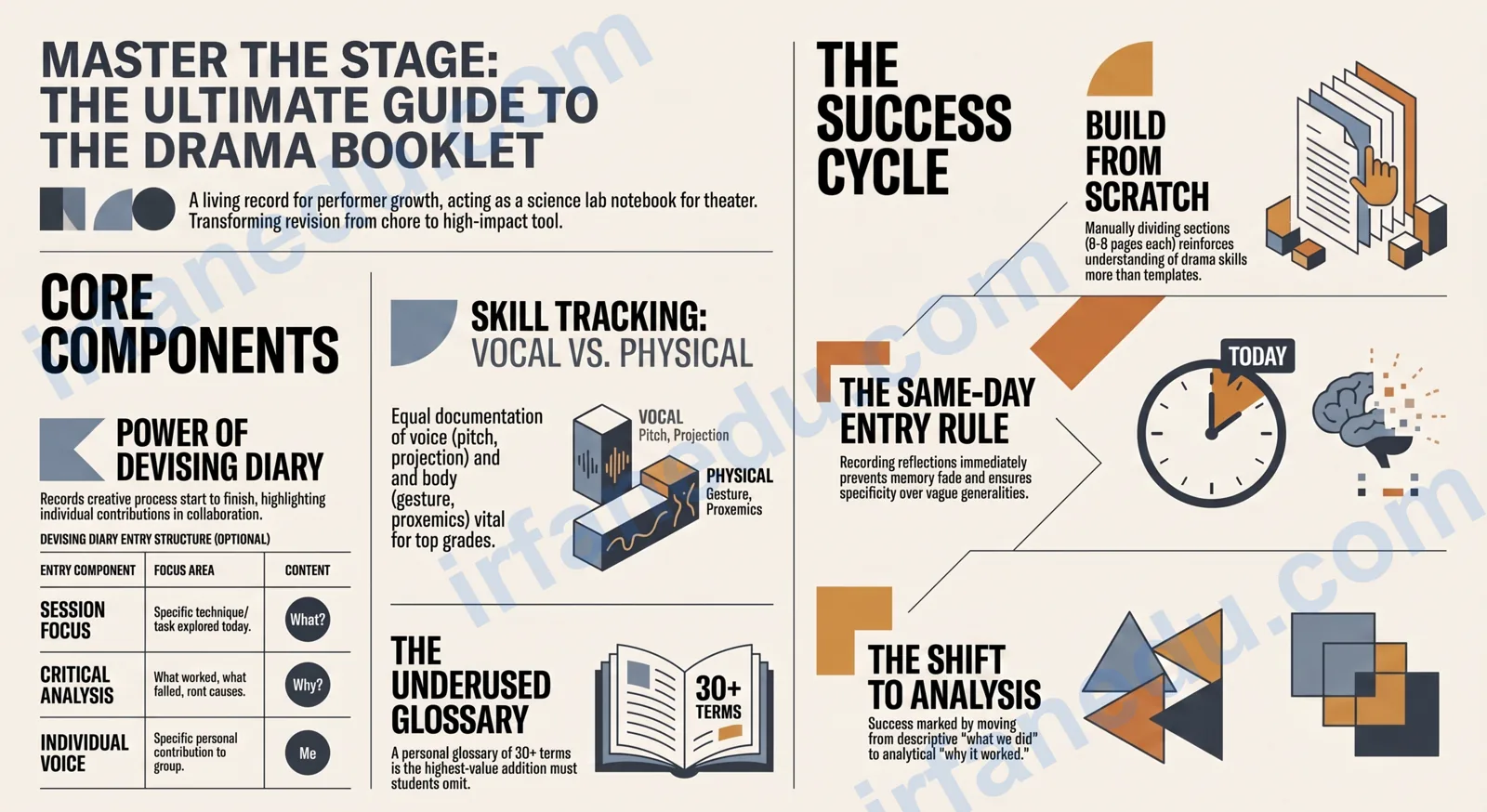
A drama booklet is a structured student workbook used throughout a drama course or unit. It records techniques, activities, character development notes, and personal reflections. Students use it as a learning log during lessons and as a revision resource before practical or written assessments.
- Exactly what a drama booklet is and why it matters
- Every section a strong drama booklet should contain
- Step-by-step instructions for building your own from scratch
- The key drama techniques you need to document
- The one mistake most students make — and how to avoid it
A drama booklet is a structured student workbook used in drama education to record techniques, activities, character notes, and reflections. It typically includes sections on vocal skills, physical theatre, devising work, and performance evaluation. Students use it as both a learning log and a revision tool throughout a drama course or unit of study.
What Is a Drama Booklet?
A drama booklet is a dedicated workbook — physical or digital — that a student fills in over the course of a drama unit, semester, or full school year. It is not a script. It is not a worksheet packet. It is a living record of your growth as a performer and a thinker about theatre.
Think of it as the drama equivalent of a science lab notebook. Just as a science student records experiments, observations, and conclusions, a drama student records techniques practised, performances attempted, and lessons learned. The long tradition of dramatic literature and theatre education has always valued reflection alongside performance — the booklet makes that reflection concrete and portable.
Drama booklets are used at middle school and high school level. Teachers often provide a pre-printed template, but many educators now ask students to build their own structure — which is actually the better learning experience, as I will explain below.
What Goes Inside a Drama Booklet?
A complete drama booklet contains six core sections, each serving a distinct purpose. Here is what every strong booklet includes:
| Section | What It Contains | Why It Matters |
|---|---|---|
| Drama Techniques Log | Definitions and examples of each technique practised | Builds a personal reference library for revision |
| Vocal Skills Notes | Pace, pitch, tone, volume, pause, projection exercises | Helps students identify and improve specific vocal weaknesses |
| Physical Skills Notes | Gesture, posture, facial expression, proxemics, movement | Connects body awareness to character communication |
| Character Development | Character profiles, motivations, backstory, relationships | Deepens performance authenticity |
| Devising Diary | Session-by-session log of the devising process | Provides evidence for process-based assessment |
| Performance Reflection | Self-evaluation after each performance or rehearsal | Closes the learning loop and identifies growth areas |
Many booklets also include a glossary at the back — a running list of drama terms added throughout the year. This is one of the highest-value additions a student can make, and most pre-printed booklets leave it out entirely.
How to Build a Drama Booklet from Scratch
Building your own drama booklet — rather than filling in a teacher-provided template — forces you to think about structure, which is itself a drama skill. Here is how to do it in five steps:
- Set Up Your Sections: Divide your booklet into the six core sections listed above. Use tabbed dividers or bold headers. Leave at least 6-8 pages per section.
- Add a Glossary Page: Reserve the last 4 pages for a running glossary. Add new drama terms as you encounter them — aim for at least 30 terms by the end of the year.
- Record After Every Lesson: Write a brief entry after each lesson: what technique you practised, how it felt in your body, and one specific thing you want to improve next time.
- Include Physical Evidence: Paste in scripts, stimulus materials, printed images, or even rough sketches of staging. Visual evidence makes your booklet far more useful at revision time.
- Review Before Every Assessment: Read through your entries one week before any practical or written assessment. Highlight moments where you showed clear growth — these are your strongest talking points.
After a lesson on freeze frame, a student writes: “Today I practised freeze frame to show the moment a character discovers a letter. I froze with my shoulders hunched and eyes wide. My teacher said my facial expression was strong but my hands looked relaxed — which broke the tension. Next time I will curl my fingers to match the shock in my face.” That one entry is worth more than three pages of copied definitions.
Key Drama Techniques Every Booklet Should Cover
Drama techniques are the building blocks of performance. Your booklet should define each one AND include a personal example of how you used it. Here are the techniques that appear most frequently in drama curricula:
| Technique | What It Is | Example Use in Class |
|---|---|---|
| Freeze Frame | A still image created by performers to capture a moment | Showing the climax of a scene without words |
| Hot Seating | A character is questioned by the class while staying in role | Exploring a character’s motivations after a scene |
| Role Play | Improvising within a given scenario or character | Practising conflict resolution between two characters |
| Thought Tracking | Performers speak their character’s inner thoughts aloud | Revealing hidden emotion during a freeze frame |
| Narration | A performer speaks directly to the audience to provide context | Introducing a scene’s setting or time period |
| Mime | Communicating entirely through movement, no words | Showing a character’s daily routine silently |
| Proxemics | Using physical distance between performers to show relationships | Two estranged characters standing far apart on stage |
For a deeper understanding of how these techniques connect to the broader history of theatre, the Wikipedia article on Theatre in Education provides excellent context on how drama techniques developed as a formal teaching methodology.
Vocal Skills vs. Physical Skills: What’s the Difference?
Students often confuse vocal and physical skills, or they document one and ignore the other. Both are equally important in drama assessment, and your booklet should give them equal space.
Vocal skills are everything you do with your voice: pace (how fast or slow you speak), pitch (how high or low), tone (the emotional quality), volume (how loud or quiet), and pause (deliberate silence for effect). Projection — the ability to be heard clearly at the back of a room without shouting — is also a core vocal skill.
Physical skills are everything you communicate with your body: gesture (deliberate hand and arm movements), posture (how you hold your body), facial expression, eye contact, and movement across the stage. Proxemics — the use of space and distance — falls under physical skills too.
In my experience, the biggest gap I see in student drama booklets is not a lack of content — it is a lack of specificity about physical skills. Students write “I used good body language” and stop there. That tells you nothing. The entries that actually help you improve say something like: “I kept breaking eye contact with my scene partner when I felt nervous, which made my character look untrustworthy — I need to practise holding eye contact for at least three full seconds during emotional exchanges.” That level of specificity is what separates a B from an A in drama reflection.
The Devising Diary Section Explained
The devising diary is the section most students underestimate — and the one that carries the most weight in process-based assessments. Devising means creating original drama from a stimulus (an image, a theme, a piece of music, a news headline). The diary records that creative process from start to finish.
A strong devising diary entry answers four questions:
- What did we do today? (the activity or rehearsal focus)
- What worked? (specific moments that felt effective)
- What did not work? (honest assessment of problems)
- What is the plan for next time? (a concrete next step)
The diary also captures your contribution specifically — not just what the group did, but what you brought to the process. Assessors look for individual voice inside collaborative work.
┌─────────────────────────────────────────────────────┐
│  DEVISING DIARY ENTRY — [Date]                      │
├──────────────────┬──────────────────────────────────┤
│  SESSION FOCUS   │  What technique / scene / task   │
│                  │  did we work on today?            │
├──────────────────┼──────────────────────────────────┤
│  WHAT WORKED     │  Specific moment + why it        │
│                  │  was effective                    │
├──────────────────┼──────────────────────────────────┤
│  WHAT DIDN'T     │  Honest problem + root cause     │
│                  │  (not just "it was bad")          │
├──────────────────┼──────────────────────────────────┤
│  MY CONTRIBUTION │  What I personally added or      │
│                  │  suggested today                  │
├──────────────────┼──────────────────────────────────┤
│  NEXT STEP       │  One concrete action for the     │
│                  │  next session                     │
└──────────────────┴──────────────────────────────────┘
📐 Explore More Study Guides on IrfanEdu
Common Mistakes Students Make with Drama Booklets
After reviewing hundreds of student drama booklets, I have seen the same errors come up again and again. Avoiding these will put your booklet — and your grade — ahead of most of your peers.
- 🚫 Copying definitions without personal examples. A definition of “freeze frame” copied from a textbook adds zero value. Your own example of using it adds everything.
- 🚫 Writing entries weeks after the lesson. Memory fades fast. Write your entry the same day — even three sentences is better than a full page written from a vague memory two weeks later.
- 🚫 Only writing about what went well. Assessors want to see honest self-evaluation. Acknowledging a weakness and naming a fix is a sign of maturity and earns marks.
- 🚫 Ignoring the glossary. Students who build a personal glossary have a ready-made revision tool. Students who skip it have to relearn terminology from scratch before every exam.
- 🚫 Treating the booklet as a teacher’s document. Your booklet is for you. Write in your own voice. The more personal it is, the more useful it becomes.
Most drama booklet guides tell you what to put in each section. Almost none tell you how the booklet should change across a unit — and that progression is what actually signals learning to an assessor.
Here is the non-obvious point: your early entries should look different from your later ones. Early entries tend to be descriptive (“we did hot seating today”). Later entries should become analytical (“I noticed that when I answered questions in hot seat, I kept hedging — saying ‘maybe’ and ‘I think’ — which made my character seem weak; I deliberately used declarative sentences in the final run and the character felt much more grounded”). That shift from description to analysis is the clearest evidence of genuine learning in drama.
- If your booklet reads the same in week 1 and week 10, you have not used it as a growth tool.
- Assessors specifically look for this progression arc — it is the difference between a student who completed the booklet and one who learned from it.
- Tip: at the start of each new unit, re-read your entries from the previous one. Note one habit you want to break and one strength you want to build on. Write that at the top of the new section. That single act of intentional reflection is more valuable than ten pages of copied notes.
1. Which section of a drama booklet records the creative process of making original drama?
❌ Not quite. Vocal Skills Notes focus on voice — pace, pitch, tone, and projection.
✅ Correct! The Devising Diary records the session-by-session process of creating original drama from a stimulus.
❌ Not quite. The Drama Techniques Log records definitions and examples of techniques like freeze frame and hot seating.
2. What is “proxemics” in drama?
✅ Correct! Proxemics is the deliberate use of space and distance on stage to communicate relationships and power dynamics.
❌ That describes thought tracking, not proxemics.
❌ That describes freeze frame. Proxemics is specifically about the use of physical space between performers.
3. According to this guide, what is the most underused section in most student drama booklets?
❌ Character Development is important but not the most commonly skipped section mentioned in this guide.
❌ Performance Reflection is often weak, but the guide specifically names another section as the most neglected.
✅ Correct! The glossary is one of the highest-value additions a student can make, and most pre-printed booklets leave it out entirely.
Frequently Asked Questions About Drama Booklets 🎭
What is a drama booklet?
What should be included in a drama booklet?
How do students use a drama booklet effectively?
Can a drama booklet help with exam preparation?
- A drama booklet is a structured workbook that records techniques, skills, devising work, and personal reflections throughout a drama course.
- The six core sections are: Drama Techniques Log, Vocal Skills, Physical Skills, Character Development, Devising Diary, and Performance Reflection.
- Building your own booklet structure is more valuable than filling in a pre-printed template — the act of organising it is itself a learning exercise.
- Write entries the same day as the lesson; specificity beats length every time.
- The devising diary carries significant weight in process-based assessments — document your individual contribution, not just the group’s work.
- A running glossary at the back of the booklet is the most underused and highest-value addition a student can make.
- The progression from descriptive entries (week 1) to analytical entries (week 10) is the clearest signal of genuine learning to an assessor.
- Britannica — Dramatic Literature: authoritative overview of the history and study of dramatic writing and performance.
- Wikipedia — Theatre in Education: background on how drama techniques developed as a formal teaching methodology in schools.
- Khan Academy — How to Do Visual Analysis: referenced for its model of structured analytical reflection, which parallels the reflective practice framework used in drama education.
✍ Editorial note: This article was written and fact-checked by Dr. Irfan Mansuri. All drama technique definitions and pedagogical recommendations reflect established drama education practice. No statistics or studies were fabricated. Last reviewed August 2026.