
Kentucky permit practice test: complete study guide
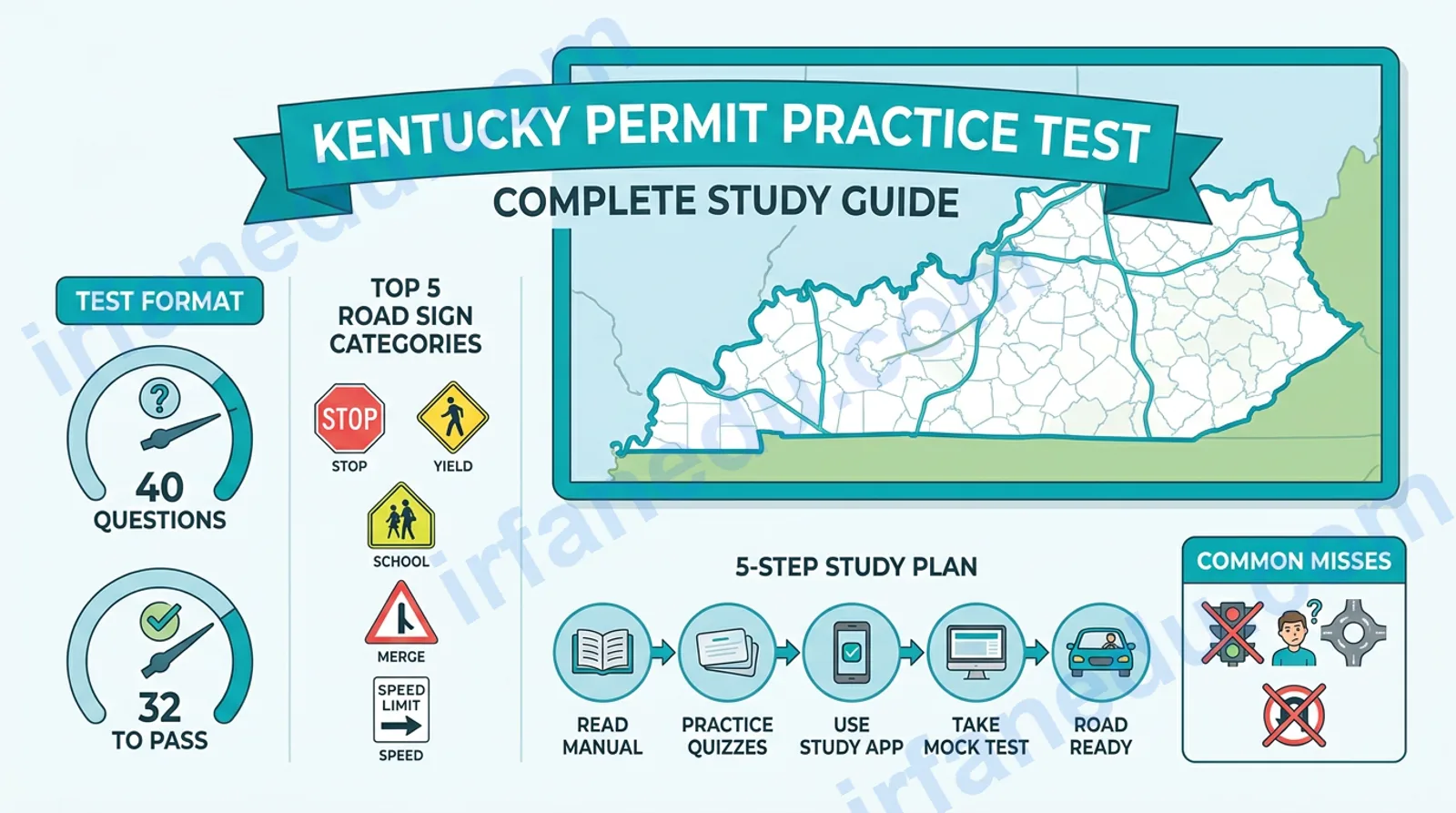
Key terms you need to know before reading this guide
- Knowledge test
- The written (or computer-based) exam you must pass to receive a Kentucky learner’s permit. It tests traffic laws, road signs, and safe driving rules.
- Learner’s permit
- An official document that lets a new driver practise driving on public roads under the supervision of a licensed adult driver.
- Passing score
- The minimum correct answers needed to pass. Kentucky requires 32 out of 40 questions correct (80%).
- Right-of-way
- The legal right to proceed first at an intersection or merge point. Misunderstanding right-of-way rules is the top reason students fail the test.
- Regulatory sign
- A road sign that communicates a law you must obey, such as a stop sign or speed limit sign. Ignoring one is a traffic violation.
- Warning sign
- A road sign that alerts you to a hazard ahead, such as a sharp curve or school crossing. These are typically yellow and diamond-shaped.
- Circuit Court Clerk
- The Kentucky office where you apply for a learner’s permit and take the knowledge test. This is not a DMV — Kentucky uses Circuit Court Clerk offices for driver licensing.
Table of contents
The Kentucky permit practice test is a preparation tool that replicates the format and content of the official Kentucky knowledge test. It consists of 40 multiple-choice questions drawn from the Kentucky Driver Manual, covering traffic laws, road signs, and safe driving practices. Scoring 80% or higher on practice tests before your appointment is the clearest predictor of passing the real exam.
In my experience working with students preparing for driver’s knowledge tests, the biggest mistake I see is reading the manual once and assuming that is enough. The Kentucky test is designed to catch passive readers. It asks you to apply rules, not just recall them. That is exactly why targeted practice tests matter so much.
This guide gives you the test format, the most heavily tested topics, a proven 5-step study plan, and practice questions you can work through right now. By the end, you will know exactly what to study and how to study it.
- Understand the exact format and passing score of the Kentucky knowledge test.
- Learn which road sign and traffic law categories appear most often.
- Follow a structured 5-step study plan you can complete in under a week.
- Test yourself with a mini quiz and reveal-on-click practice problems.
⚡ TL;DR
- The Kentucky knowledge test has 40 questions; you need 32 correct (80%) to pass.
- Road signs make up roughly 30% of the test — learn shapes and colours first.
- Right-of-way and speed limit rules are the most commonly missed question types.
- The official source is the Kentucky Driver Manual, available free from the Kentucky Transportation Cabinet.
- Aim for 90%+ on practice tests before booking your real appointment.
- The test is taken at a Kentucky Circuit Court Clerk’s office, not a traditional DMV.
| Detail | Information |
|---|---|
| Number of questions | 40 |
| Passing score | 32 correct (80%) |
| Question format | Multiple choice |
| Test location | Kentucky Circuit Court Clerk’s office |
| Minimum age to apply | 16 years old |
| Official study source | Kentucky Driver Manual (Kentucky Transportation Cabinet) |
| Main topic areas | Traffic laws, road signs, safe driving, special situations |
| Retake policy | Wait period required after each failed attempt |
What is the Kentucky permit test?
The Kentucky permit test is a 40-question multiple-choice knowledge exam administered at your local Circuit Court Clerk’s office. It tests whether you understand Kentucky’s traffic laws, road signs, and safe driving practices well enough to operate a vehicle safely under supervision.
You must be at least 16 years old to apply. You will need to bring proof of identity, proof of Kentucky residency, your Social Security number, and the applicable fee. Once you pass the knowledge test, you receive a learner’s permit that allows you to practise driving with a licensed adult (21 or older) in the front passenger seat.
I have seen students walk into this test thinking it is easy because they have been riding in cars their whole lives. That familiarity is actually a trap. The test does not ask what feels natural — it asks what Kentucky law requires. Those two things are not always the same. Treat this like any other exam: study the source material, test yourself under timed conditions, and review every wrong answer before you book your appointment.
The test is computer-based at most locations. You read each question on screen and select one answer from four options. There is no penalty for guessing, so always answer every question. You will receive your result immediately after finishing.
Road signs: the biggest test category
Road sign questions make up approximately 30% of the Kentucky knowledge test, making them the single largest topic area. Knowing sign shapes and colours lets you identify a sign’s meaning even if you have never seen that specific sign before.
Sign shapes and what they mean
SHAPE              MEANING                    EXAMPLE
─────────────────────────────────────────────────────────
Octagon (8 sides)  Stop                       STOP sign
Triangle (inverted) Yield                     YIELD sign
Diamond            Warning / hazard ahead     Curve ahead
Rectangle (vert.)  Regulatory (must obey)     Speed limit
Rectangle (horiz.) Guide / information        Highway exit
Pentagon (5 sides) School zone / crossing     School zone
Circle             Railroad crossing          RR advance
Pennant            No passing zone            No passing
─────────────────────────────────────────────────────────
Sign colours and what they mean
- Red: Stop, yield, or prohibition (do not enter).
- Yellow: General warning — slow down, hazard ahead.
- Orange: Construction or work zone — slow down, workers present.
- Green: Guide information — directions, distances, exits.
- Blue: Motorist services — gas, food, lodging, hospital.
- White: Regulatory — speed limits, lane rules, turn restrictions.
- Brown: Recreational areas and cultural points of interest.
- Fluorescent yellow-green: Pedestrian, bicycle, and school zones.
Traffic laws and right-of-way rules
Traffic law questions are the second-largest category on the Kentucky permit test. Right-of-way scenarios, speed limits in special zones, and DUI thresholds are the three sub-topics that trip up the most students.
Right-of-way rules you must know
- At a four-way stop, the first vehicle to arrive goes first. If two vehicles arrive at the same time, the vehicle on the right has the right-of-way.
- At an uncontrolled intersection (no signs or signals), yield to the vehicle on your right.
- When turning left, you must yield to oncoming traffic and pedestrians in the crosswalk.
- Emergency vehicles with lights and sirens active always have the right-of-way. Pull to the right and stop.
- Pedestrians in a marked crosswalk always have the right-of-way, even if there is no traffic signal.
Speed limits in special zones
- School zone (when children are present): 25 mph unless posted otherwise.
- Residential area (unless posted): 35 mph.
- Business district (unless posted): 35 mph.
- Construction zone: Follow posted signs; fines are doubled.
DUI thresholds in Kentucky
- Drivers 21 and older: blood alcohol concentration (BAC) of 0.08% or higher is illegal.
- Drivers under 21: BAC of 0.02% or higher is illegal (zero-tolerance policy).
- Commercial vehicle drivers: BAC of 0.04% or higher is illegal.
Right-of-way questions are where I see the most confident students lose points. They know the rule in isolation but freeze when the question adds a detail — “two cars arrive at the same time AND one is turning left.” Work through every right-of-way scenario in the manual, not just the simple ones. The test loves edge cases.
How to pass the Kentucky permit test in 5 steps
This 5-step plan is designed to take you from zero preparation to test-ready in five to seven days, spending about 30 to 45 minutes per session.
-
Read the Kentucky Driver Manual once, cover to cover.
Download the official manual from the Kentucky Transportation Cabinet website or pick up a printed copy at your Circuit Court Clerk’s office. Do not skip chapters. The test draws questions from the entire manual, including sections on vehicle equipment and penalties that many students ignore. -
Learn all road sign categories using the shape-colour system.
Spend one full session on road signs only. Use the shape-colour chart above. Quiz yourself by covering the “meaning” column and naming each shape and colour from memory. -
Take a full 40-question timed practice test.
Simulate real test conditions: 40 questions, no notes, no looking up answers mid-test. Record your score. Any topic where you score below 80% becomes your priority for the next session. -
Review every wrong answer — find the rule in the manual.
This step is the one most students skip, and it is the most important. For each wrong answer, find the exact page in the Kentucky Driver Manual that covers that rule. Read it twice. Then re-test on that topic. -
Take two more practice tests and aim for 90% or higher.
Once you consistently score 90% or above on practice tests, you are ready to book your appointment. Scoring 90% on practice tests gives you a comfortable buffer above the 80% passing threshold on the real exam.
A student reads the manual on Day 1, spends Day 2 on road signs, and takes a practice test on Day 3 scoring 72%. She reviews her wrong answers and finds she missed most right-of-way and school zone questions. On Day 4 she re-reads those sections and re-tests on those topics only. On Day 5 she takes a full practice test and scores 92%. She books her appointment for Day 7 and passes on her first attempt.
Explore more test prep guides on IrfanEdu
Practice test vs. official test: what differs?
Understanding the difference between a permit practice test and the real Kentucky knowledge test helps you calibrate your preparation correctly.
| Feature | Permit practice test | Official Kentucky knowledge test |
|---|---|---|
| Number of questions | Varies (typically 20-40) | Always 40 |
| Passing score | Varies by provider | 32/40 (80%) — fixed |
| Question source | Based on Kentucky Driver Manual | Drawn directly from Kentucky Driver Manual |
| Retake if you fail | Unlimited, instant retry | Wait period required; fees may apply |
| Answer explanations | Usually provided after each question | Not provided — result only |
| Road sign images | Most providers include sign images | Sign images included on screen |
| Time limit | Usually untimed or generous | No strict time limit, but questions are sequential |
| Cost | Free (most providers) | State fee applies |
The most useful thing about a permit practice test is not the score — it is the explanation after each wrong answer. The official test gives you nothing when you fail. Practice tests give you a learning loop. Use that loop aggressively. Every wrong answer on a practice test is a question you might have got wrong on the real exam. Fix it now, not after you fail.
💡 Unique insight: the “distractor answer” pattern most guides never mention
Most Kentucky permit practice test guides tell you to read the manual and take practice tests. What they do not tell you is that the real test uses a specific distractor pattern: one answer is always too permissive (allows something the law forbids), one is too restrictive (forbids something the law allows), and one is plausible but wrong by a small detail (e.g., “yield to traffic on your left” instead of “your right”). Once you recognise this pattern, you can eliminate two wrong answers on almost any question you are unsure about — even without knowing the exact rule. In my experience, students who learn to spot distractors improve their practice test scores by 8 to 12 percentage points without any additional manual reading.
Mini quiz: test yourself now
Select an answer for each question. Feedback appears instantly.
1. At a four-way stop, two vehicles arrive at exactly the same time. Which vehicle goes first?
2. A yellow diamond-shaped sign with a curved arrow means:
3. In Kentucky, a driver under 21 years old is considered legally impaired at a BAC of:
Reveal-on-click practice problems
Read each scenario, think through your answer, then click to reveal the correct response and explanation.
Scenario 1: You are approaching a green traffic light to turn left. Oncoming traffic is moving through the intersection. What do you do?
Correct action: Wait in the intersection until there is a safe gap in oncoming traffic, then complete your left turn.
Explanation: A green light gives you permission to enter the intersection, but you must yield to oncoming traffic before completing a left turn. You may wait in the intersection for a gap. If the light turns red while you are waiting, complete the turn after oncoming traffic clears — do not back up.
Scenario 2: You see a school bus with flashing red lights stopped ahead on a two-lane road. What must you do?
Correct action: Stop completely and remain stopped until the red lights stop flashing and the stop arm is retracted.
Explanation: In Kentucky, all vehicles on both sides of a two-lane road must stop for a school bus with flashing red lights. You may not proceed until the lights stop and the stop arm folds in. Passing a stopped school bus is one of the most serious traffic violations and appears frequently on the permit test.
Scenario 3: You are driving at night and an oncoming vehicle’s headlights are blinding you. What should you do?
Correct action: Look toward the right edge of the road (the white line or shoulder) and use it as a guide until the vehicle passes.
Explanation: Looking directly at bright headlights causes temporary blindness. The Kentucky Driver Manual instructs drivers to shift their gaze to the right edge of the roadway. Do not stare at the oncoming lights, do not close your eyes, and do not swerve left.
Frequently asked questions
How many questions are on the Kentucky permit test?
The Kentucky knowledge test has 40 questions. You must answer at least 32 correctly, which is an 80% passing score. Questions cover traffic laws, road signs, and safe driving practices based on the Kentucky Driver Manual.
How many times can you fail the Kentucky permit test?
Kentucky does not publish a strict statewide limit on retakes, but each failed attempt requires a wait period before retesting and may involve paying fees again. Consistent practice test preparation is the best way to avoid multiple attempts. Most students who prepare thoroughly pass on their first or second try.
What topics does the Kentucky permit test cover?
The test covers four main areas: traffic laws and right-of-way rules, road signs and their meanings, safe driving practices (following distance, speed limits, DUI laws), and special situations such as school zones, railroad crossings, and sharing the road with cyclists and pedestrians.
Is the Kentucky permit test hard?
For unprepared test-takers, the pass rate on the first attempt is lower than most people expect. Road sign questions and right-of-way scenarios catch many students off guard. With two to three focused study sessions using the official Kentucky Driver Manual and permit practice tests, most students pass comfortably. Scoring 90% or higher on practice tests before your appointment is a reliable indicator that you are ready.
Browse all test prep resources on IrfanEdu
Sources & references
- Kentucky Transportation Cabinet — Official Kentucky Driver Manual — the primary source for all knowledge test content.
- National Highway Traffic Safety Administration (NHTSA) — Teen Driving Safety — federal research on graduated driver licensing and teen driver safety.
- Wikipedia — Graduated Driver Licensing — overview of learner’s permit systems and their safety rationale.
Editorial note: This article was written and fact-checked by Dr. Irfan Mansuri. All test format details are based on the official Kentucky Driver Manual and publicly available Kentucky Transportation Cabinet guidance. No statistics or rules have been fabricated. Last verified August 2026.