
Ohio Permit Practice Test: Complete Study Guide to Pass in 2026
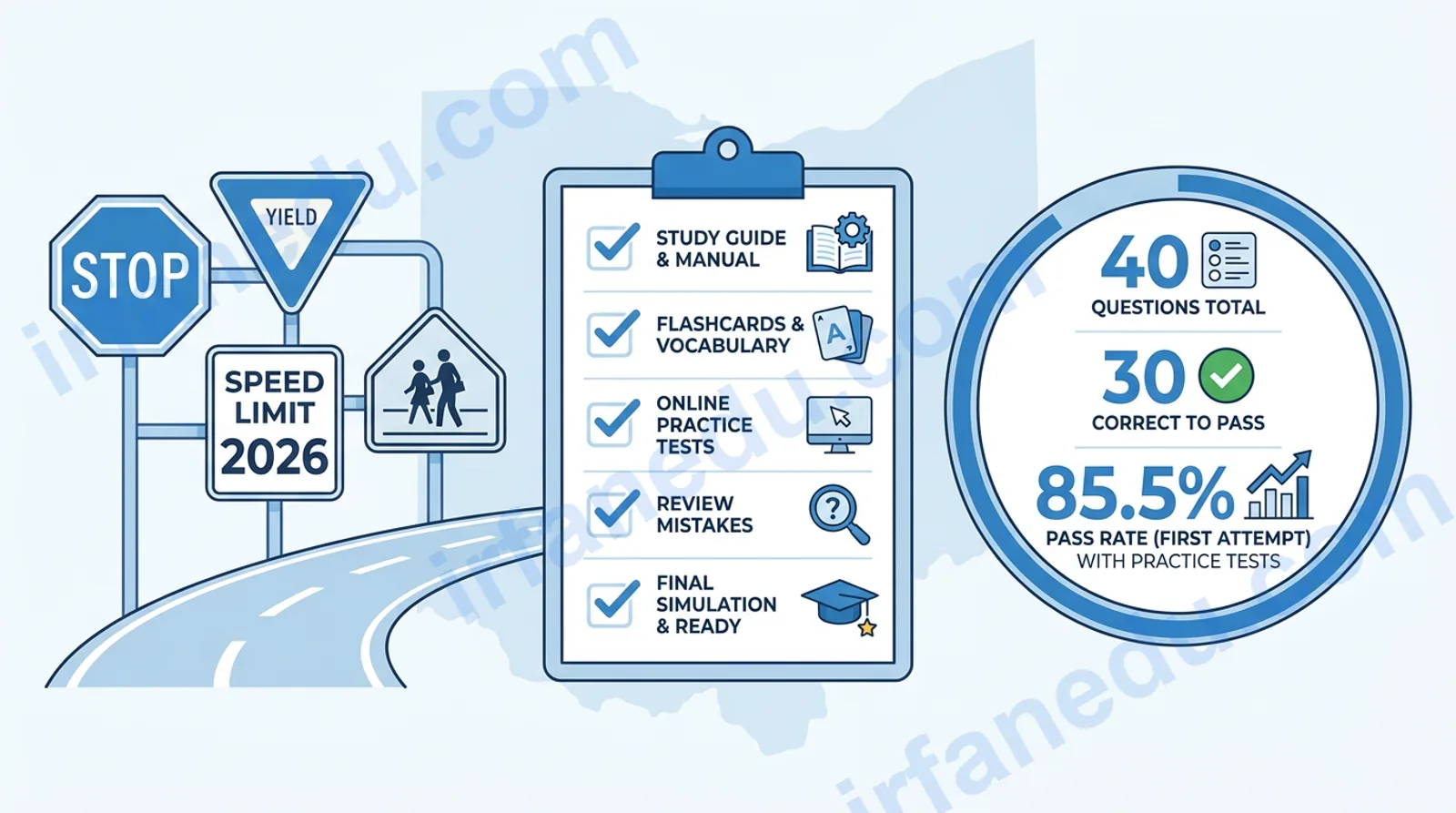
Most students who fail the Ohio BMV written test say the same thing afterward: “I didn’t know the questions would look like that.” The test is not hard — but it is specific. The exact wording, the road-sign shapes, the right-of-way scenarios — they all come straight from the Ohio Driver’s Manual, and practice tests teach you that language before you walk into the BMV.
The Ohio permit practice test is a free preparation tool that mirrors the real Ohio BMV written knowledge test. It uses the same 40-question multiple-choice format, the same road-sign categories, and the same traffic-law scenarios. Scoring 75% (30 out of 40) on practice tests consistently is the clearest predictor that you are ready for the real exam.
A Fast Example: What a Real Ohio Permit Test Question Looks Like
Before anything else, here is a sample question drawn directly from the Ohio Driver’s Manual content — the same style you will see on test day.
A pentagon-shaped sign with a yellow background and a figure of a child is posted near a school. What does this sign mean?
A) Railroad crossing ahead
B) School zone — slow down and watch for children
C) Pedestrian crossing on a highway
D) Playground area, no vehicles allowed
Correct Answer: B. The pentagon shape is used exclusively for school zone and school crossing signs in the United States. Knowing the shape alone narrows the answer instantly, even if you have never seen the exact wording before.
That is the key insight for road-sign questions: shape + color = meaning, before you even read the words. Octagons are stop signs. Triangles pointing down are yield signs. Pentagons are school zones. Diamonds are warnings. If you memorize the shape-color system, you can answer roughly 20 of the 40 questions faster and more confidently.
A Thorough Example: Working Through a Traffic-Law Scenario
Traffic-law questions are more complex because they require you to apply a rule, not just recognize a sign. Here is a worked example that shows the reasoning process.
You are at an uncontrolled four-way intersection (no signs or signals). Another driver arrives at the same time from your right. Who has the right of way?
A) You do, because you arrived at the same time
B) The driver on your right has the right of way
C) The driver going straight has the right of way
D) Whoever is driving the larger vehicle goes first
Correct Answer: B.
Here is how to reason through it step by step:
- Identify the intersection type. No signs or signals means it is an uncontrolled intersection. The Ohio right-of-way rule applies.
- Apply the “yield to the right” rule. When two vehicles arrive simultaneously, Ohio law requires the driver on the left to yield to the driver on the right.
- Eliminate distractors. Answer A is wrong because simultaneous arrival is exactly when the rule kicks in. Answer C is wrong because direction of travel does not override the yield-to-right rule. Answer D is not a real traffic law anywhere.
- Confirm the answer. The driver on your right has the right of way. You wait and let them go first.
In my experience helping students prepare for knowledge tests, this type of question trips up more test-takers than road signs do. The rule itself is simple — but students who have not read the manual assume “whoever gets there first goes first,” which is only true when arrival times are clearly different.
What Is the Ohio Permit Test? Format and Requirements
The Ohio BMV written knowledge test is a 40-question multiple-choice exam that every first-time driver must pass to receive a temporary instruction permit (TIP). You must be at least 15 years and 6 months old to apply.
| Detail | Ohio BMV Written Test |
|---|---|
| Total Questions | 40 multiple-choice |
| Passing Score | 30 correct (75%) |
| Time Limit | No fixed time limit (most finish in 20-30 min) |
| Minimum Age | 15 years, 6 months |
| Test Format | Computer-based at a BMV office |
| Retake Wait | 1 day between attempts |
| Source Material | Ohio Driver’s Manual (bmv.ohio.gov) |
| Cost | $16.25 (temporary instruction permit fee as of 2026) |
The test is computer-based and administered at any Ohio BMV Deputy Registrar location. You do not need to memorize page numbers — you need to understand the concepts well enough to recognize the correct answer among four plausible options.
What Topics Does the Ohio Permit Test Cover?
The Ohio BMV written test draws questions from three main content areas. Understanding the weight of each area helps you allocate your study time correctly.
| Topic Area | Approx. Questions | Key Subtopics |
|---|---|---|
| Road Signs and Signals | ~18-20 | Sign shapes, colors, meanings; traffic signal rules; pavement markings |
| Ohio Traffic Laws | ~12-14 | Right of way, speed limits, passing rules, school bus laws, lane changes |
| Safe Driving Practices | ~6-8 | Following distance, impaired driving, seat belts, distracted driving, sharing the road |
Road signs are the single largest category. If you study nothing else, study signs. That said, the traffic-law questions are where most students lose points, because those answers require applying a rule rather than recognizing a visual symbol.
How to Prepare: A Step-by-Step Study Plan
This plan works in 5-7 days of focused study. You do not need weeks of preparation — you need the right sequence.
- Download the Ohio Driver’s Manual. Get it free at bmv.ohio.gov. This is the only document the test questions are written from. Third-party summaries are useful supplements, not replacements.
- Read the road-signs chapter first. Chapters 2 and 3 of the Ohio manual cover signs, signals, and pavement markings. Read them in one sitting and sketch out the shape-color system on a single sheet of paper.
- Take a cold diagnostic practice test. Without any further study, take a full 40-question Ohio BMV practice test. Your score tells you exactly which chapters need the most attention. Do not skip this step — it is the most efficient way to identify gaps.
- Study your wrong answers, not the whole manual again. Go back to the manual sections that correspond to your incorrect answers. Read those sections carefully, then re-test on the same topic.
- Take three full practice tests and target 85%+. Score 85% or higher on three consecutive full-length practice tests before booking your real appointment. This buffer accounts for test-day nerves and unfamiliar phrasing.
- Book your BMV appointment and arrive prepared. Schedule at bmv.ohio.gov. Bring your birth certificate or passport, proof of Ohio residency (two documents), and your Social Security card or number.
- Proof of identity (birth certificate, U.S. passport, or equivalent)
- Proof of Ohio residency (two documents: utility bill, bank statement, school record, etc.)
- Social Security number or proof of ineligibility
- Payment for the $16.25 temporary instruction permit fee
- If under 18: a parent or guardian to sign the application
The Visual Solution: Ohio Road Sign Shape System
This diagram maps the most tested sign shapes to their categories. Memorize this chart and you can answer road-sign questions by shape alone, before reading the text.
 OHIO ROAD SIGN SHAPE + COLOR SYSTEM
 =====================================

  OCTAGON          TRIANGLE (inverted)   DIAMOND
  [  STOP  ]       [  YIELD  ]           [WARNING]
  Red + White      Red + White           Yellow + Black
  Always STOP      Yield right of way    Hazard ahead

  RECTANGLE        PENTAGON              CIRCLE
  [  INFO  ]       [ SCHOOL  ]          [RAILROAD]
  White/Green/     Yellow-green          Yellow + Black
  Blue + Black     + Black              (RR crossing)

  PENNANT          CROSSBUCK             SQUARE
  [NO PASS ]       [   X   ]            [SERVICES]
  Yellow + Black   White + Black        Blue + White
  No-passing zone  Railroad crossing    Gas/food/lodging

 KEY RULE: Shape tells you the CATEGORY before you read the words.
 Diamonds = warnings. Octagons = stop. Pentagons = school zones.
Common Mistakes That Cause Students to Fail
These are the four patterns I see most often in students who fail their first attempt — and the corrections that fix each one.
⭐ My Key Takeaway
Most Ohio permit test guides tell you to “study the manual and take practice tests.” That is correct but incomplete. The non-obvious insight is this: the Ohio BMV test is designed to catch students who studied the right facts but in the wrong order. Road signs come first on the test, and they account for nearly half the questions. Students who study traffic laws first and signs second consistently underperform on the sign section because they run out of study time or mental energy. Flip the order — signs first, laws second, safe driving last — and your pass rate on practice tests will improve noticeably within two study sessions.
Pre-Test Checklist: Are You Ready to Book Your Appointment?
Use this checklist before scheduling your real BMV test. If you cannot check every item, spend one more day studying the gaps.
- I have read the Ohio Driver’s Manual at least once, cover to cover.
- I can identify the meaning of every sign by shape and color, without reading the text.
- I know the right-of-way rules for four-way stops, uncontrolled intersections, and roundabouts.
- I know Ohio’s speed limits for school zones (20 mph when children are present), residential streets (25 mph), and highways (65-70 mph).
- I know the rules for passing a stopped school bus (must stop in both directions on undivided roads).
- I understand the 3-second following distance rule and when to increase it.
- I know Ohio’s rules on cell phone use while driving (hands-free required for all drivers).
- I have scored 85% or higher on at least three consecutive full-length practice tests.
- I have gathered all required documents for the BMV visit.
Reveal-on-Click Practice Problems
Test yourself on these five questions. Click to reveal the answer and explanation after you have chosen your answer mentally.
Problem 1: You approach a flashing red traffic light. What must you do?
Answer: Come to a complete stop, then proceed when it is safe. A flashing red light is treated exactly like a stop sign. You must stop completely, check for cross traffic, and proceed only when the intersection is clear. A flashing yellow light means slow down and proceed with caution — it does not require a full stop.
Problem 2: A school bus ahead of you on an undivided two-lane road has stopped with its red lights flashing. What do you do?
Answer: Stop and remain stopped until the red lights stop flashing and the bus moves. On an undivided road, traffic in both directions must stop for a school bus loading or unloading children. You may not pass until the bus driver turns off the flashing red lights and the stop arm is retracted. Violating this rule carries heavy fines in Ohio.
Problem 3: What does a solid yellow line on your side of the center line mean?
Answer: No passing allowed from your side of the road. A solid yellow line on your side means you must not cross the center line to pass. A broken yellow line on your side means passing is permitted when it is safe. If both lines are solid yellow (double solid), neither direction may pass.
Problem 4: At what blood alcohol concentration (BAC) is it illegal to drive in Ohio for drivers 21 and older?
Answer: 0.08% BAC or higher. Ohio’s legal limit for drivers 21 and older is 0.08% BAC. For drivers under 21, Ohio has a zero-tolerance law: any detectable BAC (0.02% or above) is illegal. Commercial drivers have a lower limit of 0.04% BAC.
Problem 5: You are driving at 60 mph on a dry highway. What is the minimum safe following distance?
Answer: At least 3 seconds of following distance (roughly 264 feet at 60 mph). The 3-second rule applies in ideal conditions. In rain, fog, or heavy traffic, Ohio’s manual recommends doubling that to 6 seconds. To measure: pick a fixed object ahead, count seconds from when the car in front passes it to when you pass it.
Frequently Asked Questions About the Ohio Permit Test
How many questions are on the Ohio permit test?
The Ohio BMV written knowledge test has 40 multiple-choice questions. You must answer at least 30 correctly (75%) to pass. The test covers road signs, traffic laws, and safe driving practices drawn from the Ohio Driver’s Manual. There is no fixed time limit, but most applicants finish in 20 to 30 minutes.
Where can I take a free Ohio BMV practice test?
The Ohio BMV offers free official practice tests at bmv.ohio.gov. Third-party sites like DMV.org and Driving-Tests.org also offer Ohio-specific practice questions that mirror the real test format. Always cross-reference any third-party question with the Ohio Driver’s Manual to confirm accuracy, since some older apps contain outdated rules.
What score do I need to pass the Ohio permit test?
You need a score of 75% or higher — that means at least 30 correct answers out of 40 questions. If you score below 75%, you must wait at least one day before retaking the test. Each retake requires paying the test fee again, so thorough preparation before your first attempt saves both time and money.
What topics does the Ohio permit test cover?
The Ohio permit test covers three main areas: road signs and their meanings (roughly 18-20 questions), Ohio traffic laws and right-of-way rules (roughly 12-14 questions), and safe driving practices including speed limits, following distance, and impaired driving rules (roughly 6-8 questions). Road signs are the largest single category on the test.
How many times can I retake the Ohio permit test if I fail?
Ohio does not cap the number of retakes, but you must wait one day between attempts. Each retake requires a new test fee. Most students pass within two attempts when they study with practice tests beforehand. If you fail twice, go back to the Ohio Driver’s Manual and re-read the chapters covering your weakest topics before attempting again.
Dr. Irfan Mansuri
Dr. Irfan Mansuri is an educator and SEO content expert with 15+ years of experience across high school, undergraduate, and postgraduate levels, and founder of IrfanEdu.com. I combine deep subject knowledge with proven test-taking strategies to make complex ideas simple. Connect on LinkedIn
Sources & References
-
Ohio Bureau of Motor Vehicles — Official Driver’s Manual and Practice Tests:
bmv.ohio.gov/dl-manual.aspx -
National Highway Traffic Safety Administration (NHTSA) — Teen Driver Safety:
nhtsa.gov/road-safety/teen-driving -
Federal Highway Administration — Road Sign Standards (MUTCD):
mutcd.fhwa.dot.gov
Editorial note: This guide is written and fact-checked by Dr. Irfan Mansuri based on the current Ohio Driver’s Manual and Ohio Revised Code. All test format details reflect Ohio BMV policy as of August 2026. Always verify current fees and requirements at bmv.ohio.gov before your appointment.