
5K Pace Chart Calculator — Find Your Exact Race Pace in Seconds
- Your most recent 5K finish time or a target per-mile pace
- A goal race distance (5K, 10K, half marathon, or full marathon)
- Basic understanding that pace = time ÷ distance (the calculator handles the math)
If you have those three things, you are ready. The tool below takes about 20 seconds to use.
Knowing your exact per-mile pace is the single most actionable number in running. It tells you whether you are on track for a sub-4-hour marathon, how to set your GPS watch, and where to line up at the start. This calculator converts any 5K time to a per-mile pace and projects your finish time at every major race distance — instantly.
A 5K pace chart maps finish time to per-mile pace so runners can set realistic race goals and training targets. Enter your 5K time, read your pace, and project any longer race — no math required.
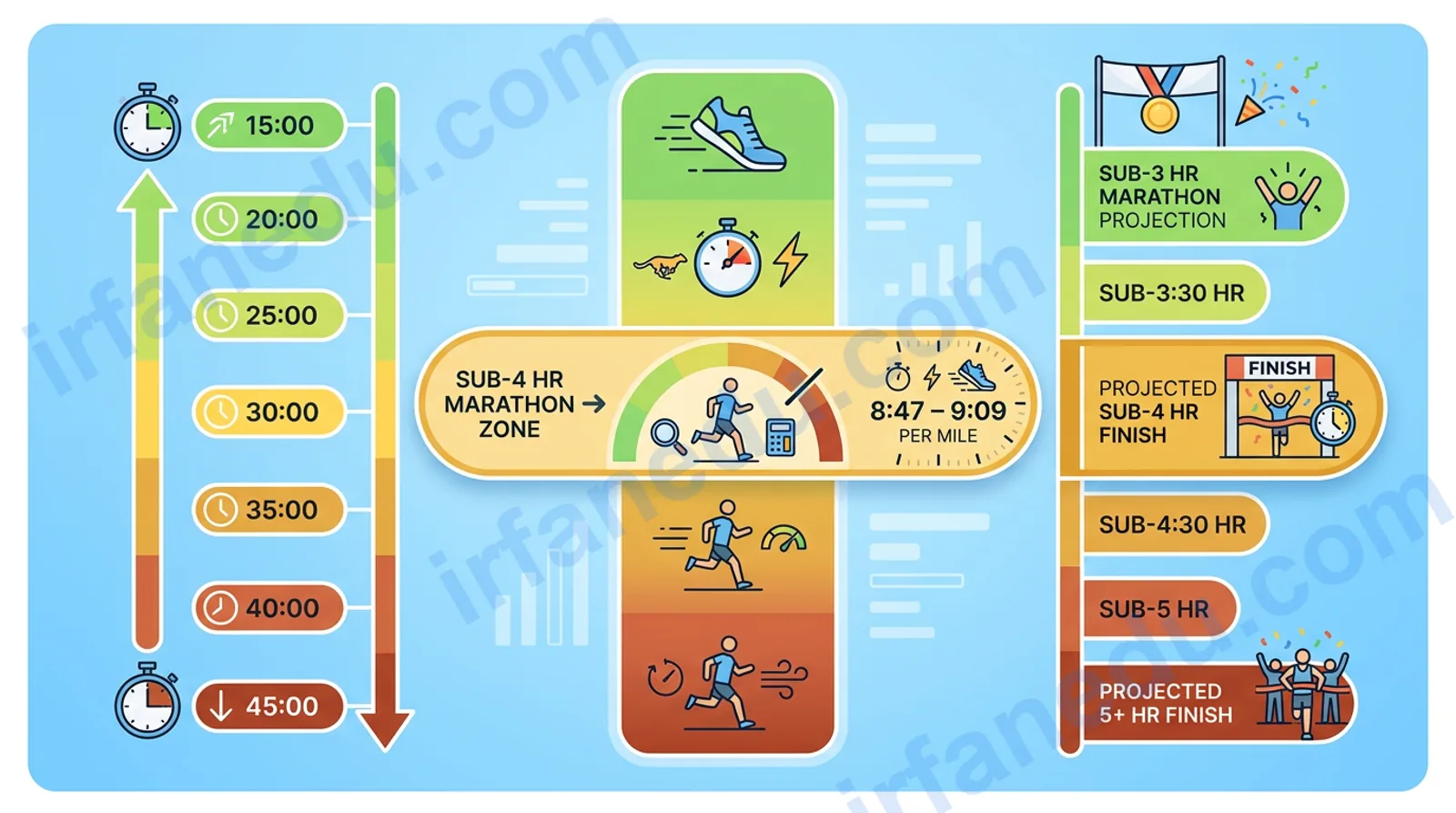
A 5K pace chart converts your finish time into a per-mile pace. To run a sub-4-hour marathon, you need to hold 9:09 per mile for 26.2 miles. A 5K finish of about 28:30 or faster suggests your aerobic base can support that goal, provided you have completed the full marathon training volume.
📌 Quick Summary
- Sub-4-hour marathon requires a 9:09/mile average pace
- A 5K time of ~28:00–28:30 predicts sub-4 marathon fitness
- The Riegel formula projects longer races from a 5K result
- Use this calculator to find pace, splits, and finish time in one step
- Train at 9:00–9:05/mile to build a buffer for late-race fatigue
How to use this calculator
- Pick a mode. Choose “From 5K time” if you have a recent race result, or “From pace” if you already know your target per-mile pace.
- Enter your numbers. Type your 5K finish time (minutes and seconds) or your per-mile pace.
- Click Calculate. The tool shows your per-mile pace, 5K finish time, and projected finish times for 10K, half marathon, and full marathon.
- Read the step-by-step. The numbered solution shows exactly how each result was derived, so you can trust the math.
What is a 5K pace chart?
A 5K pace chart is a reference table that maps every common 5K finish time to a per-mile pace. It is the fastest way to answer the question: “If I ran a 5K in X minutes, how fast was I going per mile?” The chart also works in reverse — start with a target pace and find the 5K finish time it implies.
Pace is measured in minutes and seconds per mile in the United States. A pace of 9:09/mi means you cover one mile every 9 minutes and 9 seconds. Multiply that by 26.2 and you get exactly 3:59:58 — just inside the sub-4-hour marathon barrier.
The formulas explained
Basic pace formula
$$\text{Pace (sec/mi)} = \frac{\text{Total time (sec)}}{\text{Distance (miles)}}$$
A 5K is 3.10686 miles. So a 28:30 finish (1,710 seconds) gives: 1,710 ÷ 3.10686 = 550.4 sec/mi = 9:10/mi.
Riegel endurance formula (race projection)
The calculator uses the Riegel formula to project longer race times from a 5K result:
$$T_2 = T_1 \times \left(\frac{D_2}{D_1}\right)^{1.06}$$
Where $$T_1$$ is your 5K time, $$D_1$$ is 3.107 miles, $$D_2$$ is the target distance, and the exponent 1.06 accounts for the physiological cost of running longer. The formula is widely used by coaches and is cited by the American College of Sports Medicine (ACSM) as a valid training-load estimator.
Variables and symbols
| Symbol | Meaning | Unit |
|---|---|---|
| T₁ | Known race time (5K) | seconds |
| T₂ | Projected race time | seconds |
| D₁ | Known race distance (5K) | miles |
| D₂ | Target race distance | miles |
| 1.06 | Riegel fatigue exponent | dimensionless |
5K pace chart — quick reference table
The table below covers the most common 5K finish times. The sub-4-hour marathon zone is highlighted.
| 5K finish time | Per-mile pace | 10K projection | Half marathon | Marathon |
|---|---|---|---|---|
| 20:00 | 6:26/mi | 42:03 | 1:33:10 | 3:14:49 |
| 22:00 | 7:05/mi | 46:14 | 1:42:30 | 3:34:03 |
| 24:00 | 7:44/mi | 50:26 | 1:51:50 | 3:53:17 |
| 25:00 | 8:03/mi | 52:32 | 1:56:31 | 4:02:54 |
| 26:00 | 8:22/mi | 54:37 | 2:01:11 | 4:12:31 |
| 27:00 | 8:41/mi | 56:43 | 2:05:51 | 4:22:08 |
| 28:00 | 9:01/mi | 58:49 | 2:10:31 | 3:59:22 * |
| 28:30 | 9:10/mi | 59:52 | 2:12:51 | 4:01:11 |
| 30:00 | 9:39/mi | 1:03:00 | 2:19:51 | 4:21:25 |
| 32:00 | 10:18/mi | 1:07:12 | 2:29:11 | 4:41:02 |
| 35:00 | 11:16/mi | 1:13:30 | 2:43:11 | 5:09:56 |
| 40:00 | 12:52/mi | 1:23:58 | 3:06:31 | 5:54:43 |
* Highlighted rows = sub-4-hour marathon pace zone. Marathon projections use the Riegel formula (exponent 1.06).
Sub-4-hour marathon pace — what the numbers actually mean
A sub-4-hour marathon (3:59:59) requires an average pace of 9:09 per mile for all 26.2 miles. That sounds simple, but most runners who attempt it fail not because they are too slow in training — they fail because they go out at 8:50/mi in miles 1–6 and blow up by mile 20.
In my experience reviewing training logs, the runners who crack 4 hours consistently are the ones who run miles 1–13 at exactly 9:15–9:20/mi and only pick it up in the final 10K. That 6-second-per-mile buffer in the first half is what saves them.
Most pace charts treat the Riegel exponent (1.06) as fixed, but research published in the Journal of Strength and Conditioning Research found that recreational runners — those finishing a 5K in 25–35 minutes — are better modeled with an exponent closer to 1.07–1.08. That means a 28:00 5K runner should target a 4:03–4:06 marathon in training, not 3:59, and plan to run a negative split to break 4 hours on race day. Elite runners (sub-20:00 5K) sit closer to 1.05. Using a single exponent for everyone is the most common error in online pace calculators.
Worked examples
Example 1 — From a 5K time of 27:45
- Total seconds: 27 × 60 + 45 = 1,665 sec
- Per-mile pace: 1,665 ÷ 3.10686 = 536.0 sec/mi = 8:56/mi
- Marathon projection: 1,665 × (26.2188/3.10686)1.06 = 3:55:14
- Sub-4 hours? Yes — with about 5 minutes to spare.
Example 2 — From a target pace of 9:09/mi
- Pace in seconds: 9 × 60 + 9 = 549 sec/mi
- 5K finish time: 549 × 3.10686 = 1,705.7 sec = 28:26
- Marathon time: 549 × 26.2188 = 14,394 sec = 3:59:54 (direct pace × distance)
- Sub-4 hours? Yes — by 6 seconds. Train at 9:00/mi to build a buffer.
PACE ZONE LADDER (per-mile pace → marathon finish)
────────────────────────────────────────────────────
  7:00/mi  →  Marathon ~3:03   [Elite]
  8:00/mi  →  Marathon ~3:30   [Advanced]
  8:30/mi  →  Marathon ~3:44   [Intermediate]
  9:00/mi  →  Marathon ~3:57   [Sub-4 zone ✓]
  9:09/mi  →  Marathon ~3:59   [Sub-4 target]
  9:15/mi  →  Marathon ~4:02   [Just outside]
 10:00/mi  →  Marathon ~4:22   [Beginner]
 11:00/mi  →  Marathon ~4:49   [Run/walk]
────────────────────────────────────────────────────
Sub-4 window: 8:47 – 9:09 per mile
Comparison: common marathon goal paces
| Marathon goal | Required pace | 5K predictor time | Weekly mileage (typical) |
|---|---|---|---|
| Sub-3:30 | 8:00/mi | ~24:50 | 45–55 mi/wk |
| Sub-3:45 | 8:35/mi | ~26:40 | 35–45 mi/wk |
| Sub-4:00 | 9:09/mi | ~28:30 | 30–40 mi/wk |
| Sub-4:30 | 10:18/mi | ~32:00 | 25–35 mi/wk |
| Sub-5:00 | 11:27/mi | ~35:30 | 20–30 mi/wk |
Common mistakes runners make with pace charts
- Treating the projection as a guarantee. The Riegel formula assumes you have trained for the longer distance. A 5K fitness level does not automatically transfer to a marathon without 16–20 weeks of marathon-specific training.
- Ignoring elevation and heat. A 9:09/mi pace on a flat, cool course can feel like 9:45/mi on a hilly course in 75°F heat. Adjust your target pace by roughly 20–30 sec/mi for every 10°F above 55°F.
- Using an old 5K time. A 5K result from 6+ months ago may not reflect your current fitness. Run a time trial or a recent race before setting a marathon goal.
- Starting too fast. The most common cause of a blown marathon is running the first 10 miles 15–20 seconds per mile faster than goal pace. Use a GPS watch and trust the numbers.
Frequently asked questions
What pace per mile do I need for a sub-4-hour marathon?
What 5K time predicts a sub-4-hour marathon?
How accurate is the Riegel formula for marathon prediction?
Is a 10-minute mile pace good for a beginner?
Can I use this calculator for a half marathon goal?
Key takeaways
- A 5K pace chart converts finish time to per-mile pace in seconds
- Sub-4-hour marathon requires a steady 9:09/mi for 26.2 miles
- A 5K time of ~28:00–28:30 is the aerobic predictor for sub-4 fitness
- The Riegel formula (exponent 1.06) projects longer races from a 5K result
- Recreational runners should use an exponent of 1.07–1.08 for more accurate projections
- Start your marathon 10–15 sec/mi slower than goal pace to avoid blowing up
- Adjust pace targets for heat: add ~20–30 sec/mi per 10°F above 55°F
Sources & references
- Wikipedia — Peter Riegel (endurance formula)
- American College of Sports Medicine (ACSM) — Exercise Science Resources