
kVA Calculator: Apparent Power, Formula & Worked Examples
The Answer First: What kVA Tells You Right Now
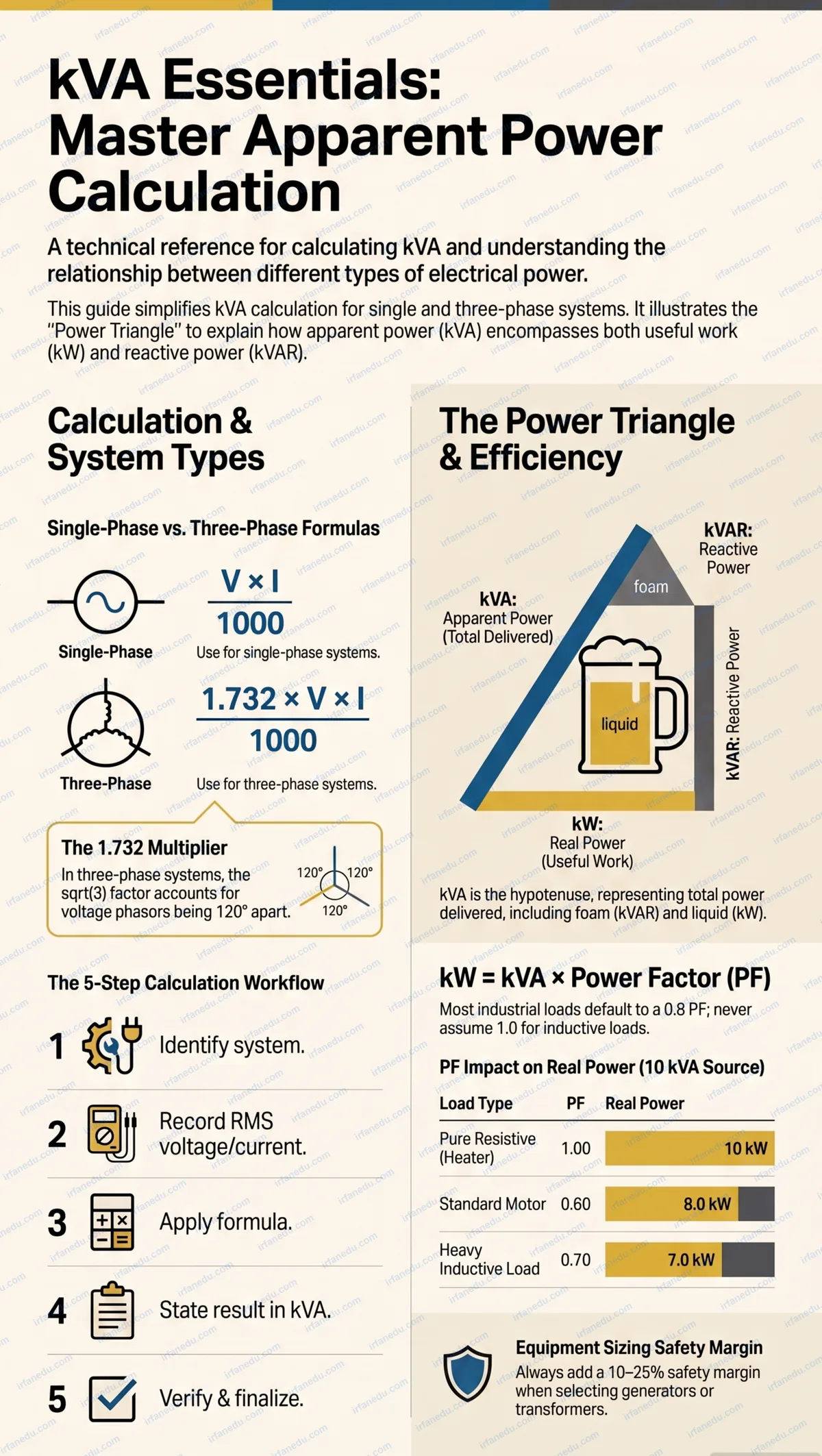
kVA (kilovolt-ampere) is the unit of apparent power in an AC circuit. You get it by dividing real power (kW) by the power factor (PF): kVA = kW ÷ PF. A 10 kW generator running at a 0.8 power factor has an apparent power of 12.5 kVA.
Here is the result you came for: if you know the real power in kilowatts and the power factor, you already have everything you need. The kVA number is always larger than the kW number (unless PF = 1), and that gap represents energy the circuit draws but never converts to useful work.
Now let me reverse-engineer why that formula works, what every variable means, and how to avoid the mistakes that trip up students and engineers alike.
- Calculate apparent power (kVA) from real power and power factor
- Convert kVA to kW and find power factor from both
- Interpret the power triangle and understand why kVA matters
- Apply the formula to real-world generator and motor sizing problems
⚡ TL;DR – Quick Summary
- kVA = kW divided by power factor (PF)
- kW = kVA multiplied by power factor
- Power factor ranges from 0 to 1; higher is more efficient
- kVA is always greater than or equal to kW
- The power triangle: kVA² = kW² + kVAR²
- Use this calculator to solve all three variables instantly
| Term | Symbol | Unit | What It Measures |
|---|---|---|---|
| Apparent Power | S | kVA | Total power drawn by the circuit |
| Real Power | P | kW | Power converted to useful work |
| Reactive Power | Q | kVAR | Power stored and returned (no useful work) |
| Power Factor | PF or cos θ | Dimensionless (0–1) | Ratio of real to apparent power |
kVA Calculator
Apparent Power · Real Power · Power Factor
Step-by-Step Solution
Core Formulas
| Symbol | Meaning | SI Unit |
|---|---|---|
| S | Apparent Power | VA (or kVA) |
| P | Real (Active) Power | W (or kW) |
| Q | Reactive Power | VAR (or kVAR) |
| PF | Power Factor (cos θ) | Dimensionless |
| θ | Phase angle between V and I | Degrees or Radians |
Key Definitions
Apparent Power (kVA): The total power a circuit draws from the source, including both useful and wasted components. It is the product of RMS voltage and RMS current.
Real Power (kW): The portion of apparent power that does actual work — running motors, producing heat, generating light.
Reactive Power (kVAR): Power that oscillates between the source and reactive components (inductors, capacitors). It does no net work but stresses the circuit.
Power Factor (PF): A number between 0 and 1 that tells you how efficiently a circuit uses the power it draws. PF = 1 means all drawn power is useful. PF = 0.7 means 30% is wasted as reactive power.
How to Use This kVA Calculator
- Choose a mode — pick the variable you want to find: kVA, kW, Power Factor, or kVAR.
- Enter the known values in the labeled input fields. Each field shows an example placeholder and its unit.
- Click Calculate (or press Enter) to
Sources & References
Reviewed by Dr. Irfan Mansuri. External links open in a new tab and are provided for further reading and verification.
Worked Examples
Example 1: Sizing a Generator for a Small Office
A small office building draws 8 kW of real power. The power factor of the electrical load is 0.8. What apparent power rating (in kVA) must the generator supply?
Given: kW = 8, PF = 0.8
Formula: kVA = kW ÷ PF
Substitution: kVA = 8 ÷ 0.8 = 10
Answer: 10 kVA. The generator must be rated at least 10 kVA, even though it only delivers 8 kW of useful work. The remaining capacity handles the reactive component of the load.
Example 2: Finding Real Power from an Appliance Label
An industrial air-conditioning unit is labeled 15 kVA. Its power factor is 0.9. How many kilowatts of real power does it actually consume?
Given: kVA = 15, PF = 0.9
Formula: kW = kVA × PF
Substitution: kW = 15 × 0.9 = 13.5
Answer: 13.5 kW. Only 13.5 kW does useful work (running the compressor, fans, etc.). The other 1.5 kVA worth of current circulates as reactive power and shows up on the kVA rating but not on the electricity bill.
Example 3: Using the Power Triangle to Find Reactive Power
A factory panel shows 50 kVA of apparent power and 40 kW of real power. What is the reactive power (kVAR)?
Given: kVA = 50, kW = 40
Formula: kVA² = kW² + kVAR², so kVAR = √(kVA² − kW²)
Substitution: kVAR = √(50² − 40²) = √(2500 − 1600) = √900 = 30
Answer: 30 kVAR. The reactive power is 30 kVAR. This value represents energy stored and released by inductive or capacitive elements each cycle rather than converted into useful work.
Common Mistakes to Avoid
- Treating kVA and kW as interchangeable. kW measures real (useful) power; kVA measures apparent power. They are only equal when PF = 1. Using one in place of the other will give a wrong equipment rating and can lead to undersized generators or transformers.
- Dividing kW by kVA instead of dividing kW by PF. The correct formula is kVA = kW ÷ PF. Confusing the arrangement and writing kVA = kW ÷ kVA is circular and meaningless. Always identify which quantity is unknown before rearranging.
- Forgetting that power factor must be between 0 and 1. A PF greater than 1 is physically impossible for a passive AC circuit. If your calculation produces a PF above 1, check whether you have swapped kW and kVA in the formula.
- Applying the kVA formula to DC circuits. Apparent power and power factor are AC concepts. In a DC circuit there is no phase difference, so kW = kVA always. Using the kVA ÷ PF formula on a DC problem introduces an error that does not exist.
- Rounding the power factor too early. Power factor values like 0.85 or 0.92 are often given to two decimal places for a reason. Rounding to 0.9 or 1.0 mid-calculation can shift the final kVA answer enough to select the wrong equipment size on an exam or in practice.
Real-World Applications
- Hospital backup generators: Hospitals must size standby generators in kVA, not kW, because medical equipment such as MRI machines and variable-speed drives carry lagging power factors near 0.7–0.8. Undersizing by ignoring apparent power can cause a generator to trip during a power outage.
- Transformer nameplate ratings: Distribution transformers are rated in kVA because the transformer core and windings heat up based on total current (apparent power), regardless of how much of that current does useful work. A 100 kVA transformer can overheat even if the connected load only draws 70 kW at a low power factor.
- Commercial utility billing: Large commercial customers are often charged a power-factor penalty by their utility if their site PF drops below 0.95. Facilities engineers calculate kVA demand to determine whether to install capacitor banks that raise PF and reduce the apparent power drawn from the grid.
- Residential solar inverter sizing: A home solar inverter must be rated in kVA to handle the full apparent power demanded by household loads, including motors in refrigerators and air conditioners. Choosing an inverter rated only in kW without accounting for PF can result in the inverter shutting down under peak load.
Frequently Asked Questions
Why is kVA always larger than kW?
kVA equals kW divided by the power factor, and the power factor is always 1 or less. Dividing by a number less than 1 always produces a larger result. The gap between kVA and kW represents reactive power, which oscillates in the circuit without performing useful work.
What does a power factor of 1 mean?
A power factor of 1 means the voltage and current waveforms are perfectly in phase. All the apparent power is converted to real power, so kVA equals kW exactly. Purely resistive loads such as incandescent light bulbs and electric heaters have a power factor very close to 1.
Can kVAR be negative?
Yes. Reactive power is positive for inductive loads (motors, transformers) and negative for capacitive loads (capacitor banks, some electronic power supplies). A negative kVAR simply means the load is supplying reactive power back toward the source rather than absorbing it.
Is kVA the same as kW on a generator spec sheet?
No. Generator spec sheets typically list both kVA (apparent power output) and kW (real power output at a stated power factor, usually 0.8). Always check which figure is quoted before sizing a generator for a specific load. Using the kVA figure as if it were kW will leave you with an undersized machine.
How do I convert kVA to amps?
For a single-phase system: Amps = (kVA × 1000) ÷ Volts. For a three-phase system: Amps = (kVA × 1000) ÷ (Volts × 1.732). Note that this gives apparent current; the real current doing useful work is smaller by a factor equal to the power factor.
Why do engineers use kVA instead of just kW to rate equipment?
Electrical equipment such as transformers, cables, and generators heats up based on the total current flowing through them, which corresponds to apparent power (kVA), not real power (kW). Rating equipment in kVA ensures it is sized to handle the full electrical stress, regardless of the load’s power factor.