
Pro Rata Calculator (With Worked Examples)
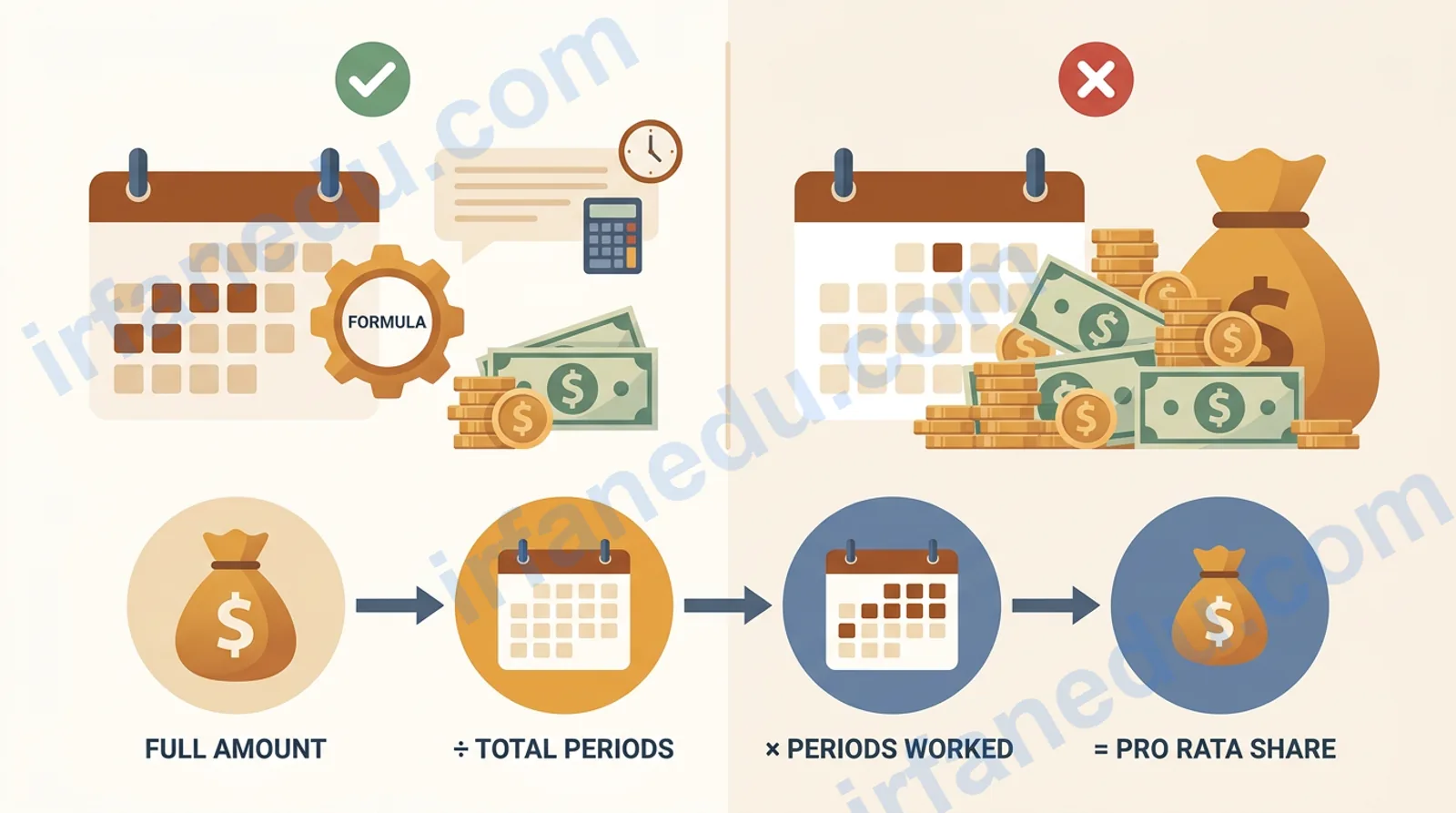
✅ Good Example vs. ❌ Bad Example: Pro Rata in Action
Before I explain the math, here is the clearest way to see why pro rata matters. These two scenarios show exactly what goes right — and what goes wrong — when a company handles a mid-month hire.
Situation: Alex starts a $6,000/month job on September 15. The month has 30 calendar days, so Alex works 16 days.
Calculation: $6,000 ÷ 30 × 16 = $3,200.00
Alex receives $3,200 — fair pay for exactly the time worked. No dispute, no underpayment.
Situation: Same hire. Payroll runs the full month without adjusting.
Result: Alex receives $6,000 for 16 days of work.
The company overpays by $2,800. Recovering it later creates legal risk and damages trust — a costly, avoidable mistake.
Q: What is a pro rata calculator and how does it work?
A: A pro rata calculator divides a full-period amount — salary, rent, or a fee — proportionally by the fraction of the period actually used. The formula is: Pro Rata Amount = (Full Amount ÷ Total Periods) × Periods Used. For a $6,000 monthly salary with 16 of 30 days worked, the prorated pay is $3,200.
- 🧮 Formula: (Full Amount ÷ Total Periods) × Periods Used = Pro Rata Share
- 💼 Salary: Divide monthly pay by working days in the month × days worked
- 🏠 Rent: Divide monthly rent by calendar days × days occupied
- 📋 US law: FLSA governs prorated pay for non-exempt workers; state rules may be stricter
- ⚠️ Biggest mistake: Mixing calendar days and working days in the same calculation
- 🔢 Use the calculator below for instant, step-by-step results
📊 Quick Facts: Pro Rata at a Glance
| Item | Detail |
|---|---|
| Latin meaning | “In proportion” or “according to the rate” |
| Most common US uses | Salary, rent, benefits, invoices, dividends |
| Governing US law (salary) | Fair Labor Standards Act (FLSA) |
| Calendar days in a month | 28–31 (use actual days for rent proration) |
| Typical US working days/month | 20–23 (use for salary proration) |
| IRS pro-rata rule | Applies to IRA distributions (Form 8606) |
| Calculator accuracy | Rounds to 2 decimal places (cents) |
🧮 Pro Rata Calculator
Select a mode, fill in the fields, and click Calculate. The result card shows your prorated amount plus a numbered step-by-step breakdown.
days
days
days
days
periods
periods
How to Use This Pro Rata Calculator
- Choose a mode: Select 💼 Salary, 🏠 Rent, or 🔢 Custom depending on what you need to prorate.
- Enter the full amount: Type the total salary, rent, or fee for the complete period (e.g., $5,000 monthly salary).
- Enter total periods: For salary, use working days in the month (typically 20–23). For rent, use calendar days (28–31). For custom, use any consistent unit.
- Enter periods used: How many days the employee worked or the unit was occupied during the partial period.
- Click Calculate: The result card shows your prorated amount, the percentage of the full amount, the remainder, and a numbered step-by-step breakdown.
What Is Pro Rata?
Pro rata is a Latin term meaning “in proportion.” In US finance and HR, it means allocating a full-period amount — a salary, rent payment, insurance premium, or fee — based on the fraction of the period actually used or worked.
The concept appears everywhere in American business life: a new employee who starts mid-month receives a prorated first paycheck; a tenant who moves in on the 10th pays prorated rent; a software subscription cancelled on day 15 of a 30-day cycle may receive a prorated refund.
In my experience working with HR teams across the US, the most common source of payroll disputes is not the formula itself — it’s the failure to document which day-count method the company uses. I always recommend putting it in the employee handbook before the first hire, not after the first complaint.
The Pro Rata Formula Explained
The core formula is simple and applies to every pro rata situation:
| Symbol / Variable | Meaning | Example Value |
|---|---|---|
| Full Amount | Total salary, rent, or fee for the complete period | $6,000 |
| Total Periods | Total days (calendar or working) in the full period | 30 calendar days |
| Periods Used | Days actually worked or unit occupied | 16 days |
| Pro Rata Amount | The proportional share owed | $3,200 |
Worked Examples
Example 1: Prorated Salary (Mid-Month Hire)
Scenario: Jordan starts a job paying $5,500/month on September 8. September has 22 working days. Jordan works 16 of them.
- Daily rate: $5,500 ÷ 22 = $250.00/day
- Prorated pay: $250.00 × 16 = $4,000.00
Jordan’s first paycheck should be $4,000.00.
Example 2: Prorated Rent (Move-In Mid-Month)
Scenario: A tenant moves into a Chicago apartment on October 14. Monthly rent is $2,100. October has 31 calendar days. The tenant occupies the unit for 18 days.
- Daily rate: $2,100 ÷ 31 = $67.74/day
- Prorated rent: $67.74 × 18 = $1,219.35
The landlord should charge $1,219.35 for October.
Example 3: Prorated Health Insurance Premium
Scenario: An employee enrolls in health insurance mid-month. The monthly employer-paid premium is $480. The month has 31 days and the employee is enrolled for 20 days.
- Daily rate: $480 ÷ 31 = $15.48/day
- Prorated premium: $15.48 × 20 = $309.68
The employer owes $309.68 for that partial month of coverage.
  PRO RATA — VISUAL BREAKDOWN
  ┌─────────────────────────────────────────────────────┐
  │  Full Amount: $5,500                                │
  │  ─────────────────────────────────────────────────  │
  │  Total Working Days:  [■■■■■■■■■■■■■■■■■■■■■■] 22  │
  │  Days Worked:         [■■■■■■■■■■■■■■■■        ] 16 │
  │                                                     │
  │  Daily Rate = $5,500 ÷ 22 = $250.00/day            │
  │  Pro Rata   = $250.00 × 16 = $4,000.00             │
  │                                                     │
  │  ████████████████████████░░░░░░░░░░░░░░░░░░░░░░░░  │
  │  ◄──── $4,000 earned ────►◄── $1,500 not owed ──►  │
  └─────────────────────────────────────────────────────┘
Common Mistakes — Wrong vs. Right
Using calendar days (30) to prorate a salary when the company’s payroll is based on working days (22). This inflates the daily rate and overpays the employee.
Use working days for salary proration and calendar days for rent/lease proration. Match the day-count method to the type of amount you are prorating.